
Knowledge · Tackle
Carp rod: Length, test curve and action
A carp rod is a strong bottom rod for heavy leads and big fish. It is usually marked in imperial units: the length in feet (ft), the strength as a test curve in pounds (lb). This page explains both figures and gives usual values.
What the carp rod is built for
In carp fishing the rod spends most of its time on a rod rest. It is put to work in the cast, when lead and bait have to land accurately on the spot, and in the fight, when it absorbs the fish’s lunges and so keeps the hook in the mouth. Fishing is mostly with a fixed lead, against which the carp hooks itself. For a reliable self-hooking effect the trade press names leads of at least 60 g.
Length in feet: 12 ft as standard
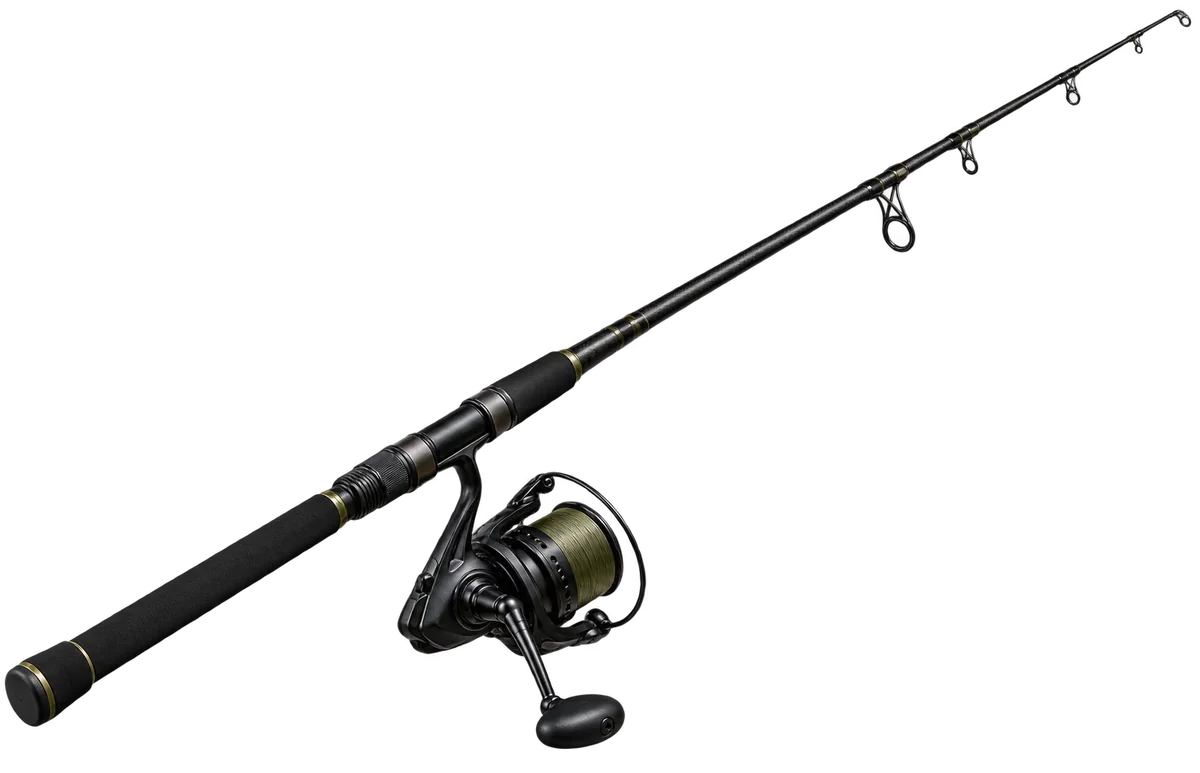
The length is printed on the rod in feet, abbreviated ft or with a prime mark (12′). 12 ft is 3,66 m by calculation, usually given as 3,60 m; this length is regarded as standard. 13 ft, 3,96 m by calculation and usually called 3,90 m, is meant for large waters and long casts. In return the rod becomes unwieldy in tight swims and under trees. Shorter rods of 9 to 11 ft, about 2,70 to 3,35 m, suit small waters, overgrown swims and the boat, where they give more control in the fight. The unit converter translates other markings.
Test curve in lb: what the number measures
Instead of a casting weight in grams, the carp rod carries a test curve in imperial pounds (lb). The number states how much weight has to hang from the tip for the blank, the body of the rod, to bend through 90 degrees so that the tip stands across the handle. So it describes how stiff the rod is. Most carp rods lie between 2 and 4 lb. Models of 4 to 6 lb are mostly meant for casting spombs and for plumbing depths.
Worked example: The rod says “12 ft 3 lb”. It is just over 3,60 m long. One lb is about 454 g, so about 1,36 kg at the tip bends the rod to a right angle. By the rule of thumb below that gives roughly 90 g casting weight.
Rule of thumb for casting weight
A common rule of thumb equates 1 lb of test curve with roughly 30 g of casting weight. This is only a rough guide. If the data sheet for your rod states a casting weight in grams, that value applies.
| Test curve | Casting weight by rule of thumb | Typical use |
|---|---|---|
| 2,5–2,75 lb | about 75–80 g | small waters, short and medium distance |
| 3–3,25 lb | about 90–100 g | all-round, where most carp rods lie |
| 3,5 lb and more | from about 105 g | heavy leads, current, distance, obstacles |
Action: through or tip-heavy
The action describes how the rod bends under load. A through action, also called parabolic, bends from the tip to the handle. It cushions a great deal in the fight, and hooks pull out less often. Stiff, tip-action rods load in the cast and spring back quickly. That gives casting distance. In the fight the stiff rod gives less, so you play the fish more carefully with it.
Rings, sections, reel and line
Carp rods have fairly large rings. The line runs off with less friction in the cast, and the knot of a shock leader, a thicker length of line in front of the rig, passes through more easily. For long casts a start ring, the first ring above the reel, of 50 mm is considered favourable. Without a refined casting technique, a British angling magazine says 40 mm is enough.
Two-piece rods have the most even action, but at 3,60 m they are almost 1,90 m long when packed. Three-piece rods and four-piece travel models are shorter. In the trade press, telescopic rods are regarded as less robust and they cast worse.
Two types of reel come into question. The freespool reel is a fixed-spool reel in which the fish can take line against slight resistance even with the bail arm closed. Usually one turn of the handle switches over to the actual drag. Large fixed-spool reels with a long-cast spool hold more line and cast further. Monofilament of 0,30 to 0,45 mm is usually spooled on, its stretch cushioning the fish’s lunges. The line calculator shows whether breaking strength and knots go together.
Carp rod or bottom rod
Technically the carp rod is a specialised bottom rod. For classic bottom fishing for carp with a running lead, one angling magazine names bottom rods of 3 to 3,60 m with a casting weight up to 60 g and a medium-sized fixed-spool reel. The carp rod is built for heavier leads, has larger rings and is marked in ft and lb.
Common mistakes
- Misreading lb: On the carp rod, lb means the test curve. On sea rods, the same unit can instead mean the line class, that is the breaking strain of the line the rod is built for.
- Rod too light for heavy work: For long casts and for swims with weed and obstacles, a British magazine names 3,5 lb and more. A rod of 2,5 lb is meant for small waters and short to medium distance.
- Rod too stiff for short range: If you fish close to the bank, you do not need a distance rod. It gives little in the fight, and hooks are more likely to pull out.
Frequently asked questions
How many lb of test curve does a carp rod need?
Most carp rods lie between 2 and 4 lb. Around 3 to 3,25 lb counts as the all-round value. Rods of 3,5 lb and more are meant for heavy leads, current, distance and obstacles.
What does 12 ft 3 lb on the rod mean?
The rod is 12 feet long, which is just over 3,60 m. The 3 lb is the test curve: about 1,36 kg at the tip bends it to a right angle. By the rule of thumb that gives roughly 90 g casting weight.
Is a bottom rod good enough for carp fishing?
For classic bottom fishing with a running lead, yes; the carp rod is a specialised bottom rod. It is built for heavier leads, has larger rings and is marked in ft and lb.
Which length suits small waters?
Shorter rods of 9 to 11 ft, that is about 2,70 to 3,35 m, suit small, overgrown swims and the boat. Otherwise 12 ft is regarded as standard.
Related
- Bottom fishing: the method the rod is built for
- Boilies: the usual bait on the hair
- Bottom rod: the design the carp rod grew out of
- Freespool reel: how the freespool works
- Setting the reel drag: drag to suit rod and line
- Fishing rods: overview of action and casting weight
Sources
- Blinker: Karpfen, welche Rute für welchen Zweck? (Längen, Testkurve, Ringe, Teilung)
- Blinker: Ist die Länge der Karpfenrute noch entscheidend? (kurze Ruten, parabolische Aktion) und Seite 2 (steife Wurfruten, Startringe)
- Blinker: Karpfenangeln, Tipps für eine erfolgreiche Fangstrategie (Faustformel 30 g je lb, Blei ab 60 g, Rollen, Schnur, Grundrute) und Blinker: Karpfen-Kickstart (Dehnung monofiler Schnur)
- Angling Times: How to buy a carp rod (12 ft und 13 ft, Stufen der Testkurve, Startring 50 oder 40 mm)
- Wikipedia: Angelrute (Testkurve, lb auf Meeresruten), Wikipedia: Karpfenrute (Einordnung als Grundrute) und Blinker: Die richtige Meeresrute (lb als Schnurklasse)
- Freistaat Sachsen: Fragen für die fischereiliche Sachkundeprüfung, Gerätekunde (Freilaufrolle) und Fischereiverein Löningen: Gerätekunde zur Fischerprüfung (Aktion)
All figures are guide values without guarantee. The casting weight for a given test curve varies from rod model to rod model. The figure for your rod applies.