
Knowledge · Fishing methods
Bottom fishing
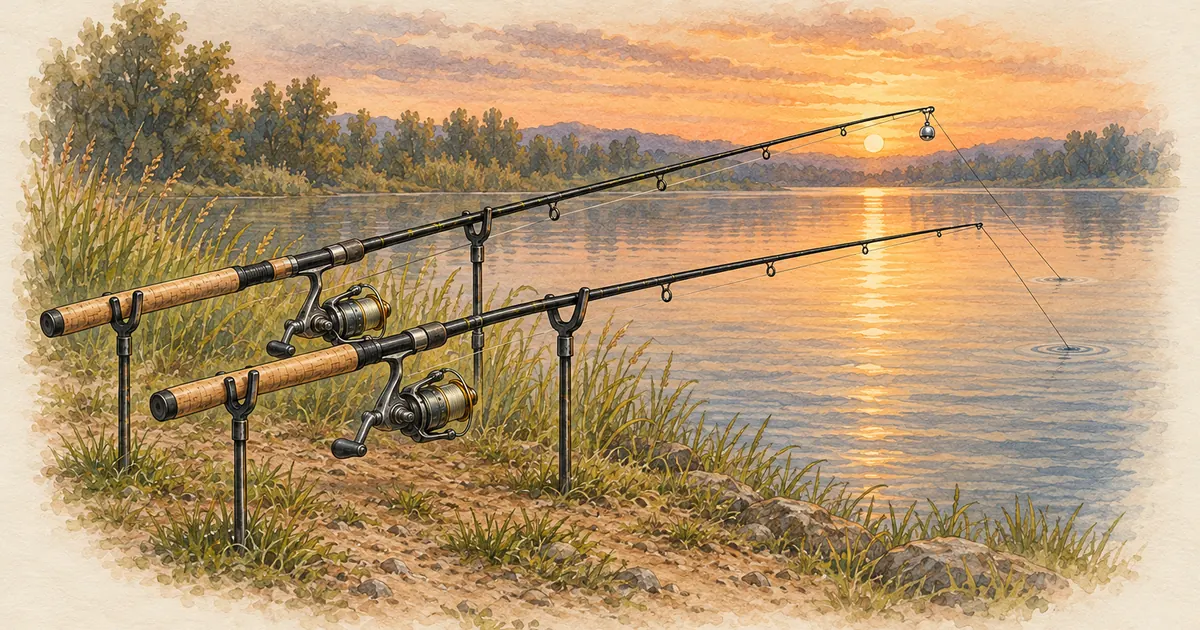
In bottom fishing the bait lies on the bottom, a ledger weight holds the rig in place and you wait for the bite. The method is passive and catches everything from roach to eel.
Why fish feed on the bottom so often
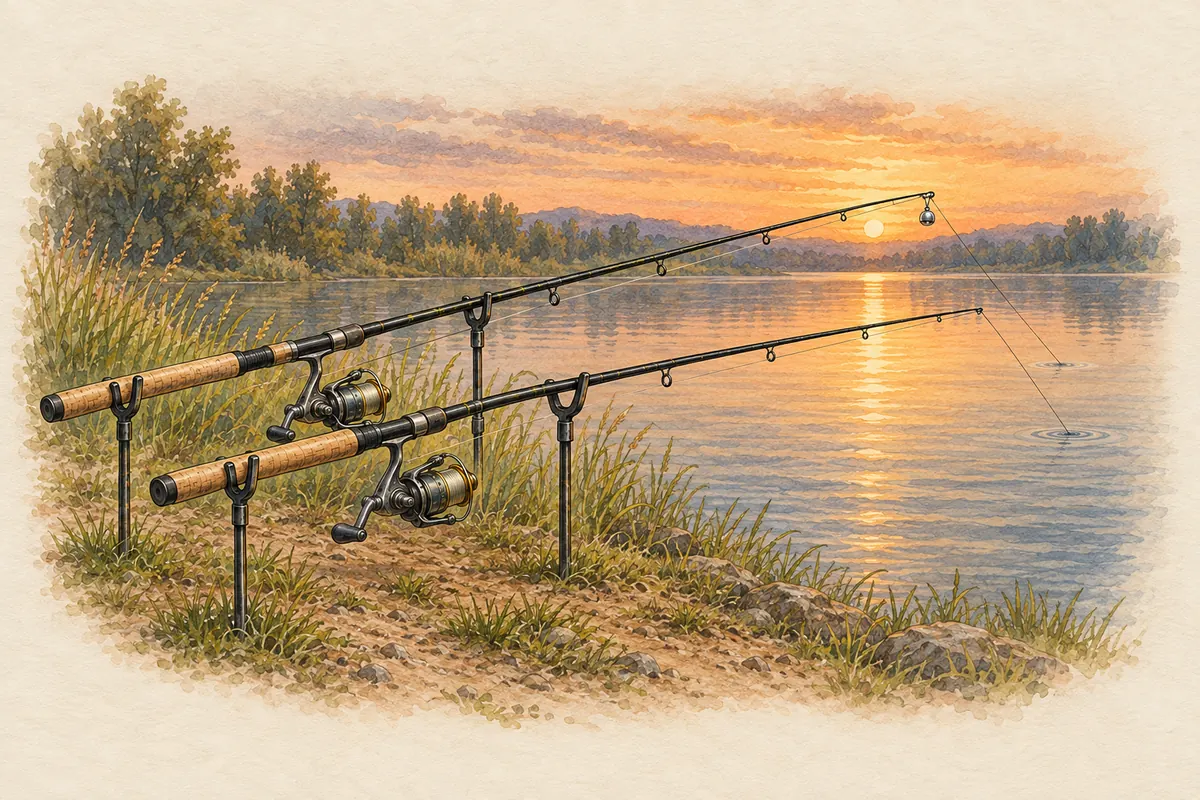
Most fish get the main part of their food from the bottom, writes Rute & Rolle: mussels, crayfish, larvae and worms live in mud and sand, and dead fish sink there too. According to the Landesfischereiverband Bayern, the bream roams shallow bankside zones at night and searches the soft bottom there, the tench roots through it from dusk, the barbel lives on worms, insect larvae, snails and mussels, and the eel is regarded as a nocturnal bottom fish.
Blinker names roach, white bream, carp, barbel and bream as bottom feeders, plus the predatory eel, wels catfish and zander. According to Wikipedia, fish in heavily fished waters and in winter prefer to feed on the bottom. That does not apply to every species: in winter, according to the LFV Bayern, bream rest in shoals in deep, sheltered spots, and the wels catfish then does not feed at all. Where the fish are through the year is explained under The year at the water.
Tackle to start with
For simple bottom fishing, angling instructor Jan Pusch recommends in Blinker a rod of 3 to 3.60 metres. With more length you cast further and can use a longer hooklength; where there are trees you need a shorter one. He also gives a casting weight of around 60 to 80 grams, a robust fixed-spool reel in size 35 to 50 and a monofilament main line of around 0.30 millimetre, which with about eight kilos of breaking strain is abrasion-resistant enough. You check the drag before every session. According to the Löningen tackle guide, bottom rods have a semi-parabolic action: the upper section bends to about the middle, the backbone stays strong. More: Bottom rod, Fixed-spool reel and Setting the reel drag.
Lead, hooklength and bait
Most of the time you fish with a running lead. It has a bore or an eye, the main line runs freely through it and is stopped only by a swivel from which the hooklength hangs. When a fish takes the bait, according to Blinker it should feel no resistance at first. So after casting you leave the bail arm open or engage the free-spool. The set-up is shown under Running lead rig.
How heavy the lead has to be depends on the water. Rute & Rolle gives these guide values:
| Water | Lead weight |
|---|---|
| Still water | around 20 to 50 g |
| Slow river, canal | rather 50 to 80 g |
| Strong current | 100 to 200 g |
Opinions differ on weight. An AngelWoche article on Blinker.de advises fishing as light as possible and as heavy as necessary. Rute & Rolle says that if in doubt it is better to use a few grams more, since it makes no difference to bite indication. If wind or current moves the lead, the rig gets stuck or the hook collects dirt. Both agree that the lead has to stay put.
The shape also affects bite indication. If the line passes only through an eye or a swivel, there is hardly any friction according to Blinker. If it runs through the whole lead, as with inline and coffin leads, that dampens the bite, especially in mud. On soft ground a running lead sinks in and the line no longer runs through cleanly (Rute & Rolle). A lead with an eye on a ledger boom helps there, a kinked plastic tube with a clip that keeps hooklength and main line apart during the cast. Leads with a buoyancy body, such as the Tyrolean stick (Tiroler Hölzl), keep the line out of muddy ground according to the Löninger tackle guide. Shapes at a glance: Fishing leads.
The hooklength, the piece between main line and hook, you choose one gauge thinner than the main line. In a snag it then breaks as the weak link (Löningen). Long hooklengths give fish plenty of time to take the bait, according to Blinker.
As bait, according to Blinker, almost all natural ones will do, from worms through corn and maggots to potato. Less is often more: a single maggot often catches more fish than a bunch of maggots. To choose from: worms, sweetcorn and particles, maggots and larvae.
The second design is the fixed lead. Blinker describes it with leads of 60 to 180 grams, short hooklengths and a hair rig: the bait hangs on a short piece of line beside the free hook. The resistance of the lead makes the hook take hold in the mouth, so you do not need to strike. This is the technique of carp fishing; the set-up is shown under Hair rig. Fig. 2 compares both designs.
Checking the spot and the bottom
Ledges, stones or ripple marks in the sand slow the current, and in their lee food gathers and with it fish, writes Blinker about plumbing. With a plummet and a plumbing float you pay out line in 50-centimetre steps until the float surfaces. At 5.5 steps the water is about 2.75 metres deep. If you then reel the lead in two to three metres and need only 3 steps, it is 1.5 metres deep there, and according to Blinker there is a distinct edge here. More: Plummet.
The bottom reveals itself on the lead. If it sinks into mud and is hard to free, the ground is soft. If it is easy to pull across the bottom, the ground is firm. A hard impact after it sinks points to stone according to Blinker, a soft one to sand or mixed ground. Black, stinking mud is low in oxygen just a few centimetres down and offers hardly any food animals; grey or brown mud is full of life. Soft ground, branches and weed can also hinder the free run of the line. More: Fishing on a lake and Reading the current.
Bite indication and strike
The simplest indicator is the rod tip. Rute & Rolle recommends setting the rod up so high that line and tip form roughly a right angle, and keeping the line slightly tight so that the bite arrives directly in the tip. In current that is often the best method, but the fish quickly feels resistance and cannot take line.
A hanging indicator is better. The rod lies flat and points at the rig; the indicator hangs between the rings at roughly half the height to the ground. If the fish takes line, the indicator rises; if the fish swims towards you, it drops (drop-back bite). For this the main line must, according to Blinker, be under tension. The plain hanging ring stays on the line during the fight, is susceptible to wind and can damage delicate rod rings. The monkey climber (Kletteraffe), an indicator on a metal rod, works silently and even in wind, but only with a passively lying bait. Bell and electronics for the night: Bite indicators and Night fishing.
With a running lead you set the hook yourself: when the fish takes line, you pick up the rod and strike (Blinker). Then you play the fish with a properly set drag, see Landing a fish and unhooking it.
- Put the rod down: After the cast the rod goes flat on the two rests, with the tip pointing towards the lead.
- Tension and clip on: Wind in the slack until the line is slightly taut, and open the bale arm or engage the free spool. Clip the hanger on between the reel and the first ring, so that it hangs roughly halfway down to the ground.
- Read the bite: If the fish takes line, the hanger rises. If it drops instead, the fish is coming towards you, which is a drop-back.
- Strike: When line is running, pick up the rod and strike.
Keep an eye on your rod. Fisheries law is state law. In Bavaria the hand line must, according to the implementing regulation to the Fisheries Act, be supervised at all times; in Brandenburg, hand lines that are out must be supervised constantly and directly by the angler. What applies to you is set out in the state regulation (Landesverordnung) and on your fishing permit (Erlaubnisschein), see Fishing permit and water map.
Predatory fish on the bottom
According to Blinker, zander are sensitive: if one feels resistance or the baitfish looks unnatural because a thick, heavy weight is holding it, it spits it out at once. In the article’s example the weight, rather too heavy than too light, sits on a side arm about 10 centimetres long, and the hooklength measures about 70 centimetres (steel where there are pike in the water). A treble hook instead of a single hook sits firmly in the baitfish and allows an immediate strike. In winter, predatory fish are mostly inactive according to Blinker and feed only briefly; then bottom fishing with a dead baitfish, known as deadbaiting, is the best alternative. Baitfish and rules: Baitfish and Baitfish drop net.
Common mistakes
- Weight too light: It shifts in wind or current, the rig gets stuck or the hook picks up debris.
- Bail arm and drag closed: The fish feels resistance, and the advantage of the running lead is gone.
- Coffin lead in mud: The line has to pass through the whole weight and slows the bite indication. A lead with an eyelet is better.
- Too much bait: A bunch of maggots often catches less than a single maggot.
- Spot not checked: On weed, branches or deep mud the bait sits badly and the line does not run freely.
Frequently asked questions
When is bottom fishing especially worthwhile?
According to Wikipedia, in heavily fished waters and in winter, because fish then prefer to search for food on the bottom. Not all species feed then: in winter the wels catfish rests without feeding, according to LFV Bayern.
How heavy does the bottom weight need to be?
Rute & Rolle gives about 20 to 50 grams in still water, 50 to 80 in slow current and 100 to 200 in strong current. The weight has to stay put. Whether it should also be as light as possible is something the sources see differently.
Do I need a bite indicator?
Not necessarily. The rod tip is enough to start with; a swinger also shows drop-back bites. On long sessions or in the dark, a bell or an electronic bite alarm helps.
Do I always have to strike when bottom fishing?
With a running lead, yes: when the fish takes line, you pick up the rod and strike. With a fixed lead and a hair rig, the fish hooks itself, according to Blinker.
Related
- Running-lead bottom rig: step-by-step set-up
- Feeder fishing: bottom fishing with a feeder
- Carp fishing: fixed lead, hair and baited spot
- Night fishing: eel and zander in the dark
- Bottom rod: length, casting weight and bite indication
- Bite indicators: electronic, mechanical, bell
- Angling leads: shapes and what they are good for
- Plummet: measuring depth and bottom
Sources
- Blinker: Grundangeln, dein Weg zum Fangerfolg (Gerät, Laufblei, Festblei)
- Rute & Rolle: Grundangeln, so gelingt der Einstieg (Bleigewichte, Rutenspitze, Einhänger)
- Blinker (AngelWoche): Grundangeln mit Laufblei, welche Bleiform ist die richtige? (Bleiform)
- Blinker: Bissanzeiger richtig nutzen und mehr fangen (Einhänger, Fallbiss)
- Blinker: Loten beim Angeln (Kanten, Bodenart)
- Blinker: Köderfischmontage zum Grundangeln, der Weg zum Zander (Zander)
- Blinker: Deadbaiting, Grundangeln auf Winter-Hechte (Winter)
- Landesfischereiverband Bayern: Fischlexikon (Nahrung der Arten)
- Fischereiverein Löningen: Gerätekunde zur Fischerprüfung (Rutenaktion, Vorfach, Auftriebsblei)
- Wikipedia: Grundangeln (Prinzip)
- Freistaat Bayern: Ausführungsverordnung zum Fischereigesetz (AVFiG) (Aufsicht)
- Land Brandenburg: Brandenburgische Fischereiordnung (Aufsicht)
Text AI-assisted, drawing AI-generated. Sources opened and checked in October 2026; no graphics taken from the sources.
All figures are guide values without guarantee. Follow the water’s rules and state law, especially on the number of rods, supervision of the rod and natural baits.