
Knowledge · Rigs & setups
Running lead rig
In a running lead rig the lead slides freely on the main line, and a swivel stops it in front of the hooklength. If a fish moves off with the bait, it doesn’t feel the weight at first. You do have to strike yourself, though, because unlike with a fixed lead and hair rig, the fish doesn’t hook itself.
What you need
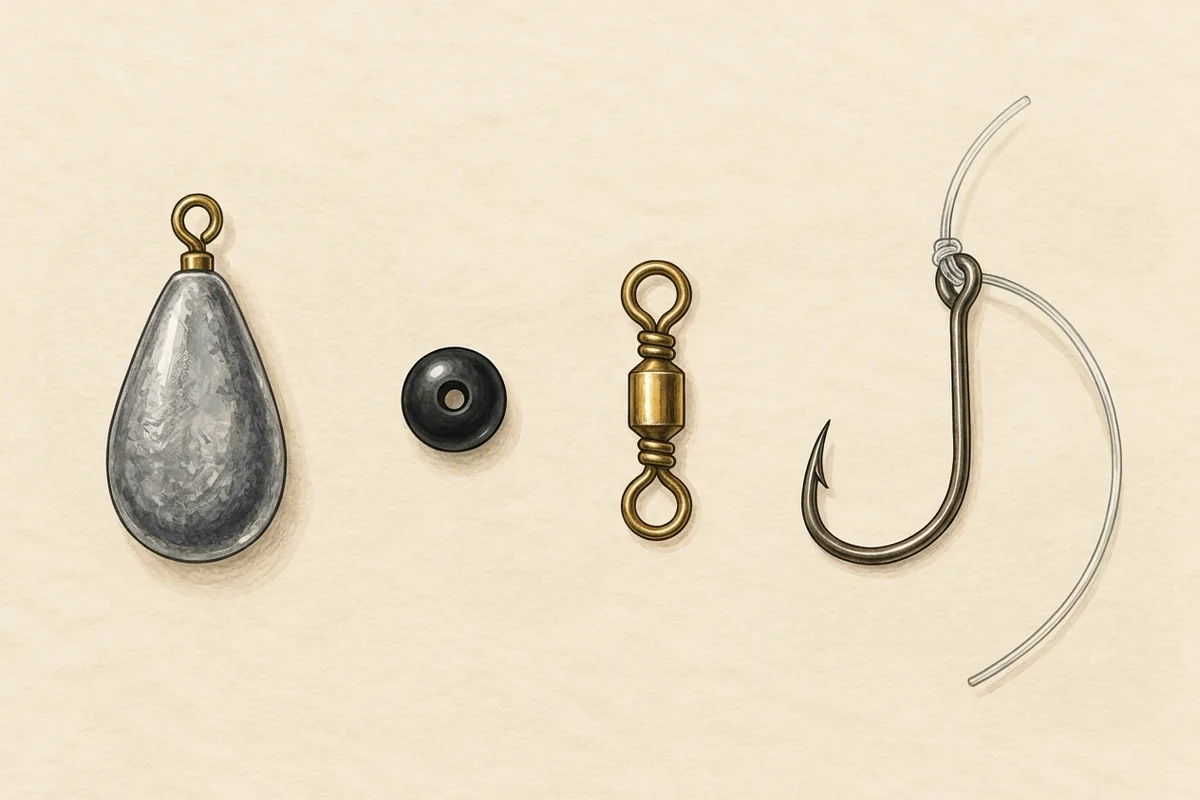
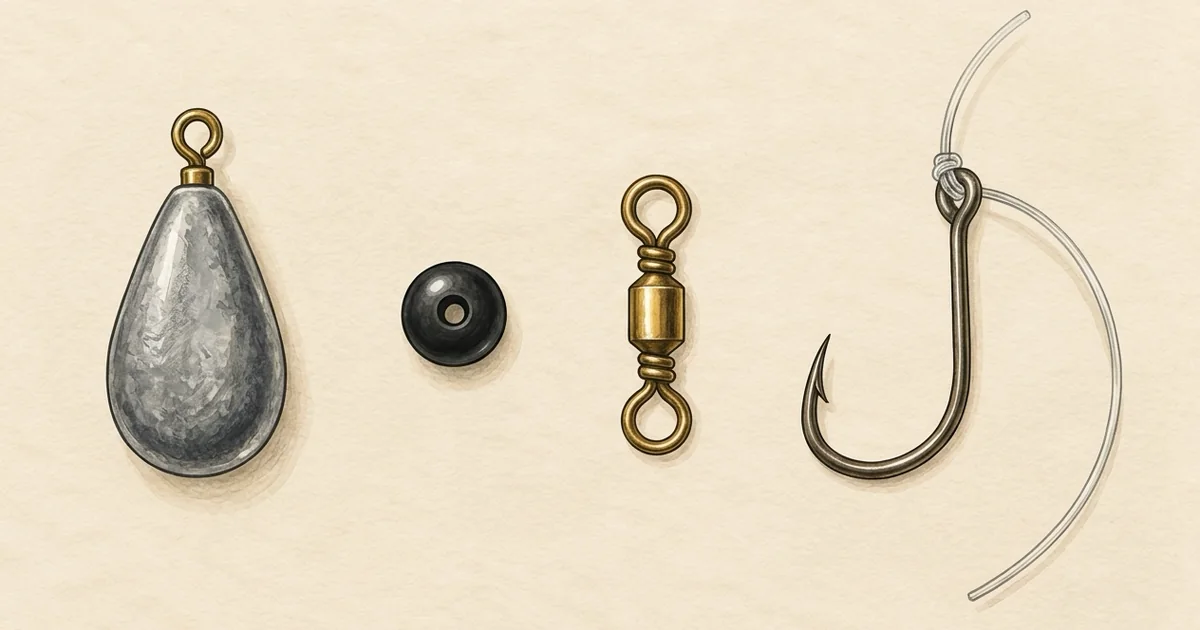
- a running lead whose shape and weight suit the water and the current
- a rubber bead between the lead and the swivel
- a swivel or snap swivel for the hooklength
- a hooklength with hook
- a reel where you can leave the bail arm open or use the free spool
For simple bottom fishing, Blinker describes rods of three to 3,60 metres with a casting weight of about 60 to 80 grams and a monofilament main line of about 0,30 millimetres. Further rod questions are answered on the bottom-fishing rod page, and line types in the line comparison. Mostly animal natural baits serve as bait.
How the rig works
The lead has a bore or an eye through which the main line runs. A swivel at the end of the line stops it in front of the hooklength. When a fish takes the bait and swims off, it pulls the line through the lead without moving it. According to Blinker, it does not feel the resistance of the lead, and the pull arrives at the rod tip or the bite indicator. With very cautious fish and an open bail arm it can even take real line. According to Blinker, typical targets are eel, zander and barbel, plus many coarse fish that feed on the bottom.
Build it in six steps
- Thread the lead onto the main line. It must run unhindered.
- Slide on the rubber bead. It protects the knot at the swivel and lets the line pull off freely.
- Tie on the swivel, for example with the improved clinch knot.
- Clip on the hooklength or tie it on.
- Put on the bait, cast out and tighten the line slightly.
- Leave the bail arm open or set the drag or free spool so that line can run off.
Lead shape and lead weight
According to the equipment guide for the angling exam (Gerätekunde zur Fischerprüfung), running leads come as ball, olive and coffin leads. The difference lies in how far the line runs inside the lead. If it runs only through an eye, there is almost no friction and the bite arrives almost one to one. If it goes through the whole lead, as with a coffin or inline lead, friction slows it, especially when it lies in mud. The coffin lead, on the other hand, lies still on the bottom. According to Blinker, anyone who wants fine bite indication does better with a lead with an eye.
For soft bottoms, Rute & Rolle describes a second design: a lead with a swivel or eye, clipped into a ledger boom. That is a small, slightly angled plastic tube with a snap link. The lead may sink in a little here, yet the line still runs almost without friction, and the boom keeps hooklength and main line apart during the cast.
The weight: as light as possible, as heavy as necessary, writes Blinker. Rute & Rolle adds that the lead must lie securely on the bottom; if in doubt it may be a little heavier, and bite indication does not suffer. If wind or current moves the lead, the rig easily gets stuck or the hook picks up debris.
| Water | Guideline lead weight | Source |
|---|---|---|
| still water | around 20 to 50 g | Rute & Rolle |
| slow river, canal | 50 to 80 g | Rute & Rolle |
| strong current | 100 to 200 g | Rute & Rolle |
| eel in a river, lead rolls along | 10 to 20 g | Spoon |
| eel in a river, autumn | 40 to 90 g | Spoon |
The last two rows are figures from a single author for particular rivers and not a general value. With a rolling lead the current finds the spot itself: the round lead lands one to two metres beyond the edge of the current, the bail arm stays open, and the rig drifts to a place where food also collects. In autumn, with cautious bites, the lead must instead be just heavy enough to stay put but to move at the slightest pull. More on lead shapes and current is on their own pages.
Muddy bottom: bait and lead sink in
On a soft bottom a running lead sinks in, and the line no longer runs through it freely, according to Rute & Rolle. The bait can also disappear into the mud; Blinker describes this for fixed-lead rigs with heavier leads. Proceed like this:
- Test: Reel the rig in after one to two hours. Blinker suggests a smell test on the buoyant bait: if it smells of mud, it was lying in the sediment.
- Buoyant baits: A pop-up boilie floats a little way above the bottom, according to Blinker. A piece of foam in the mouth or some injected air gives a dead baitfish buoyancy, so it floats just above the bottom (also Blinker).
- Bait at a distance: With deeper mud, put the bait on a longer hooklength (Blinker). If it still smells of mud afterwards, look for a spot with a hard bottom.
- Lead with a buoyant body: According to the tackle guide (Gerätekunde), it is meant to stop the line being pulled into a muddy bottom. The tackle guide lists the stand-up lead, the Perfekt lead and the Tyrolean stick (Tiroler Hölzl) here.
According to Blinker, the Tyrolean stick (Tiroler Hölzl) is a plastic tube with lead set into it, which you either run directly on the main line or hang on an anti-tangle tube. It glides over stones, rubble and debris without getting stuck, the magazine says, and causes far fewer snags than a conventional ledger rig. Blinker gives 15 to 60 grams depending on water depth and current pressure, plus a hooklength of about 60 centimetres, and describes it for searching the bottom with a dead baitfish.
Hooklength, hook and bait
The hooklength acts as a weak link and, according to the Gerätekunde, is one line strength thinner than the main line. If you snag, the hooklength breaks, not the main line. As a rule of thumb Blinker says: the more cautiously the fish bite, the longer the hooklength should be. Two figures show the range for eel. For the rolling lead a Blinker author considers about 50 centimetres sufficient, because a shorter hooklength tangles less. In autumn the same author recommends two to three metres so that the bait moves naturally in the current. The figures do not contradict each other; they apply to different situations.
The Gerätekunde divides hooks into large (5/0 to 2), medium (3 to 10) and small (11 to 20), with the maxim never smaller than necessary. For eel in a river, Fisch & Fang names ready-made hooklengths with eel hooks in sizes 4 to 8. The bait counts too: according to Blinker a single maggot often catches more than a thick bunch of maggots, and a halved lobworm smells stronger, which draws eels faster (Fisch & Fang). Used hooklengths kink or fray and should then be replaced. More baits are listed under eel, zander and barbel.
Recognising the bite and striking
Without a float you need a different bite indicator. The rod tip is enough if you hold the rod up, leave about 90 degrees between line and tip and tighten the line slightly. Rute & Rolle points out, however, that the fish then quickly feels resistance and cannot take line. Hanger bite indicators are better: the rod lies flat, the hanger hangs roughly halfway between rod and ground, falls when a fish swims towards you and rises when line runs off. More under bite indicators. If a rolling lead drifts across the bottom, a jerking rod tip shows that it is moving (Fisch & Fang).
On a bite you pick up the rod and strike. Unlike a fixed lead with a hair rig, the fish does not hook itself here. How the fixed lead works is covered in the hair rig.
Lead and the law: The EU has adopted the restriction on lead in fishing tackle with Regulation (EU) 2026/2501, which applies from 3 December 2026 (as of November 2026). It governs sales, not recreational angling. Weights and lures containing lead up to 50 grams may no longer be sold from 3 December 2029, heavier ones up to 1 kilogram from 3 December 2031, and lead wire and drop-off leads from as early as 3 June 2027. What applies at the water is set by the water rules and the fishing permit (Erlaubnisschein).
Common mistakes
- Bead missing: The knot at the swivel lies unprotected and the line no longer pulls off freely.
- Lead too light: Current or wind move the rig, it gets stuck or collects debris.
- Bail arm closed: The fish feels resistance before it has the bait securely.
- Coffin lead in mud: The line runs stiffly through the lead, and bites come through muffled. Remedies are in the section on muddy bottoms.
- Hooklength thicker than the main line: The weak link is then in the wrong place.
- Rod left unattended: With an open bail arm you have to notice the bite and strike yourself.
Frequently asked questions
What is the bead for?
It protects the knot at the swivel and lets the line pull off freely. The lead hits the soft bead instead of the knot.
Do I have to strike myself on a bite?
Yes. Unlike a fixed lead with a hair rig, the fish does not hook itself. When it takes line, you grab the rod and strike.
How heavy does the weight have to be?
Heavy enough to stay on the bottom. Rute & Rolle names around 20 to 50 grams in still water, 50 to 80 in a slow river and up to 200 grams in strong current. Blinker advises not choosing heavier than necessary.
May I keep fishing with lead?
Yes, under EU law at least: Regulation (EU) 2026/2501 concerns sales, not use in recreational angling (as of November 2026). Whether special rules apply at your water is set out in the water rules and the fishing permit (Erlaubnisschein).
What can I do when the bait sinks into the mud?
Give the bait buoyancy, for example with a pop-up or a baitfish with foam in its mouth. Put it on a longer hooklength and use a lead with a buoyant body so that the line doesn’t get stuck in the mud.
Related
- Bottom fishing: the method behind this rig
- Feeder rig: the running principle with a feeder
- Hair rig: fixed lead and hair as a self-hooking rig
- Paternoster rig: lead at the end, hook on a dropper above
- Angling leads: shapes and what they are good for
- Bottom rod: length, casting weight and bite indication
- Free-spool reel: giving line freely when sitting and waiting
Sources
- Blinker (Frank Schlichting): Grundangeln mit Laufblei, welche Bleiform ist die richtige? (Prinzip, Zielfische, Reibung je Bleiform, Gewichtsregel)
- Blinker (Jan Pusch): Grundangeln, dein Weg zum Fangerfolg (Gerät, Wirbel als Stopper, Bügel offen, Vorfachregel, Anhieb, Köder)
- Blinker: Der schwebende Köderfisch (Gummiperle als Knotenschutz und für freien Schnurabzug)
- Blinker (Fabian Frenzel): Aal Total, Tipps zum Aalangeln (Rollblei, Gewicht, Vorfachlänge)
- Blinker (Fabian Frenzel): Aalangeln im Herbst, 4 goldene Tipps (Bleigewicht und Vorfachlänge im Herbst)
- Rute & Rolle: Grundangeln, so gelingt der Einstieg (Bleigewichte, Durchlaufblei, Ledger Boom, Bissanzeige)
- Fisch & Fang: Einfach auf Aal am Fluss (Aalhaken, halbierter Tauwurm, Rollblei in der Strömung, Vorfachzustand)
- Blinker: Tiroler Hölzl Montage, erfolgreich am Grund angeln (Aufbau, Hänger, Gewichte, Auftrieb für den Köderfisch)
- Blinker: Karpfen fangen trotz Schlamm? (Pop-up, längeres Vorfach, Geruchsprobe)
- Fischereiverein Löningen: Gerätekunde zur Fischerprüfung (Vorfach als Sollbruchstelle, Bleiformen, Auftriebsbleie wie das Tiroler Hölzl, Hakengrößen)
- EUR-Lex: Verordnung (EU) 2026/2501 der Kommission vom 12. November 2026, Blei in bestimmtem Fischereigerät und Berichtigung vom 17. November 2026 (Stichtage, Verkauf statt Verwendung)
- Deutscher Angelfischerverband: EU-Bleibeschränkung für Angelgeräte, aktueller Stand (Verkauf statt Verwendung, Fristen, Stand 4. Mai 2026)
Text AI-assisted, drawing AI-generated. Sources opened and checked in October and November 2026, no graphics taken from the sources.
All details are guideline values without guarantee. Observe the water rules, fishing permit and state law.