
Knowledge · Rigs & setups
Side-arm rig
In the side-arm rig the weight lies on the bottom at the end of the line, and the hook hangs a little above it on its own short arm. The bait sits above mud and stones, and the taut line passes bites straight to the rod tip. With several arms one above another it becomes the paternoster.
Weight below, bait above
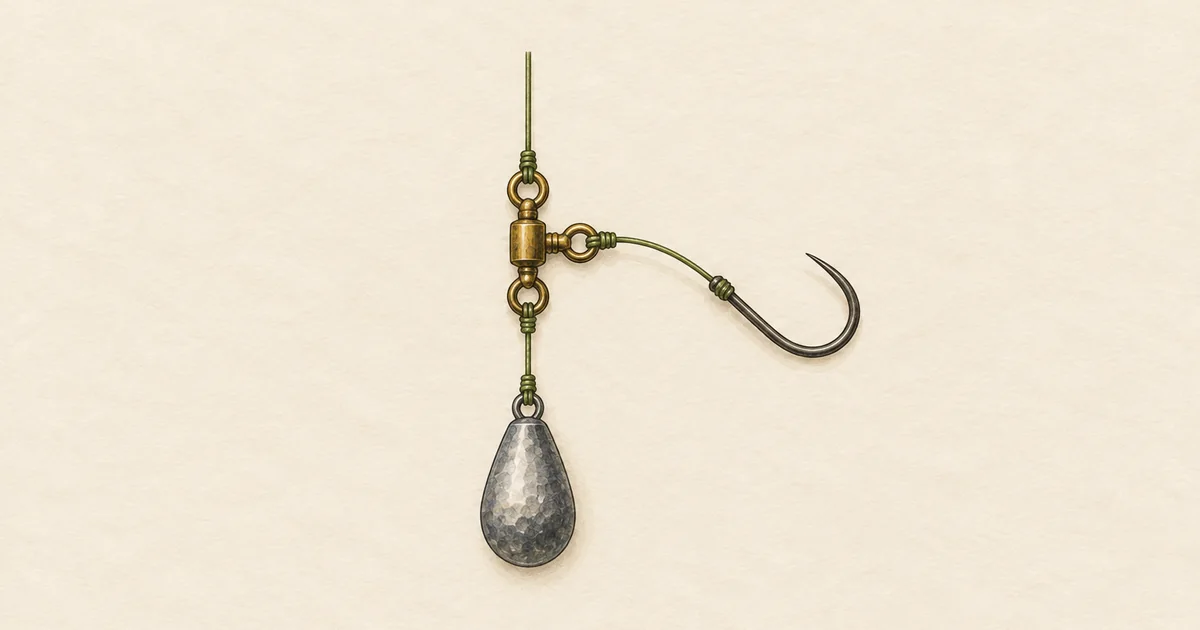
The Bavarian exam questions for the angling exam (Fischerprüfung) describe a bottom rig with a weight at the end of the line and hooks on movable side arms as a paternoster rod (Landesanstalt für Landwirtschaft Bayern). The side-arm rig is this design with a single arm. If the arm is shorter than the line to the weight, the bait does not reach the bottom.
An author in Blinker ties the rig for eels at stone revetments in the river: the bait hovers just above the bottom and does not wedge between the stones. An eel angler in Fisch & Fang likewise lifts the worm a little off the bottom over soft, dirty ditch beds.
On a taut line the rod tip shows bites directly, which is why Blinker never lets the herring paternoster sink on a slack line. The weight stays put and the fish feels resistance. If the fish is to be able to take line freely, the running ledger rig suits better: the line runs through, so a biting fish hardly notices any resistance (Blinker).
What you need
- a main line as for bottom fishing; at the stone revetment the Blinker author uses monofilament from 0,30 millimetres
- a three-way swivel, or just line if you tie the arm as a side-arm loop
- hooklength line for the side arm and a hook that suits the bait
- thinner line for the weight, 0,20 millimetres in the Blinker example
- a pear-shaped weight, and in strong current a flow weight that stays on the bottom thanks to its shape
- as bait worms, a small dead baitfish or strips of fish
Construction
The main line ends at the three-way swivel. Its barrel has another eye sticking out at a right angle; according to Blinker a side arm is easy to attach there. The line to the weight goes on the lower eye. Do not confuse it with the triple swivel: that has three barrels one behind the other and helps against line twist.
It also works without a swivel. A Blinker guide ties the arm on directly with a knot; if you want to swap it more often, use a swivel instead. The author at the stone revetment ties a loop about 50 centimetres long into the main line and cuts it through in the middle: one end for the hook, one for the weight.
Weak link: The line to the weight is thinner than the rest. If the weight snags between stones, only it breaks and the fish on the hook can still be landed. The Blinker author ties on 0,20 monofilament for this and reports that he was able to land many eels this way even though the weight was stuck.
Tying in six steps
- Tie the main line to the upper eye, for example with the improved clinch knot that Blinker names for monofilament at the swivel.
- Tie the side arm to the protruding eye and tie on the hook.
- Tie the weight line to the lower eye. It must be longer than the side arm.
- Tie on the weight. Choose it heavy enough for the rig to stay on the bottom in the current.
- Put on the bait. Worm, baitfish or strip of fish, depending on the target fish.
- Cast out and tighten the line. The weight stays put, the taut line passes bites to the rod tip.
Guide values from the sources
The values come from practical articles in the angling press. For the side arm on the dropshot rig Blinker gives a few up to 50 centimetres: the more cautiously the fish bite, the longer the arm.
| Part | Use | Guide value | Source |
|---|---|---|---|
| Side arm | Perch, zander (dropshot) | 5 to 15 cm | Spoon |
| Side arm | Flatfish from a boat | 20 to 30 cm | Fisch & Fang |
| Distance to the weight | Worm at the stone revetment | Weight arm 20 to 30 cm longer | Spoon |
| Weight | Burbot in the river | 30 to 200 g, depending on the river | Spoon |
| Weight | Herring from the shore | 30 to 80 g | Spoon |
| Weight | Mackerel from a cutter | 200 g, up to 400 g when drifting | Fisch & Fang |
When and where
In the river: zander, perch, burbot
- Zander: In the river you find him, according to Blinker, at current edges and sheet piling, at the steps of rock fills and in deeper spots of the groyne fields.
- Perch: On a short side arm a bait, according to Blinker, sways in the current instead of hanging stiffly on the line, and is easier to suck in; this is described for soft plastic lures. According to Blinker, worms for perch must be fresh and lively.
- Burbot: According to Blinker it also stands in strong current and likes weirs; ordinary bottom rigs with a lobworm or strips of fish are enough. Its lies are often snag-prone, and the thinner weight line helps there.
Whether you may fish for burbot or eel, and when, is regulated by the state and the fishing permit (Erlaubnisschein).
At sea: herring, mackerel, flatfish
At sea there are usually several arms one above another. For herring the question catalogue for the angling exam (Fischerprüfung) in Saxony-Anhalt names the paternoster as the usual choice, fitted with artificial lures or unbaited hooks. The weight lies on the bottom, the arms dance in the current above it (Blinker). For mackerel from a cutter, Fisch & Fang names paternosters with three to seven hooks, mostly with feathers. With flatfish two baited arms often bring double catches, because one biting fish encourages a second to grab (Blinker).
Presentation and season are covered on the lure page Sea paternoster, the beach by the surf rig. If a pilker hangs at the end as the actual lure, the extra lure on the side hooklength is called a dropper (Springer), see Pilking.
Number of hooks, as of October 2026: This is regulated by the state. In the coastal waters of Mecklenburg-Western Pomerania the Küstenfischereiverordnung has, since the end of September 2026, allowed a paternoster with up to six single hooks when fishing for mackerel or herring, otherwise up to two baits with up to three hooks each per hand-held rod. Elsewhere state law and the fishing permit (Erlaubnisschein) apply.
Difference from the dropshot rig
In the dropshot rig the weight also sits at the end. There, however, the hook is normally tied directly into the line (Blinker), and you work the bait on the spot with the rod. In the side-arm rig the hook hangs on its own piece of line, and the weight stays put.
Names are not very reliable: in the kickback rig the weight hangs on the short side arm, yet Rute & Rolle calls it a simple side-arm rig. This page means the form with the weight at the end.
Common mistakes
- Side arm too long: It tangles with the main line or the weight line during the cast and the sink. According to Blinker, hooklengths dangling far in front of the weight tend to tangle.
- Arm longer than the weight line: The bait lies on the bottom and the advantage of the rig is gone.
- Weight too light: The current shifts the rig. For burbot Blinker advises going heavier until the rig holds on the bottom. For herring in mid-water, on the other hand, a heavy weight crashes through the shoal.
- Weight line as strong as the main line: Without a weak link a fish can swim off with line and weight after a snag (Blinker).
- Arms too close together: The hooks tangle. Leave enough space between the arms that they do not catch in each other (Blinker, flatfish hooklength).
Frequently asked questions
Three-way swivel or tied side arm?
Both work. With a swivel the rig is more flexible according to Blinker; the tied arm manages without an extra small part.
Does the fish notice the weight?
Yes, because it lies fixed at the end. If cautious fish are to be able to take line freely, a running rig is the better choice, because the line slides through the weight (Blinker).
How many side arms make sense?
For eels in a ditch, one hook is enough today in the view of an angler in Fisch & Fang. Flatfish are caught well, according to Blinker, with two baited arms; mackerel paternosters from a cutter carry three to seven hooks according to Fisch & Fang. How many are allowed is regulated by the state.
Related
- Side-arm loop: tying the arm without a swivel
- Sea paternoster: feather hooks for herring and mackerel
- Surf rig: two snoods and a grip lead for the beach
- Dropshot rig: actively working a soft plastic above the weight
- Running ledger rig: when the fish should take line without resistance
- Reading the current: where fish hold in a river
- Line calculator: comparing the strength of main line and weight line
- Bottom rod: length, casting weight and bite indication
Sources
- Prüfungsfragen zur Fischerprüfung: LfL Bayern, Fragenkatalog 2023/2024 und Saxony-Anhalt, Fragenkatalog des Landwirtschaftsministeriums (Paternosterangel, Hering, Springer)
- Land Mecklenburg-Vorpommern: Fünfte Änderung der Küstenfischereiverordnung, September 2026 (§ 9, Hakenzahl)
- Blinker: Angeln auf Aal, Duftbombe für Bomben-Aale (Bauweise, Sollbruchstelle, Maße)
- Blinker zu Wirbeln und Montagen: Wirbel zum Angeln, Dreifach-Wirbel, Plattfisch-Vorfach, Drop-Shot, Endmontagen für das Grundangeln (Dreiwegewirbel, Knoten, Länge des Arms, Verhedderung)
- Blinker zu den Arten: Steckbrief Barsch, Steckbrief Quappe, Quappen im Winter, Heringsangeln, Heringsblei, Plattfischangeln (Köder, Standplätze, Bleigewichte, straffe Schnur)
- Blinker zum Zander: Steckbrief Zander, Köderfischmontage zum Grundangeln (Fangplätze im Fluss, Durchlauf ohne Widerstand)
- Landesfischereiverband Baden-Württemberg: Gerätekunde (PDF) (Strömungsblei)
- Fisch & Fang: Aktiv auf Aal, Auf Plattfisch und Wittling, Vorsicht, bissige Meute (Paternoster im Graben, Armlänge, Makrele)
- Rute & Rolle: Barsch-Special, Teil 3 (Kickback-Rig)
Text AI-assisted, drawing AI-generated. Sources opened and checked in October 2026; no graphics taken from the sources.
All figures are guide values without guarantee. How many hooks and rods are allowed is regulated by state law, the water’s rules and the fishing permit.