
Knowledge – Fish
Herring: Features, difference from the sprat and season
The Atlantic herring (Clupea harengus) is a shoaling fish of the North Atlantic, the North Sea and the Baltic Sea. In spring the shoals move right inshore to spawn. They can then be caught from the shore.
In brief: You catch herring best from March to May, mainly in the evening and at night. Good spots on the coast: open and deep water. Proven baits: a herring rig with small decorated hooks. From the shore herring is mainly worthwhile during the spring spawning run. The “possible” rating in the other months applies mainly to boats: over deeper water herring can be caught all year round, often as bycatch. Step by step: Fishing for herring.
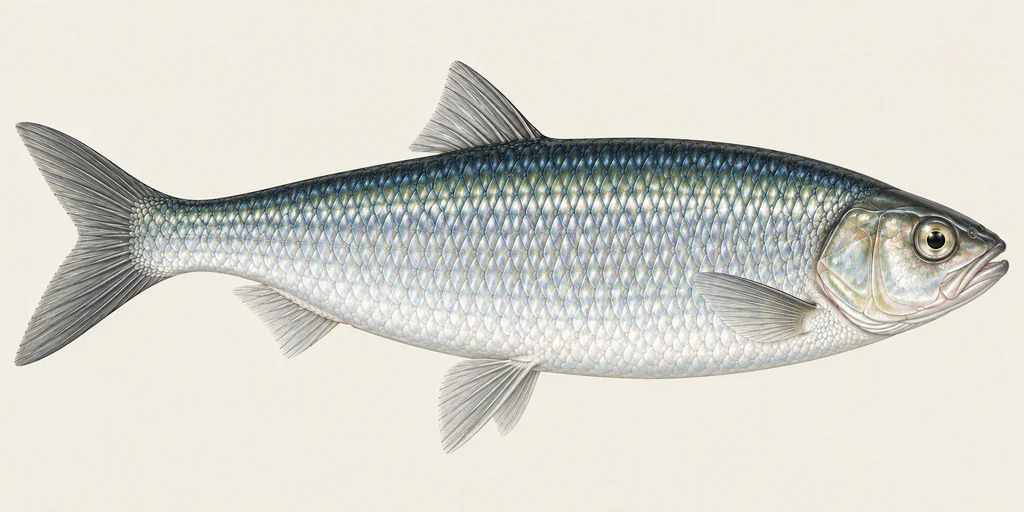
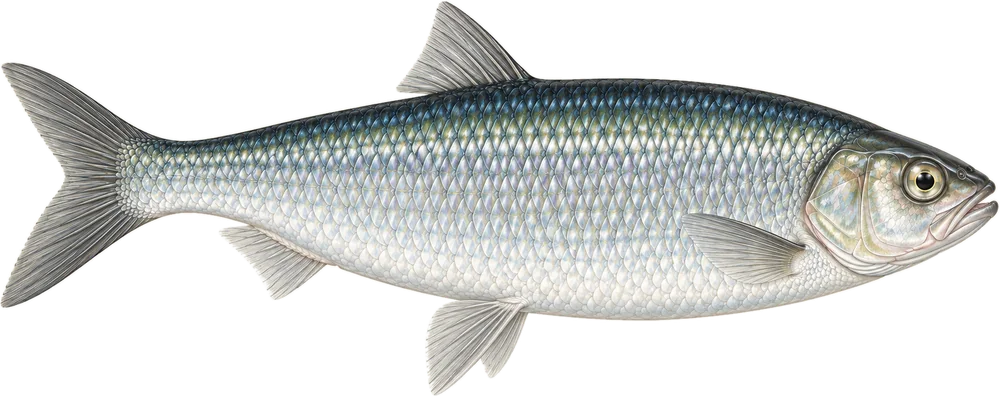
- Large, loosely set scales and silvery shining flanks
- Lower jaw slightly longer than the upper jaw (slightly superior mouth)
- Belly edge with rounded, barely keeled scales, no barbels
Catch chances through the year
- Hardly any chance
- Possible
- Good
- Peak season
- Spawning (observe the closed season)
Editorial assessment for waters in Germany, not a measured value and no guarantee. Spawning time is not the same as the legal closed season.
Species profile and sources in the catch calendarAll species compared month by monthThe rules of your federal state
How to recognise it
The herring is slim and flattened from the sides. The back shimmers blue to greenish, flanks and belly are silvery, and dark spots are absent. There is no lateral line; only the first scales behind the gill cover have pores. The scales are large, thin and round and sit so loosely that they fall off at a touch. The mouth is slightly upturned, the tail fin deeply forked and the dorsal fin short.
The herring usually stays smaller than it could grow. According to the brochure of the Deutscher Angelfischerverband (DAFV), herring average 30 to 35 centimetres and weigh 120 to 200 grams. FishBase gives maxima of 45 centimetres, 1,1 kilograms and 25 years. For the Baltic Sea the Swedish fisheries authority gives 15 to 24 centimetres, and in the North Sea stock fish over 25 centimetres are rare according to the Havforskningsinstituttet. Baltic herring mature at two to three years, Norwegian ones often only at five.
The only difficult part is telling young herring from adult sprats. Both grow to five to 15 centimetres and sometimes swim in the same shoal. The DAFV names the most reliable feature: in herring the base of the pelvic fins lies further back, behind the base of the dorsal fin. In the sprat it lies beneath it or further forward. The herring also has keeled scales on the belly; they are just less distinct to the touch than in the sprat. Adult sprats stay under 16 centimetres.
The sardine has three to five grooves on the gill cover, the twaite shad a notch in the upper jaw that is easy to see from the front on the snout. The herring lacks both features.
Side by side
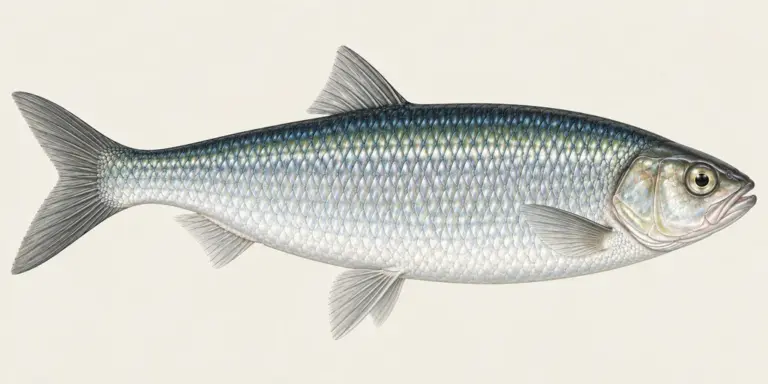
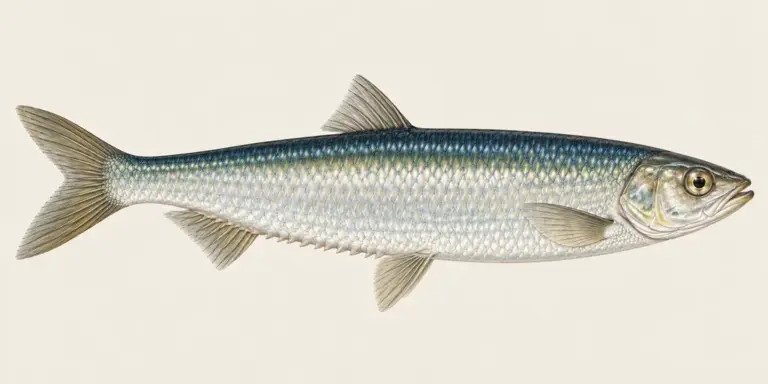
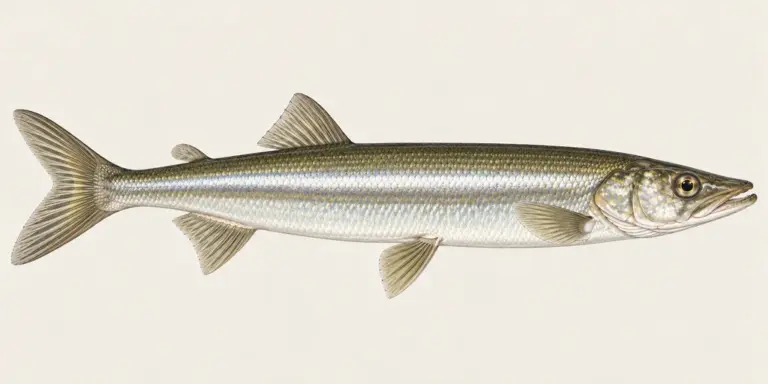
AI-generated illustrations.
Where it holds
Herring live in the North Atlantic from southern Greenland and Labrador to Spitsbergen and the Bay of Biscay, as well as in the North Sea and the Baltic Sea. They swim in open water and tolerate temperatures from 0 to 18 °C. On the usual depth the figures differ: FishBase mostly gives 0 to 200 metres, the DAFV for the open sea 150 to 350 metres. Young fish up to two years stay close inshore, adults stand further out.
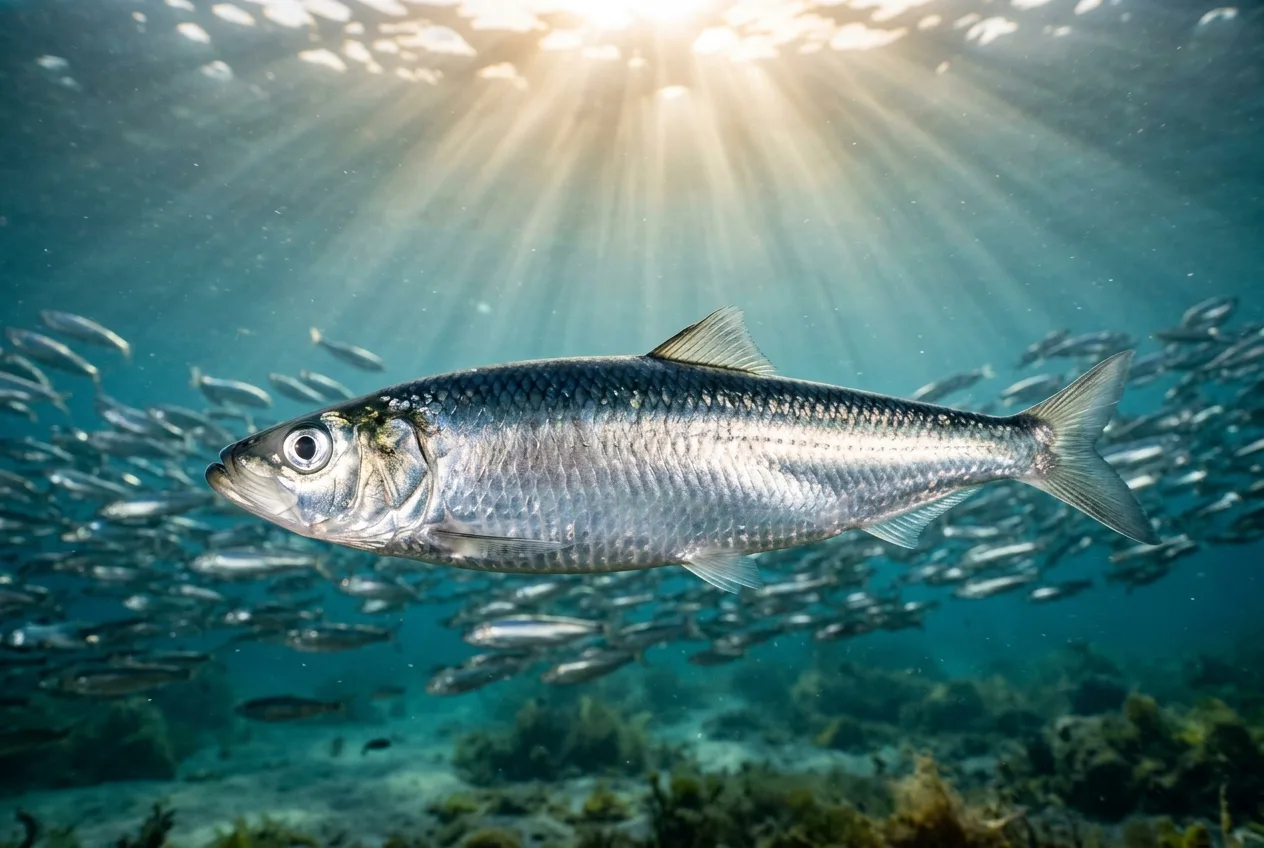
To spawn, the Baltic herring move into shallow water: bays, firths, river mouths, harbours and canals. From the shore you catch them where deep water is close, at steep quay walls, bridges and jetties. In narrows they stand packed together, and on gently shelving beaches they are mostly absent. More on these spots under Fishing in the harbour and from the pier and in lagoons and fjords.
Holding spots in the picture
Choose a season and time of day: the picture shows where the species sits then. Tap a fish or a spot in the list to bring it closer. The picture is schematic and AI-generated, every water is different.
Chance of a catch in springgoodSpawning, observe the closed seasons
Catch chances in summerpossible
Catch chance in autumnpossible
Catch chance in winterpossible
- J
- F
- M
- A
- M
- J
- J
- A
- S
- O
- N
- D
Spawning season
No peak time By day the shoals hold deep, in the evening they break up and follow the plankton to the surface.
No peak time By day the shoals hold deep, in the evening they break up and follow the plankton to the surface.
Active time By day the shoals hold deep, in the evening they break up and follow the plankton to the surface.
Active time By day the shoals hold deep, in the evening they break up and follow the plankton to the surface.
On the coast
Deep, colder water
Herring are here all year.
Open water, mid-water
Herring are here all year.
The herring is a shoaling fish of open water. By day the shoals stay in deeper water layers near the bottom, at night they rise to the surface. Juveniles stay close to the coast, adult herring hold further out.
Spring: catch chance good according to the catch calendar. The spawning time falls in this season, observe the closed seasons. In spring the shoals come close inshore and move into river mouths, canals, harbours and bays to spawn. From the shore they hold where it drops steeply into the deep: at quay walls, bridges and landing stages, not on gently shelving beaches.
Summer: catch chance possible according to the catch calendar. In summer the shoals hold further out in deeper water. From a cutter or boat they can be caught all year, often as bycatch.
Autumn: catch chance possible according to the catch calendar. In some places herring are also caught from the shore from October to December.
Winter: catch chance according to the catch calendar possible.
Depth: Herring occur down to about 360 metres, usually to 200 metres. By day they mostly travel one to three metres above the bottom.
Size comparison: AI-generated drawing, schematic.
How it feeds and spawns
Herring larvae and young fish first eat phytoplankton, later mainly zooplankton, above all copepods and small snails. When food is dense they filter it out of the water with their gill rakers, otherwise they hunt by sight. In autumn, according to the DAFV, herring eat fish larvae to a large extent. By day the shoals stand deeper, in many areas just above the bottom; in the evening they break up and rise to the surface with the plankton.
The herring spawns on the bottom and sticks its eggs on. According to the Thünen-Institut, the spring spawners of the western Baltic attach them to large algae and eelgrass in the coastal zone, the most important area being the Greifswalder Bodden. They start laying at 3,5 to 4 °C, and in mild winters eggs are already on the plants in February. According to FishBase a female lays 10 000 to 60 000 eggs. Not all stocks spawn in spring: North Sea herring spawn from August to February, Norwegian herring mainly in February and March.
When it bites
Fishing is targeted in spring, when the spawning shoals come right inshore. On the German Baltic coast the season runs from the end of March into May, and start and end depend on the place and the water temperature. According to the DAFV, spawning herring can be fished successfully from a water temperature of 6 to 7 °C, with March and April the main time. Mild winters bring the spawning run forward, and the timing varies from year to year.
From a boat you can catch herring in the North Sea and the Baltic Sea all year round, mostly at depths of over ten metres.
Today’s catch index needs JavaScript. Season and spawning time are in the catch calendar.
You will find the monthly overview of all species and the water temperature check in the catch calendar.
From the blog: Baltic Sea catch quotas 2027: what the agreement means for anglers
What you catch it with
Step by step: Fishing for herring: tips on bait, rigs and tackle – season, spots, bait, tackle and rules on one page.
The classic is the herring rig, a hooklength with two to six small gold hooks. The fish also take bare hooks. Hook sizes from 8 are considered sensible, though the sizing differs from maker to maker. At the end hangs a herring weight of 30 to 80 grams, the heavier the stronger the current. The side-arm rig explains the set-up, and the hooklengths are covered under Paternoster rigs. In the Banter See in Wilhelmshaven, where the paternoster is not allowed, anglers catch herring with a single maggot on a small hook, hanging freely in the water.
The tackle is uncomplicated: a not-too-stiff spinning rod of 2,40 to 3 metres, a fixed-spool reel in size 2000 to 4000 and monofilament line of 0,22 to 0,30 millimetres. Herring have a soft mouth and thrash about, and the stretch of the mono and a soft rod cushion that, whereas braided line is too direct.
You cast far, let the weight sink to the bottom and search the water depths with short stops. Herring stand in all layers of water, and anglers report that in weak current they often travel high and in strong current close to the bottom. A slow retrieve usually brings more fish than hard jerking: the weight lies on the bottom, the line is taut, you reel only a little and inch it gently. When the shoals travel in mid-water, light herring weights or light spoons that tumble slowly will catch.
The bite shows as a trembling of the rod tip. Do not strike, wait a moment and reel in steadily. Often several herring are then hanging on the hooklength. Play them carefully, because the hook easily tears out of the soft mouth. Deal with the catch straight away: a blow to the head, then a stab to the heart or a gill cut, more under Stunning and killing fish. Keep the catch moist, otherwise the scales dry on.
Wait after the first bite: Once a herring is on, move the rod only lightly and do not reel in straight away. Often more fish take the remaining hooks.
Choose steep banks: Herring avoid gently shelving beaches. Look for spots with deep water right at the bank, ideally in narrows.
Keep the catch moist: Cover the fish you have caught with a wet cloth. Scales that have dried on are almost impossible to remove, also from rod, reel and hands.
Suitable lures
Herring rig with small decorated hooks.
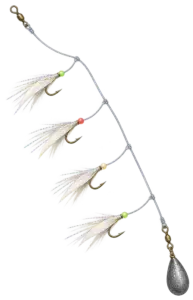
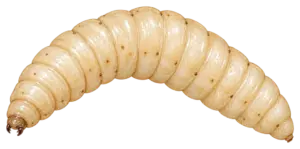
AI-generated illustrations. A click opens the lure’s page.
Rigs for these baits: Side-arm rig.
From the bucket to the kitchen
Fried herring, rollmops, matjes and Bückling are the best-known preparations. Think beforehand about what you will do with a mass catch. A wire keepnet is enough for scaling, then gutting; for smoking you will find everything under Smoking fish.
Sea fish from open water can carry roundworm larvae. Heat and deep-freezing kill them, so thoroughly cooked fish is safe. The Lower Saxony state office LAVES advises against eating self-caught fish raw or nearly raw unless it has been frozen through sufficiently. This does not replace medical advice; more under Parasites in fish.
What you need to observe
Closed seasons, minimum sizes and harvest slots are set by the federal states (Bundesländer) and by the fisheries authorities of the neighbouring countries on the coast (Denmark, Norway, Poland). They vary by type of water, stretch of coast and time of year. We only give figures together with the date and source; the fisheries regulation of your federal state and your fishing permit (Erlaubnisschein) are always what is binding. You will find a list of links to the official sources in the catch calendar.
A fish of legal size that you want to keep you stun and kill at once, in line with animal welfare rules. Protected, undersized fish or fish too large under a harvest slot you unhook, if possible still in the water and with wet hands, and release gently. What exactly applies is regulated by state law and your fishing permit (Erlaubnisschein).
According to the Thünen-Institut, the western Baltic herring is far below the limit value for spawning stock biomass, deep in the red zone. Targeted fishing is only permitted in 2026 for vessels under twelve metres, and the International Council for the Exploration of the Sea has recommended closing it completely for years. For anglers, local rules on the number of hooks and on the fishing permit (Erlaubnisschein) apply, which you ask about before fishing at the harbour, at the municipality or in the tackle shop. The IUCN rates the species as least concern.
What closed season, minimum size and harvest slot mean and where to find them is explained on the page Closed season and minimum size explained.
What state law sets for the closed season (Schonzeit) and minimum size (Mindestmaß) of this species is in the “At a glance” box on the state pages for Mecklenburg-Western Pomerania and Schleswig-Holstein. For the other states our overview does not list this species; there the state fisheries regulation (Landesfischereiverordnung) is decisive.
Frequently asked questions (FAQ)
When does the herring season begin on the Baltic?
Usually at the end of March, running into May. Place and water temperature determine the start, which varies from year to year; according to the DAFV, spawning herring can be fished successfully from 6 to 7 °C.
How do I tell a herring from a sprat?
If the pelvic fins start behind the dorsal fin, it is a herring; on a sprat they sit below it or in front of it. Adult sprats stay under 16 centimetres, have larger scales and a more pronounced keel along the belly.
Should I strike when I get a bite?
No. Wait a moment and reel in steadily; often several herring end up on the hooklength. A strike easily tears the hook out of the soft mouth.
Sources
The rating of catch chances is an editorial assessment. The facts come from these sources, and the text is worded in our own words. The illustration is an original design by Angel Momente in the style of a natural history plate (AI-generated, see the AI notice).
- FishBase: Clupea harengus
- DAFV: Fisch des Jahres 2021, der Atlantische Hering (Broschüre)
- Thünen-Institut, Fischbestände online: Hering, Frühjahrslaicher westliche Ostsee (Laichzeit, Laichgebiet)
- Havforskningsinstituttet: Norsk vårgytende sild (Laichzeit, Laichgebiet, Wanderung)
- Havforskningsinstituttet: Nordsjøsild (Laichzeit, Laichgebiet)
- DTU Aqua, Fiskepleje.dk: Sild (Aussehen, Laichgebiete, Lebenslauf)
- Havs- och vattenmyndigheten: Sill/Strömming (Alter, Größe, Tagesrhythmus)
- Blinker: Steckbrief Hering
- Blinker: Heringsangeln, Tipps für das Angeln auf die Silberlinge
- Blinker: Silber satt, 18 Profitipps zum Angeln auf Hering
- LAVES Niedersachsen: Parasiten in Fischen und Fischereierzeugnissen, ein Problem?
- Wikipedia: Atlantischer Hering
- Thünen-Institut, Fischbestände online: Hering
- Blinker extra: Die Fische der Ostsee und wie man sie beangelt (Stand 2007)
Created with AI support from the sources listed. Figures only appear in the text if a source gives them. Last updated: 9 November 2026. Found a mistake? Write to us. Who is behind this site: About me.
More in the lexicon
- All fish species at a glance
- Catch calendar – month, water temperature and profile for 93 species
- Line calculator – breaking strain after the knot, drag guideline, backing
- Angling methods