
Knowledge · Types of water
Fishing in harbours and from the mole
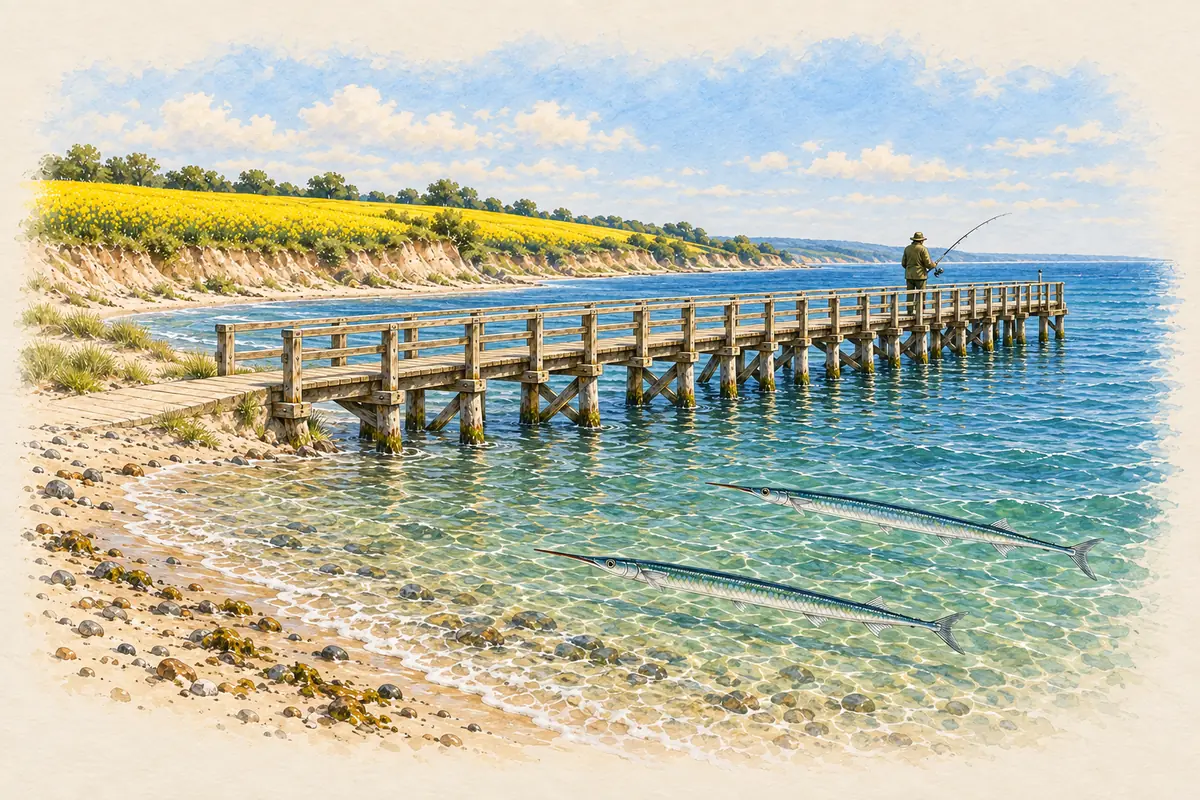
A breakwater gets you to deep water without a boat. From breakwaters, piers and quay edges on the North Sea and Baltic you catch herring, garfish, mackerel and flatfish, depending on the season. Fishing law and harbour regulations (Hafenordnung) decide whether you may fish at a spot.
At a glance
- Spots
- Breakwater head and harbour entrance, rock armour, sheet piling and quay, ship landing stage, sandy channels in the harbour, pier
- Fish
- Herring, garfish, mackerel, grey mullet, flounder, plaice, dab, whiting; cod in the Baltic and eel in 2026 to be put back only
- Method
- Herring paternoster worked through the whole water column, lugworm on the bottom for flatfish
- Papers
- Differs by coastal state, to choose below, plus the harbour regulations (Hafenordnung)
- Take care
- Slippery rocks, steep walls with no landing aid, eddies around structures, cold water
What makes a breakwater, pier and harbour
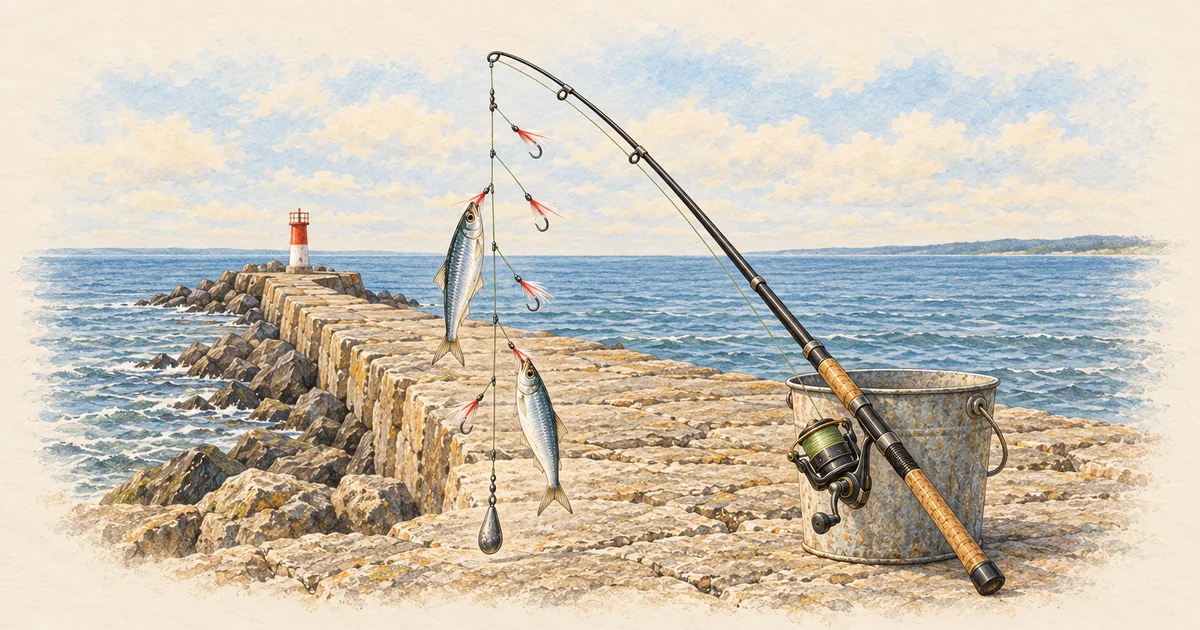
At breakwaters and harbour entrances you quickly have deeper water in front of you, especially at ship landing stages. Long casts are mostly not needed, and many jetties are lit. That makes handling hooks, bait and fish easier in the dark (DAFV booklet on the flounder).
The structure holds fish for two reasons: according to Blinker, breakwaters usually have strong currents, which mean food, and the growth shelters small fish and fry.
Plan how to land the fish before the first one bites. Because of the often steep walls, the DAFV recommends a sheet-piling net (Spundwandkescher). Blinker mentions steep, slimy access points where landing a larger fish at night is said to be dangerous, and recommends very long landing nets or net baskets on a rope.
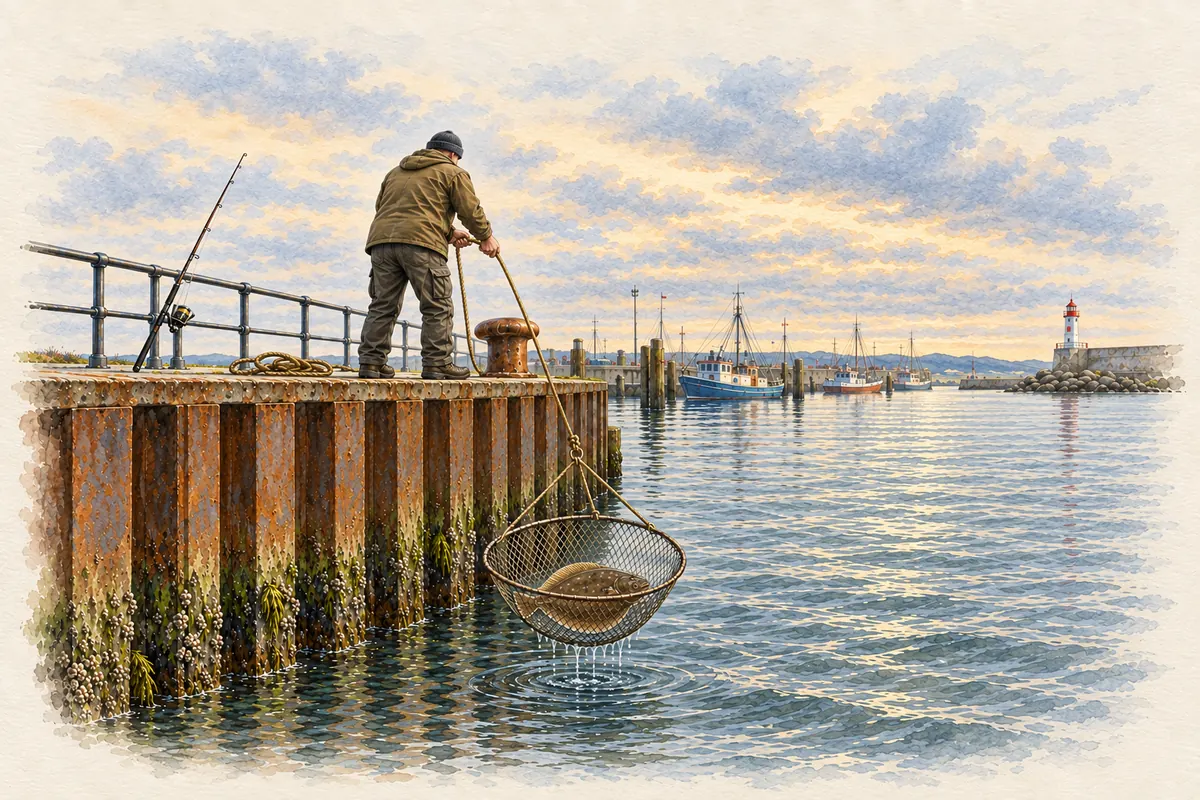
Hydraulic structures and pier pilings create their own currents and eddies (DLRG booklet „Gefahren am Meer“).
The map shows where to start at the breakwater and harbour. Tap a number:
- Breakwater head and harbour entrance: Here you quickly have deeper water in front of you; long casts are mostly not needed (DAFV). According to Blinker, breakwaters usually have strong currents, which mean food.Suits: herring on the paternoster, garfish from May
- Rock armour with growth: The growth shelters small fish and fry (Blinker). Algae and weed make the rocks very slippery when wet, and there are sharp edges and mussels too (DLRG).Watch out for: a firm footing, never on wet, overgrown rocks
- Sheet piling at the quay: Grey mullet stand in harbours at sheet piling and pilings, from June to September (Blinker supplement). Because of the steep walls, the DAFV recommends a sheet-piling net (Spundwandkescher).Suits: grey mullet on float and white bread
- Ship landing stage: Especially at ship landing stages you quickly have deeper water, and many jetties are lit. That makes handling hooks, bait and fish easier in the dark (DAFV). From ship berths, fishing is allowed in Heiligenhafen, for example, only with a special permit (Ausnahmegenehmigung).
- Sandy channel in the harbour: In a tidal harbour the flounders stand in sandy channels, hollows and depressions (DAFV). How the tide works there is shown in the section Flatfish in a tidal harbour.Suits: flounder on lugworm on the bottom
- Pier: Garfish stay around breakwaters, landing stages and piers from early or mid-May, mackerel in the deep water in front of them from July to September or October (Blinker supplement). The pilings create their own currents and eddies (DLRG).
Fish at the breakwater and quay
Spots, times and tackle values for garfish, mackerel, grey mullet and whiting come from a Blinker supplement on the Baltic from 2007. It is old, so the values are guidelines.
In spring herring migrate from the western Baltic to the river mouths to spawn. Fishing then takes place from Flensburg to Stralsund at breakwaters, quay edges and bridges, often until mid-May (DAFV booklet on the herring).
In the areas around breakwaters, landing stages and piers, from early or mid-May. As a rule of thumb the supplement says: when the rapeseed is in full bloom, the garfish are usually there too. It recommends a spinning rod of about 3 metres with a casting weight of 10 to 40 grams and 0,20 to 0,25 millimetre monofilament line, and small strips of herring or garfish as bait.
In deep water in front of breakwaters, piers and landing stages, from July to September or October. On breakwaters that reach far out into the sea, according to Blinker, mackerel are sometimes caught in summer with a float rig and fish strips.
In harbours at sheet piling and pilings, from June to September. The supplement mentions a float rod of about 3 to 3,90 metres with 0,20 to 0,25 millimetre monofilament line and white bread as bait.
You catch flatfish on natural baits from breakwaters and in harbour entrances too (DAFV booklet on the flounder).
Flatfish like the flounder, on natural baits from breakwaters and in harbour entrances too.
The third flatfish at the breakwater, same baits as for flounder and plaice.
All year round from breakwaters and piers, occasionally as bycatch.
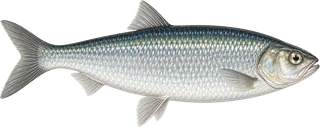

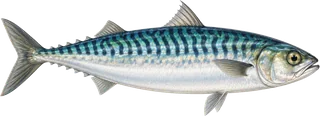
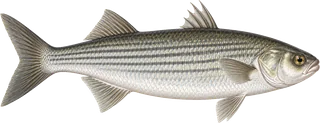
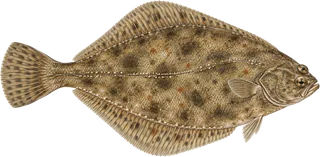
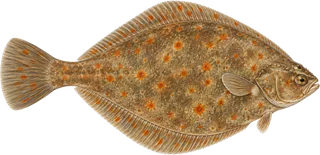
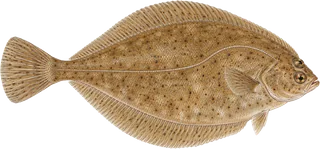
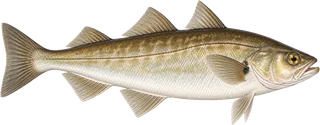
Fish pictures: AI-generated illustrations. A click opens the portrait.
The bars come from the Catch calendar and apply to the North Sea and Baltic together; the texts for the breakwater and quay come from the sources named.
For cod and eel fishing bans (Fangverbot) apply in 2026: recreational fishing for cod is banned in the Baltic all year round, and for eel in the North Sea and Baltic. You put bycatch back at once, gently. On the Schlei and Trave, on the inland side of the breakwater heads, neither ban applies, and the eel ban does not apply on the lower Elbe and the Untereider either (State of Schleswig-Holstein on cod and eel).
Herring fishing with the paternoster
When: From 6 to 7 degrees water temperature, herring coming to the coast to spawn can, according to the DAFV, be fished successfully. For shore fishing the Blinker supplement gives, depending on water temperature, the start as early to mid-March and the main season as late March to early April, in some places also autumn catches from October to December. According to the DAFV, catches vary a lot, depending on the spawning migration and the reach of the shoals. Mass catches of several hundred fish a day are possible, but boat anglers have better odds. The months are shown in the Catch calendar.
With what: The 2007 supplement recommends a spinning, bottom or carp rod of about 3,60 metres with a casting weight of 80 grams and 0,25 to 0,35 millimetre monofilament line. The DAFV mentions a medium-heavy spinning or bottom rod as tackle. The herring paternoster, a hooklength with several side arms, is 70 to 120 centimetres long according to Blinker, carries 2 to 5 hooks and hangs from a herring lead of 30 to 80 grams. The DAFV mentions 5 or 6 bite points, fewer depending on local rules. More on the hooklength: Sea paternoster, on tackle Sea fishing.
How: After the cast you let the rig sink slowly and bring it back with up-and-down movements. Search the whole water column that way until you have found the depth of the fish. Bites show as a slight twitch of the rod tip (DAFV booklet on the herring).
- Hooks in Mecklenburg-Western Pomerania: When fishing for mackerel or herring, a paternoster with up to six single hooks is permitted. Otherwise, up to two baits with up to three hooks each are allowed per hand-held rod. A maximum of three hand-held rods is allowed, and only for your own use (Küstenfischereiverordnung, Änderung vom 11. September 2026).
- Minimum sizes (Mindestmaße): Schleswig-Holstein gives, for the North Sea, 20 centimetres for herring, 30 for mackerel and 35 for cod (information sheet of the state, as of March 2026). In Mecklenburg-Western Pomerania herring is not on the list of minimum sizes. For flounder, plaice and dab 25 centimetres apply there.
- No bucket of live herring: Keeping live herring in a keepnet or a bucket of water is not considered humane by the state office in Mecklenburg-Western Pomerania (LALLF). More on this: Stunning and killing a fish.
Flatfish in a tidal harbour
Flatfish can be found in the harbour too, even in winter. The DAFV describes this for a harbour on the Elbe: anglers are drawn to the quay there from September to early February. According to the booklet the flounders stand in sandy channels, hollows and depressions. Choose how the tide is running right now:
Falling tide
As the water runs out, the current gets stronger and washes food free.
Rising tide
On a rising tide the chances improve because shallow spots that are uninteresting at low tide become attractive.
As bait, the DAFV recommends lugworms on the bottom, on long-shank hooks size 1. A lead of up to 200 grams in grapnel, pyramid or star shape holds against the current. The rod should have a casting weight of 250 grams. In winter the DAFV prefers monofilament, because braid soaks up water and can freeze in frost. A rod rest can be fixed to the railing. The rig is described on the page Surf rig, and how ebb and flood change on the page Tides.
Methods and rigs
Herring
Let the herring paternoster, a hooklength with several side arms, sink slowly and search the whole water column with up-and-down movements. More on the hooklength: Sea paternoster, on tackle Sea fishing.
Flatfish
Lugworms on the bottom, a lead of up to 200 grams in grapnel, pyramid or star shape against the current. The rig is described on the page Surf rig.
Garfish and mackerel
For garfish a spinning rod with small fish strips, for mackerel on breakwaters reaching far out the float rig with fish strips.
Drawings: AI-generated, schematic.
Common mistakes
- Striking when fishing for herring: According to the DAFV you must not strike when fishing for herring. The soft mouth tears easily; it is best to reel in slowly without slackening the line. Monofilament absorbs shocks with its stretch.
- Reeling in straight after the first bite: According to the DAFV the rig is better left lying, and more herring usually bite.
- No landing aid with you: Without a sheet-piling net (Spundwandkescher) or net basket you cannot lift a fish up safely at the steep quay edge.
- Fishing only one depth: Find the depth of the herring by working the whole water column.
Papers on the coast
Papers and the most important rules for the breakwater and harbour depend on the coastal state. Choose yours:
Schleswig-Holstein
You need a valid fishing licence (Fischereischein); without an exam the holiday fishing licence (Urlauberfischereischein) will do. You always pay the state’s fishing levy (Fischereiabgabe), also in addition to the levy of another federal state (Bundesland). In coastal waters fishing is generally free. In addition you need a fishing permit (Erlaubnisschein) in the Schlei, in the inner Neustädter Bucht, in the inner Lübecker Bucht including Travemündung and in the Untereider from the B5 bridge near Tönning (State of Schleswig-Holstein, information sheet).
- Minimum sizes (Mindestmaße) in the North Sea: herring 20, mackerel 30, cod 35 centimetres (information sheet of the state, as of March 2026)
- Schlei and Trave: on the inland side of the breakwater heads the bans on cod and eel do not apply (Cod, Eel)
Mecklenburg-Western Pomerania
Three documents are always needed: fishing licence (Fischereischein), angling permit for the coastal waters (Angelerlaubnis) and proof of payment of the fishing levy (Fischereiabgabe). Without an exam there is the tourist fishing licence (Touristenfischereischein) for up to 28 days (LALLF).
- Paternoster: up to six single hooks when fishing for herring or mackerel, at most three hand-held rods (Küstenfischereiverordnung, Änderung vom 11. September 2026)
- Minimum sizes: flounder, plaice and dab 25 centimetres, herring is not on the list
- Herring: do not keep alive in a keep net (Setzkescher) or bucket (LALLF)
- Stralsund harbour: from 12 October to 10 March no fishing in the northern part and in the canals (Allgemeinverfügung des LALLF)
Lower Saxony
In coastal waters, fishing for fish and crustaceans is free (§ 16 Nds. Fischereigesetz). Exception: for the Outer and Lower Weser you need a fishing permit (Erlaubnisschein) from the Staatliches Fischereiamt Bremerhaven. You only get it with a fishing licence (Fischereischein) or proof of having passed the exam (conditions of the fisheries office).
- Harbours: fishing only on water areas that the harbour authority (Hafenbehörde) has expressly released (§ 14 NHafenO)
Since 10 January 2026, Germany has had to ensure under EU law that sea anglers are registered and report catches of certain species electronically. Whether this already applies to you is stated on Portal Fischerei von Bund und Ländern (the fisheries portal of the federation and the states).
As of: October 2026. According to the State of Schleswig-Holstein the cod ban applies to the year 2026; the EU Fisheries Council will deliberate on 2027 at the end of 2026. Before fishing, read the website of the fisheries authority (Fischereibehörde) of your coastal state. Basics: Fishing licence and angling exam, Closed season and minimum size explained.
Harbour regulations (Hafenordnung): where fishing is banned
In a harbour the harbour regulations apply alongside fishing law. Three official examples:
- Lower Saxony: The Lower Saxony harbour regulations (Niedersächsische Hafenordnung) ban bathing, angling and fishing in harbour waters. Exceptions are water areas that the harbour authority has expressly released (§ 14 NHafenO).
- Heiligenhafen: From the cargo-handling facilities and from the ship berths, fishing is permitted only with a special permit, the Ausnahmegenehmigung (Hafenbenutzungsordnung vom 13. Juni 2024).
- Stralsund: From 12 October to 10 March all fishing is banned in the northern part of the harbour and in the canals, to protect the fish in their winter quarters (Allgemeinverfügung des LALLF).
Look out for signs and, if in doubt, ask the harbour authority before you set up.
Safety on the breakwater and quay
- Slippery rocks: Algae and weed settle on rocks and structures and, with water, form a very slippery surface. Sharp-edged rocks and mussels add to it (DLRG booklet „Gefahren am Meer“).
- Cold water: At water temperatures below 20 degrees, according to the DLRG the body can no longer compensate for the loss of heat by itself. A fall into the water at structures with eddies and steep walls must therefore be taken seriously.
- Weather and equipment: The weather at sea is much more changeable than on land. An experienced sea rescuer (Seenotretter) always has a life jacket and protection against the cold with them when fishing (Seenotretter: Sicherheit beim Angeln).
- Emergency: You can reach the Rettungsleitstelle See (sea rescue coordination centre) in Bremen round the clock on 0421 53687-0.
More: Shore and waders, Thunderstorms and weather.
Before you set off
- Papers for your coastal state: in Schleswig-Holstein and Mecklenburg-Western Pomerania a fishing licence (Fischereischein) or holiday or tourist licence and fishing levy (Fischereiabgabe), in Mecklenburg-Western Pomerania also the angling permit (Angelerlaubnis)
- Harbour regulations and signs checked, asked the harbour authority if in doubt
- Sheet-piling net or net basket on a rope with you
- Herring paternoster with the number of hooks allowed in your state
- Fish priest with you, do not keep herring alive in a bucket
- Non-slip shoes, life jacket and protection against the cold
- Rettungsleitstelle See emergency number saved: 0421 53687-0
- 2026: put cod in the Baltic and eel back gently at once
Frequently asked questions
When do herring bite at the breakwater?
In spring, when the herring come to the coast to spawn. The DAFV gives 6 to 7 degrees water temperature, and it is often over by mid-May. Catches vary a lot.
Why must I not strike when fishing for herring?
Herring have a soft mouth and easily pull free. The DAFV therefore recommends not striking but reeling in slowly.
May I fish at every breakwater and in every harbour?
No. Alongside the fishing law of your coastal state, the harbour regulations (Hafenordnung) apply. They can ban fishing or make it subject to release by the harbour authority.
How do I land a fish from the high quay wall?
With a sheet-piling net (Spundwandkescher), which the DAFV recommends for steep walls. Blinker also mentions very long landing nets and net baskets on a rope.
Examples in the areas
These area pages describe waters of this type with their local rules:
Germany: Baltic coast of Schleswig-Holstein, North Sea coast, Fishing in Hamburg, Fishing in Bremen
Denmark: West coast of Jutland, Hvide Sande and Ringkøbing Fjord
Poland: Polish Baltic coast, Gulf of Gdańsk and the Hel Peninsula
The Netherlands: North Sea coast and Wadden Sea, North Holland coast
Italy: Northern Adriatic
Related
- Sea fishing: tackle and methods from beach to charter boat
- Sea paternoster: the hooklength for herring and mackerel
- Herring and garfish: the fish profiles for the most common breakwater fish
- Surf rig and Bottom fishing: flatfish on the bottom
- Fishing on the coast and in the surf: beach, tides and papers
- Fishing in Bodden and fjords: shallow water behind the coast
- Fishing from a charter boat and boat: when the herring stay away from the shore
- Catch calendar and Fishing in Germany: months by species and areas
Sources
- Mecklenburg-Vorpommern: Fünfte Verordnung zur Änderung der Küstenfischereiverordnung (11. September 2026) und Allgemeinverfügung zum Hafen Stralsund (Haken, Mindestmaße, Hafenverbot)
- LALLF Mecklenburg-Vorpommern: Fischereischein und Angelerlaubnis, Verhalten beim Angeln (Papiere, Hältern von Heringen)
- Land Schleswig-Holstein: Angelfischerei, Merkblatt zum Urlauberfischereischein, Dorsch 2026, Aal 2026 (Papiere, Mindestmaße, Fangverbote)
- Niedersachsen: § 16 Nds. Fischereigesetz, § 14 Niedersächsische Hafenordnung (freier Fang, Hafenverbot)
- Stadt Heiligenhafen: Hafenbenutzungsordnung für den Kommunalhafen (2024; Angeln im Hafen)
- Portal Fischerei: Fragen und Antworten zum Meeresangeln (Stand 5. Februar 2026; Registrierung und Fangmeldung)
- Deutscher Angelfischerverband: Broschüren zum Fisch des Jahres, Hering (2021) und Flunder (2017) (Heringsangeln, Plattfisch im Hafen, Landehilfe)
- Blinker: Brandungsangeln (Strömung und Bewuchs an Molen, Landung); Blinker extra: Die Fische der Ostsee und wie man sie beangelt (Beilage 04/2007; Plätze, Saison und Gerät)
- DLRG Burscheid: Gefahren am Meer (9. Auflage, Februar 2023); Seenotretter (DGzRS): Sicherheit beim Angeln (Strudel, Rutschgefahr, Kälte, Notruf)
- Saisonbänder der Fischkarten: Fangkalender von Angel Momente (redaktionelle Einschätzung mit den dort genannten Quellen)
Text AI-assisted, drawings AI-generated. Sources opened and checked in October 2026; no graphics taken from the sources.
Guide without guarantee. As of 26 October 2026, checked against state law and authority websites. What counts are the fisheries acts and regulations of the respective coastal state, EU law and the harbour regulations on site. The safety notes do not replace instruction by rescue organisations or medical advice.