
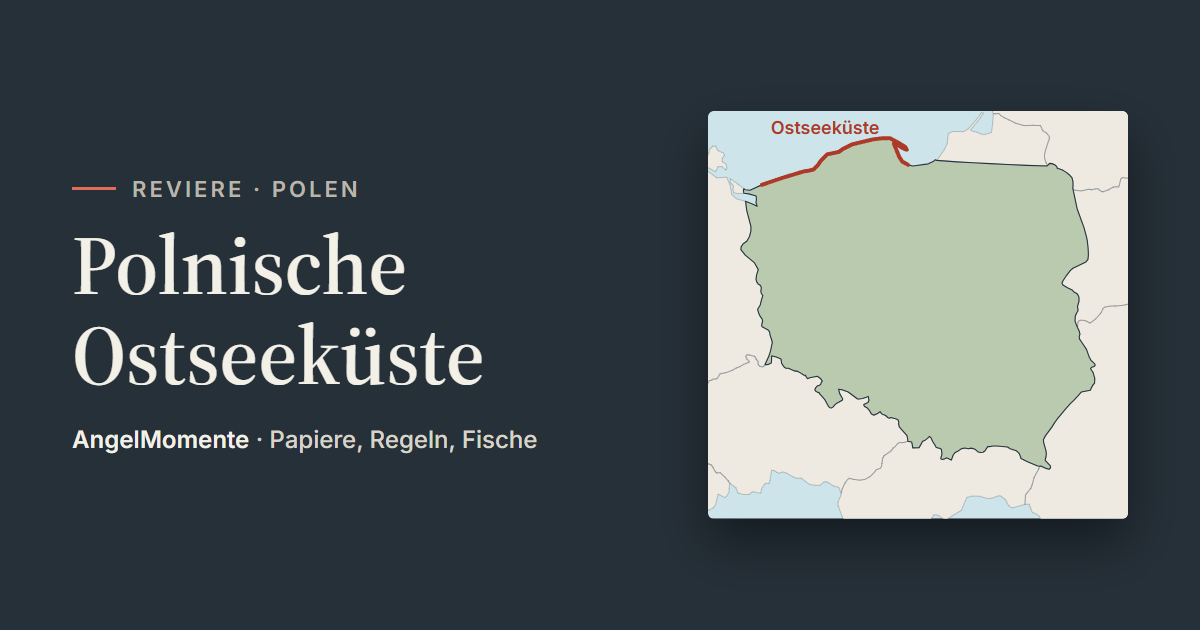
Destinations · Poland
Fishing on the Polish Baltic coast
The Polish Baltic coast runs from Świnoujście to the Hel Peninsula and into Gdańsk Bay. You fish in the surf, in harbours or from a boat. At sea you do not need a fishing licence, only the receipt for a state fee. Cod and eel are off limits.
- Papers
- Fee to GIRM; at the water ID and payment receipt
- Fishing seasons
- In seven harbours from 15.9. to end of February no angling from 17:00 to 07:00
As of October 2026
At a glance
- Papers
- Fee to GIRM; at the water ID and payment receipt
- Licence and permit
- Fishing seasons
- In seven harbours from 15.9. to end of February no angling from 17:00 to 07:00
| Fish | Minimum size | Closed season | Catch limit | Note |
|---|---|---|---|---|
| Cod | – | Fishing ban 2026 | – | EU ban; protected all year round in Poland |
| Herring | 16 cm | none | 6 kg per day | up to 5 hooklengths, hooks up to 6 mm |
| Garfish | 60 cm | none | 10 per day | |
| Sea trout | 50 cm | 15.9.–15.11. | 2 per day | Closed season within the 4 nautical mile strip, in seven harbours until 31.12.; 1 salmon instead of 2 sea trout |
| Atlantic salmon | 60 cm | 15.9.–15.11. | 1 per day | only with the adipose fin clipped (EU); in seven harbours until 31.12. |
| Flounder | 23 cm | none | – | other species 7 kg a day in total |
| Turbot | 30 cm | 1.6.–31.7. | – | Closed season east of 15° east |
| Perch | 20 cm | none | 15 a day | |
| Zander | 50 cm | 25.3.–10.5. | 2 per day | west of 16°40′ E; up to 19°21′ E 10.4.–31.5., further east 20.4.–10.6.; limit shared with pike |
| Eel | – | protected all year round | – |
Polish sea areas: regulation on recreational sea fishing of 27.12.2023 (Dz. U. 2023 item 2816), plus the EU rules for the Baltic for 2026. In the Szczecin Lagoon and the inner Gdańsk Bay some closed seasons differ. As of October 2026. What counts are the regulation and your fishing permit (Erlaubnisschein).
Location and waters Open coast, harbours and Gdańsk Bay
- Open coast: The southern coast of the Baltic is mostly beaches, dunes and cliffs. On average the water is five times less salty than the ocean (MIR-PIB, Nasz Bałtyk).
- Supervision: The marine fisheries authority GIRM (Główny Inspektorat Rybołówstwa Morskiego) in Słupsk is responsible. It has branch offices in Szczecin and Gdynia (GIRM) and offices in Świnoujście, Dziwnów, Kołobrzeg, Darłowo, Ustka and Hel, among others (GIRM, Büros).
- Gdańsk Bay and Hel: Legally, the inner part of the bay behind the baseline counts as inland marine water (Gesetz über die Meeresgebiete, Artikel 4). More in the profile Gdańsk Bay and Hel.
- The two lagoons: The Polish parts of the Szczecin Lagoon and the Vistula Lagoon are also inland marine waters, partly with their own closed seasons. Details are under Szczecin Lagoon and lower Oder and Vistula Lagoon.
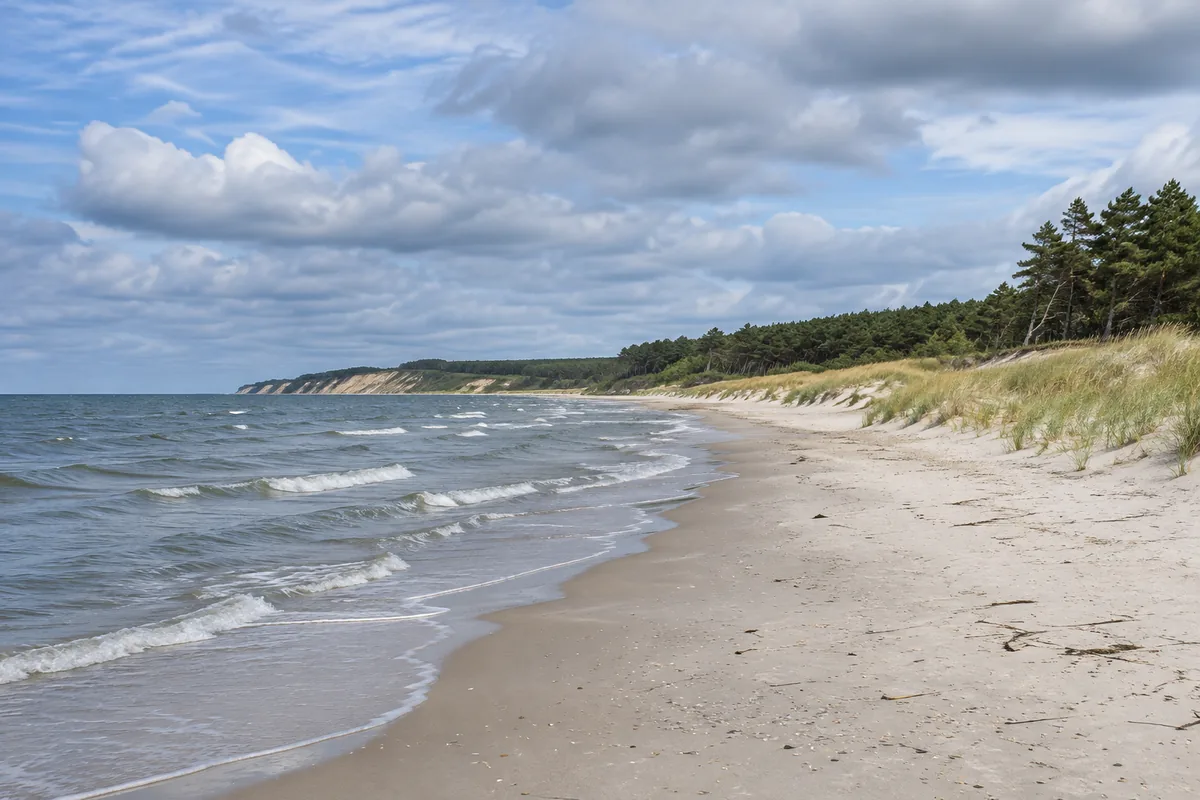
Fish and best time Herring, flatfish, garfish, salmon and sea trout
- Open sea: Herring, sprat and flatfish such as turbot and flounder characterise the open Baltic. The garfish comes in from the North Sea (MIR-PIB, Nasz Bałtyk).
- Charter boats: Since the cod ban, reported angling trips have almost disappeared. In 2016, 173 boats reported catches, in 2024 only six. Besides cod, the reports mostly named salmon, mackerel, garfish, flounder and herring. Salmon are trolled for from the boat (MIR-PIB, Wiadomości Rybackie 5-6/2025).
- Sea trout: Like the salmon, it runs up the coastal rivers to spawn. In the Reda, which flows into the Bay of Puck, state stocking has supported the population for decades (MIR-PIB). If you catch a tagged fish, report it to MIR-PIB.
- Perch, zander, pike: They live in bays and inshore waters. From 2020 to 2022 MIR-PIB released more than 300,000 young pike into the Bay of Puck (MIR-PIB).
- Cod: In 2026 the EU bans angling for cod throughout the Baltic. If one bites anyway, it goes straight back into the sea (Verordnung (EU) 2025/2454, Artikel 10). Poland protects cod and eel at sea all year round anyway.
The catch calendar shows the months for the individual species.
Papers and permit Fee to GIRM instead of a fishing card, from 15 złoty
- Fee instead of a card: The sea fisheries act does not require the Polish fishing card (karta wędkarska). You pay GIRM 15 złoty for one week, 25 for one month or 65 for twelve months. The period starts on the day of payment; there is no paper permit (GIRM). At the water you show ID and the payment receipt (Seefischereigesetz, Artikel 90).
- Reporting a boat trip: On the open Baltic and in the Bay of Puck and Gdańsk Bay you send GIRM the boat name, start time and area by e-mail at least two hours before you set off (Article 96a).
- Catch report from the boat: If you have herring, sprat, cod or eel on board, you write a report before entering the harbour and submit it by the following day at the latest.
- RecFishing: You record species with EU catch rules in the free RecFishing app (GIRM).
Special rules Harbours in winter, sea marks and stocking areas
- Seven harbours in winter: In Darłowo, Dźwirzyno, Kołobrzeg, Łeba, Mrzeżyno, Rowy and Ustka spinning is suspended from 15 September to the end of February, and from 17:00 to 07:00 there is no angling at all. Salmon and sea trout are protected in these harbours until 31 December. In Kołobrzeg harbour a stretch of the Parsęta is closed from 1 September to 31 December.
- Sea marks, bridges, harbour installations: You may not fish from sea marks and bridges. In the harbours of the Szczecin maritime office, from Świnoujście to Darłowo, this also covers harbour installations (Hafenvorschriften, § 31).
- Stocking areas: Where the ministry announces stocking, angling is banned. In 2026 this affected five harbours and 1,000 m around the mouths of the Rega, Parsęta, Słupia, Łupawa and Łeba from 25 March to 31 May (Bekanntmachung bei der GIRM).
- Commercial fishing exclusion zones: Where commercial fishers may not fish, you may not angle either (Seefischereigesetz, Artikel 96). You keep 100 m away from these areas, and from bathing spots too.
- Salmon: You may keep only one salmon with the adipose fin clipped. After that, salmon fishing is over for the day (Verordnung (EU) 2025/2454, Artikel 11).
- Rods and light: You fish with no more than two rods, one when spinning or fly fishing. Artificial light to locate or attract fish is banned.
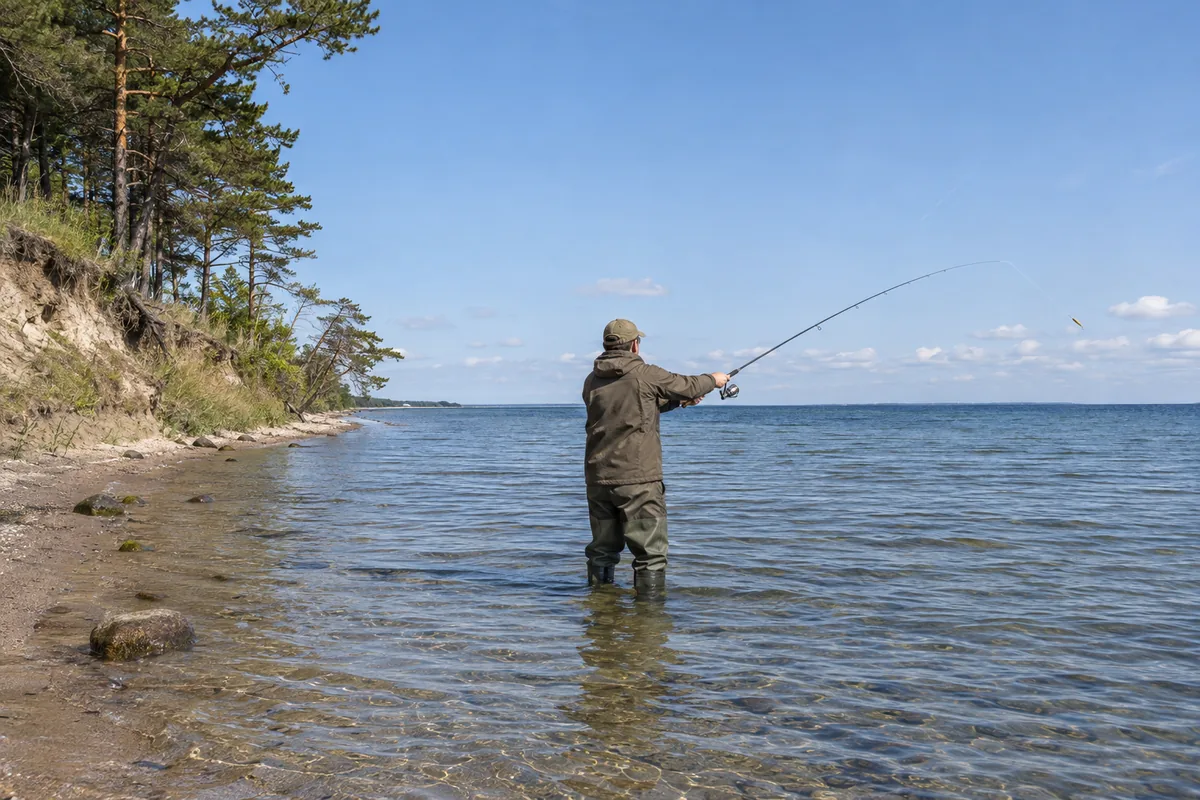
- Rigs on the open coast: In the surf with natural bait up to three hooklengths with single hooks up to 20 mm gape. For herring up to five hooklengths with hooks up to 6 mm, for garfish an artificial lure with a wool loop.
- Distances and boat: On the bank you keep 20 m from your neighbour, 50 m when spinning. Boats keep 50 m apart, 150 m when spinning, avoid fairways and anchorages and stay 100 m away from nets and wrecks. At sea you troll with no more than twelve rods per boat and without live baitfish.
- Catch: You keep it alive in a keepnet or kill it at once. From a boat you land it whole.
As of October 2026. The sizes, closed seasons and catch limits in the box come from the regulation on recreational sea fishing of 27 December 2023, the cod ban from the EU regulation for 2026. The ministry announces stocking areas in the Monitor Polski. In harbours east of Darłowo, such as Ustka, Łeba and Władysławowo, ask the harbour office before fishing from the pier.
Related
- Fishing from the coast and surf, Fishing in harbours and from piers and Fishing from cutters and boats
- Angling in Poland: papers for inland waters and boat rules
- More coastal profiles: Gdańsk Bay and Hel, Vistula Lagoon and Szczecin Lagoon
- Surf rig and Sea angling
- Baltic coast of Mecklenburg-Western Pomerania and Returning fish
Sources
- Verordnung über Maße, Schonzeiten und Bedingungen des Freizeitfischens im Meer vom 27.12.2023 (Dz. U. 2023 Pos. 2816)
- Seefischereigesetz (ustawa o rybołówstwie morskim), einheitlicher Text Dz. U. 2025 Pos. 590, und Gesetz über die Meeresgebiete, einheitlicher Text Dz. U. 2024 Pos. 1125
- Główny Inspektorat Rybołówstwa Morskiego: Freizeitfischerei, RecFishing, Besatzgebiete 2026, Außenstellen und Büros (abgerufen 04.10.2026)
- Verordnung (EU) 2025/2454 des Rates zu den Fangmöglichkeiten in der Ostsee 2026, Artikel 10 und 11
- Urząd Morski w Szczecinie: Hafenvorschriften, Stand 1. Juli 2026
- Morski Instytut Rybacki, PIB: Freizeitfangberichte 2016 bis 2024, Meerforelle in der Reda, Hecht in der Putziger Wiek, markierte Meerforellen und Lachse, Portal Nasz Bałtyk: Artenvielfalt, Hydrologie, Küsten
Guide without guarantee, as of October 2026. What counts are the Polish rules on recreational sea fishing, the harbour regulations of the maritime offices, the ministry’s announcements and the EU rules for the Baltic as currently in force.