
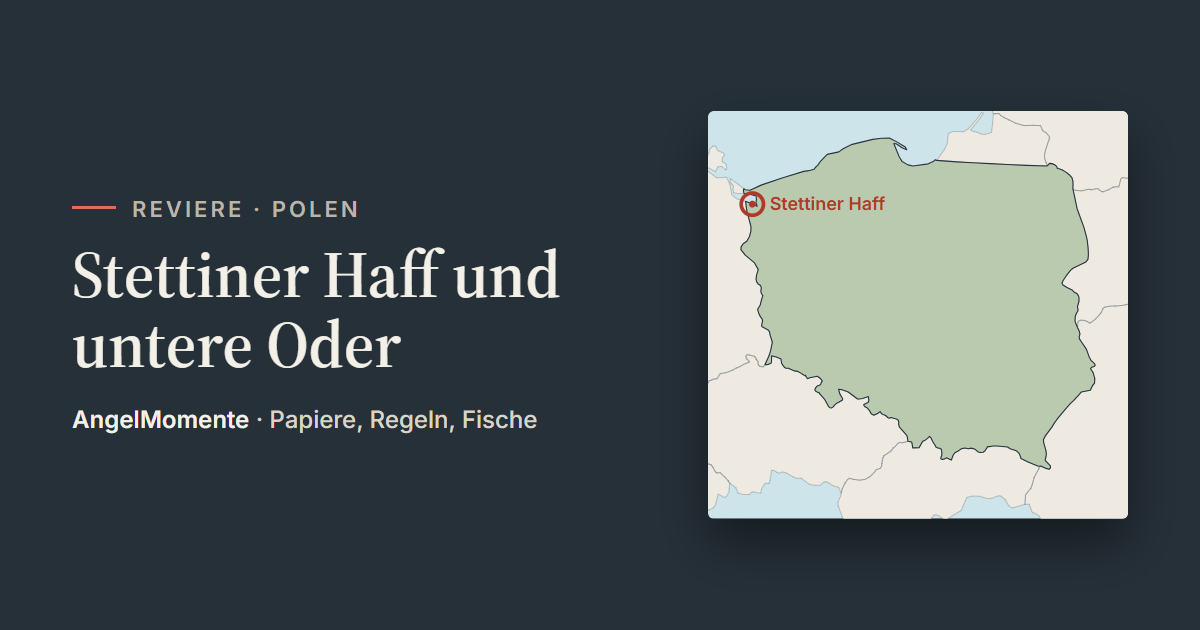
Destinations · Poland
Fishing on the Szczecin Lagoon and the lower Oder
The Szczecin Lagoon is the broad lagoon at the mouth of the Oder. Poland treats the Polish part, the Oder up to Szczecin and Lake Dąbie as sea for fishing purposes. You need no fishing licence there, and you pay the state fee for sea angling.
- Papers
- Fee to the GIRM; permit above the Szczecin bridges
As of October 2026
At a glance
- Papers
- Fee to the GIRM; permit above the Szczecin bridges
- Licence and permit
| Fish | Minimum size | Closed season | Catch limit | Note |
|---|---|---|---|---|
| Zander | 50 cm | 25.3.–10.5. | 2 per day | Limit shared with pike |
| Pike | 50 cm | 1.1.–30.4. | 2 per day | Limit shared with zander |
| Perch | 20 cm | none | 15 a day | |
| Roach | 20 cm | none | – | other species 7 kg a day in total |
| Bream | 40 cm | none | 5 a day | |
| Wels catfish | 70 cm | 1.5.–15.6. | 2 per day | |
| Burbot | 40 cm | 1.12.–28.2. | – | Closed season until the end of February, until 29.2. in a leap year |
| Large whitefish (Schnäpel) | 40 cm | 20.10.–15.12. | – | |
| Sea trout | 50 cm | 15.9.–31.12. | 2 per day | instead of 2 sea trout, 1 salmon with the adipose fin clipped |
| Eel | – | protected all year round | – |
Polish lagoon, Oder up to the Szczecin border bridges and Lake Dąbie: regulation on recreational sea fishing of 27.12.2023 (values for the inner sea waters west of 15°23′ east). Above the bridges the inland regulation and the permit apply. Status: October 2026. The regulation and your fishing permit (Erlaubnisschein) are what count.
Location and waters Zalew Wielki, Neuwarp Lake and the Oder to Szczecin
The Polish sea research institute MIR-PIB describes the lagoon as a very productive water that fish use for spawning. The Polish part is called Zalew Wielki and measures around 410 km² (MIR-PIB).
The state border with Germany divides the lagoon and Neuwarp Lake. Polish maritime law applies only east of it (Gesetz über die Meeresgebiete, Artikel 4). The inner sea waters there include the Polish part of the lagoon and Neuwarp Lake with the Świna, Dziwna and Zalew Kamieński, the Oder between the lagoon and the port of Szczecin, and the harbour waters. West of the border lies the Kleines Haff, under German law. The rules there are under Usedom and Baltic Sea Mecklenburg-Western Pomerania.
For fisheries, a separate regulation of 2004 draws the line between sea and inland water. In Szczecin it runs at three bridges: on the Western Oder at the bridge of the Trasa Zamkowa, on the Regalica at the Most Cłowy and on the Parnica at the Most Portowy. Lake Dąbie belongs to the sea side, with the boundary running at the mouths of its tributaries. Upstream of the bridges inland water begins, with more in the profile Oder.
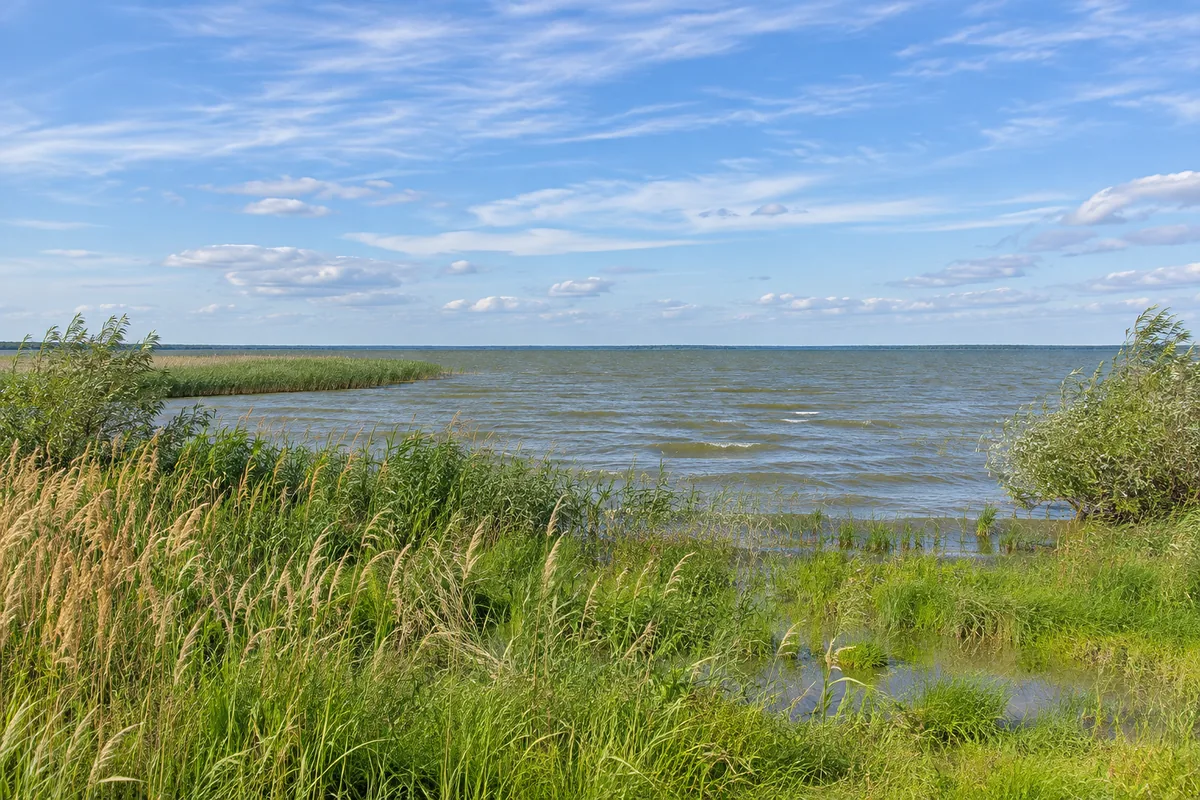
Fish and best time Zander, perch, pike and bream in brackish water
- Freshwater fish in brackish water: In the lagoons and bays of the Polish coast, perch, roach, zander, pike, ruffe and bream are common (MIR-PIB, Nasz Bałtyk).
- Zander and perch: Both spawn in the lagoon. MIR-PIB maps their spawning grounds in the Polish part and calls them two economically important species (Project description). The institute has evaluated the growth, diet, migrations and catches of the lagoon zander for 2011 to 2016 (MIR-PIB).
The catch calendar shows which months suit which species. The closed seasons (Schonzeit) on the lagoon are in the box.
Papers and permit Fee to the GIRM instead of a fishing licence
- Lagoon, Oder up to the bridges, Dąbie Lake: The basis is the receipt for the fee you have paid (Seefischereigesetz, Artikel 90). You pay the marine fisheries authority GIRM 15 złoty for one week, 25 for one month or 65 for twelve months, each running from the day of payment. There is no paper permit. At the water you show ID and the payment receipt (GIRM). GIRM has a branch office in Szczecin and offices in Trzebież, Świnoujście and Dziwnów.
- From a boat: The duty to report a trip by e-mail two hours beforehand comes from Article 96a and covers the open Baltic, the territorial sea and the Bay of Puck and Gdańsk Bay. The lagoon is not mentioned there.
- Above the bridges: The Binnenfischereigesetz applies here. You need the permit of the fishing-rights holder. The Polish fishing card is not required of foreigners who are staying in Poland temporarily and hold this permit (Article 7). Each fishing district has only one rights holder (Article 12). Before your first cast, find out who is responsible for your stretch of the Oder or the Regalica.
Special rules Own closed seasons and restricted areas along the shipping channel
On the sea side, the regulation on recreational sea angling applies. For the inland marine waters west of 15°23′ east and for Dąbie Lake it sets its own closed seasons, including for pike, wels catfish and burbot. The lagoon and the lower Oder lie in this area.
- Restricted areas: Where commercial fishing is banned, you may not angle either (Seefischereigesetz, Artikel 96). You also keep 100 m away from these areas. Permanently closed are, among others, the Świnoujście–Szczecin shipping channel on the lagoon with a strip of 300 m on both sides, further towards Szczecin as far as Chełminek island a strip of 200 m, areas in the Wolin National Park including Lake Wicko Wielkie, and the Zatoka Cicha. Many bays on Dąbie Lake, on the Roztoka Odrzańska and on the Dziwna are closed for part of the year. The list with coordinates is in Annex 1 of the regulation on commercial sea fishing.
- Tackle: two rods, one when spinning. On the lagoon an artificial lure may carry no more than two hooks with up to three points each. Artificial light to attract fish is banned. You keep 20 m away from your neighbour on the bank, 50 m when spinning.
- Bridges and harbours: No fishing from bridges and sea marks. In the harbours of the Szczecin maritime office, including Szczecin, Police, Trzebież, Stepnica, Nowe Warpno and Świnoujście, this also covers harbour installations (Hafenvorschriften, § 31).
- Boat: On the lagoon you may troll with one rod outside the harbours, but not with a live baitfish. Shipping channels and anchorages are off limits, and you keep 100 m from nets that have been set. Fish you keep must be landed whole.
- Returning and killing: Undersized and protected fish go back at once. Non-native species such as the round goby you kill and do not put back.
As of October 2026. Upstream of the Szczecin border bridges the inland regulation applies with different values: zander 45 cm and closed from 1 March to 31 May, pike 45 cm and closed from 1 January to 30 April. The conditions of your permit come on top. For the restricted areas currently in force, ask at the GIRM branch office in Szczecin. The regulations are what counts.
Related
- Angling on the Bodden and fjords and Angling in Poland
- Neighbouring waters: Oder, Polish Baltic coast and, on the German side, Usedom
- Zander, perch and pike in the fish lexicon
- Closed seasons and minimum sizes explained and Boats and life jackets
Sources
- Gesetz über die Meeresgebiete (einheitlicher Text Dz. U. 2024 Pos. 1125) und Verordnung über die Grenze zwischen Meeres- und Binnengewässern für die Fischerei (26.07.2004)
- Seefischereigesetz (einheitlicher Text Dz. U. 2025 Pos. 590), Verordnung über das Freizeitangeln im Meer (27.12.2023) und Verordnung über die Berufsfischerei im Meer (21.08.2019, einheitlicher Text Dz. U. 2022 Pos. 1556, geändert zuletzt 2026)
- Binnenfischereigesetz und Verordnung über Schutz und Fang der Fische in Binnengewässern (12.07.2023)
- Główny Inspektorat Rybołówstwa Morskiego: Freizeitfischerei, Außenstellen und Büros (abgerufen 04.10.2026); Urząd Morski w Szczecinie: Hafenvorschriften, Stand 1. Juli 2026
- Morski Instytut Rybacki, PIB: Laichplätze im Oder-Ästuar, Zander des Stettiner Haffs 2011 bis 2016, Forschungsstation Świnoujście und Portal Nasz Bałtyk: Artenvielfalt
Guide without guarantee, as of October 2026. What counts are the Polish rules on sea angling, the list of restricted areas, the 2004 border regulation and, above Szczecin, the permit of the fishing-rights holder.