
Knowledge – Fish
Whitefish (Maräne / Renke / Felchen): Features, depth and hegene rig
Maräne, Renke, Felchen, Reinanke and Schnäpel are regional German names for fish of the genus Coregonus (whitefish), one of the most varied among the salmonids. The fish travel in shoals through deep, cold, clear lakes and feed on plankton or bottom animals. Anglers mostly catch them with the hegene rig.
In short: You catch whitefish best from May to July, especially in the morning and evening. Good spots in the lake: open water and deep bottom. Proven baits: hegene rig with small nymphs, in spring also maggot or worm on a fine rig. A collective term for many regional forms of the genus Coregonus. Almost only caught with the hegene rig; pelagic whitefish usually feed at a depth of 15 to 22 m. Step by step: fishing for whitefish.
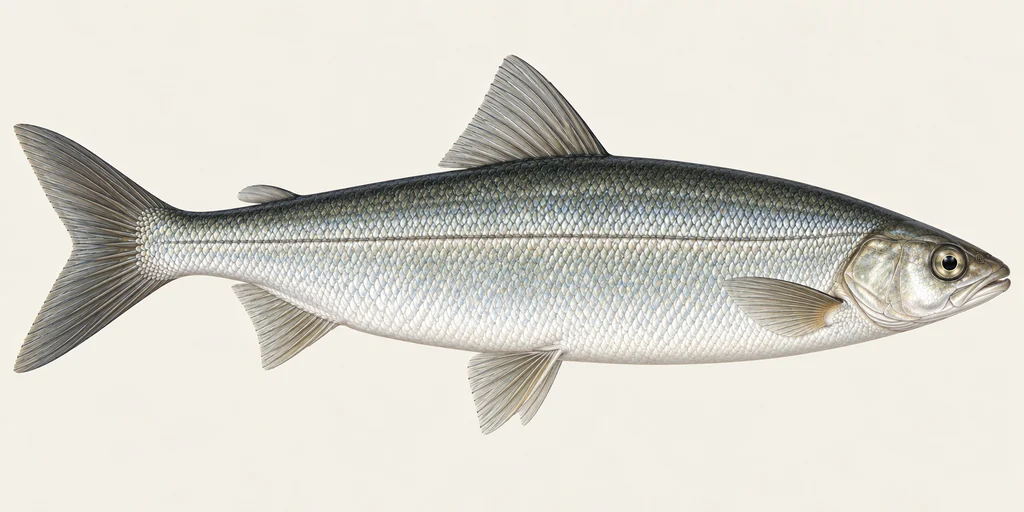
- Small adipose fin between the dorsal fin and the tail fin
- Small head with a large eye and a small gape, terminal or inferior
- Deeply forked tail fin
Catch chances through the year
- Hardly any chance
- Possible
- Good
- Peak season
- Spawning (observe the closed season)
Editorial assessment for waters in Germany, not a measured value and no guarantee. Spawning time is not the same as the legal closed season.
Species profile and sources in the catch calendarAll species compared month by monthThe rules of your federal state
How to recognise it
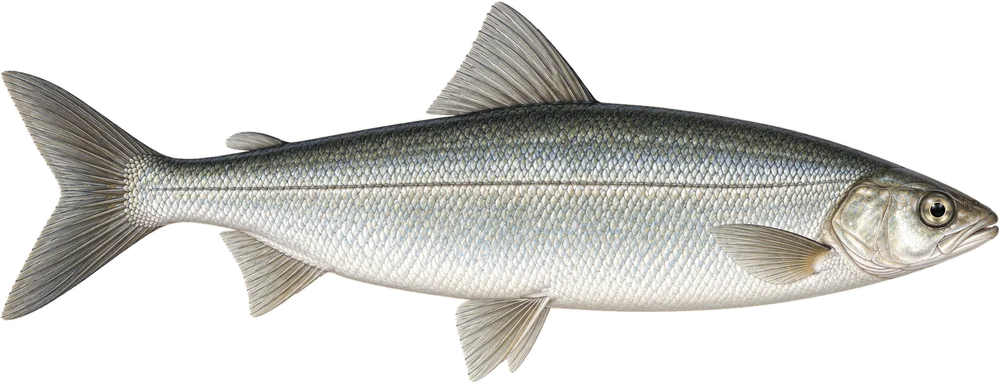
Whitefish look similar to herring: elongated, flattened from the sides, the back bluish-green to dark green, the flanks and belly silvery white. The head is small, the eye large and the tail fin deeply forked. The small adipose fin shows that they are salmonids.
Their species and forms can hardly be told apart from the outside. Experts count the gill rakers (Kiemenreusendornen), the projections on the gill arches with which the fish sieve food from the water. Pelagic whitefish have many slender ones, bottom-dwelling whitefish fewer and shorter ones. The teeth are small and reduced.
The Landesfischereiverband Bayern gives 25 to 45 centimetres on average, 70 at most. Austrian sources give 30 to 50 centimetres, in nutrient-rich lakes with fast growth up to about 6 kilograms. FishBase lists 73 centimetres and 10 kilograms as maximum values for Coregonus lavaretus. The names change with the region: in Bavaria the fish is called Renke, in Baden-Württemberg Felchen, in Austria Reinanke. Around Bregenz it even carries six different names depending on its age, from Heuerling to Dreier.
The vendace (Coregonus albula) is a species in its own right. It stays smaller, usually about 20 centimetres according to FishBase with a maximum of 48 centimetres, and feeds on planktonic crustaceans. Among cyprinids in a shoal you recognise whitefish by the adipose fin.
Within the genus, reliable identification is a matter for experts: the classification is difficult, there are transitional forms and naturalised alien forms, and many scientific names are used in parallel and in part wrongly.
Side by side
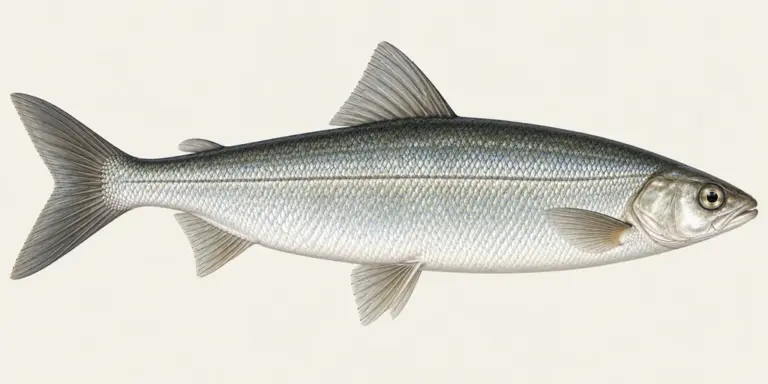
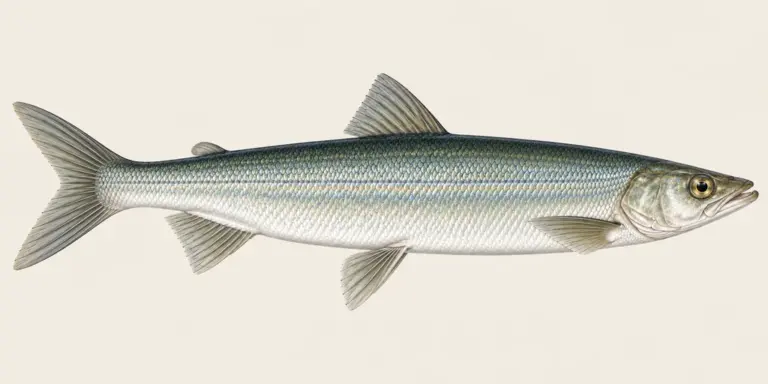
AI-generated illustrations.
Where it lives
Sedentary whitefish live mainly in larger, clear, nutrient-poor lakes of the Alps and the Alpine foothills. The genus is regarded as a relic of the Ice Age and is a thoroughly cold-water fish. FishBase gives 4 to 16 °C for Coregonus lavaretus. There are also migratory forms that run up rivers to spawn. According to the BfN, the original habitat of the houting (Schnäpel) included the North Sea coast and the Wadden Sea; in German waters it has survived only in the Peene-Oder area on the Baltic. For the North Sea it is considered extinct or missing according to the Red List.
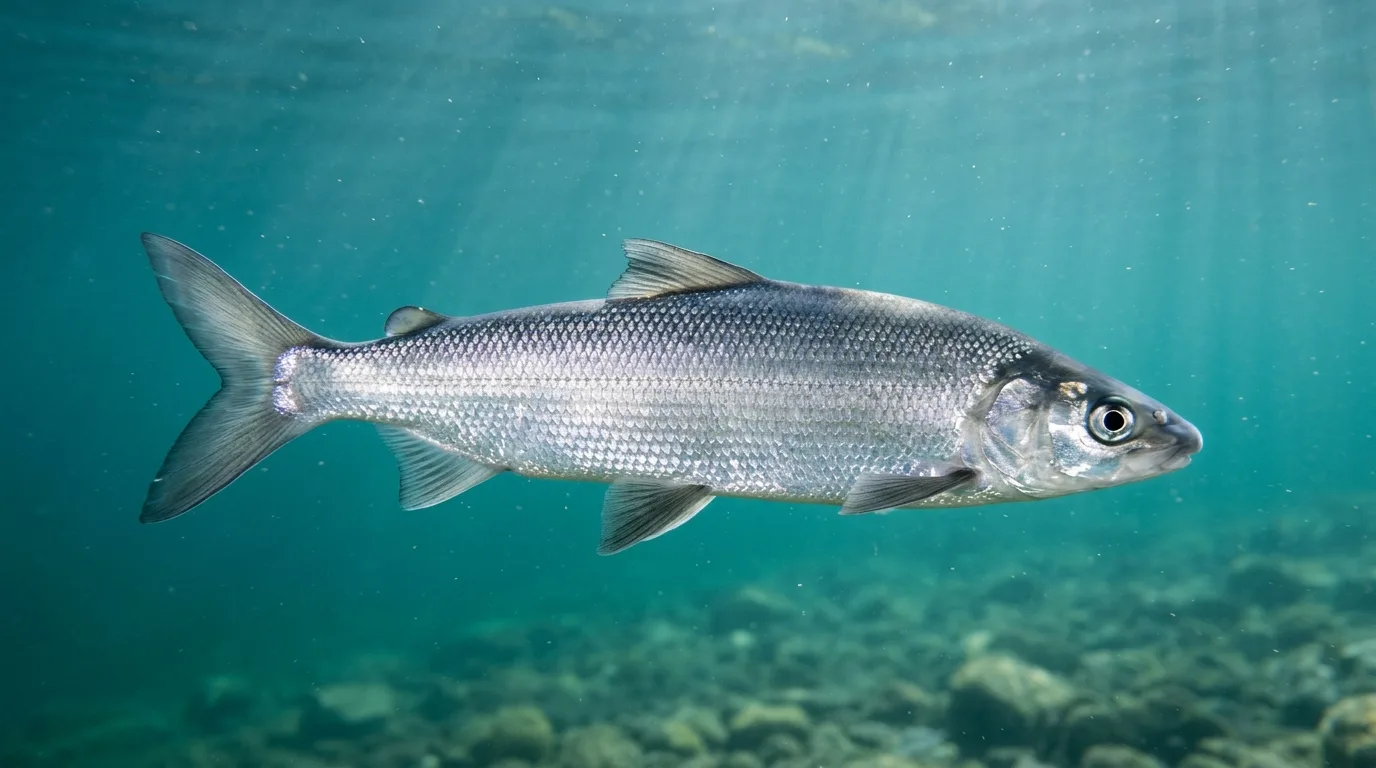
Pelagic whitefish travel in shoals through open water. According to Blinker they usually feed at a depth of 15 to 22 metres, sometimes deeper, preferably over hard bottom. Bottom-dwelling whitefish stand deeper still, up to 150 metres according to Blinker, preferably at cold springs. The layers in the water are easy to see on the echo sounder: the fish often stand in several layers one above the other.
Your water is therefore the lake. More about this type of water is under fishing on lakes.
Holding spots in the picture
Choose the season and time of day: the picture shows where the species stands then. Spots outlined in red apply only in the chosen season. Tap a fish or a spot in the list to bring it closer. The picture is schematic and AI-generated, every water is different.
Chance of a catch in springgood
Catch chance in summerPeak season
Catch chance in autumnpossible
Catch chance in winterslimSpawning, observe closed seasons
- J
- F
- M
- A
- M
- J
- J
- A
- S
- O
- N
- D
Spawning season
Active time Whitefish of deep lakes rise at evening dusk and sink again at morning dawn. This does not apply to every lake: in Lake Constance the depth changed only slightly between day and night.
Not a prime time Whitefish of deep lakes rise at evening dusk and sink again at morning dawn. This does not apply to every lake: in Lake Constance the depth changed only slightly between day and night.
In the lake
Deep bottom
Whitefish are present here all year.
Open water
Whitefish are present here only in spring, summer and autumn.
Just below the surface
Whitefish are present here only in spring.
Pelagic whitefish travel in shoals through the open water of larger, clear, cool lakes. They avoid the warm surface layer. Bottom-dwelling whitefish live near the bottom and feed on small bottom-living animals.
Spring: according to the catch calendar, chances of a catch are possible in March, good in April and peak season in May. At the start of the warm season the open-water whitefish of Lake Constance stand near the surface, around April and May. On individual lakes fishing is worthwhile just after the ice melts. On the Sauerland reservoirs, by contrast, the whitefish still stood very deep in March and April and only bit well in May as the temperature rose.
Summer: according to the catch calendar, peak season in June and July, good in August. With temperature stratification the shoals move deeper and stay in the thermocline zone, which lies between 5 and 20 metres. June and July are considered good months.
Autumn: according to the catch calendar, chances are good in September, possible in October and slim in November. In Lake Constance the whitefish gathered at depths of 20 to 30 metres in November.
Winter: according to the catch calendar, chances are slim in December and January and possible in February. Spawning falls in this period, so observe the closed seasons (Schonzeiten). In winter the whitefish stand just above the bottom. They spawn from November to January in open water or over sandy and stony ground close to the shore, and the species is protected in many places at that time.
Depth: Pelagic whitefish usually feed at 15 to 22 metres, bottom-dwelling whitefish stand deeper. In Lake Constance the whitefish travel in shoals by day, and at night the shoals break up; the depth changes only slightly.
Size comparison: AI-generated drawing, schematic.
How it feeds and spawns
Pelagic whitefish filter planktonic animals out of the water with their gill rakers. Bottom-dwelling whitefish eat planktonic crustaceans, ostracods, freshwater shrimps, water lice, worms, insect larvae, small snails, mussels and occasionally young fish. Fish eggs and small fish are also on the menu. The depth of the shoals follows the zooplankton.
Spawning takes place in winter. It begins at water temperatures below 7 °C, in the Alpine lakes from November to January. The fish spawn in open water, over sand and rubble near the shore, or in inflowing streams. The eggs sink to the bottom, at a good 30.000 eggs per kilogram of female. The larvae hatch after two to four months, depending on temperature. At spawning time the males carry a distinct spawning rash.
According to the BfN, the houting (Schnäpel) ran up the rivers mainly in autumn and winter, and spawning falls mainly in November and December.
When it bites
Blinker names June and July as the best time for whitefish angling, when the shoals are easy to find. The window shifts from lake to lake: for the Schliersee, Fisch & Fang gives March to early June and then September again; on the reservoirs of the Sauerland the whitefish bite well from May. On some lakes it is also worth starting after the ice melts, sometimes even from the bank. Commercial fishing runs roughly from April to October.
In spring whitefish occasionally also take maggots, worms or grasshoppers. In late autumn and winter the fish spawn. Whether a closed season (Schonzeit) applies on your lake then is stated in the fishing permit (Erlaubnisschein). Where fishing is allowed in late winter, the whitefish stand just above the bottom. Blinker then advises a short hegene rig of about 1,30 metres at most and dark nymphs in black, brown or dark violet.
Today’s catch index needs JavaScript. Season and spawning time are in the catch calendar.
You will find the monthly overview of all species and the water temperature check in the catch calendar.
What to catch it with
Step by step: Fishing for whitefish: tips on bait, rig and tackle – season, swims, baits, tackle and rules on one page.
The most important tackle is the hegene rig, a hooklength with three to five short side arms, small nymphs and a weight of 10 to 20 grams at the end. It resembles the side-arm rig. The side arms are at least 10 centimetres long and tied from 0,18 or 0,20 line; the hooklength at 0,15 millimetres is inconspicuous. The rod needs a soft tip and, with three side arms, a good two metres in length, with five arms over three metres. On holiday a very light spinning rod of 5 to 15 grams will also do.
You usually fish the hegene rig vertically from an anchored boat; it counts as bottom fishing because every round begins at the bottom. Let the weight sink to the bottom, raise and lower the rod evenly and, after a few strokes, wind up a few metres higher. Count the turns of the reel as you do so. If a whitefish then bites, you know the height of the shoal for the next cast. The nymphs are used in many colours; the lowest one should be red when fishing just above the bottom. A maggot on the nymph often increases the catch.
Whitefish are shy. Line that is too heavy scares them off, and they spit out the bait at once if the strike does not come in a flash. From the bank you offer the hegene rig on a sliding float, but that reduces bait presentation and the number of bites you convert. With a float or ledger rig you need fine tackle: hooklength 0,15, hook size 14 and a bite indicator offering hardly any resistance (float fishing, maggots and larvae).
Sometimes, especially in northern German waters, whitefish snap at small pilkers or spinners, mostly as bycatch when perch fishing. Do not aim for it. If you have a whitefish on the hook, play it calmly and land it safely, see landing and unhooking a fish.
Find the shoal: Look for the fish with the echo sounder, watch for the nets of commercial fishermen or for pike anglers trolling in open water: whitefish often stand packed close together there.
Remember the height: Count the turns of the reel as you wind up. After the first bite you know the depth of the shoal and can work the hegene rig exactly there.
Stay fine: Choose thin, inconspicuous line, also for the hooklength. Whitefish see a thick, vertical hooklength as a threat.
Suitable lures
Hegene rig with small nymphs, in spring also maggot or worm on a fine rig.
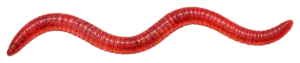
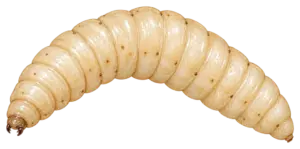
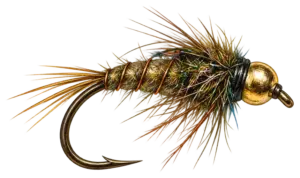
AI-generated illustrations. A click opens the lure’s page.
Rigs for these lures: float rig, running ledger rig.
What whitefish tastes like and what to do with it
The flesh of whitefish is white and firm and has a strong flavour. Smoked, it was already regarded as a delicacy in the Middle Ages. How to prepare the fish is explained under gutting a fish, filleting a fish and smoking a fish. Take only what is permitted and of legal size.
What you need to observe
Many whitefish are considered threatened; some forms are extinct or occur in only one lake district. The North Sea houting (Nordseeschnäpel) is listed in Annexes II and IV of the Habitats Directive (FFH-Richtlinie) and is considered extinct or missing in Germany according to the Red List.
Closed seasons (Schonzeit), minimum sizes (Mindestmaß) and harvest windows are set by the federal states (Bundesland), and on many waters additionally by the club or leaseholder. They differ depending on the water and the time of year. We give figures only with a date and a source; always binding are the fisheries regulation of your federal state and your fishing permit (Erlaubnisschein). You will find a list of links to the official sources in the catch calendar.
A fish of legal size that you want to keep you stun and kill immediately, in line with animal welfare (stunning and killing a fish). Protected fish, undersized fish or fish too large under a harvest window you unhook if possible in the water and with wet hands, and release gently (releasing a fish).
What closed season, minimum size and harvest slot mean and where to find them is explained on the page Closed season and minimum size explained.
What state law says about the closed season (Schonzeit) and minimum size (Mindestmaß) for this species is in the “At a glance” box on the state pages for Baden-Württemberg, Bavaria and Mecklenburg-Western Pomerania. For the other states our overview does not list this species; there the state fisheries regulation (Landesfischereiverordnung) is decisive.
Frequently asked questions (FAQ)
Are Maräne, Renke and Felchen the same fish?
They are regional names for fish of the genus Coregonus. Behind them stand many local forms and species that can hardly be told apart from the outside.
At what depth do whitefish stand?
Pelagic whitefish usually feed at 15 to 22 metres, sometimes deeper. Bottom-dwelling whitefish stand deeper still, up to 150 metres according to Blinker. The echo sounder shows you the layer in which the shoal is standing at the moment.
Is the vendace a young whitefish?
No. It is a species in its own right, stays small (usually about 20 centimetres, 48 at most) and feeds on planktonic crustaceans.
Sources
The rating of catch chances is an editorial assessment. The facts come from these sources, and the text is worded in our own words. The illustration is an original design by Angel Momente in the style of a natural history plate (AI-generated, see the AI notice).
- Landesfischereiverband Bayern: Fischlexikon (Laichzeit, Lebensraum, Nahrung, Aktivität)
- BMLUK Österreich: Reinanke (traditionelle Lebensmittel; Namen, Formen, Fortpflanzung, Nahrung, Fischerei)
- Blinker: Steckbrief Renke (Fresstiefe, Saison, Hegene)
- FishBase: Coregonus lavaretus (Größe, Temperatur, Biologie, Laichen)
- FishBase: Coregonus albula (Höchstalter)
- Bundesamt für Naturschutz: Artenporträt Coregonus oxyrinchus, Schnäpel (FFH-Anhänge, Rote Liste, Lebensraum, Laichwanderung)
- LAWA-Projekt O 10.20 (Leibniz-IGB, 2021): Temperaturempfindlichkeiten der Fischgemeinschaften
- Blinker: Renkenangeln mit der Hegene (Standtiefe nach Jahreszeit, Sprungschicht)
- Fisch & Fang: Bayern, der Schliersee (Renken: Fangzeiten März bis Anfang Juni und September, Hegene)
- Fisch & Fang: Renkensaison im Sauerland (Renken im März und April noch tief, ab Mai gut, Hegene)
- Wikipedia: Kleine Maräne (Coregonus albula)
- Universität Konstanz / IBKF (Eckmann 2010): Hydroakustische Untersuchung der Horizontal- und Vertikalverteilung der pelagischen Felchen im Bodensee-Obersee
- Aqua & Gas 7+8/2023 (Projekt SeeWandel): Felchen im Bodensee, gestern, heute, morgen
- Mehner 2012 (Leibniz-IGB), Freshwater Biology 57: Diel vertical migration of freshwater fishes (Vertikalwanderung der Coregonen, Auslöser, Fressphasen)
Created with AI support from the sources listed. Figures only appear in the text if a source gives them. Last updated: 27 October 2026. Found a mistake? Write to us. Who is behind this site: About me.
More in the lexicon
- All fish species at a glance
- Catch calendar – month, water temperature and profile for 93 species
- Line calculator – breaking strain after the knot, drag guideline, backing
- Angling methods