
Knowledge · Kitchen and use
Smoking fish
To smoke fish, you salt it, let it dry on the surface and hang it in the smoke of smouldering wood. In hot smoking the heat cooks it, in cold smoking it does not. Whether hot-smoked fish is done is shown more reliably by a thermometer in the thickest part than by the clock.
Hot smoking and cold smoking
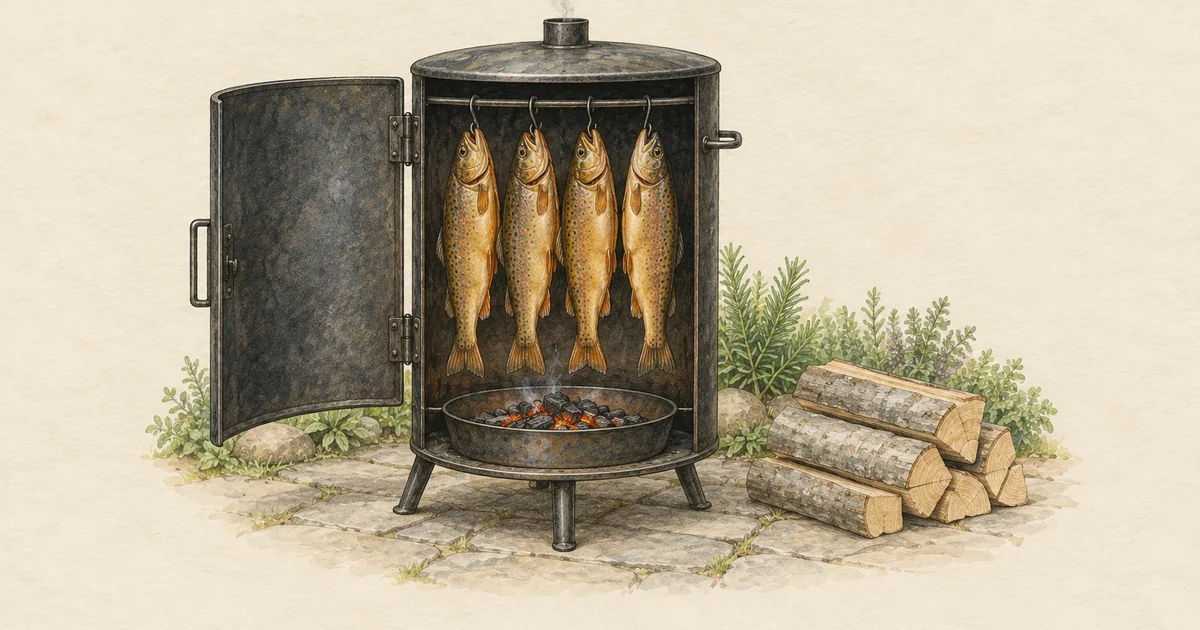
According to the Leitsätze für Fisch und Fischerzeugnisse (German guidelines for fish and fish products), smoked fish products are made by a combination of salting, drying, smoking and, where necessary, heating. In hot smoking, drying, heating and smoking follow one another in a single chamber until the muscle protein has fully coagulated. In cold smoking the protein does not coagulate, or only partially. The flesh stays soft and elastic.
The guidelines do not give temperatures for smoking. The values in the table come from the Bundeszentrum für Ernährung (BZfE) and from angling magazines.
| Feature | Hot smoking | Cold smoking |
|---|---|---|
| Temperature | Cooking at around 90 °C, then smoke, depending on the source 40 to over 60 °C | at most 30 °C |
| Duration | depending on the source one to many hours | longer, salmon fillets about eight hours |
| Fish flesh | cooked through and firm | not cooked, soft and elastic |
| Germs | most are killed by the heat | are not killed by heat |
Which fish are suitable
Oily fish is considered particularly suitable. The flesh of the eel is fatty, which is why, according to the Thünen-Institut, around 80 per cent of eels in Germany are sold smoked. The Bundesamt für Verbraucherschutz und Lebensmittelsicherheit (BVL) also counts herring and mackerel among the oily fish. BZfE names mackerel, halibut, trout and salmon as fish for hot smoke. For anglers, trout means rainbow trout, for example from a trout pond, or brown trout. Whitefish are also eaten smoked (Wikipedia: Coregonus).
Lean species such as pike, zander and perch can also be smoked. The magazine Blinker advises eating them while still warm, because the flesh becomes firm once it has cooled. With silver fish such as roach or bream, the bones are a nuisance, above all in cooled fish.
Closed seasons, minimum sizes and fishing restrictions are regulated by your federal state, more under Closed seasons and minimum sizes explained.
Hot smoking in five steps
The figures are guideline values from angling magazines. They differ from one another, which is why they are shown side by side.
- Gut and clean. Gutted, cleaned fish go into the brine, see Gutting fish.
- Salting. In brine, a salt solution, the salt spreads more evenly than when sprinkled on. How much salt goes into a litre and how long the fish stays in it is explained in the section “Making the brine”. Raw fish stays in the fridge throughout.
- Rinse and dry. After the salt bath you wash the fish briefly, rub them dry and thread them on smoking hooks. Then they dry in the air or in the open oven until the skin feels dry. According to Blinker, eels hung in the smoke while still damp turn dark instead of golden yellow.
- Cook. The oven is heated up slowly. Blinker gives about 90 degrees and, as a rule of thumb, half an hour; Rute & Rolle gives 90 to 100 degrees.
- Smoke. Smoking sawdust, that is, fine wood shavings, now lies on the embers or in a tray above them. Air inlet and vent are closed. The wood should smoulder, not burn. Rute & Rolle smokes at 60 degrees. Blinker keeps the temperature below 50 degrees, ideally at about 40, and leaves the fish in the smoke for half an hour to three hours. They are already cooked by this point; the longer smoking time only makes the flavour stronger.
For hot dishes the Federal Institute for Risk Assessment (BfR) generally names two ways: keep them at no less than 60 degrees, or cool them to below 7 degrees within a few hours. Germs can multiply between 10 and 60 degrees. So do not leave the fish hanging in lukewarm smoke longer than necessary, and cool it quickly afterwards.
Doneness check
According to the BfR, fish is done as soon as the flesh no longer looks glassy and separates easily with a fork. Blinker names two signs on a whole fish: the eyes are white, and the dorsal fin pulls out easily. A probe thermometer in the thickest part measures more precisely. The BfR gives at least 70 degrees for at least two minutes.
Making the brine
The salt content of a brine is given in per cent by mass. That is the mass fraction (Spektrum Lexikon der Chemie) times 100, so here grams of salt divided by grams of salt plus grams of water. A litre of water weighs about one kilogram, so for p per cent: salt in grams = 1000 × p ÷ (100 − p). The first two columns are calculation; the third places the amounts from the instructions. Blinker gives 60 grams per litre as the lower limit, which is 5,7 per cent.
| Salinity | Salt per litre of water | In the instructions |
|---|---|---|
| 3 % | 31 g | not stated |
| 5 % | 53 g | Fisch & Fang: 50 to 55 g, i.e. 4,8 to 5,2 % |
| 8 % | 87 g | Blinker, oily species: 80 to 100 g, i.e. 7,4 to 9,1 % |
| 10 % | 111 g | Blinker calls 100 g “ten per cent”; by calculation it is 9,1 % |
The times depend on the salt content and the thickness of the fish. All figures are guide values from angling magazines; no official instructions with figures could be found:
- Whole fish: eight to ten hours at 50 to 55 grams (Fisch & Fang), eight to twelve hours at a minimum of 60 grams (Blinker).
- Eel: 80 grams per litre, at least twelve hours, about one litre of water per kilogram of eel (Blinker).
- Fillets: one hour at 100 grams, very thick fillets about an hour and a half (Blinker).
- Quick salting: in a saturated brine, in which no more salt dissolves, about two hours are enough according to Blinker. Thick, large fish are then salted unevenly.
Dry salting, that is sprinkling with salt, is quicker. Fisch & Fang warns that thin belly flaps become too salty and thick back portions too bland, and that the salt draws juice out of the fish. Blinker considers it suitable for fillets because they leach out in brine, but mentions a higher risk of salting incorrectly.
Brine and fish stay cool. The BfR gives a maximum of 7 degrees for the fridge, preferably below 5. Blinker assumes a cool place at about ten degrees for eel, which is higher: stick to the BfR value. After the bath the fish are briefly rinsed in cold water and patted dry; on eels the slime loosens and can be stripped off under running water (Fisch & Fang).
Wood, smoke and drip tray
The smoke comes from smouldering wood shavings, often of beech or alder (BZfE). Blinker recommends hard deciduous woods, above all beech, and fruit woods as well. According to it, softwood and resinous wood are not suitable. Use only untreated wood. For the production of smoke flavourings, EU Regulation No 2065/2003 requires this so that no toxic substances form when it burns. Varnished, impregnated or glued wood therefore does not belong in the oven.
Smoked foods can contain polycyclic aromatic hydrocarbons, PAHs for short. BfR calls them carcinogenic. When grilling, more of them form when fat drips onto the embers, and the longer the food stays in the smoke, the more is deposited. In a smoker the drip tray catches the fat (Fig. 1). The guidelines list tar stains, visible soot particles and a tarry taste as processing faults. The right result is a golden-yellow to golden-brown surface.
Listeria, parasites and risk groups
Listeria are bacteria that can cause serious infections. They do not spoil the fish, and you cannot see or smell them (BfR leaflet). According to BfR, both cold- and hot-smoked fish are often contaminated. In official tests from 2007 to 2017, 7 to 18 per cent of samples of cold-smoked or cured fish contained Listeria monocytogenes; for hot-smoked fish it was 3 to 9 per cent. Heat kills the germs. Afterwards they can get back onto the fish during handling, for example via hands, knives and work surfaces.
For risk groups: BfR advises pregnant women, older people and people with a weakened immune system to avoid raw, smoked and cured fish products and to eat fish only when well heated through. That applies to cold-smoked and hot-smoked fish. This text does not replace medical advice.
In cold smoking there is no heat. Germs are not killed during production, so shelf life depends all the more on the salt (Max Rubner-Institut). For parasites the position is this: according to LAVES Niedersachsen, roundworm larvae die from freezing temperatures or from heat. Neither is present in cold smoke. Businesses must freeze fish that is eaten raw or almost raw for at least 24 hours at minus 20 degrees. LAVES advises against eating raw or almost raw fish you have caught yourself if it has not been frozen through sufficiently. For home use, LAVES gives at least 24 hours at minus 20 degrees for sea fish and at least one week for freshwater fish (LAVES). More on this: Parasites in fish.
Salt, cooling and vacuum: hygiene by the numbers
The salt content of the brine describes the bath, not the fish. In the Max Rubner-Institut project, commercial cold-smoked salmon contained 3 per cent salt. Salt slows listeria down but does not stop them: according to the BfR they multiply between minus 0,4 and 45 degrees, and only a little or not at all in very salty foods.
- According to the BfR, fish that is to be preserved by salting and drying should be gutted completely soon after the catch and washed thoroughly inside and out. If it lies in salt for several days, it must stay chilled.
- If listeria get onto the fish after smoking, they multiply more easily, because the heat has killed off the other bacteria (BfR). So handle it only with freshly washed hands, and the board you used for gutting is off limits.
- The LAVES calls vacuum-packed smoked fish a food with a particular risk of botulism. Without oxygen the pathogen can grow and form toxin, and the only way to prevent this is chilling at 7 degrees at most. Smelling does not help, because some strains do not change the smell (BfR).
According to the LAVES, problems swallowing, speaking or seeing after eating can point to botulism. Anyone affected needs medical treatment immediately. This text does not replace medical advice.
Storage and shelf life
Smoked fish belongs in the fridge (BZfE). BVL gives about two days for cooked or smoked fish. Store it covered (BfR). Cold does not make contaminated fish safe: listeria also keep multiplying slowly at fridge temperature and can survive deep freezing.
The Verbraucherzentrale describes spoiled smoked fish like this: the colour fades, it smells sharply fishy and the surface turns slimy. On the cold chain before smoking: Storage and hygiene.
Fire safety and neighbours
An oven with embers belongs outdoors. BfR calls charcoal grilling indoors, including in garages, life-threatening because glowing charcoal releases a lot of carbon monoxide. The Berlin fire brigade gives rules for the barbecue that can be applied to a smoker:
- A fixed spot, with distance from flammable material.
- Watch the wind direction so that neither sparks nor embers are blown about.
- Keep an eye on the oven, and have a fire blanket, a bucket of sand or a powder extinguisher ready.
- No accelerants such as petrol or methylated spirits.
- Dispose of charcoal only when it has cooled completely.
Under § 906 BGB, a neighbour cannot prohibit smoke and smells as long as they do not affect the use of his property at all or only insignificantly. Where that line lies is decided case by case. Rules of the municipality, the landlord or a garden code may also apply. Ask beforehand and tell your neighbours.
Frequently asked questions
What temperature does the oven need for hot smoking?
For cooking, Blinker and Rute & Rolle give 90 to 100 degrees, and for the smoking phase, depending on the source, 40 to over 60 degrees. For safety the temperature inside the fish counts: BfR gives at least 70 degrees for two minutes.
How much salt goes into the brine for smoking?
The angling magazines give 50 to 100 grams of salt per litre of water, which is around 4,8 to 9,1 per cent. Oily fish such as eel tend to get the higher amounts. The table above converts per cent into grams.
How long does fish you have smoked yourself keep?
BVL gives about two days in the fridge. Store it covered at no more than 7 degrees. If it smells sharp or the surface is slimy, throw it away.
Can pregnant women eat smoked fish?
The BfR advises pregnant women to eat smoked fish products only if they have reached at least 70 degrees in the core immediately beforehand. That includes smoked trout and smoked mackerel. If you have questions, your doctor or midwife can help.
Related
- Gutting fish: belly cut, kidney and gills
- Scaling and skinning fish: removing scales and skin
- Filleting fish: cutting fillets for cold smoking
- Storage and hygiene: cold chain from the catch to the fridge
- Tabletop smoker: hot-smoke trout and fillets in small batches
- Smokehouse: smoke larger catches in a cabinet or barrel
- Catch calendar: when each species is good to catch
Sources
- BfR: Unsichtbare Gefahr: Listerien in Räucherfisch (belastete Proben, Risikogruppen)
- BfR: Verbrauchertipps: Schutz vor Lebensmittelinfektionen mit Listerien (Risikogruppen, Kühlschrank, Kälte)
- BfR: Verbrauchertipps: Schutz vor Lebensmittelinfektionen im Privathaushalt (Garprobe, 70 Grad, Heißhalten, Abkühlen)
- BfR: Bedenkenlos Grillen – so lassen sich gesundheitliche Risiken minimieren (PAK, Kohlenmonoxid)
- BfR: Schutz vor Botulismus durch Lebensmittel (Sporen, Geruch, gesalzene Fische)
- LAVES Niedersachsen: Clostridium botulinum (Vakuum, 7 Grad, Symptome)
- Deutsche Lebensmittelbuch-Kommission: Leitsätze für Fisch und Fischerzeugnisse (Verfahren, Verarbeitungsfehler)
- BZfE: Fisch und Meeresfrüchte: Vom Fang in den Handel (Temperaturen, Holz, Kühlung)
- BVL: Hygienischer Umgang mit Fisch (Haltbarkeit, Fettfische)
- LAVES Niedersachsen: Parasiten in Fischen und Fischereierzeugnissen – ein Problem? (Parasiten, Einfrieren)
- Max Rubner-Institut: Salzreduktion in Fischprodukten (Salz und Keime beim Kalträuchern)
- Thünen-Institut, Fischbestände Online: Aal, europäischer (Räucheraal)
- Verbraucherzentrale: Fisch: Alles zu Haltbarkeit und Lagerung (Zeichen für Verderb)
- Spektrum Lexikon der Chemie: Zusammensetzungsgrößen (Massenanteil, Masseprozent)
- Verordnung (EG) Nr. 2065/2003 über Raucharomen (unbehandeltes Holz, PAK)
- Blinker: Fisch räuchern: In 4 Schritten zum Räucherprofi (Richtwerte, Holz, Fischarten, Lake, Trockensalzen)
- Blinker: Aal räuchern (Trocknen, Räuchermehl, Lake für Aal)
- Blinker: Fit für den Forellensee: Stremellachs wie vom Profi! (Lake und Zeit für Filets)
- Fisch & Fang: Nass-Salzen vor dem Räuchern ist sicherer (Lake, Trockensalzen, Schleim)
- Rute & Rolle: Räucher-Special: Holz oder Gas? (Temperaturen)
- Berliner Feuerwehr: Grillen (Brandschutz)
- Bürgerliches Gesetzbuch, § 906 (Rauch vom Nachbargrundstück)
- Wikipedia: Coregonus (Maränen als Räucherfisch)
Text AI-assisted, drawing AI-generated. Sources opened and checked in October and November 2026, no graphics taken from the sources.
All details are guidelines and given without guarantee. The advice of food inspection and BfR is what counts; the text is no substitute for medical advice.