
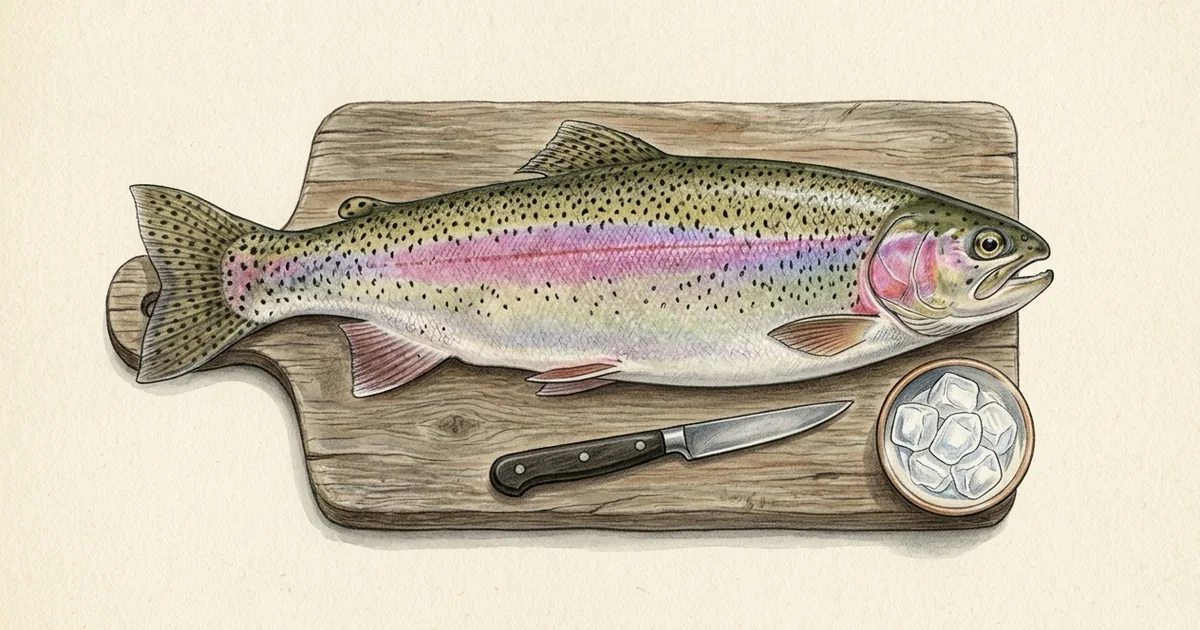
Knowledge · Kitchen and use
Gutting a fish
When gutting a fish you open the belly cavity, remove the innards, gills and kidney and rinse the fish briefly with drinking water. The page shows the belly cut step by step, how deep the knife may go, where the kidney sits and what is different for zander, wels catfish and eel.
Preparation and space
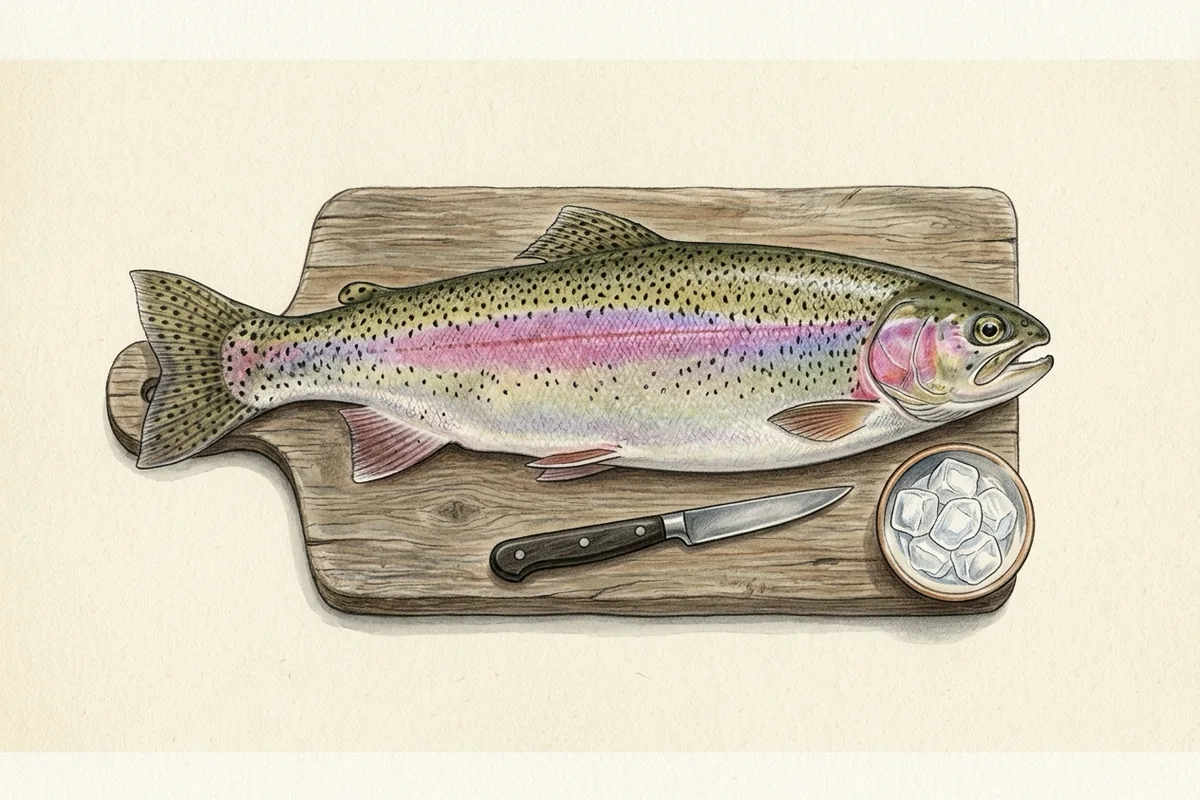
Only fish that may lawfully be taken and has been killed humanely is gutted (see Stunning and killing a fish). The learning portal of the Landesfischereiverband Bayern names a cut-proof surface and a washable table as the place to prepare it, ideally with running tap water. A small, sharp kitchen knife with one rounded side is enough there for a fish the size of a tench. According to the Bavarian exam questions, a short, rigid blade is suitable for slitting open the body cavity of cyprinids, pike and salmonids. You also need a spoon for the kidney and a sieve in the sink so that scales and scraps do not block the drain.
Whether you gut at the water depends on your club or leaseholder. The learning portal points out that most angling clubs forbid gutting directly at the water, and advises asking. Until then the catch stays cool: in the exam questions, for a carp caught on a summer morning the cool box with ice packs counts as the right choice, not the plastic bag in the shade and not the keepnet (Cool box and cool bag).
The belly cut step by step
- Start at the vent. The vent is the anal opening just in front of the anal fin. You insert the knife there and open the belly cavity towards the head.
- Cut shallow to the pectoral fins. According to LFV Baden-Württemberg, the cut runs from the vent to between the pectoral fins. For a tench, the learning portal gives the thickness of the belly wall of about a centimetre as the working depth and the spot between the pelvic fins as tricky: there is cartilage there that needs a little more pressure.
- Look inside. Watch for worm infestation and signs of disease. If the fish shows any, the learning portal advises asking an experienced angler and, if in doubt, discarding the fish (see Parasites in fish).
- Loosen the innards. Reach along the belly flaps with two fingers down to the spine. The organs then come out in one pull, according to the learning portal. You tear off or cut through the gullet and cut off the rectum from the inside at the vent.
- Scoop out the kidney. It is a dark red-brown organ beneath the spine. In small fish a fingernail is enough, in larger ones a spoon helps.
- Remove the gills. Cut through the gill arches at the top and bottom and pull them out with a finger. Most of the blood is in the gills, and blood spoils fastest, says the learning portal.
- Rinse out. Rinse the inside of the fish with clean tap water, only briefly. The BZfE advises rinsing fish gently and very briefly under a little cold water and patting it dry with kitchen paper.
Bile and gut: The knife must not hit the gall bladder (green in Fig. 1). The Bavarian exam questions name it as a risk of injury when preparing salmonids and cyprinids. If it is damaged, bitter bile leaks out according to the learning portal, and with the gut, intestinal bacteria reach the flesh.
With the cross-section in mind, you cut more safely. The belly wall is thin, and behind it lie the gut and the gall bladder. Above the body cavity sit the swim bladder, kidney and backbone. So you only reach the kidney with the spoon once the innards are out.
What is different in individual fish
| Fish | Special feature |
|---|---|
| Trout, pike, zander, wels catfish | Kidney covered by the swim bladder, scoop it out thoroughly |
| Zander | Swim bladder fused to the belly flanks, hard to detach |
| Wels catfish | Swim bladder grown fast to the spine behind the head, pull it off firmly |
| Eel | Open the belly wall beyond the vent, remove the kidney strand |
The first three rows come from the learning portal of the LFV Bayern, which calls the wels catfish Waller. For eel, the Bavarian exam questions require the belly wall to be slit open towards the rear beyond the vent so that the rear kidney extension can be removed. Kidneys and kidney strand must be removed completely according to the learning portal, otherwise the flesh turns bitter.
Blood of eel and wels catfish: The learning portal calls raw eel and Waller blood poisonous and advises never letting it get into open wounds, onto mucous membranes or into the eyes. If it touches you, wash it off thoroughly at once. From 70 degrees it is harmless according to the learning portal. More under Scaling and skinning a fish. The text does not replace medical advice.
Hygiene and time
Fish spoils quickly, especially in warmth. The learning portal states: stored damp at 20 degrees, bacteria multiply a hundredfold in six hours. It advises not storing the fish together with the innards and washing it only with clean drinking water, because there could be coli bacteria in the water of the fishing water. The exam questions see it the same way: after killing, the fish is not washed out in the water but cleaned with drinking water you brought and kept cool.
The sources do not answer in the same way how urgent gutting is. The teaching slides of the LFV Baden-Württemberg require gutting the fish immediately after killing. A dissertation at the Humboldt-Universität Berlin compared rainbow trout and zander on ice in 2003: with optimal storage, ungutted fish were hygienically safe and stayed equivalent in quality for several days. The bacterial load of the belly cavity was even higher with early gutting. This is not a free pass but a hint: cooling and clean working count, and the fishing permit (Erlaubnisschein) or water rules take priority.
Raw fish belongs apart from food that will not be heated again. According to the BVL, you clean hands, utensils and work surfaces thoroughly with hot water during and after preparation. The old 3-S rule (clean, sour, salt) no longer applies according to the BZfE. While gutting you also see how fresh the fish is: the BVL names moist, light red gills, glossy skin, a neutral smell and clear eyes as signs, the BfR bulging, deep black eyes. After that it goes into cooling (Storage and hygiene). The learning portal advises not leaving the fish in the plastic bag in the fridge but wrapping it in dry cloths or paper.
The same applies to freezing: gut first. Blinker names the innards as the cause of unpleasant taste and faster spoilage. For dried fish, the Lower Saxony state office LAVES advises using only gutted fish, because with ungutted ones it sees a considerable danger from botulism pathogens.
Common mistakes
- Cutting too deep: bile or gut spoil the flesh.
- Forgetting kidney and gills. The exam questions say both are well supplied with blood, spoil faster and impair the quality of the flesh.
- Washing the fish in the water or throwing innards into the water.
- Leaving the catch for a long time uncooled, in the sun or in a plastic bag.
- Throwing the organs away at once: in the stomach you see what the fish has just eaten, and the learning portal expressly recommends this.
Disposing of the scraps
The LFV Baden-Württemberg has the innards disposed of in household waste. In warm weather, the waste is frozen until collection according to the learning portal. In Bavaria, dead fish and parts of fish may not be put into a water, with exceptions for bait and feed fish (§ 21 AVBayFiG). What applies where you are is regulated by your federal state (Bundesland); if in doubt it is stated in the fishing permit (Fishing permit and water map).
Frequently asked questions
Do I really have to remove gills and kidney?
Yes. In the Bavarian exam questions it counts as correct that both are well supplied with blood, spoil faster and impair the quality of the flesh. In eel the flesh turns bitter according to the learning portal if kidney and kidney strand are left in.
May I wash the fish at the water?
Better not. According to the exam questions, you clean it with drinking water you brought and keep it cool. Whether you may gut at the water at all is governed by the club and the water rules.
Do I have to gut every fish?
A fish you want to use is gutted, including before freezing. Take only what you can use. When filleting, too, bile and gut contents should not touch the flesh.
How can I tell while gutting that the fish is fresh?
Look at the gills and eyes. According to the BVL, light red, moist gills and clear eyes indicate freshness. According to the BfR, the eyes of a fresh fish are bulging and deep black, those of one no longer edible are sunken and grey.
Related
- Stunning and killing a fish: what comes before gutting
- Scaling and skinning a fish: the work before the belly cut, with eel blood
- Filleting a fish: the cuts after gutting
- Parasites in fish: what may stand out in the belly cavity
- Storage and hygiene: chilling and freezing after gutting
- Cool box and cool bag: keeping the catch fresh until then
- Eel: the species with special treatment
- Zander: fish with a firmly attached swim bladder
Back to the kitchen and use overview.
Sources
- Landesfischereiverband Bayern, Lernportal: Betäuben und Schlachten (Ausnehmen, Besonderheiten je Art, Aal- und Wallerblut, Hygiene, Entsorgung)
- Landesfischereiverband Bayern, Lernportal: Fische versorgen (Schlachtplatz, Schnitttiefe, Organe, Niere, Kiemen)
- LfL Bayern: Staatliche Fischerprüfung, Prüfungsfragen 2023/2024 (Gallenblase, Kiemen und Niere, Klinge, Kühlbox, nicht im Gewässer auswaschen, Aal)
- Landesfischereiverband Baden-Württemberg: Gerätekunde, Arbeitsblätter zur Fischerprüfung (Ausweiden unmittelbar nach dem Töten, Bauchschnitt, Entsorgung im Hausmüll)
- Humboldt-Universität zu Berlin: Dissertation, Einfluss des Ausnehmens auf eisgelagerte Zander und Regenbogenforellen (Zeitpunkt des Ausnehmens, Bakterienlast)
- BVL: Hygienischer Umgang mit Fisch (Reinigen mit heißem Wasser, Trennung von Speisen, Zeichen der Frische)
- BZfE: Fisch, vom Einkauf in die Küche (kurzes Abspülen, überholte 3-S-Regel)
- BfR: Verbrauchertipps im Umgang mit Fisch (Augen als Frischezeichen)
- LAVES Niedersachsen: Ausführungshinweise Fischhygiene (Trockenfisch nur aus ausgenommenem Fisch)
- BLINKER: Sichere Fischverwertung, 10 Mythen aus der Fischküche (Einfrieren nur ausgenommen)
- Bayerische Ausführungsverordnung zum Fischereigesetz, § 21 (tote Fische und Fischteile nicht ins Gewässer)
Text AI-assisted, drawing AI-generated. Sources opened and checked in October 2026; no graphics taken from the sources.
All figures are guide values without guarantee. The fishing permit (Erlaubnisschein), the water rules and the instructions of the food inspection authorities are what count.