
Knowledge · Fish biology
Body structure and fins of fish
A fish’s body shape reveals how it lives: the form shows whether it holds in the current, pushes through weed or lies on the bottom. You can recognise whole families by their fins. Slime coat, gills and swim bladder all help determine how you handle and treat a fish.
Five body shapes and what they tell you
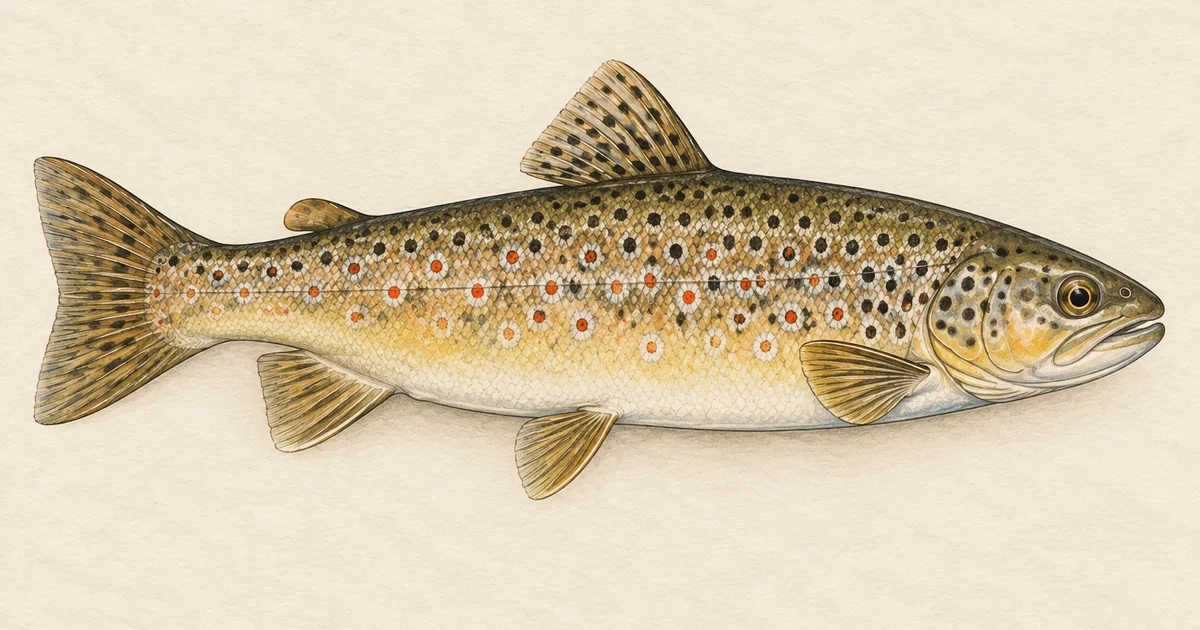
How a fish is built depends on where it lives and how it gets its food. Teaching material for the angling exam (Fischerprüfung) therefore distinguishes a few basic shapes (Aufbau und Funktion des Fischkörpers).
| Shape | Examples | Way of life |
|---|---|---|
| spindle-shaped | brown trout, salmon, zander | good swimmer in current and open water |
| deep-bodied | bream, silver bream, crucian carp | still water with many plants |
| arrow-shaped | Pike | lurks and strikes quickly |
| snake-shaped | Eel | lives on the bottom, swims long distances |
| flat | plaice, flounder | lies camouflaged on the bottom |
The spindle shape, also called torpedo shape, offers little resistance to the water. According to the Bavarian exam catalogue, fish that live in strong current generally have this shape (Landesanstalt für Landwirtschaft).
Deep-bodied fish are flattened from the sides. The narrow body fits through dense plant growth, and above a certain size a predator can no longer get hold of them.
In the pike the dorsal fin sits right at the back, just before the tail. Together with the anal and tail fins this gives, according to the Landesfischereiverband Bayern, a large surface that provides thrust at the start. This lets it strike from a standstill: it waits among the plants until prey swims past. In the sources its shape is also called torpedo-shaped or cylindrical.
With its long, round body the eel covers large distances without much effort. Flatfish are flattened sideways and lie on one side of the body, the blind side. Both eyes sit on the upper side (Lexikon der Biologie: Plattfische). The wels catfish and the bullhead are wedge-shaped: broad mouth, life on the bottom, hunting from ambush.
In the Identify a fish tool the body shape is the second question. Spindle- and arrow-shaped species are called „elongated“ there.
Fins: names and functions
Fish have paired and unpaired fins. The pectoral fins behind the gill cover and the pelvic fins are paired. They correspond to the limbs of land vertebrates (Kompaktlexikon der Biologie: Flossen) and serve mainly for steering. The dorsal, anal and tail fins are unpaired. Propulsion comes from the tail and tail fin, while the dorsal and anal fins keep the body stable.
For identification, three things are worth looking at.
- Number of dorsal fins: one in pike and bream, two in perch and zander, three in cod (Wikipedia: Atlantischer Kabeljau).
- Position of the pelvic fins: abdominal, behind the pectoral fins as in the ide, thoracic, far forward as in the perch, jugular, in front of the pectoral fins as in the burbot.
- Fin fringe: In the eel the dorsal, tail and anal fins are joined into one fringe, and it has no pelvic fins.
The adipose fin
Between the dorsal and tail fins, some species have a small, fleshy fin without rays, the adipose fin (Lexikon der Biologie: Fettflosse). It is typical of salmonids: trout, salmon, chars, huchen, grayling and whitefish. The brown bullhead also has one, the large wels catfish does not.
Hard and soft rays
Apart from the adipose fin, all fins are supported by rays. Hard rays, also called spiny rays, are unsegmented and in a fin always stand in front of the soft rays, which are also called segmented rays (Wikipedia: Flosse). In the perch the first dorsal fin carries only spiny rays, the second almost only soft rays. In the barbel the longest ray of the dorsal fin is hard and serrated at the back.
For species with spiny rays in the dorsal fin, the Bavarian catalogue warns of injuries that heal badly. Perch and zander also carry a spine on the gill cover.
Skin, scales and mucus
Scales are thin bony plates in the dermis, the lower layer of the skin. They overlap like roof tiles, and the thin epidermis lies over their free end (Lexikon der Biologie: Schuppen). What you touch is therefore never the bare scale. It is living skin with a layer of mucus on top.
Cyprinids, salmonids and the pike have smooth-edged round scales. Perch and zander have comb-edged scales with a toothed rear edge and therefore feel rough. The wels catfish has no scales. In the eel and tench very small scales sit under a thick layer of mucus. Scales grow with the fish and form rings, from which the age can be read. If it loses scales, it grows new ones.
The mucus is produced by gland cells of the epidermis. It reduces friction when swimming and protects against outside influences and pathogens.
Wet hands: The Ministry of Agriculture of Mecklenburg-Western Pomerania advises always handling fish with wet hands only, to avoid damage to the mucous membrane (Hinweise zur Einhaltung des Tierschutzes). The Bavarian exam catalogue gives the same reason: the fish’s skin should not be damaged. It calls mechanical injuries possible entry points for fungi, bacteria and viruses. The handling for this is explained under Landing a fish and unhooking it.
Gills and gill cover
Fish breathe with gills. The fish sucks water in through the mouth, closes it and presses the water out over the gills. On the thin-skinned gill filaments the blood takes up oxygen and gives off carbon dioxide. Water and blood flow in opposite directions, which makes better use of the oxygen (Kompaktlexikon der Biologie: Kiemen). If the fish needs more oxygen, the gill covers beat faster.
The gill cover is a bony plate that encloses the gill chamber. Underneath, according to the teaching material from Schwedt, four pairs of gill arches carry the filaments. On the inside of the arches sit the gill rakers, depending on the species a fine filter or coarse spines. The gills have a particularly rich blood supply. Anyone reaching in can injure the fish and themselves. The Bavarian catalogue names this danger for the pike, which is gripped by hand behind the head for landing. So do not hold a fish that is to go back by the gills.
When a fish is kept, stunning is followed by the heart cut or the gill cut. The procedure is described in Stunning and killing a fish.
Swim bladder and pressure from the depths
The swim bladder is a gas-filled sac between the gut and the spine. With it the fish adjusts its buoyancy and hovers without having to swim. Many bottom fish lack it, for example the flatfish and the bullhead. The mackerel does not have one either, although it swims constantly (Lexikon der Biologie: Fische).
There are two designs. In cyprinids, salmonids, pike, wels catfish and eel the bladder stays connected to the foregut by a duct, through which they can release gas. In perch-like fishes and cod-like fishes, which include the burbot, the duct regresses after the larval stage. They remove excess gas via the blood, and that takes time.
If you bring a fish up quickly from great depth, the outside pressure drops and the gas expands. If there isn’t enough time to equalise, the swim bladder pushes the foregut out of the mouth. This is called barotrauma, in German Trommelsucht (Lexikon der Biologie: Schwimmblase). In zander, according to the Schwedt training material, the bladder can inflate or burst.
For practice the magazine Blinker gives guide values: if perch and zander are cranked up quickly from more than 10 metres, they show pressure damage. Blinker therefore advises not to fish deeper than 10 metres for these species and to take breaks during the fight. From about 6 to 9 metres, immediate release usually causes hardly any problems (Blinker: Barotrauma bei Fischen). What is to be done with an undersized, visibly damaged fish is regulated by your federal state (Bundesland). A starting point is Closed season and minimum size explained.
Lateral line
The lateral line runs as a row of fine pores along the flank, and the scales there are perforated. Beneath it lies a canal with sensory cells. They register pressure changes, currents and the movements of prey. You can read more on the page Fish senses. For identification you count the scales along the lateral line: the chub has 44 to 46, the ide 55 to 60 (Sächsische Fischereibehörde).
Frequently asked questions
Which fish have an adipose fin?
Mainly the salmonids, that is trout, salmon, chars, huchen, grayling and whitefish, plus the brown bullhead. Cyprinids, perches, pike and the large wels catfish do not have one.
Do all fish have scales?
No. The wels catfish has no scales. Eel and tench do have scales, but they are very small and covered by a thick layer of slime.
What is barotrauma (Trommelsucht)?
If a fish is brought up quickly from great depth, the gas in the swim bladder expands and pushes it or the foregut out through the mouth. Species without a duct to the swim bladder, such as perch and zander, are especially prone to it.
Related
- Identify a fish: asks about body shape, dorsal fins, barbels and mouth position.
- Species trainer: practise recognising fish species from pictures.
- Fish: all profiles with identification features.
- Releasing a fish: when it is compulsory and how to do it gently.
- Gutting a fish: belly cut, removing the gills and kidney.
- Water temperature and oxygen: why warm water holds less oxygen.
- Hook injuries and first aid: a hook in the skin, the doctor and tetanus protection.
- Recognising fish families: which fins give away the family.
- Age and growth of fish: reading annual rings on the scales.
Sources
- Kreisanglerverband Schwedt: Aufbau und Funktion des Fischkörpers (Lehrmaterial: Körperformen, Flossen, Haut, Kiemen, Schwimmblase, Seitenlinie).
- Bayerische Landesanstalt für Landwirtschaft: Staatliche Fischerprüfung in Bayern, Prüfungsfragen (Flossen, Schuppen, Schleimschicht, Schwimmblase, Trommelsucht, nasse Hände).
- Landesfischereiverband Bayern: Fischlexikon (Merkmale der einzelnen Arten).
- Spektrum, Lexikon der Biologie: Fish, Flossen, Fettflosse, Schuppen, Schwimmblase, Plattfische; Kompaktlexikon der Biologie: Flossen, Kiemen (Bau und Aufgabe der Organe).
- Ministerium für Landwirtschaft und Umwelt Mecklenburg-Vorpommern: Angeln in MV, Hinweise zur Einhaltung des Tierschutzes (nasse Hände, Herzstich und Kiemenschnitt).
- Sächsische Fischereibehörde: Artenkunde, verwechselbare Fischarten (Schuppenzahl an der Seitenlinie).
- Blinker: Barotrauma bei Fischen (Richtwerte zur Angeltiefe).
- Wikipedia: Flosse, Atlantischer Kabeljau (Flossenstrahlen, Rückenflossen der Dorsche).
Text AI-assisted, drawing AI-generated. Sources opened and checked in October 2026; no graphics taken from the sources.
All information is indicative and given without guarantee. It does not replace medical advice, and what applies to the closed season (Schonzeit), minimum size (Mindestmaß) and releasing fish is set by your federal state (Bundesland) and your fishing permit (Erlaubnisschein).