
Knowledge – safety by the water
Hook injuries and first aid
A hook injury often begins with a puncture that hardly hurts and only becomes a problem because of the barb. This page sums up what aid organisations, the statutory accident insurance and the Robert Koch Institute say about it: what you do at the water, when to call 112 and what matters for tetanus protection.
In an emergency: 112 If the hook is in the eye or there is heavy bleeding, call 112 at once; otherwise do not move the hook, pad it softly and have it removed by a doctor.
Why a hook in the skin is different from a splinter
Blinker describes how the puncture itself often hurts less than you would expect. It gets difficult when the hook, barb and all, sits deep in the tissue: the barb blocks any movement backwards and holds it fast. Without the barb, according to Blinker, the point could be pulled out almost painlessly.
According to Blinker, the danger is particularly great when landing a fish by hand while a lure with several trebles (triple hooks) is still hanging in its mouth. If you grab wrongly or the fish thrashes, a hook ends up in your hand, and the remaining hooks in the fish’s mouth pull it deeper with every movement. Other anglers can also hit you: Blinker names crowding, inattention and alcohol as risks and advises keeping your distance.
For foreign bodies in wounds, the aid organisations share one principle. The DRK (German Red Cross) writes that only a doctor removes them, and points out that a foreign body sometimes even seals the wound. The statutory accident insurance (DGUV) explains in its first-aid handbook that pulling it out risks extra pain, damage to blood vessels and nerves, or heavy bleeding. This applies to small objects as well as larger ones.
Important: This page deliberately does not explain how to cut a hook out yourself, push it through or tear it out. The sources provide for removal by a doctor. The text is no substitute for medical advice.
First aid at the water until a doctor takes over
The following steps come from the first-aid guidance of the DRK, the Johanniter and the DGUV. They apply to a hook in the skin. For the eye and heavy bleeding, the next section applies.
- Sit or lie down. The Johanniter give this as a way of stabilising the circulation. Whoever helps keeps eye contact, to notice for instance if the person turns pale.
- Do not move anything. The DGUV requires that the foreign body is not moved when applying a dressing. A tug on the line, lure or rod would move the hook too.
- Leave the wound alone. According to the DGUV you do not touch it with your hands or rinse it, and without a doctor’s instruction no powder, ointment or disinfectant goes on it. The Johanniter say the same: do not touch the wound, do not rinse it.
- Pad and secure. A dressing that is as sterile as possible goes around the hook, extra padding if needed, then a bandage or plaster holds everything in place. That way the dressing cannot push the hook deeper (DRK, DGUV, Johanniter).
- Gloves for the helper. If there is bleeding, helpers wear disposable gloves to protect against infection, according to the DRK and the Johanniter.
- Then to a doctor or the hospital. Tell your companions so that you do not set off alone.
The Johanniter name a single exception to the principle: very small foreign bodies such as little stones, spines or thorns, provided they do not splinter. A fishing hook clearly does not fall under this, because its barb holds it in the tissue, according to Blinker.
Hook in the eye, heavy bleeding and the emergency call
The DRK advises calling the emergency number as soon as the situation stays unclear, you doubt the condition of the injured person or life is at risk. For heavy bleeding it gives 112 without qualification.
For foreign bodies in the eye, the DGUV says: do not rub, do not let laypeople remove anything, and take the person for treatment by an eye doctor or call the rescue service. For small particles such as dust it also describes a bandage over both eyes, because that is the only way to keep the eyes still, and the DRK too mentions the bandage over both eyes and the emergency call. Both texts mean foreign bodies in the eye in general, not hooks. If a hook is in or near the eye, call 112 at once and let the control centre guide you; according to the DRK it gives help over the phone where needed.
On the phone, the control centre asks specific questions. The DRK lists as the details to give: the place with access routes, what happened, how many people are affected and what injuries there are. You only hang up when the control centre ends the call.
| Time | What the sources recommend |
|---|---|
| Hook is in the skin | do not move, pad, bandage, have a doctor remove it (DRK, DGUV) |
| Hook in or near the eye | do not rub, do not remove anything, 112 (DGUV, DRK) |
| Heavy bleeding | always 112 (DRK) |
| Scratch, hook no longer in | have a doctor check your vaccination protection (RKI) |
At the doctor and afterwards
According to the DGUV, a foreign body secured in this way is normally removed professionally in hospital. The same source requires every wound to be shown to a doctor within six hours.
Blinker advises not to feel ashamed because of a hook: the emergency department is usually the least painful and safest solution, and doctors know how to help quickly. How the hook comes out is decided by the medical staff according to its position. Describe to the doctor what happened and bring your vaccination card.
Tetanus: check your vaccination protection
The tetanus bacterium lives as a spore in the soil. According to the RKI guide, it survives heat and disinfectants and persists in the ground for years if no sunlight reaches it. The spores often get under the skin together with foreign bodies, the wound does not have to be open, and even barely visible minor injuries can be dangerous. The DGUV likewise mentions inconspicuous, very small wounds if they are dirty.
According to the RKI, the incubation period is usually between 3 days and 3 weeks, but can range from one day to several months. For adults with a complete primary vaccination, the RKI gives a booster every 10 years, and by its evaluation only about half of adults received a tetanus vaccination in the ten years before.
For the case of an injury, the table in the RKI guide (as of 2018, based on STIKO) distinguishes two groups. Anyone who has had at least three vaccine doses gets a booster for a clean, minor wound if the last vaccination was 10 years or more ago. For deep or dirty wounds and when foreign bodies have penetrated, an interval of 5 years already applies. Anyone who has had fewer than three doses or does not know also gets tetanus immunoglobulin for these wounds. Whether your hook falls into the second group is for the doctor to decide.
If you cannot find your vaccination card, according to the RKI the vaccination can wait a few hours if you credibly state that you have had the primary vaccination and submit the proof later. The card should be available within 24 hours where possible; otherwise, with only two documented vaccinations, a combined vaccination would be necessary.
If a child is hurt by a hook
First, stay calm yourself. The DRK points out that panic and stress are passed on to the injured child. It advises kneeling down to the child’s eye level, speaking calmly and carefully making physical contact. A cuddly toy helps with comforting. After that, the same applies as for adults: do not pull the hook out, cover the area loosely and see a doctor.
For children and young people, the RKI says tetanus protection follows the vaccination schedule: primary immunisation in infancy, a booster at preschool age and another one between 9 and 16. So take the child’s vaccination record with you or photograph the page with the vaccinations beforehand. Then the doctor does not have to guess.
Best of all, it does not happen in the first place: with a fixed float and a single hook on the children’s rod, a child casts more calmly than with lures and trebles. The hook box stays with the adult, and nobody stands behind the child when casting. What children may do in your state is explained under Fishing with children.
First-aid kit and prevention
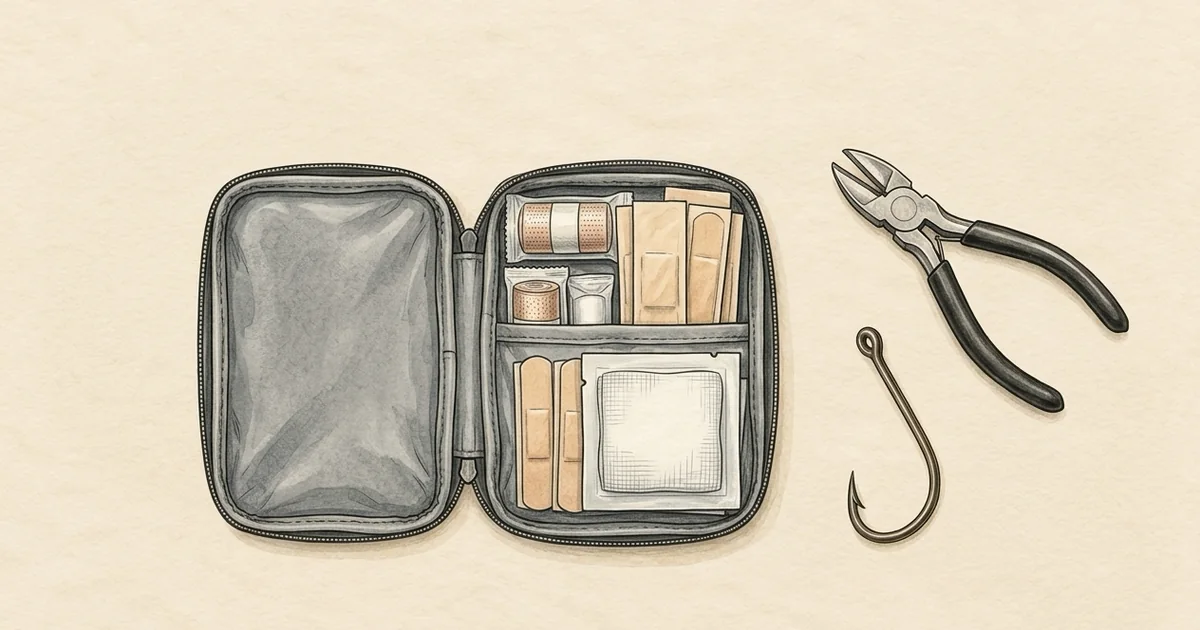
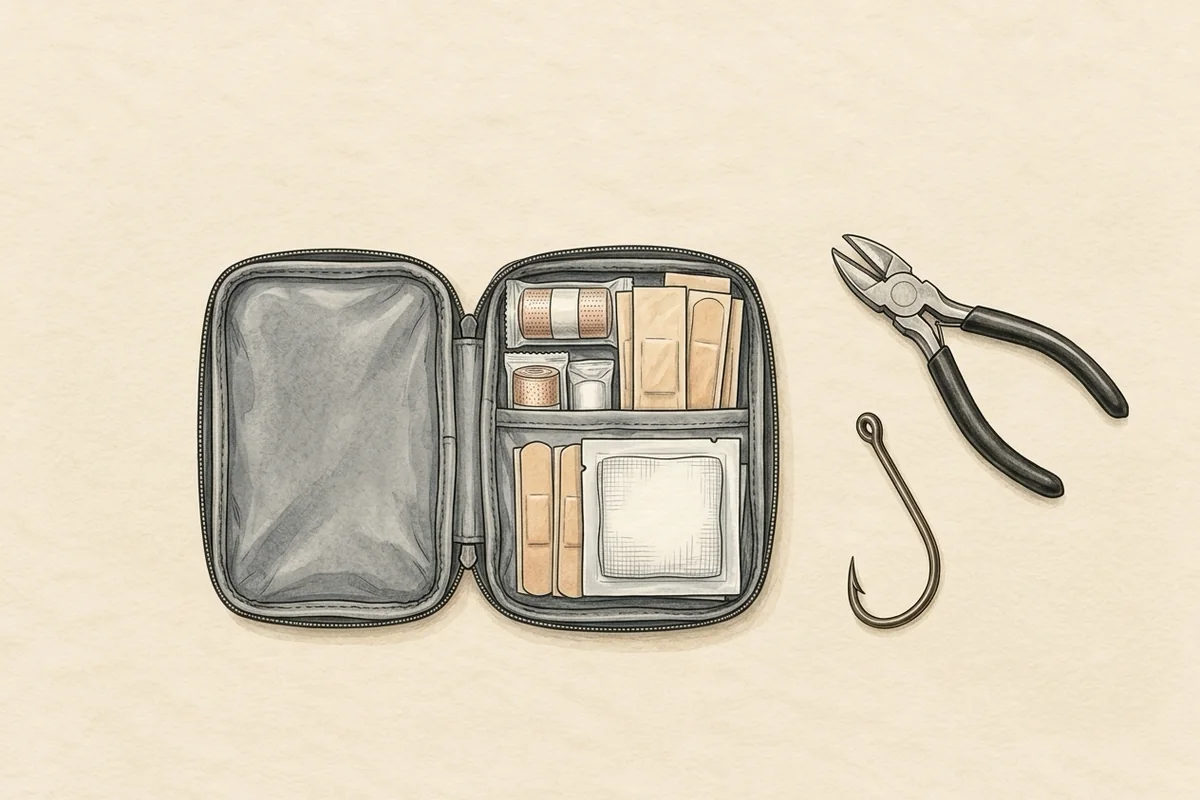
The DRK mentions disposable gloves, which are in first-aid kits to DIN 13164 and 13157, and advises getting familiar with the contents. The DGUV describes the dressing pack, a sterile wound pad on a bandage, as a good means for bleeding wounds, and the triangular bandage for securing it.
Prevention is possible above all for the eyes. Blinker points out that polarised glasses not only clear the water but also protect against stray lures and hooks, and advises wearing them in dull weather too. When landing a fish by hand with trebles, it helps to hold the fish so that no hooks point towards your hand. What aids exist for this is covered on the pages Disgorger and Pliers and forceps.
Common mistakes
- Rinsing the wound, treating it with ointment or disinfectant, or touching it before a doctor has seen it (DGUV).
- Putting off the doctor’s visit even though the DGUV gives six hours.
- Forgetting the vaccination card or not mentioning tetanus protection at all (RKI).
- Not going to the emergency department out of embarrassment (Blinker).
Frequently asked questions
May I pull the hook out myself?
The DRK, DGUV and Johanniter provide that laypeople do not remove foreign bodies from wounds. With a fishing hook, the barb adds to this, as it holds the hook in the tissue. That is why this page contains no instructions for removing it yourself.
Do I have to see a doctor for every hook injury?
If the hook is still in, yes. If it is only a scratch, according to the RKI a doctor should still check your tetanus protection, because even barely visible injuries can be a point of entry. If in doubt, ask a doctor.
How quickly do I have to see a doctor after a hook injury?
The DGUV requires every wound to be shown to a doctor within six hours. For a hook in the eye or heavy bleeding you do not wait but call 112 straight away.
When do I need a tetanus vaccination after a hook injury?
That depends on your vaccination status and the wound. With a complete primary vaccination the RKI gives 10 years, and for deep or dirty wounds with foreign bodies 5 years since the last vaccination. Whether a vaccination is due is for the doctor to decide.
Related
- Fishing with children and children’s rod: rules and tackle for the first day at the water
- Landing and unhooking a fish: how to get the fish safely into your hand and release the hook
- Disgorger: a tool for quick, gentle unhooking
- Pliers and forceps: when the hook sits deep in the mouth
- Unhooking mat: lay the fish down softly and unhook it
- Fishing hook: shapes, sizes and hook points
- Sun, heat and ticks: glasses, heat protection and tick bites
- Boats and life jackets: emergency call and preparation on the water
- Safety at the water: all the safety topics of this section at a glance
Sources
- DRK: Wundbedeckung (Fremdkörper nur vom Arzt, Umpolstern, Einmalhandschuhe, Verbandkästen)
- DRK: Fremdkörper im Auge (Reiben verschlimmert, Verband beider Augen, Notruf)
- DRK: Starke Blutungen (bei starken Blutungen immer 112)
- DRK: Notruf 112 (wann der Notruf, welche Angaben, Anleitung durch die Leitstelle)
- DGUV-Information 204-007, Handbuch zur Ersten Hilfe: Wundversorgung bei kleineren Verletzungen (Fremdkörper belassen und polstern, Auge, sechs Stunden, Tetanus)
- Johanniter: Erste Hilfe Tipps, Wundversorgung und Blutung stoppen (hinsetzen, Fremdkörper fixieren und polstern, Ausnahme für sehr kleine Fremdkörper)
- RKI: Schutzimpfung gegen Tetanus, häufig gestellte Fragen (Auffrischung alle 10 Jahre, Impfkalender für Kinder, unklarer Impfnachweis, Impfquote)
- DRK-Kreisverband Müllheim: Notfälle mit Kindern (ruhig bleiben, Augenhöhe, Körperkontakt, Kuscheltier)
- RKI-Ratgeber: Tetanus (Erreger, Eintrittspforten, Inkubationszeit, Tabelle zur Impfung im Verletzungsfall)
- Blinker: Achtung, scharfe Haken (Widerhaken, Handlandung, Abstand, Arztbesuch)
- Blinker: Polarisationsbrille, voller Durchblick (Augenschutz vor Ködern und Haken)
Text AI-assisted, drawings AI-generated. Sources opened and checked in October 2026; no graphics taken from the sources.
All figures are guide values without guarantee and are no substitute for medical advice. A hook in the eye and heavy bleeding are emergencies. In an emergency, call 112.