
Knowledge · Tackle
Disgorger: Unhook quickly and gently
A disgorger is a slim rod with an eye or notch that slides along the line to the hook and pushes it back out of the fish’s mouth. It is built for small hooks and small fish. For bigger fish, pike and deeply swallowed hooks, specialist sources name forceps, pliers or scissors.
Designs: eye, notch and twist rod
The classic disgorger is a thin rod of plastic or metal with a notch or eye at the tip. The notch or eye takes the line so that the rod finds its way along it into the mouth. Blinker considers the disgorger with an eye, usually plastic, particularly suitable for small hooks.
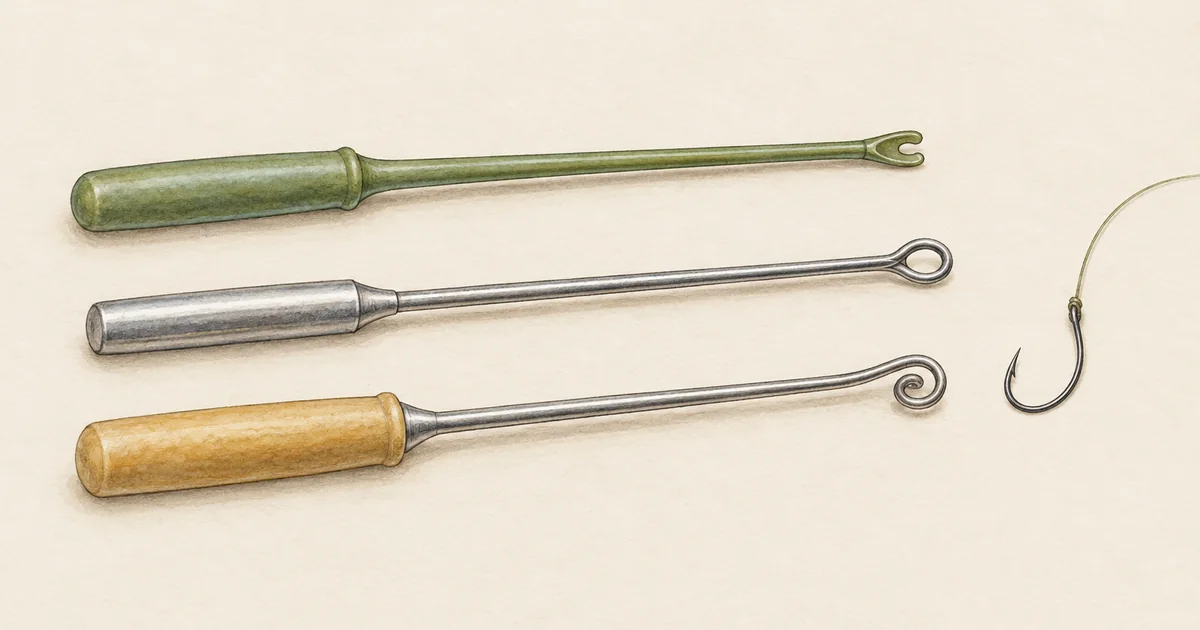
How wide the eye has to be depends on the rig. When fishing a nymph for large rudd, the disgorger needs a large eye that fits over the bead of the nymph. An eye that is too narrow catches on the bead and does not reach the hook.
A special design comes from flatfish angling. The Thünen-Institut für Ostseefischerei (Thünen Institute of Baltic Sea Fisheries) describes a special flatfish disgorger: a rod is placed in the mouth, the hooklength is wound around the rod and the fish is turned around it until the hook comes free. The researchers call this the twist method. The study covered plaice, dab and flounder from the Baltic Sea.
Removing a hook in three steps
- Place it on the line. Put the eye or notch around the line. From now on the line is the guide.
- Slide down to the bend of the hook. Push the disgorger along the line into the mouth until its tip rests against the bend of the hook.
- Push rather than pull. Press the disgorger a little way towards the fish. This pushes the hook back against the direction in which it went in, and the point comes out of the tissue. Then you pull disgorger and hook out together.
You often cannot manage entirely without touching the fish. Petri-Heil writes that unhooking rarely works without a brief hold. In that case wet your hands first and do not squeeze the fish.
When pole fishing, a simple adjustment helps: according to Rute & Rolle, the line should be slightly shorter than the rod. If you lift the rod, you can reach the hook comfortably, which makes unhooking and baiting easier. According to Rute & Rolle, the disgorger belongs in every tackle box.
Unhooking small fish in the water
If a fish has to go back because it is undersized or caught in the closed season (Schonzeit), it is best to remove the hook in the water. The English angling body Angling Trust and a WWF guide advise this. The Leibniz-Institut IGB and the state office LALLF Mecklenburg-Western Pomerania contributed expertise to the latter. If you do have to unhook in the air, according to WWF you then place the fish gently in the water rather than throwing it.
How the landing net, wet hands and unhooking mat work together is described under Landing and unhooking a fish.
When pliers or a clamp suit better
The Angling Trust draws the line by fish size. For small fish it names the disgorger, for larger species a clamp. For fish with teeth such as pike, a long pair of forceps and side cutters are part of the kit, to cut through hooks if necessary. The British Pike Anglers‘ Club gives at least 10 inches, so around 25 cm, for the forceps. Blinker also advises extra-long forceps for pike.
| Tool | Use | Special feature |
|---|---|---|
| Disgorger with eye or notch | small fish, small hooks | runs along the line to the hook |
| Artery clamp | larger fish | can be locked |
| Long forceps | Pike and other predators | Keep clear of the teeth |
| Side cutters | Hook sits awkwardly | snips the hook through |
„Lockable“ means: the clamp holds itself closed. The equipment guide of the Löningen angling club calls the artery clamp the proven disgorger and advises a gag for larger predators, which holds the mouth open, though in the section on fish that are kept and only unhooked after being killed. With live pike that are returned, pike anglers see it differently: the Pike Anglers‘ Club writes never to use a gag when unhooking, and relies on forceps and a firm grip. The DHC tips on returning fish, published by Blinker, likewise rely on the gill-cover grip, which makes a gag unnecessary. According to these tips, hook points near the eye or gills should be snipped off. More on the pliers is under Forceps and artery clamp.
When the hook sits too deep
A deeply swallowed hook is the limit of any disgorger. The brochure of the German Anglers‘ Association on the Fish of the Year 2025 describes Thünen Institute trials with eels. When someone tried to remove the hook, the wounds bled more often, especially with deeply swallowed hooks. In 77 per cent of these attempts the hook stayed in anyway. The brochure’s advice: if the hook sits deep, the line is cut close to the mouth. A hook that could no longer be seen in the mouth counted as deeply swallowed there.
With perch, the British specialist group Perchfishers draws the same line: if the hook is visible, the disgorger comes into play. If it cannot be seen or cannot be removed quickly, the line is cut as close to the lips as possible. The reason, according to Perchfishers: in perch the heart lies very close to the back of the throat.
For flatfish there is a separate 2025 evaluation by the Thünen Institute. The anglers surveyed most often removed deeply swallowed hooks with pliers or an artery clamp (38.5 and 42.0 per cent in two sub-studies), with the conventional disgorger only a few (3.7 and 6.7 per cent). Of deeply hooked flatfish, around 55 per cent died after the twist method and around 71 per cent after pliers or clamp. The researchers treat this only as a tendency, because too few fish died to run a statistical test.
Rule of thumb from the sources: If you can no longer see the bend of the hook in the mouth, the disgorger stays in your pocket. Cut the line close to the mouth. Not every set of exam materials provides for this: the Saxony-Anhalt question catalogue allows it only for undersized eels, and more detail is under Forceps and artery clamp. Whether the fish may then go back or has to be kept is set by state law, see Releasing a fish. What the new hooklength and knot will hold you can work out in the line calculator.
If a fish of legal size is kept, according to the Löninger equipment guide you only remove the hook once the fish has been killed. The procedure is described in Stunning and killing a fish.
Disgorger in the exam and water regulations
In the materials for the angling exam (Fischerprüfung), the disgorger is part of the basic equipment. The Bavarian exam questions 2023/2024 count it, together with a length measure, fish stunner and knife, among the gear that should come to the water for reasons of sporting conduct. In the Saxony-Anhalt question catalogue it appears among the accessories you absolutely need, alongside landing net, centimetre rule, fish killer and knife.
Exam questions do not replace the law, however. Whether you must carry it at your water is set by your federal state (Bundesland), and it is in the conditions of your fishing permit (Erlaubnisschein). How the exam itself works is explained in Fishing licence and angling exam.
Common mistakes
- Looking for the disgorger only once the fish is thrashing. It belongs within reach before the bite, not at the bottom of a pocket.
- Yanking on the line. Perchfishers expressly warn against pulling hard on the line. The disgorger pushes the hook back, and only then does it come out.
- Probing further down the throat. With deeply swallowed hooks, an attempt to remove them leads to bleeding, as the eel trials show. Here the scissors are the right tool.
- An eye that is too narrow. If it does not fit over the bead in front of the hook, the disgorger does not reach the bend of the hook.
- Using the short rod on a pike. For fish with teeth, the Angling Trust and Pike Anglers‘ Club recommend long forceps.
Frequently asked questions
Is a pair of pliers enough instead of a disgorger?
For larger fish the Angling Trust recommends the clamp anyway. For small hooks in small fish, the classic disgorger with an eye is regarded as particularly suitable.
Is a disgorger compulsory?
In the exam materials from Bavaria and Saxony-Anhalt it is part of the basic equipment. What state law and the fishing permit prescribe is binding.
Do I need a disgorger for eel fishing?
Fisch & Fang recommends it for fine eel fishing, especially for silver fish that take the bait as bycatch. If an eel has swallowed the hook deeply, the angling association’s brochure advises cutting the line close to the mouth.
Related
- Landing and unhooking a fish: landing net, mat and wet hands
- Forceps and artery clamp: tools for larger fish and predators
- Fish hook: parts, sizes and barbless hooks
- Releasing a fish: when it is compulsory and what studies show about survival
- Unhooking mat: the surface for when the fish does have to come onto land
- Hook injuries and first aid: when the hook is stuck in your own hand
- Line calculator: breaking strain of the new hooklength after cutting
Sources
- Angling Trust: Best Practice Guide for Freshwater Angling (PDF) (Werkzeug nach Fischgröße, Abhaken im Wasser)
- Pike Anglers‘ Club of Great Britain: Faltblatt zum Hechtangeln (PDF) (Zangenlänge, keine Rachensperre) und The Perchfishers: Handling Perch (sichtbarer Haken oder Schnur kappen)
- WWF Deutschland: Fische angeln und wieder zurücksetzen (PDF) (unter Wasser abhaken, Schnur kappen)
- Deutscher Angelfischerverband: Der Europäische Aal, Fisch des Jahres 2025 (PDF) (Lösungsversuche beim Aal, Schnur am Maul kappen)
- Thünen-Institut: Überlebensraten zurückgesetzter Plattfische, Working Paper 262 (PDF) (Drehmethode, Lösemethoden, Sterblichkeit)
- Bayerische Landesanstalt für Landwirtschaft: Prüfungsfragen 2023/2024 (PDF) (Geräte der Waidgerechtigkeit) und Land Sachsen-Anhalt: Fragenkatalog zur Fischerprüfung (nötiges Zubehör)
- Fischereiverein Löningen: Gerätekunde (PDF) (Arterienklemme, Rachensperre, Abködern nach dem Töten)
- Blinker: Angler-Werkzeug: Was muss noch mit ans Wasser? (Bauform, Klemme, Hechtzange), Wie behandelt man untermaßige Fische richtig? (Löser griffbereit), Fische landen: Kescher, Lip-Grip und Co. (im Wasser abhaken), Fliegenfischen auf Rotfedern (große Öse) und DHC-Tipps zum schonenden Zurücksetzen (Kiemengriff, Spitzen abkneifen)
- Rute & Rolle: Grundkurs Stippfischen (Schnurlänge beim Stippen), Fisch & Fang: Fein auf Aal (Beifänge) und Petri-Heil: Vom Haken zurück ins Wasser (Anfassen mit nassen Händen)
Text AI-assisted, drawing AI-generated. Sources opened and checked in October 2026; no graphics taken from the sources.
All figures are guide values without guarantee. How deep a hook sits and which tool then suits is for you to decide fish by fish; what is compulsory is set by your water regulations.