
Knowledge · Fishing methods
Whip fishing
In pole fishing you fish with a long rod without rings or reel, with the line tied directly to the tip. Because there is no reel to operate and no long cast to learn, the method is considered the easiest introduction to float fishing.
Rod with no rings and no reel
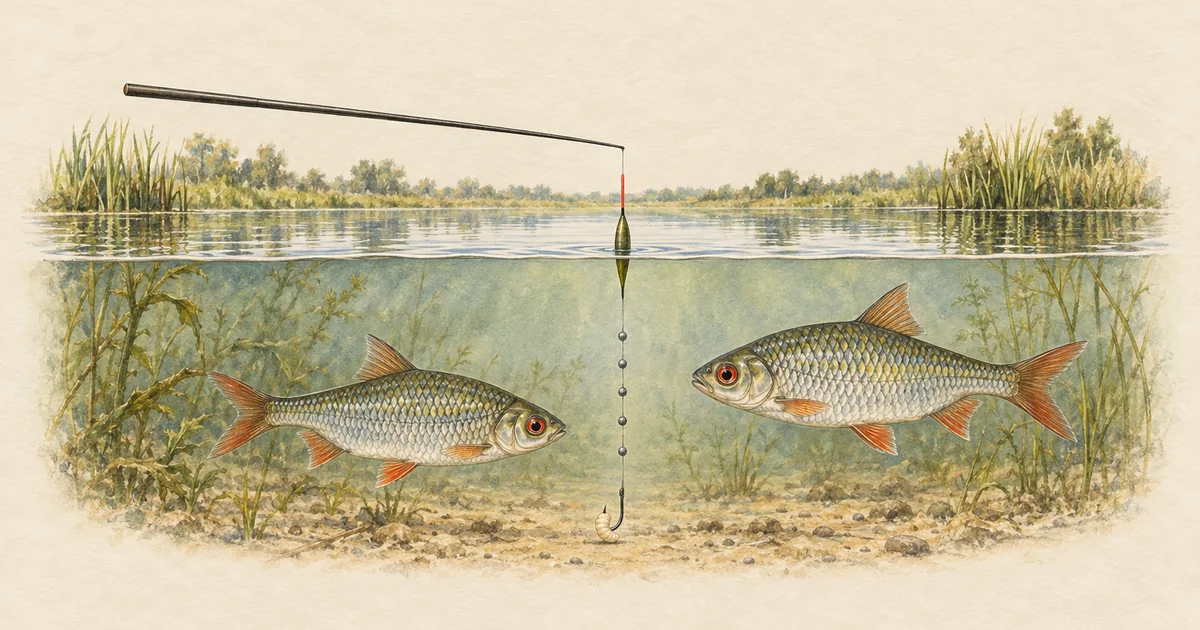
The whip is a long pole with no rings and no reel seat. The line is tied only to the tip, as stated in the teaching material of the Löningen fishing club for the angling exam (Fischerprüfung). The Landesfischereiverband Baden-Württemberg calls it the tip line and gives the length of the rod as its length. Rute & Rolle advises a little less: when you lift the rod you must be able to reach the hook comfortably.
This sets the limit of the method: the bait cannot go further out than the rod is long (Blinker). In return it lands in the same spot every time.
Rute & Rolle calls whip fishing the best method for beginners: you need little gear and, with a little practice, soon catch your first fish. To start with, the magazine recommends a rod of 6 to 8 metres at most and a model you can hold without effort. Shorter rods suit children but do not reach as far.
Whip and pole
The simple whip is usually telescopic, and its line is about as long as the rod. The long rod made of sections is called a Kopfrute. On it the line can be much shorter, the rear sections are taken off for landing, and the tip can hold an elastic that absorbs runs (Blinker). More about this and the inconsistently used names under Float rod.
Rig: fine float, shot line, thin hooklength
You fish with a fixed float, that is, with a float rig with no stopper, only finer (Fig. 1).
- Float: light, according to Rute & Rolle with a carrying capacity of 1 to 4 grams, for still and gently flowing water.
- Main line: monofilament, 0,15 to 0,20 millimetres in the teaching material. With no reel the fish cannot take line, and its stretch helps to cushion the fight.
- Shot line: small split shot in a row, getting smaller towards the bottom so that nothing tangles. Spread evenly, the bait sinks slowly. Set close together and low, it sinks quickly past the small fish.
- Hooklength: thinner than the main line so that only the hook breaks off if you snag. Blinker gives 0,02 millimetres less as a rule of thumb. On length the figures differ: according to Rute & Rolle, ready-tied hooks have about 70 centimetres of hooklength, while Blinker considers 15 to 35 centimetres right on a pole.
- Hook: hook sizes count backwards, so a higher number means a smaller hook. Rute & Rolle recommends size 14 to 16 to start with, and Blinker gives 16 to 22 for bleak and small roach.
The float is shotted correctly when only the tip shows above the water. The float shotting calculator works out which shot suit the carrying capacity.
Plumb the depth
You measure the water depth with a plummet: a hollow lead ball that is opened and clipped to the hook (Landesfischereiverband Baden-Württemberg). It should weigh clearly more than the float carries so that it lies firmly on the bottom (Blinker).
- Lower the rig. Lower the shotted rig with the plummet into the water at your fishing spot.
- Float goes under. It is set too shallow. Slide it a little way up the line.
- Float lies flat. It is set too deep, the shot lie on the bottom and do not cock it. Slide it down.
- Only the tip shows. Now the distance between float and hook equals the water depth.
You adjust from this point. If you slide the float a few centimetres down, the bait hangs just above the bottom. If you slide it up, bait and hooklength lie on the bottom. Plumb the depth beside your spot too: according to Blinker, bait collects at small steps, and the fish with it.
Which fish at which depth
You mostly catch silver fish that live in shoals. Where the bait should hang depends on the species. The middle column follows the fish encyclopedia of the Landesfischereiverband Bayern.
| Species | Way of life | Present the bait |
|---|---|---|
| Roach | shoaling fish, very adaptable | bottom to mid-water, try it out |
| rudd | likes to stay near the bank and close to the surface | shallow, in mid-water |
| Bleak | in shoals just below the surface | shallow, very small hook |
| Bream | bottom-dwelling, searches soft ground | lying on the bottom |
| Silver bream | mostly bottom-dwelling, often with bream | on the bottom |
| Crucian carp | still, warm, weedy waters | check protection rules first |
Roach do not always stay on the bottom. Fisch & Fang calls them mid-water fish: if you only fish on the bottom, you go home empty-handed on some days. For big bream, a whip angler in Blinker lets the hooklength and bait lie on the bottom for about 10 centimetres.
For the crucian carp the fish encyclopedia names the loss of small waters and displacement by the Prussian carp as threats. Whether it is protected where you fish is regulated by your federal state (Bundesland), see Closed seasons and minimum sizes explained.
Feeding sparingly
Groundbait draws coarse fish to the fishing spot and keeps them there, writes the Anglerverband Niedersachsen. In whip fishing it belongs exactly where the bait hangs. In Blinker a whip angler throws his balls of groundbait in by hand with pinpoint accuracy and later adds small amounts.
The association advises topping up only when fish have settled on the swim. According to its figures, anyone who feeds in Germany uses on average 120 to 150 grams of groundbait per hour of fishing.
Maggots, maize or a small worm go on the hook. How to bait maggots is covered under Maggots and larvae.
Feeding rules, as of October 2026: Whether and how much you may feed is set by the water rules. One example: the Landesanglerverband Brandenburg allows at most 2 kilograms of dry or wet groundbait per fishing day and can restrict or ban groundbait altogether on individual waters. Read your fishing permit (Erlaubnisschein) before the first ball of groundbait.
Bite, strike and landing
When the float goes under, you strike quickly and lift the rod smartly to do so. If the float rises out of the water and lies flat, the fish has swum up with the bait. This lift bite is also struck (Blinker).
According to Blinker, you swing small fish in to your hand on the line, and for bigger ones the landing net is ready. The Löninger teaching material warns that with bigger fish such as carp a whip does not allow a proper fight and the rod can break.
The hook is removed as gently as possible; for small fish there are special disgorgers (Landesfischereiverband Baden-Württemberg). More on this under Landing and unhooking a fish. Whether you may keep fish in a keepnet is governed by your federal state (Bundesland).
Long rod, power line and thunderstorm
According to Rute & Rolle, whips are made of light carbon fibre, and according to the teaching material carbon fibre conducts electric current. The Luxembourg grid operator Creos warns anglers: telescopic rods can be up to 14 metres long when extended, and under the standards medium- and high-voltage lines may run as low as 6 metres above the ground. Even a beginner’s rod reaches that high. If you get too close with the rod you can cause an arc, even without touching the line.
- Look up before you extend the rod, and do not fish near power lines.
- Keep your distance. Creos gives at least 4 metres, and the Berufsgenossenschaft der Bauwirtschaft and Netze BW assume 5 metres when the voltage is not known. Add the length of the rod to that.
- Carry the rod level at the water.
- If line or rod gets caught in a power line, do not touch any of it. Call the grid operator or 112.
In thunderstorms the VDE advises anglers to leave the water and the bank zone as soon as a storm approaches. Details are under Power lines and fishing rods and Thunderstorms and weather.
Frequently asked questions
How deep can you fish with a whip?
With a fixed float, no deeper than the rod is long. Otherwise, according to Blinker, you get problems when casting or landing at the latest. For deeper water you need a rod with a reel and a sliding float, see Float fishing.
When does the rod need an elastic?
Not for small fish. Blinker calls it indispensable as soon as you go for bream, tench or carp, because the cushion of the ringless rod is used up quickly. Another article in the same magazine says you can fish for bream without it.
Can you fish a whip on a river too?
Yes. In the current the float needs more carrying capacity. For stronger current Blinker names egg-shaped or round floats and, instead of the shot line, a compact weight.
Related
- Float fishing: fixed float and sliding float compared
- Float rig: how to build it step by step
- Loop-to-loop connection: how to attach the hooklength
- Feeder fishing: for fish beyond the length of the rod
- Catch calendar: good months for roach, rudd and bream
Sources
- Rute & Rolle: Grundkurs Stippfischen (Einstieg, Rute, Schnur, Bleie, Haken)
- Landesfischereiverband Baden-Württemberg: Gerätekunde zur Fischerprüfung (Kopfschnur, Lotblei, Kescher, Hakenlöser)
- Fischereiverein Löningen: Zusammenfassung Gerätekunde (Schnur an der Spitze, Schnurstärke, Kohlefaser)
- Blinker: Alles Wichtige für deinen Einstieg (Bleikette, Ausloten, Bisse), Fehler beim Stippangeln (Vorfach, Posen im Fluss), Die Sache mit den Angelhaken (Hakengrößen), Loten beim Angeln (Lotblei)
- Blinker: Brassen angeln, alle Grundlagen (Kopfrute, Futter, aufliegender Köder), Kopfrute mit Gummizug (wann er nötig ist)
- Landesfischereiverband Bayern: Fischlexikon (Lebensweise der sechs Arten)
- Fisch & Fang: Zielfisch Rotauge (Angeltiefe)
- Anglerverband Niedersachsen: Faktencheck Anfüttern (Wirkung, Menge, Nachfüttern), Landesanglerverband Brandenburg: Gewässerordnung (Höchstmenge)
- Creos: Vorsicht bei elektrischen Leitungen (Angelruten, Abstand), BG BAU: Arbeiten in der Nähe elektrischer Freileitungen und Netze BW: Gefahren durch Stromleitungen (5 Meter), VDE: Blitzschutz beim Wassersport (Gewitter)
- Wikipedia: Stipprute (Bauarten, ergänzend)
Text AI-assisted, drawing AI-generated. Sources opened and checked in October 2026; no graphics taken from the sources.
All details are guidelines and given without guarantee. For feeding, keepnets and closed seasons, state law and the water rules apply, and the section on power lines and thunderstorms is no substitute for medical advice.