
Knowledge – safety by the water
Thunderstorms and weather
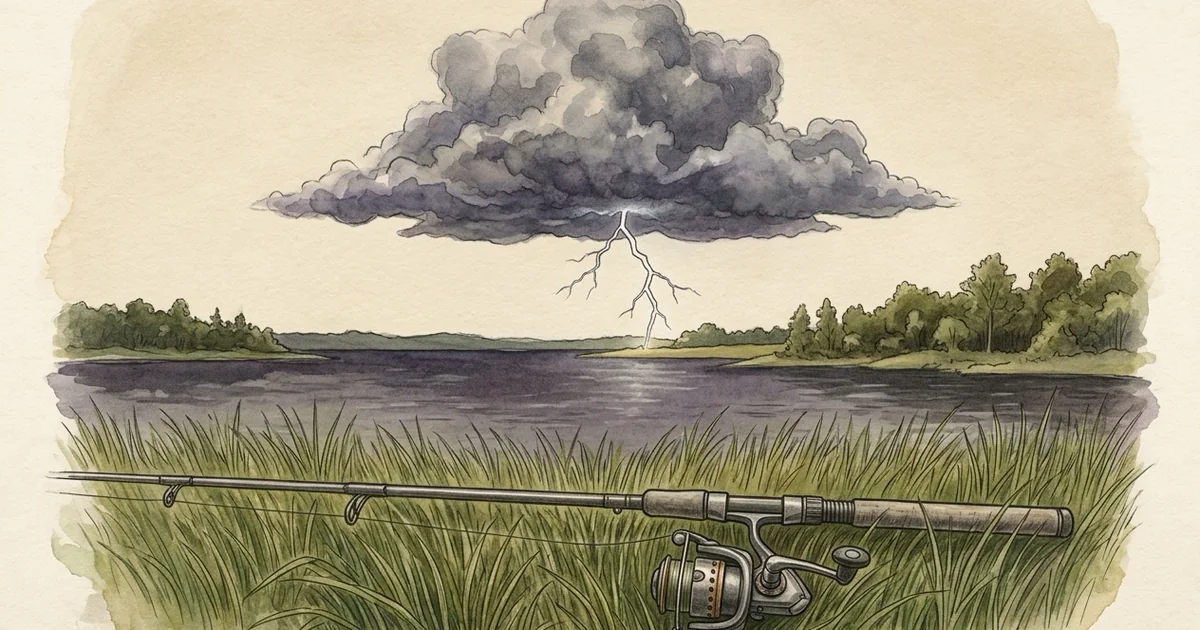
Thunderstorms while fishing are one of the few situations where you do not weigh things up but pack up. This page shows how to estimate the distance from lightning and thunder, why water and the bank are so dangerous, where to find shelter and what the warning levels of the German Weather Service (DWD) mean for you.
In an emergency: 112 After a lightning strike, call 112 immediately; you can touch the person who was struck without danger.
Why the water is the worst place
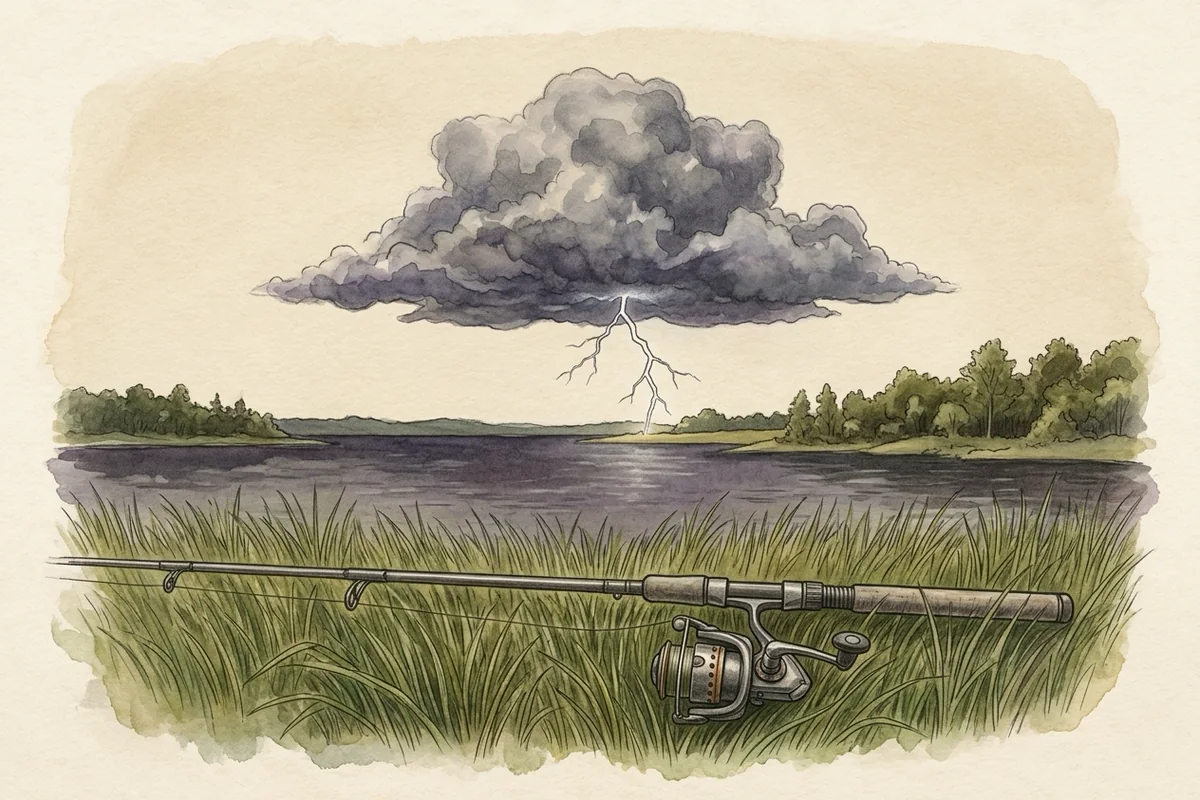
Thunderstorm season is also fishing season: according to the VDE, more than 95 per cent of a year’s lightning strikes fall between May and September. According to the VDE’s lightning accident statistics, at least 4 people a year die from lightning strikes in Germany on average, and around 110 are injured.
The VDE (Association for Electrical Engineering) explains where the real danger at the water lies. Using swimmers as an example, it writes that a direct hit is relatively unlikely. What is dangerous is the lightning current, which spreads in all directions across the water surface from the point of impact. Because of the good conductivity, according to the VDE currents that can cause shock and drowning still flow at a distance of more than 100 metres. From about 10 joules in the body, ventricular fibrillation sets in. With a strong lightning strike this threshold is only dropped below beyond 40 metres, with a medium one at around 15 metres. Even at 100 metres you feel a painful shock that can trigger panic.
Wading is life-threatening in a thunderstorm, and the bankside zone is not safe either. According to the VDE, anglers should leave the water and the bankside zone as soon as a thunderstorm approaches. Even a small lake surrounded by tall trees offers no protection, because lightning can strike straight into the water. More on rivers: Bank and waders.
Estimating distance: lightning, thunder and the ten-kilometre mark
Light reaches you with practically no delay; according to the DWD, thunder travels only about 330 metres per second, so one kilometre in roughly three seconds. Count the seconds between lightning and thunder and divide by 3. The DWD’s example: 9 seconds is about 3 kilometres.
| Observation | Distance | Assessment |
|---|---|---|
| 10 seconds at most | about 3 km | VDE: lightning strike possible at any time, danger to life |
| around 30 seconds | about 10 km | DWD: increasingly dangerous from here |
| Thunder can be heard | VDE: under 10 km; DWD: usually up to 25 km | Sources differ, the more cautious mark applies |
On the question of how far thunder can be heard, the two bodies differ. The VDE equates audible thunder with less than 10 kilometres. The DWD writes that the sound fades at 25 kilometres at the latest, and that in the rare ideal case a dull rumble can be heard up to 50 kilometres. In practice the stricter figure is enough: if you hear thunder, pack up.
According to the DWD, lightning is usually visible by day only up to 20 or 25 kilometres. Lightning without thunder is called sheet lightning. A bolt from the blue is possible: usually the thunderstorm is then 10 to 20 kilometres away, but 40 kilometres has been documented. Most thunderstorms last one to one and a half hours, according to the DWD.
Exercise: Tap “Lightning seen” at the flash and “Thunder heard” at the thunder. The seconds divided by 3 give roughly the distance in kilometres.
What you should do as an angler
- At the first signs, and at the latest when thunder is audible, leave the water and the bankside zone (VDE).
- A car with an all-metal body protects best (VDE, DWD). Motorhomes with a fibreglass body and convertibles without a metal frame do not protect, according to the VDE.
- A building with a lightning protection system generally offers protection according to the VDE. In wooden huts and wooden barns there is a danger to life, according to the VDE; better to stay outside.
- Without shelter: do not be the highest point in the terrain, go into a hollow in the ground and crouch, feet close together (VDE). Do not touch the umbrella or other objects with metal parts while you do so (BBK).
- Keep your distance from other people: at least one metre, better three (VDE).
- Only go back to the water once no thunder has been heard for half an hour (VDE).
Trees, dykes, woods
The VDE counts single trees, groups of trees, woodland edges, dykes and wooden poles of overhead lines among the places particularly at risk of being struck, where flashover and step voltage threaten. The best distance is at least 10 metres from trees and branches. The saying that you should avoid oaks and seek beeches is wrong: according to the VDE, lightning strikes all tree species alike. In the middle of a forest of even height the danger is lower than at the woodland edge or by a single tree, according to the VDE.
Step voltage and lying on the ground
The current also spreads through the ground; step voltage then arises between your feet. According to the VDE it is dangerous up to about 30 metres around the point of impact, and further on rocky ground. That is why the VDE lists among the things you must avoid: lying on the ground or propping yourself up on your hands.
Rod, umbrella and tent
According to the magazine Blinker, every carbon-fibre rod carries a warning that it conducts electricity well. In the official exam questions of the Bavarian state angling exam, the correct answer for the carbon-fibre rod is: keep away from overhead lines and stop fishing in a thunderstorm. The Federal Office of Civil Protection (BBK) advises not touching objects with metal parts, such as umbrellas, during a thunderstorm. According to the German Weather Service (DWD), such objects do not make a strike more likely, but they can cause injuries if lightning strikes. None of the sources checked proves that a rod attracts lightning.
Note: The danger arises above all from being in open country and at the water. A rod laid down does not make you safe. Anyone who first packs away rigs, deadbaits and rod rests loses the minutes the rule of thumb is meant to buy.
When fishing from a tent, the following applies: according to the VDE, a tent without a metal frame offers no more protection than open ground. The VDE advises not pitching tents on rises, at the edge of a wood or under isolated trees, keeping three metres from neighbouring tents and not running metal guy wires.
Boat
Boats are exposed points on a flat water surface, especially those with a mast. The VDE is clear on this: on no account fish and do not stand on deck. On a boat, it advises crouching as low as possible with your legs together and not touching metal parts such as the rigging. More on this on the page Boats and life jackets.
Reading DWD warnings
The DWD warns in four levels: yellow (weather warning), orange (notable weather), red (severe weather warning) and violet (extreme severe weather). For thunderstorms, according to the warning criteria: yellow means a thunderstorm with electrical discharge, also with gusts. Orange stands for a strong thunderstorm with storm-force gusts, heavy rain or hail, red for a severe one with hailstorm, torrential rain or hurricane-force gusts, violet for an extreme one.
Do not underestimate yellow. The DWD writes that every thunderstorm brings an increased risk of lightning, and that it flashes not only in the core but also at a considerable distance from it. From red, time spent outdoors should be avoided where possible. As a guide, the DWD gives 15 to 25 litres of rain per square metre per hour and hail under 1.5 centimetres for orange, and 25 to 40 litres and larger stones for red. Its recommendations for action are non-binding guidance.
There are separate warning services for larger lakes. According to the DWD, the Regional Weather Advisory Service in Munich warns of gusts and storms for selected Bavarian lakes, every year from 1 April to 31 October. On the Steinhuder Meer there are also thunderstorm warnings. Check the warning situation for your location before the trip and again when the sky clouds over, on the DWD site or in the WarnWetter app. How the weather affects the fish is covered on the page Weather, air pressure and wind. For safety, the warning situation counts, not whether the fish are biting.
If something does happen: According to the VDE, the emergency number 112 applies immediately. Touching the injured person is harmless, and a second strike at the same spot is highly unlikely. In cardiac arrest, permanent brain damage threatens after three to four minutes. This is no substitute for medical advice or a first-aid course.
Common mistakes
- Waiting until it thunders directly overhead. According to the VDE, an audible thunderstorm is already closer than 10 kilometres.
- Seeking shelter under a single tree, at the edge of a wood or on a dyke.
- Lying flat on the ground instead of crouching (VDE).
- Dismissing a yellow thunderstorm warning as harmless (DWD).
Frequently asked questions
How far away must a thunderstorm be for me to keep fishing?
There is no safe limit. According to the DWD it becomes increasingly dangerous below about 10 kilometres (around 30 seconds), and the VDE equates audible thunder with under 10 kilometres. If you are cautious, you pack up at the first signs.
Is a boat safe in a thunderstorm?
No. The VDE calls boats exposed points on the water surface and says you should on no account fish. On a boat you should crouch low and avoid metal parts. Plan your return to the bank early.
Does it help to lie flat on the ground?
No. The VDE counts lying on the ground among the things you must avoid in a thunderstorm. Without shelter, the VDE and BBK recommend crouching in a hollow, feet close together.
How long do I wait after the thunderstorm before going back to the water?
The VDE gives half an hour: if no thunder has been heard for that long, the thunderstorm has passed.
Related
- Bank and waders: safe footing and wading when the weather turns
- Boats and life jackets: what to check before casting off
- Power lines and fishing rods: why carbon needs a safe distance
- Hook injuries and first aid: emergency call and first aid by the water
- Weather, air pressure and wind: how the weather affects the fish
- Weather at the water: wind, rain and temperature for your fishing day
- Catch calendar: which species bite when
- Sun, heat and ticks: protection on hot summer days at the water
- Safety at the water: all the safety topics of this section at a glance
Sources
- Deutscher Wetterdienst: Die Entfernung von Gewittern (Faustregel Sekunden durch 3, 10-km-Marke, Sicht- und Hörweite, Blitz aus heiterem Himmel, Lebensdauer)
- Deutscher Wetterdienst: Starkes, schweres oder extremes Gewitter (Bedeutung der Gewitterwarnfarben, Blitzgefahr auch in Entfernung)
- Deutscher Wetterdienst: Warnstufen und Farbskala (Bedeutung der vier Stufen)
- Deutscher Wetterdienst: Warnkriterien (Gewitter, Starkregen, Hagel je Stufe)
- Deutscher Wetterdienst: Binnensee- und Küstenwarnungen (Warndienste für Seen und Küsten)
- VDE Ausschuss Blitzschutz und Blitzforschung: Blitzschutz beim Wassersport (Blitzstrom im Wasser, Ausbreitung, Angler, Boote)
- VDE Ausschuss Blitzschutz und Blitzforschung: Blitzunfälle (Blitztote und Verletzte pro Jahr in Deutschland seit 2000)
- VDE Ausschuss Blitzschutz und Blitzforschung: Vor Blitzen schützen (Donner unter 10 km, halbe Stunde Wartezeit, Schutzorte, Bäume, Zelt, Schrittspannung, Erste Hilfe)
- Bundesamt für Bevölkerungsschutz und Katastrophenhilfe: Was tun bei Sturm, Gewitter und Hagel? (Hocke mit eng stehenden Füßen in einer Mulde, Gegenstände mit Metallteilen wie Regenschirme nicht berühren)
- Deutscher Wetterdienst: Thema des Tages, Gewitter im Anmarsch: So verhalten Sie sich richtig (Fahrzeuge mit Metallkarosserie, Metallgegenstände erhöhen die Trefferwahrscheinlichkeit nicht)
- Bayerische Landesanstalt für Landwirtschaft: Prüfungsfragen der staatlichen Fischerprüfung Bayern 2026 (Frage 4.003, Kohlefaserrute: Freileitungen meiden, bei Gewitter das Angeln einstellen)
- Blinker: Angler vom Blitz getroffen (Warnhinweis auf Kohlefaserruten, guter Stromleiter)
Text AI-assisted, drawings AI-generated. Sources opened and checked in October 2026; no graphics taken from the sources.
All figures are guide values without guarantee and are no substitute for medical advice. If in doubt, the warning of the local authorities counts. In an emergency, call 112.