
Knowledge – safety by the water
bank and waders
Safety on the bank comes down to a few places: on wet stone, at an undercut edge and in water that pulls harder than it looks. Waders keep you dry but change what happens in a fall. So if you are alone at the water, decide on your way out and the location details for an emergency call before you get in.
In an emergency: 112 If someone has fallen into the water, you first get yourself out of the danger zone and then place the emergency call.
Bank and entry

A bank is not load-bearing everywhere. A DLRG training document on lakes says that gravel-pit lakes in particular can have unreinforced and partly undercut banks. A whole strip can slip away there. Anyone standing on it suddenly falls into the water and can be buried, and the slide can also trigger a suction. Steep slip edges make it hard to get back out of the water.
Reinforced banks have their pitfalls too. According to the same document, sharp-edged stones carry a risk of injury from slipping, twisting an ankle and falling. On rivers, according to the DLRG document on flowing waters, such stone riprap is slimy with algae and deposits, and it also lies under water. Soft, muddy ground can hold your feet so that you fall over.
For flowing water, the magazine Blinker recommends shoes with good grip.
Judging the current
According to the DLRG, how fast a river flows is determined mainly by the volume of water, the gradient and the width of the riverbed. That is why a calm-looking river can turn into fast, tearing water within a few metres. The document on flowing waters also names the water level and the course of the river as factors. The water is fastest at the surface in the main current line and slows down towards the bed and the banks. Fast sections are usually also deeper, because the current scours out the bed.
As a numerical example, the same document gives for a large river, the Rhine at Cologne, normally about 5 to 6 km/h. Above high-water mark II it is 10 to 12 km/h. Other values apply to smaller waters, but the order of magnitude shows how much a rise in water level changes the situation.
| Where | What happens there | Advice from DLRG material |
|---|---|---|
| Groyne | usually calmer in the shelter of the groyne, at its head eddies and strong cross and back currents | Do not enter the water at groyne heads |
| Weir, waterfall | hydraulic roller below, self-rescue hardly possible even for experienced swimmers | Keep your distance |
| Pier, rock, bush | Eddies in front of and behind it; branches can pull you under | Keep clear of structures in the current |
| Ship’s wave | Suction in shallow water, the water level suddenly rises | Do not enter the water near commercial vessels |
You can find out more about the position of eddies, inflows and slack water from an angler’s point of view on the page Fishing on a river.
Waders, wading belt and wading staff
Waders keep you dry and warm, but they change what happens in a fall. In connection with floods, the DLRG writes that waders full of water are almost impossible for the unpractised to take off and, in the worst case, drag you under. It therefore expressly asks people to do without waders. It also warns that even knee-deep current can sweep you away.
Note: The DLRG warning applies to floods and strong current. None of the sources used gives a depth in centimetres up to which wading is safe. That depends on the current, the bottom and your height. If in doubt, stay on the bank. The text is no substitute for a rescue course or medical advice.
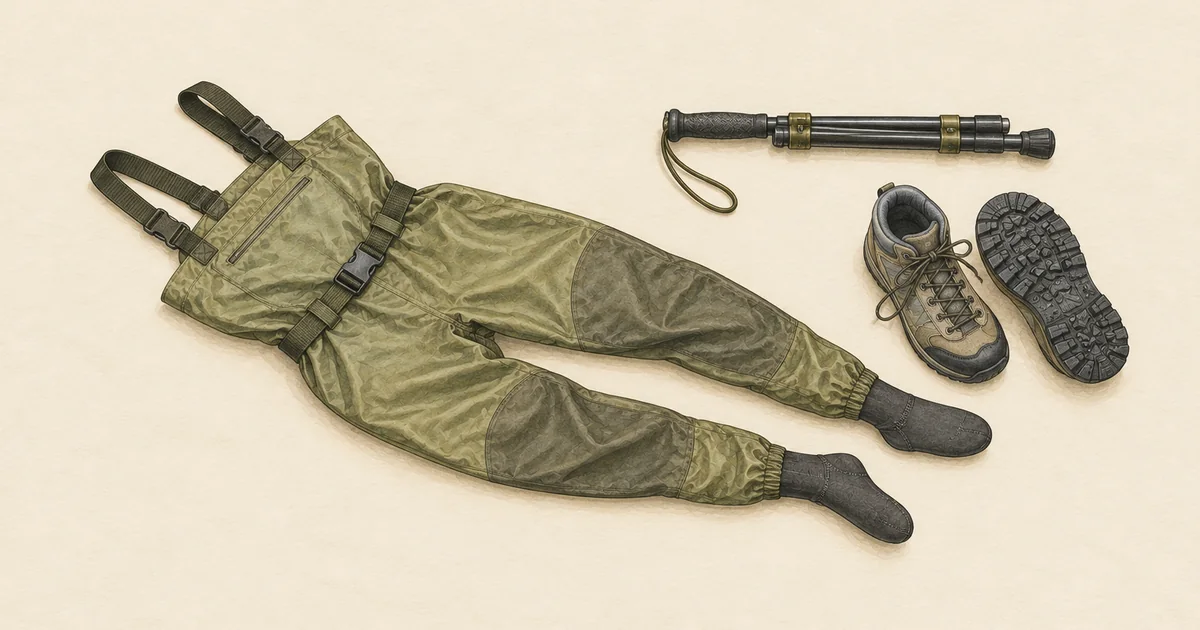
Blinker counts a firmly fitted wading belt as basic kit with hip or chest waders. If you fall, less water gets into the waders. In strong current, according to the magazine, a wading staff and grippy boots are added. You check the current, depth and bottom before you step in. Waders keep out wet and cold, but they do not relieve you of choosing a cautious route. You will find more on types and fit under Waders and Wading belt.
- Fasten the belt before you go into the water.
- Check warnings and water levels: the cross-state flood portal of the federal states shows official flood warnings and current water levels, and the DLRG refers people to it during floods.
- On a stony bottom, do not step into gaps: the DLRG material describes a danger to life for swimmers if their feet jam between stones and the current knocks them over. The same applies by analogy when wading over rip-rap.
- Before you get in, pick an exit point where the bank slopes out gently (see below).
If you fall into the water
The first seconds are often the most dangerous. Below a water temperature of 15 degrees, people gasp for air uncontrollably after immersion, with the risk of inhaling water according to the DLRG material. Heart rate and blood pressure rise sharply. According to the same source, sensitive people can show such reactions even below 25 degrees. In addition, the body cools three to four times faster in water than on land, because water conducts heat about 22 times better than air. Below 20 degrees the body can no longer compensate for the heat loss on its own. What this looks like on a boat is covered under Boat and life jacket.
For current, the DLRG gives a clear sequence. Do not swim against it; that costs strength and rarely gets you anywhere. Instead, work slowly diagonally with the current towards the bank, even if drifting feels unpleasant. When your strength fades, turn onto your back and drift feet first; you can correct your direction slightly with your arms. You steer round bridge piers, rocks, bushes and trees, because eddies form in front of and behind them and a branch can push you under.
Close to the bank, the material also advises lying on your back, feet first, in running water to cushion impacts. At a steep rip-rap bank you move further downstream to a gently sloping spot. Standing up among the stones is dangerous there. If someone else is in trouble, your own safety comes first: the DLRG says you only call the emergency number 112 once you are yourself outside the danger zone.
Cold and wet: If you come out of the water wet, you keep cooling down. The DRK describes the onset of hypothermia as shivering, faster breathing and a person who at first seems agitated and later calmer. In the second stage, muscle rigidity, increasing tiredness and unconsciousness follow. A DLRG document gives inability to move and clouding of consciousness below a core body temperature of 34 degrees. For hypothermia, the DRK advises calling the emergency number 112, removing wet, cold clothing and wrapping the person in warm blankets. It advises against active warming by rubbing or with a hot-water bottle. This does not replace medical advice. Warm gear for the cold season is covered under Fishing shoes and boots and Fishing gloves; falling through ice is covered in Walking on ice.
It remains an open question how best to get rid of waders full of water while in the water. The sources used give no method for this. Only a rescue or river-swimming course helps here, but above all prevention: a belt, and keeping away from risky spots.
Alone at the water
On the bank there is often nobody within earshot. Then what counts is who knows where you are, and how quickly the control centre learns your location.
- Let someone know: For mudflat walks, the DLRG advises telling someone before you set off and allowing enough time for the way back. It doesn’t say this for rivers and lakes, but the idea applies there too: one person should know which water you are at and when you plan to be back.
- Phone: In its safety tips for anglers, Blinker lists a waterproof mobile phone as equipment that can help a rescue start sooner. It only helps if you can reach it in the water, so keep it packed on your body, not in the rucksack at your spot.
- Give your location: The control centre’s first question is where it happened. For rivers, a DLRG document names the river kilometre, prominent structures nearby and the side of the bank. So when you arrive, make a note of a bridge or an access point where the emergency services can find you.
- Send your location: The official emergency app of the federal states sends the device’s location to the responsible control centre, even if you don’t know exactly where you are yourself. It supplements the numbers 110 and 112; it doesn’t replace them.
- Current: In floods, the DLRG asks people not to go through the water alone if possible, and advises never to go into fast-flowing water.
None of the official sources used requires you to wear a buoyancy aid when wading. What lifejackets and buoyancy aids can do is explained under Lifejacket.
Common mistakes
- Forgotten belt: Without it, more water gets in when you fall. The DLRG describes waders filling with water as a danger.
- Going into the water despite a flood: When the water level is rising and the current is strong, the DLRG asks people to do without waders.
- No exit in mind: The material advises looking beforehand for a spot where you can get back on land safely.
- Ignoring shipping: On waterways, a wave in shallow water can suddenly raise the water level.
- Location unclear: The dispatcher’s first question is where it happened. Anyone who can name only the water, but not the location, loses time.
Frequently asked questions
Do I need a life jacket when fishing from the bank?
There are clear recommendations for boats, see Boat and life jacket. For the bank, the sources used here give no fixed rule. On steep or undercut banks and in current, a life jacket is an extra safeguard; more under Life jacket.
Is a wading belt compulsory?
The sources state no obligation. Blinker does, however, count it as basic kit with hip or chest waders, because less water gets into the waders if you fall.
How deep may I wade in a river?
None of the sources gives a fixed depth. The DLRG warns that even knee-deep current can sweep you away. Blinker requires you to check the current, depth and bottom beforehand. If you have doubts, stay closer to the bank.
How fast does a river flow?
That depends on the volume of water, the gradient and the river bed. As an example, a DLRG document gives 5 to 6 km/h normally for a large river and 10 to 12 km/h in a flood. Small waters can differ.
What information does the control centre need at a river?
First the location: the water, the side of the bank and a structure nearby. For rivers, a DLRG document also names the river kilometre. Then say briefly what happened and stay on the line until the control centre ends the call itself.
Related
- Boat and life jacket: life jackets, capsizing and hypothermia in cold water
- Thunderstorms and weather: when you should leave the bank and the water
- Walking on ice: guide values and rescue after falling through
- Hook injuries and first aid: when something happens at the water
- Power lines and fishing rods: distance from overhead lines when fishing from the bank
- Waders: types, fit and safety
- Wading belt: why it belongs with every pair of waders
- Fishing on a river: current and spots from an angler’s point of view
- Safety by the water: all pages in this section
Sources
- DLRG: Gefahren in fließenden Gewässern (Strömung, Wehre und Walzen, Buhnen, Auskunft von Ortskundigen)
- DLRG: Hochwasser (Wathosen im Hochwasser, knietiefe Strömung, nicht allein, Hochwasserportal)
- DLRG: Selbstrettung aus Strömungen (schräg mit der Strömung, Rückenlage, Einbauten meiden)
- DLRG: Notruf richtig absetzen (eigene Sicherheit zuerst, Fragen der Leitstelle)
- DLRG-Ausbildungsunterlage: Gefahren an Fließgewässern, 9. Auflage 2017 (Strömungsgeschwindigkeit, Uferbefestigung, Schiffswellen, Ausstieg)
- DLRG-Ausbildungsunterlage: Gefahren an Seen, 6. Auflage 2017 (Uferbeschaffenheit, Schlamm, Kälteschock, Auskühlung)
- Länderübergreifendes Hochwasser Portal der Bundesländer (amtliche Hochwasser-Warnungen und Pegel)
- Blinker: Wathose kaufen (Watgürtel, Watstock, Schuhe mit Halt, Routenwahl)
- DRK: Erfrierungen und Unterkühlungen, Erste Hilfe (Anzeichen und Maßnahmen bei Unterkühlung)
- DLRG: Allgemeine Sicherheitstipps (Bescheid geben und Rückweg planen im Watt)
- Bundesländer: Notruf-App der Bundesländer (Standortübermittlung an die Leitstelle)
- Blinker: Rettungswesten retten Leben, Sicherheitstipps für Angler (wasserdichtes Mobiltelefon)
Text AI-assisted, drawings AI-generated. Sources opened and checked in October and November 2026; no graphics taken from the sources.
All details are guide values without guarantee and are no substitute for medical advice or a rescue course. In an emergency, call 112.