
Knowledge · Tackle
Fishing shoes and boots: A sure step on the bank
Good fishing shoes keep you on your feet on wet stone, in bank mud and on an icy groyne. Which sole grips where depends on the ground: treaded rubber, felt and studs each have their own terrain. In a boat and in winter there are requirements of their own.
Which sole holds on which ground
At the water the ground often changes within a few metres: first a wet meadow path, then a clay bank, then stones with a green coating. Three types of sole are common, and the Blinker magazine sorts them like this:
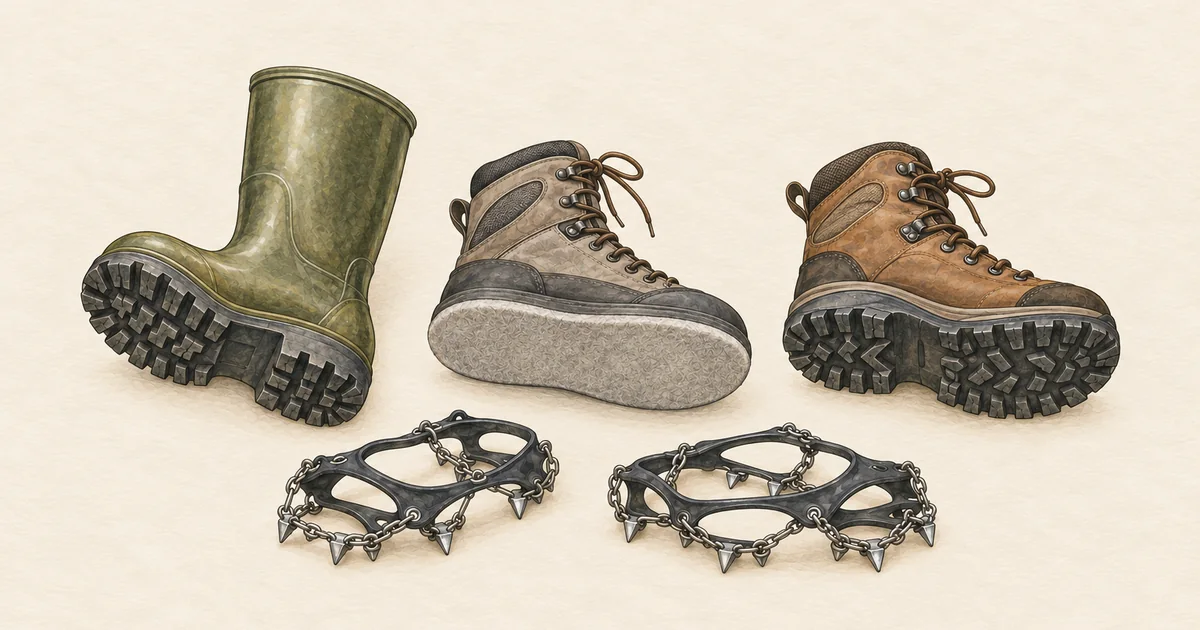
- Treaded rubber: The coarse lugs are meant to dig into soft ground. This sole suits muddy banks, changing ground and long walks, and it cleans quickly.
- Felt: Under water felt often grips very well on smooth, algae-covered stones and rock. On land it is weaker, especially on mud, snow and damp grass. Felt soaks up water and dries slowly.
- Studs: Pins that on many wading boots can be fitted to felt or rubber soles. They help on some rocky ground, but can damage boat floors and slip themselves on individual surfaces.
There are also hybrid soles, for example with a felt core in a treaded rubber rim.
| Sole | Grips well on | Weak on |
|---|---|---|
| Treaded rubber | mud, soft ground, long walks | smooth rock, depending on the rubber compound |
| Felt | algae-covered stone under water, rock | mud, snow, wet grass |
| Studs | rocky ground, ice | boat floors, individual smooth surfaces |
On rubber on rock, two Blinker articles contradict each other. An older guide thinks the tread on hard ground rather useless or even slippery and recommends felt there. A 2026 article by contrast holds that rubber soles developed specially for wading can also grip well on rock. How well, it says, depends on compound and tread. For changing waters and long walks it calls a well-treaded rubber sole the most versatile choice.
Rubber boots, hiking boots or wading boots
Rubber boots keep water out and go on quickly. It gets tricky when their sole is smooth. Stepping into a boat across a wet jetty covered in leaves or hoar frost then turns into a slide. On an icy groyne rubber boots are simply too slippery; sure-footed winter boots are the better choice there.
Hiking boots are worth considering when the way to the spot leads a long way over farm tracks and banks. The Swiss Council for Accident Prevention (BFU) counts sturdy hiking boots with a grippy tread as necessary equipment for hiking. It names slipping and tripping above all as hazards; in Switzerland, according to its figures, over 40 000 people have accidents every year while hiking and mountain walking.
Wading boots go with stockingfoot waders, which have neoprene feet at the bottom. This combination usually grips better because you can lace the boot to fit your foot, and it suits long treks and difficult terrain. With bootfoot waders, rubber boots are fixed on. They go on faster but, without lacing, fit less precisely. Which type suits your water is on the Waders page.
Slipping on a groyne and rock armour
Groynes are dams that project from the bank across into the water and steer the current. The DLRG describes them in larger rivers, where they protect the bank and regulate the current. In the shelter of a groyne the water often looks calmer, but at its head and between the groynes strong cross-currents and back-currents can form. So a slip there ends in moving water. On riprap, i.e. banks reinforced with stones, you stand on wet blocks. Where algae grow on them, the stones are slippery.
In the water the cold adds to it. The brochure „Sicherheit auf dem Wasser“ from the federal authorities warns that after a fall into the water the risk of hypothermia is particularly high. For the way back in the dark, a headlamp belongs in your bag. How to stand safely on the bank and what applies after a fall into the current is under Bank and waders.
Note: The safety information on this page reflects what the DLRG, DRK, Wasserwacht, BFU, the Aktion Das Sichere Haus and the federal authorities publish. It does not replace a first aid course or medical advice. In an emergency, call 112.
In the boat
In the brochure „Sicherheit auf dem Wasser“ from the Federal Ministry of Transport, the BSH and the Waterways Administration, non-slip shoes on board are part of what you wear just like the life jacket. For children on board the brochure expressly recommends the non-slip sole, and always. You leave studs on land: they can damage boat floors. More on the life jacket and capsizing is under Boat and life jacket, and on fishing itself under Fishing from a cutter and boat.
Winter: cold from below, slippery ice
Blinker counts cold feet among the biggest problems of winter fishing. The magazine considers normal rubber boots not frost-proof because the cold passes quickly through the rubber. Boots lined with neoprene or thickly insulated winter boots are said to be better. When you stand on frozen ground or on the ice, the cold comes mainly from below. A slab of rigid foam or a piece of cardboard under your boots slows the chilling.
On the ice, studs under your shoes help you walk safely, more under Ice fishing. The Wasserwacht Bayern names studs on shoes as an aid for getting about on the ice. They do not reveal whether the ice will hold. The guide values for ice thickness are under Walking on ice.
According to the German Red Cross, frostbite arises from prolonged cold, usually together with wet and wind. Toes are among the commonly affected places. Among the signs the DRK lists numbness and the feeling that the shoe is too small. As first aid it names, among other things, the emergency call and loosening tight clothing and shoes.
Slip-on spikes and shoe crampons
The studs in a wading boot are fixed in the sole. In addition there are anti-slip devices that you strap under an ordinary shoe, often called shoe spikes or shoe crampons. According to the Aktion Das Sichere Haus (DSH), a non-profit association from Hamburg, their teeth, chains or studs sit under the forefoot and under the heel. They are meant to grip on snow, ice and muddy paths. The Swiss BFU distinguishes chains, spikes, coils and flat ceramic inserts, also in combination, and advises choosing the type according to the intended use.
Don’t confuse them with ice claws for the hands. These are two sharp spikes that hang around your neck, clipped together, when ice fishing. If you go through the ice, according to Blinker, you drive them into the ice one after the other and pull yourself out of the hole with them. More on this under Ice claws, ice picks and throw line.
On ice and frozen banks
On bare ice it is easy to slip. The DLRG names broken bones and traumatic brain injuries as possible consequences of such a fall. For the teeth to grip, according to the DSH, you should put your weight down evenly as you step. They therefore suit shoes with little tread best. Under a deeply treaded sole the spikes often sit at an angle and do little on the path. The BFU recommends sturdy, flat shoes without a heel and trying the anti-slip device on before buying, because it has to fit the shoe well. For a winter session this means: test it on the thick boot you will also be wearing at the water.
Riprap, groynes and wet rock
On riprap, the blocks also lie below the waterline. The DLRG describes such stones on rivers as sharp-edged and greasy and slippery from algae and deposits. At groynes it warns of a high risk of slipping on wet stones. According to the DLRG, anyone who falls into the water there has difficulty getting out again. On the coast, algae and seaweed grow on stones and groynes. According to the DLRG, a fall on them can result in broken bones, bruises and wounds.
For rocky ground there are spikes that can be retrofitted to many wading boots. Blinker writes that they improve grip on some rocky surfaces, but on certain surfaces they slip themselves. A water portrait in the magazine recommends wading boots with spikes for a river with high, slippery banks, branches and stones in the bed. How well slip-on spikes from winter equipment hold on algae-covered stone, the specialist sources evaluated gave no information. In any case, they don’t replace a careful step.
Take them off before the boat and tarmac
Before you get into a boat or onto a fishing kayak, the spikes come off. Blinker warns that spikes can damage boat floors. The plastic deck of a kayak is a boat floor too. For indoors, the BFU gives the same advice: spikes damage parquet or carpet, and if you catch on something with them, you can fall. Outdoors, according to its recommendation, the anti-slip device should come off as soon as the ground gives grip again, for example on concrete or tarmac.
Step by step to the water with anti-slip spikes:
- At home, try them on the winter boot you will wear at the water. It has to sit firmly, and the teeth should lie flat under the sole.
- Only put them on where ice or snow begins; according to the BFU’s advice, this is easiest sitting down.
- When walking, put your whole foot down with each step so that all the teeth bear weight.
- Take them off again on cleared tarmac or concrete and before getting into a boat.
- If you go out on the ice, also hang the ice claws for your hands around your neck. Shoe spikes help you walk; they won’t pull you out of a hole in the ice.
After fishing: dry your shoes thoroughly
Crayfish plague is a disease that kills native crayfish such as the noble crayfish within a few days and can wipe out whole populations. Its pathogen travels from one water to the next in the tiniest amounts of water. The Edelkrebsprojekt NRW, run by the Fischereiverband Nordrhein-Westfalen and NABU NRW, names wet boots, waders, landing nets and fishing tackle as possible carriers of the spores. People do not fall ill, they only carry the pathogen on. According to the project, thorough drying makes the spores harmless, and at noble crayfish waters it asks for particular care.
You clean waders and wading boots every time you change water and leave them to dry. Felt soles take longest because felt soaks up water.
Common mistakes
- Smooth rubber boots in late autumn and winter. Wet leaves, hoar frost and ice on jetties and groynes make a smooth sole a slip trap.
- Felt for the walk in. On grass felt is a poor choice, especially when the ground slopes. If you walk far, you are better off with treaded rubber.
- Stepping into the boat with studs on. The pins can damage the boat floor.
- Unlined boots for a winter sit. Through thin rubber and from the frozen ground the cold quickly gets into your feet.
- Wet shoes straight to the next water. Pathogens such as crayfish plague can travel in leftover water.
Frequently asked questions
Felt or rubber for a trout stream?
That depends on the ground. On smooth, algae-covered stones felt is considered grippy; on mud and on a grassy bank treaded rubber grips better. Studs to retrofit exist for both soles.
Are rubber boots enough in winter?
Unlined ones, rather not; they let the cold through quickly. Boots lined with neoprene stay warm longer. On icy groynes and jetties rubber boots are also too slippery.
Do studs make the ice safe?
No. Studs improve grip when walking; they say nothing about the load-bearing capacity of the ice. The checked ice thickness and the rules of the rescue organisations apply regardless.
Why should I dry my shoes between two waters?
Because wet boots can carry crayfish plague spores to another water. Drying makes them harmless. Felt needs more time for that than rubber.
What is the difference between shoe spikes and ice claws for the hands?
You strap shoe spikes under your shoe; they give you grip on ice and snow while walking. The ice claws for the hands hang around your neck when ice fishing. After going through the ice, you drive them into the ice and pull yourself out with them.
Related
- Waders: stockingfoot or bootfoot, material and fit
- Bank and waders: secure footing, current and what to do after a fall
- Walking on ice: guide values for ice thickness and help if the ice gives way
- Boat and life jacket: life jackets, capsizing and hypothermia
- Ice fishing: gear and bait at the ice hole
- Ice claws, ice picks and throw line: self-rescue after going through the ice
- Fishing trousers: what protects your legs against wet and cold
- Line calculator: working out breaking strain and backing for the reel
Sources
- Blinker: Wathose kaufen: So finden Sie das richtige Modell (Filz-, Gummi-, Spike- und Hybridsohlen, Spikes und Bootsböden, Watschuh und Bootfoot, Trocknen nach Gewässerwechsel)
- Blinker: Wathose: Welche passt zu mir? (Profil auf weichem Grund und auf Fels, Filz auf Gras, Spikes zum Nachrüsten)
- Blinker: Spätherbst: Angeln, aber sicher (glatte Gummistiefel auf nassem Steg) und Blinker: Welche Fische beißen beim Angeln im Januar? (Gummistiefel auf vereister Buhne)
- Blinker: Keine kalten Füße (Gummistiefel und Neoprenfutter, Kälte von unten) und Blinker: Eisangeln, heiße Tipps (Spikes auf dem Eis)
- DLRG: Gefahren in fließenden Gewässern (Zweck der Buhnen, Quer- und Rückströmungen) und Bundesanstalt für Wasserbau: Buhnen (Poster, PDF) (Buhnen quer zur Strömung)
- BMVI, BSH, WSV: Sicherheit auf dem Wasser (PDF) (rutschfeste Schuhe an Bord, Unterkühlung nach Sturz ins Wasser)
- BFU: Wandern und Bergwandern (feste Wanderschuhe mit griffigem Profil, Ausrutschen und Stolpern, Unfallzahl)
- Wasserwacht Bayern: Eisregeln (PDF) (Spikes an den Schuhen) und DRK: Erfrierungen und Unterkühlungen (Entstehung, Anzeichen, Schuhwerk öffnen)
- Edelkrebsprojekt NRW: Gefährdung des Edelkrebses (nasse Stiefel als Sporenträger) und Edelkrebsprojekt NRW: Tipps und FAQs (Trocknen macht Sporen unschädlich)
- BFU: Gleitschutz für Schuhe (Bauarten, Anprobieren, flache Schuhe ohne Absatz, im Sitzen anlegen, auf Beton, Asphalt und empfindlichen Böden abnehmen)
- Aktion Das Sichere Haus: Bei Schnee und Eis sturzfrei unterwegs (Aufbau von Schuhspikes, gleichmäßig belasten, tiefes Sohlenprofil) und Aktion Das Sichere Haus: Kurzporträt (gemeinnütziger Verein in Hamburg)
- DLRG Burscheid: Gefahren an Fließgewässern (PDF) (Steine an befestigten Ufern, Rutschgefahr, schwerer Ausstieg), DLRG Burscheid: Gefahren am Meer (PDF) (Algen und Tang auf Steinen und Buhnen) und DLRG Burscheid: Gefahren an Seen (PDF) (Stürze auf glattem Eis)
- Blinker: Sicherheit beim Eisangeln (Eiskrallen für die Hände) und Blinker: Angeln in Hessen, Fliegenfischen an der Mümling (Watschuhe mit Spikes an rutschigen Böschungen und Steinen)
Text AI-assisted, drawing AI-generated. Sources opened and checked in October and November 2026, no graphics taken from the sources.
All figures are rough guides with no guarantee. How well a sole grips only your own ground will show, and even the best shoe is no substitute for a careful step or, in a boat, a life jacket.