
Knowledge · Tackle
Ice claws, ice prod and throw line: Self-rescue on the ice
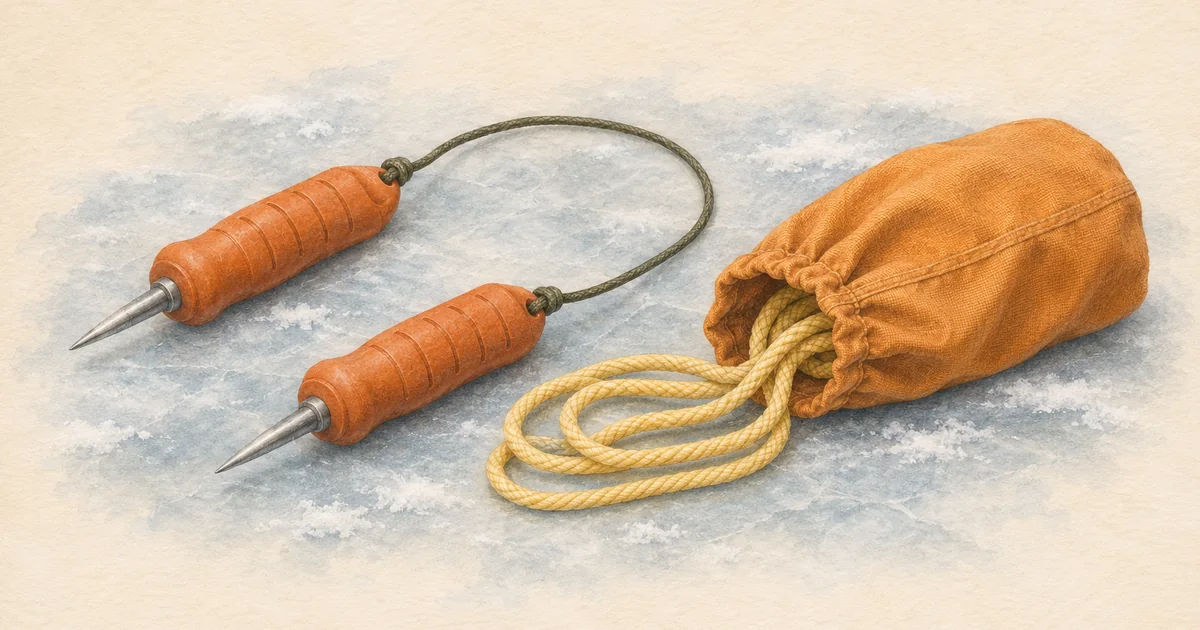
Ice claws are two handles with steel spikes that hang on a cord around your neck. If you fall through, you drive the spikes alternately into the smooth edge of the ice and pull yourself out. They go together with an ice prod that tests the ice ahead of you, a floating throw line and a companion who can throw it.
In an emergency: 112 According to the DLRG, this number reaches the ambulance service and fire brigade around the clock. What to do after a rescue from the ice is covered under Walking on ice.
One device, many names
An ice pick set, as described in an article in Blinker, consists of two handles with steel nails set into them. Each handle hangs on a cord that you wear around your neck, and the points are covered when the handles sit in their holder. In Scandinavia almost every ice angler has one, the magazine writes. The same device is also called ice claws. Elsewhere Blinker calls them rescue spikes and hand spikes, while the Wasserwacht Bayern speaks of ice picks (Eispicker) and counts them as personal equipment. In Sweden they are called isdubbar.
They are needed for one single moment. According to Blinker, the broken edge is as smooth as glass: anyone who tries to support themselves without aids slips off again and again, or the edge breaks away. At the same time, time is short. According to the DLRG, just a few minutes in ice-cold water make your limbs so stiff that any attempt to rescue yourself fails. With two spikes in your hands you have grip where your fingers find none.
Terms: On this page, ice claws means the handles with a spike for your hands. The ice prod (Eispickel) is a staff with a point that you use to test the ice ahead of you. The Wasserwacht calls the claws ice picks (Eispicker), not to be confused with the prod.
Wearing and releasing ice claws
The claws are only worth something if you can find them immediately in the water with cold hands. The Swedish ice safety council, in which the Swedish life saving society, the sea rescue service and the anglers’ association Sportfiskarna work together, among others, gives precise advice on this:
- High and on the outside: The claws hang high on your neck over your jacket, within easy reach under your chin while ice fishing. Under your jacket you will struggle to reach them with gloves on.
- Whistle: A plastic whistle without a pea belongs on the claws, because a pea can freeze in place. A whistle makes it easier to summon help than your voice.
- Releasing: Flip the claws forwards so the cord unwinds from the handle, one after the other. Keep your gloves on while you do this.
- Grip and strike: Take each handle in your full fist; your thumbs may rest on top of the handle. Strike at an angle backwards, with the point facing slightly towards you.
The handles do not get in the way while fishing when they hang around your neck plugged together. In an emergency, according to Blinker, you pull them apart with one jerk. The ice safety council advises practising: release the claws with gloves on, place them on the ice and pull yourself forward a little with them. That way the grip is second nature when it matters. At the same time it warns that not everyone gets out of the hole, even with claws.
Note: This page reflects what the DLRG, DRK, Wasserwacht and the Swedish ice safety council publish. It does not replace training in self-rescue and ice rescue or medical advice. In Sweden, the life saving society shows at demonstrations how to fall into an ice hole under supervision and get out again. Ask your local DLRG or Wasserwacht whether they practise ice rescue.
Self-rescue after falling through
The steps combine the guidance of the DRK, DLRG, Wasserwacht Bayern and the Swedish ice safety council:
- Spread your arms and call out: The DRK advises spreading your arms immediately so that you do not go under the ice. Then shout loudly for help or blow your whistle. Keep your clothes on (Wasserwacht Bayern).
- Turn towards the way back: Face the side you came from. The ice held you there, the ice safety council writes. The ice-cold water hurts a lot, which is why the DLRG urges you to gather all your strength against panic.
- Release the claws: one after the other, gloves on.
- Drive in the spikes and pull yourself up: According to Blinker, you drive the spikes into the ice one after the other and pull yourself out bit by bit. Keep your elbows close to your body (ice safety council). Training material from a local DLRG group mentions front-crawl leg kicks with which the person who has fallen in supports the rescue.
- If the edge breaks: Break off the thin ice towards your way back until it holds again, then push or roll yourself flat onto it, on your stomach or back (DLRG, DRK).
- Stay flat: Crawl well out onto ice that holds before you stand up (ice safety council). If that does not work, the Wasserwacht Bayern advises staying calm and moving as little as possible.
- Afterwards: Hypothermia can be life-threatening, so an emergency doctor should be called after the rescue (DLRG). According to the ice safety council, anyone who is chilled through needs dry clothes quickly; according to the Wasserwacht Bayern, you only take off the wet ones once you are somewhere warm. How helpers should look after a hypothermic person is covered under Walking on ice.
Ice prod: testing the ice ahead of you
The ice prod is a staff with a sharp point, called ispik in Swedish. According to the ice safety council, it should float and still have a certain weight. A ski pole is usually too light to judge the ice with. Every group on the ice should carry at least one prod.
This is how you use it: strike the ice firmly ahead of you, often, and every time the ice changes colour, shape or sound. If water rises into the hole, the ice is too weak; turn back or take a different route. In an emergency the prod serves as an extended arm to help someone out of the hole.
Many ice anglers measure the thickness with their ice auger. Where the ice may be weak, the ice safety council recommends supplementing the auger with a prod or the heavier ice chisel with a chisel point, which experienced anglers like to take onto spring ice. According to Blinker, you drill test holes every few metres on fresh ice, because it can be 20 centimetres thick at the bank and 3 in the middle. As a guide value for going onto the ice, the DLRG gives 15 centimetres of ice on a lake and 20 on flowing water. Thickness alone is no guarantee; Walking on ice explains the weak spots.
Throw line: rescuing from a safe distance
Even with claws it is hard to get out of an ice hole on your own, writes the ice safety council. Then a companion with a line helps. It describes a 23-metre floating line in a throw bag whose softly padded weight allows long throws and does not hurt the person it hits. Every group should carry at least two lines, better still one each. The line sits in a side pocket of the rucksack or is fixed to the outside with an elastic band, with its loop hanging on the shoulder strap. You need to be able to reach it even if you are in the water yourself.
According to the DLRG, a lifebuoy or rescue ball on a line is even better than boards, ladders or branches held out in an emergency. Training material on ice rescue from the DLRG local group Furth im Wald gives three rules for throwing: throw the line beyond the person in the water, not at them; secure the end of the line; and wear waterproof, warm gloves on land, because a wet line is almost impossible to hold with bare hands in the cold. More on the throw bag and lifebuoy under Rescue throw line.
Practice pays off; it usually takes a few throws before you get the swing right. If a throw misses, the ice safety council says not to stuff the line back into the bag first, because that only costs time.
Shoe spikes, buoyancy and phone
According to the ice safety council, clear ice is often too slippery to walk on comfortably without spikes. Blinker says spikes on your soles give you a secure footing on the ice. The Wasserwacht Bayern names spikes on the shoes and ice picks as aids when helpers have to work their way laboriously towards the hole on a sledge or ladder. Fishing shoes and boots covers warm footwear for long hours sitting at the hole.
Anyone who stays on the surface is easier to rescue. According to the ice safety council, a vest gives the most buoyancy, ideally a lifejacket that also keeps an unconscious person’s head above water. As further buoyancy aids it names a flotation suit or a rucksack with a change of clothes packed watertight. The rucksack then needs a hip belt and a crotch strap, otherwise it rides up and pushes your face under water. Thermal suit and flotation suit and Lifejacket explain suits and vests.
Keep your phone in a waterproof case, as high up on your body as possible. In severe cold, batteries can fail, so carry it close to your body; a power bank helps (ice safety council). Tell someone beforehand where you are going onto the ice and when you will be back, the council advises in its ice rules.
| Tackle | What for | How to carry it |
|---|---|---|
| Ice claws with whistle | pull yourself out of the hole | on the outside around your neck, under your chin |
| Ice prod | test the ice ahead of you, hold it out to others | in your hand while walking |
| Throw line in a bag | rescue others from a distance | rucksack pocket, loop on the shoulder strap |
| Shoe spikes | grip on clear ice | under your shoes |
| Vest or flotation suit | stay on the surface | worn, straps fastened |
| Phone | Emergency number 112 | waterproof, close to your body |
Checklist before going onto the ice
- Not alone: the DLRG says never go onto the ice alone. According to the ice safety council, anyone on their own rarely gets out of the hole unless they are strong and well trained.
- Someone on land knows where you are and when you will be back.
- Asked the responsible authority whether the ice will hold (DLRG). Whether you may go onto the surface and fish there is governed by the state, the municipality and the water rules, see Ice fishing.
- Ice thickness checked at the bank and along the way and compared with the DLRG guide values.
- Ice claws on the outside around your neck, with a whistle without a pea attached.
- Ice prod in your hand, throw line within reach, at least two in the group.
- Vest or flotation suit on, spikes under your shoes.
- Phone charged and packed watertight, a change of clothes in a waterproof bag (ice safety council).
- Weather forecast read: strong wind can break up the ice on large lakes, and rain or strong sun weaken it quickly (ice safety council, ice fishing).
Mandatory equipment lists the tackle your federal state requires when fishing.
Common mistakes
- Claws under your jacket: With gloves and cold fingers you will not find them there. They belong high on your neck, on the outside.
- Whistle with a pea: The pea can freeze in place, and then the whistle stays silent. The ice safety council advises a whistle without a pea.
- Ski pole instead of a prod: A ski pole is usually too light to judge the ice. The prod needs weight and must float.
- Following others: Check the ice yourself, even if other anglers are already sitting out there, the ice safety council advises.
- Rucksack without straps as buoyancy: Without a hip belt and crotch strap it rides up in the water and can push your face under.
Frequently asked questions
Are ice picks and ice claws the same thing?
Yes. Both names mean two handles with a spike on a neck cord. The Wasserwacht Bayern speaks of ice picks (Eispicker), Blinker also of rescue spikes and hand spikes. This page calls the staff for testing the ice an ice prod.
Can I go onto the ice alone with ice claws?
The DLRG advises never going onto the ice alone. According to the ice safety council, self-rescue is not guaranteed even with claws; a companion with a throw line can make the difference and make the emergency call.
How thick does the ice need to be before I go onto it?
The DLRG gives 15 centimetres for a lake and 20 for flowing water. Thickness varies within a single water, so keep checking as you go. Background information is under Walking on ice.
Do I need a lifejacket on the ice?
The Swedish ice safety council counts a buoyancy aid as part of the equipment on the ice and names the vest as the most effective. Whether a set of water rules requires one is stated there and in the fishing permit.
Related
- Walking on ice: guide values, weak spots and help for people who have fallen through
- Ice fishing: tackle, bait and rules at the ice hole
- Ice auger: drilling holes and measuring ice thickness at the same time
- Rescue throw line and lifebuoy: help from the bank
- Thermal suit and flotation suit: protection from the cold and minutes in cold water
- First-aid kit for fishing: what belongs in the bag
- Line calculator: breaking strain of the fishing line for the ice rod
Sources
- Issäkerhetsrådet (schwedischer Eissicherheitsrat): Isdubbar, Ispik, Räddningslina, Flythjälp, Mobiltelefon, Om isen brister, Isvett, Isfiske, Promenad på is, Om Issäkerhetsrådet (Tragen und Gebrauch der Krallen, Pickel, Leine, Auftrieb, Telefon, Selbstrettung, Mitglieder des Rats)
- DLRG: Selbstrettung bei Eisunfällen, Fremdrettung, Notruf richtig absetzen, Eisregeln (Plakat) (Ablauf der Selbstrettung, Rettungsring mit Leine, 112, Eisdicke, nie allein)
- Deutsches Rotes Kreuz: Betreten von Eisflächen (Arme ausbreiten, Eis Richtung Rückweg abbrechen)
- Wasserwacht Bayern, Faltblätter: Eisregeln, Winterliche Gewässer, beide Stand 2008 (Eispicker als persönliche Ausrüstung, Spikes, Verhalten nach dem Einbruch)
- DLRG-Ortsgruppe Furth im Wald: Ausbildung Eisrettung (PDF beim Kreisfeuerwehrverband Cham) (Werfen der Leine, Handschuhe, Kraulbeinschläge)
- Blinker: Sicherheit beim Eisangeln, Eisangeln: Heiße Tipps (Aufbau und Einsatz der Krallen, Schuhspikes, Probebohrungen; Praxisrat einer Angelzeitschrift)
Text AI-assisted, drawings AI-generated. Sources opened and checked in November 2026, Swedish sources translated by meaning, no graphics taken from the sources.
All information is a guide only, without guarantee. No equipment makes thin ice safe, and this text replaces neither training in ice rescue nor medical advice. In an emergency, call 112.