
Knowledge · Tackle
Lifejacket: Buoyancy for boat, jetty and wading anglers
A lifejacket keeps you afloat after a fall into the water, but only a rescue jacket is built to turn you onto your back. Here you will find the buoyancy levels under ISO 12402, the difference between inherently buoyant and automatic jackets, the quick check at the trigger, fit and crotch strap, servicing, and the situations in which anglers should wear one.
Buoyancy aid and rescue jacket
In everyday speech anything with buoyancy is called a life jacket, but the specialist bodies separate two groups. According to the DGUV, the German Social Accident Insurance, a rescue jacket turns you onto your back by itself and keeps your airway clear. With a buoyancy aid you have to hold your head up under your own power. It is not unconsciousness-safe, so it does not keep an unconscious person’s mouth and nose above water.
Buoyancy is given in newtons (N); the DGUV equates 10 N with about 1 kg. The DIN EN ISO 12402 series has four levels, and each has its own part: part 5 for the buoyancy aid with 50 N, part 4 for 100 N, part 3 for 150 N and part 2 for 275 N. This is how the Federal Ministry of Transport classifies them. According to the DGUV, rescue jackets have at least 100 N; anything below that is only a buoyancy aid. The minimum values apply to wearers from 70 kg; for lighter people and especially for children they are correspondingly lower.
Since the body has almost the density of water, the jacket mainly has to lift the head above the waterline. According to ISO, part 5 of the standard describes buoyancy aids for adults and children over 25 kg in sheltered waters. They require the wearer to help themselves, because help and rescue are close at hand.
| Class | Species | Intended for | Unconsciousness-safe |
|---|---|---|---|
| 50 N (part 5) | Buoyancy aid | swimmers in sheltered waters, help close by | no |
| 100 N (part 4) | Rescue jacket | sheltered waters and inland waters | limited |
| 150 N (part 3) | Rescue jacket | all waters, including the sea with oilskins | yes or only conditionally, depending on the source |
| 275 N (part 2) | Rescue jacket | offshore, extreme weather, heavy protective clothing | yes, almost always with heavy clothing |
The areas of use are given by the Federal Ministry of Transport and the sea rescue service. At 150 N the sources differ: the sea rescue service calls this level safe for unconscious wearers, while the DGUV writes “only conditionally” for inflatable 150 N jackets. For work, the DGUV requires at least 150 N. For sport and leisure it does not recommend automatic jackets with 100 N.
Inherently buoyant jackets, automatic and manual inflation
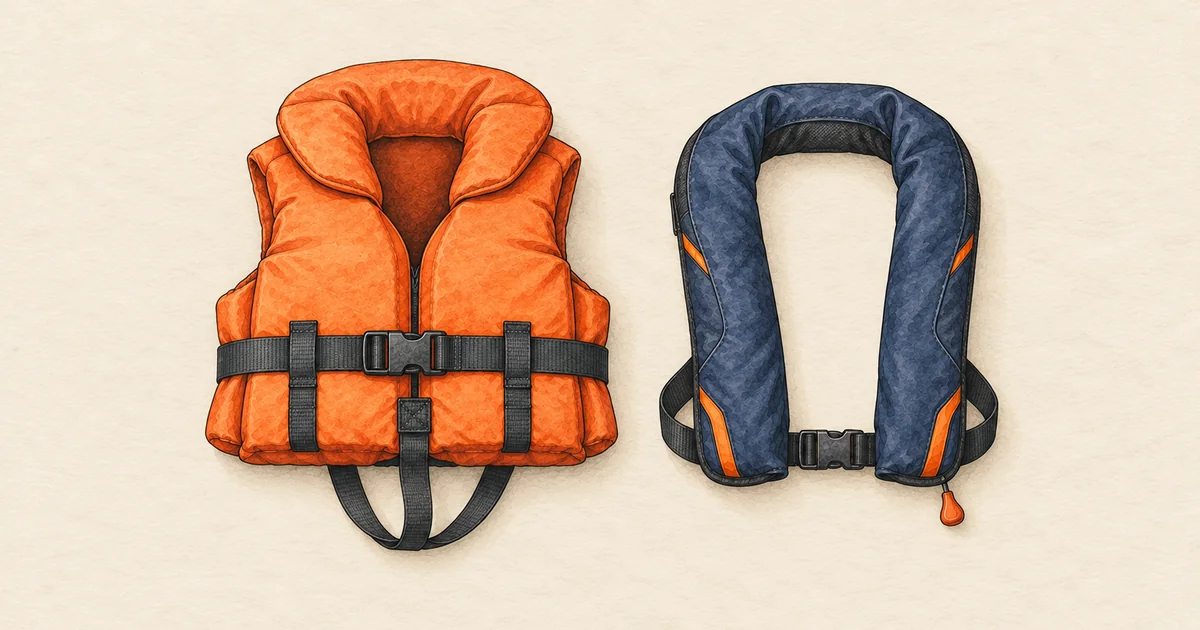
The inherently buoyant jacket carries its buoyancy inside as foam. It is always there, even if you fall into the water dazed, and foam is less sensitive than an air chamber. In return the jacket is thick and restricts movement. The DGUV calls inherently buoyant rescue jackets with 100 and 150 N only conditionally safe for unconscious wearers: anyone who falls into the water unconscious and face down lies with mouth and nose under water. Level 100 is tested in swimwear and turns a fully clothed wearer noticeably worse.
The inflatable jacket lies folded in a protective cover. When it is immersed, the trigger opens the gas cartridge, which the sea rescue service calls a CO2 cartridge, and the buoyancy chamber fills. According to the DGUV you float back to the surface after a few seconds; rain or damp air do not set off the automatic.
The cover of the air chamber is thin and can quickly be damaged on stones, rocks or branches. For this reason the DGUV considers inflatable jackets unsuitable in white water. Jackets that only inflate by hand via a pull cord do not help unconscious people. After a fall, a head injury, disorientation or cold shock with uncontrolled hyperventilation can prevent you from pulling it.
| Design | Buoyancy | Unconscious-safe according to DGUV | Limit |
|---|---|---|---|
| Inherently buoyant, 100 and 150 N | always there, as foam | only conditionally | a lot of volume, little freedom of movement |
| Automatic, 100 N | after a few seconds | generally in swimwear | not recommended for leisure |
| Automatic, 150 N | after a few seconds | only conditionally | Build and equipment count too |
| Automatic, 275 N | after a few seconds | yes, once inflated | cover sensitive to stones and branches |
| Manual inflation | only after pulling the cord | not guaranteed | an unconscious person cannot trigger it |
The DGUV also names accessories: an oral inflation tube as a back-up, a signal whistle, reflective strips and an emergency light that makes a person in the water easier to find. Anyone fishing at night can choose an emergency light, according to the DGUV. Some jackets can be retrofitted with an automatic lock-out. It blocks the automatic release on contact with water and turns the automatic jacket into a manually inflated one, with all the limits shown in the table.
Trigger, cartridge and quick check
Before every use, an automatic jacket gets a quick check. In its example the DGUV shows three questions with a red and green indicator: manual release lever secured, automatic tablet present, cartridge screwed in correctly. If the jacket has a viewing window, you read the indicators from outside. Without a window you have to open the cover. How exactly the quick check works is in your jacket’s instructions. The DGUV requires it according to the manufacturer’s specifications.
The indicators do not always tell you whether the cartridge is still full. To find out, you unscrew it and look at the end face of the thread: if it is intact, the cartridge is full; an empty one has a hole there. After triggering, the jacket needs a new cartridge according to the sea rescue service, and with an automatic jacket a new automatic tablet as well. In occupational safety only a specially instructed person may make the jacket ready for use again. In private use you are left with the service station or the manufacturer’s procedure.
Fit, weight, crotch strap and clothing
Every jacket has a maximum permitted body weight; above it, according to the Ministry of Transport, a safe position is no longer guaranteed even with tested jackets. The DGUV advises paying attention to the length of the waist strap when buying. Besides the standard length there are shorter and longer versions, and the adjustment range is printed on the jacket. According to the DGUV, good fastenings are ones you can open and close with one hand, similar to a car seat-belt buckle. Complicated fastenings may not be closed properly, and then the jacket does not protect you.
For children the sea rescue service gives a rule of thumb: if you can lift a correctly adjusted jacket at the shoulders by more than 2,5 cm, it is too loose.
Air under closed weatherproof clothing can work against the back position; the DGUV then considers 275 N necessary in occupational safety. Tool belts and bags slung over the shoulder also require more buoyancy. Wet clothing, on the other hand, generally does not pull you down according to the DGUV and the Ministry. Waders are closed, waterproof clothing. None of the sources checked quantifies how much air they hold in the water or how they change the turn onto the back.
When combining with other equipment, the DGUV names one point to check: with inflatable jackets, the interaction of the inflated buoyancy chamber with the rest of the protective equipment has to be considered. As an example it gives the straps of a fall-arrest harness, which can prevent inflation. Applied to angling, that means: try on the bank whether rucksack straps, a net lanyard or the belt of waders and wading jacket would trap the buoyancy chamber when it inflates. You will find the combination with jacket and belt under Wading jacket and Wading belt.
The crotch strap runs between the legs and gives the jacket hold in the water. Without a crotch strap a jacket can slide over the head when someone is pulled up, especially if the casualty raises their arms. The BSU, the Federal Bureau of Maritime Casualty Investigation, records this in an investigation report. The DGUV also names drawbacks: the loops are less comfortable and can snag.
Check, service, store
For maintenance the sea rescuers advise:
- Inflate with a hand pump about every six months and check the next day that it is airtight.
- Look over folds, straps and fasteners, and check the cartridge for fill level, tight fit and rust.
- After salt water, rinse with tap water and dry thoroughly.
- Every two years to a certified service station. The DGUV gives the same interval as a rule for jackets used at work.
- Store dry and well ventilated; in winter, lightly inflated on a hanger without metal.
With an inherently buoyant jacket a visual check before use is enough. According to the DGUV, the buoyancy bodies themselves are tested regularly, in operation for example annually at the start of the season. Damaged inherently buoyant jackets should be taken out of use. According to the DGUV the jacket is also not suitable as a seat cushion, as the foam can suffer. For inland vessels with an operating licence the DGUV requires a documented check at least annually for automatic jackets and, as a rule, servicing by the manufacturer or a specialist workshop every two years.
Quick check before casting off: indicators on the trigger green, cartridge tight, waist belt closed, crotch strap clipped in. On the inspection tag a notch marks, according to the DGUV, as a rule the month of the next service.
Boat, belly boat, jetty and wading
How often jackets lie on board instead of on the body is shown by the BSU: for 2003 to 2016 it records that none of the anglers who survived a capsize or sinking while fishing, injured, was wearing a life jacket. The checklist for casting off is under Boat and life jacket.
On the Schlei, the Schleswig-Holstein water police found fault with 103 of 276 boats checked in the 2010 herring season, according to Fisch & Fang, among other things for missing jackets. For jetty and bank the sources give no fixed rule. According to the DGUV, employees should wear the jacket wherever a fall into the water is possible. The Irish water safety authority Water Safety Ireland writes for anglers in general: wear a lifejacket on and near the water. On undercut or steep banks and in current this is especially worthwhile, see Bank and waders.
In a belly boat, an inflatable float seat, you sit in the water in waders and fins, and a fall into the water is possible at any moment. So the DGUV principle applies: wear a jacket where a fall is possible. More on the boat under Belly boat.
For wading, no recommendation of its own was found from the DLRG or German authorities. The British accident prevention society RoSPA advises a lifejacket when wading in its safety code for anglers. The University of Auckland requires one for its field work in water above knee height, and the New Zealand Department of Conservation DOC mentions fishing vests that inflate via a pull cord. That is manual inflation, and the DGUV names its limit: an unconscious person can no longer pull it. An automatic jacket, on the other hand, inflates on immersion, and its thin air chamber suffers on stones and branches. No source says whether it already inflates from a wave when wading. For deliberate contact with water the DGUV describes manual inflation and the retrofittable automatic lock-out, each with the drawback that protection is missing if you are unconscious. What matters when wading itself is under Waders, Wading belt and Bank and waders.
On the obligation, the BSU wrote in 2017 that for sport anglers there is no rule requiring a life jacket to be worn. More may apply locally: the Ministry of Transport names a life jacket requirement for some waters on which houseboats with a charter certificate travel. What applies on your water is governed by the shipping authority, the water regulations (Gewässerordnung) or the boat hire firm. Ask there or read the fishing permit (Erlaubnisschein).
Common mistakes
- The jacket lies in the locker. In the water a jacket is hard to put on, says the US National Park Service NPS, and on the bank or in the boat you may not be able to reach it after a fall.
- Mistaking a 50 N buoyancy aid for a rescue jacket. It does not keep your head up by itself. Look at the newton figure and at the CE mark or the helm symbol that the Ministry names when buying.
- Crotch strap open or not there at all. Then the jacket can slide over your head if someone pulls you out of the water by it.
- Simply putting the triggered jacket back on. Without a new cartridge and tablet it is useless at the next fall.
- Skipping the quick check. A cartridge with a hole in the end face is empty, and the indicators do not always show this.
- Not allowing for weight and clothing. Above the permitted body weight, or with a lot of air under thick rain gear, the buoyancy may not be enough for the back-floating position.
Frequently asked questions
Does an automatic jacket go off in the rain?
According to the DGUV, no. Heavy rain and high humidity do not set it off; it reacts to immersion. For deliberate contact with water, the DGUV describes jackets with manual release and a retrofittable automatic lock.
Is a 100 N jacket enough on a gravel-pit lake?
The Ministry names 100 N for sheltered waters and inland waters. The DGUV points out that this class is tested in swimwear and does not recommend automatic jackets of 100 N for leisure. The sea rescuers describe 150 N as the class for all waters.
Do children need a jacket of their own?
Yes. According to the DGUV, children’s jackets are cut for the small body and do not ride up in a fall. The sea rescuers stress that size and weight must suit the child.
How do I tell that the cartridge is empty?
The indicators on the trigger do not always show it. Unscrew the cartridge: according to the DGUV it is full if the end face of the thread is intact, and empty if there is a hole.
How often does an automatic jacket need servicing?
The sea rescue service recommends a certified service station every two years, and the DGUV generally gives the same interval for work use. The manufacturer’s instructions are decisive. On top of that comes the quick check before every use.
Related
- Boat and life jacket: checklist before casting off, clothing, children on board
- Children’s rod and fishing with children: tackle and rules for the first day at the water
- Fishing from a boat and a charter boat: minimum equipment and licence for a small boat
- Belly boat: set-up, wind and rules on the lake
- Waders: types, soles and safe wading depth
- Wading belt: the belt that closes the waders at the top
- Bank and waders: current, weirs and undercut banks
- Line calculator: breaking strain and backing for the reel
Sources
- DGUV Information 212-004: Rettungswesten und Schwimmhilfen, Juli 2022 (Stufen, Bauarten, Kleidung, Schrittgurt, Kurzcheck, Patrone, Wartung)
- BMDV, BSH, WSV: Sicherheit auf dem Wasser, Dezember 2023 (Teile der Norm, Stufen nach Einsatzgebiet, Körpergewicht, Kennzeichnung, Rettungswestenzwang)
- Die Seenotretter (DGzRS): Sicherheitsausrüstung auf See (Stufen, Kinderwesten, Pflege und Wartung)
- ISO 12402-4:2020, Teil 4 (Stufe 100), ISO 12402-3:2020, Teil 3 (Stufe 150) und ISO 12402-5:2020, Teil 5 (Schwimmhilfe, Stufe 50) (Titel und Anwendungsbereich der Normteile)
- BSU: Untersuchungsbericht 262/14, Untergang des Fischkutters ANDREA, 2017 (Auswertung 2003 bis 2016, Tragepflicht)
- BSU: Untersuchungsbericht 143/11, Segelyacht SPECIAL ONE vor Fehmarn, 2012 (Weste ohne Schrittgurt)
- Water Safety Ireland: Angling (Rettungsweste auf und nahe am Wasser), Department of Conservation Neuseeland: Wading safety (Angelwesten mit Reißleine) und University of Auckland: Rivers, Streams, and Wading (PDF) (Weste ab Kniehöhe beim Waten)
- Fisch & Fang: Aktion „Anglersicherheit 2011“ (Kontrollen der Wasserschutzpolizei an der Schlei), U.S. National Park Service: Reel It In, Be Prepared for a Successful Fishing Day (Weste am Körper, im Wasser kaum anzulegen) sowie RoSPA: Angling Safety Code (PDF) (Rettungsweste beim Waten)
Text AI-assisted, drawings AI-generated. Sources opened and checked in November 2026, no graphics taken from the sources.
All figures are rough guides without guarantee and replace neither medical advice nor the instructions for your jacket. In an emergency call 112.