
Knowledge · Tackle
Wading belt: Why it belongs with every pair of waders
A wading belt is fastened on the outside around the waders and limits how much water runs in if you fall. It does not make the waders watertight and does not keep you afloat. Here you will find what specialist sources credit it with, where its limits are, how it should sit and how to behave if you are lying in the current.
What the belt does in a fall
If you slip while wading or a wave rolls over the top, water runs into the waders from above. Without a belt it has a free path down to the booties. Blinker therefore counts a snug-fitting wading belt as basic kit for both hip waders and chest waders: it reduces the amount of water that gets in during a fall.
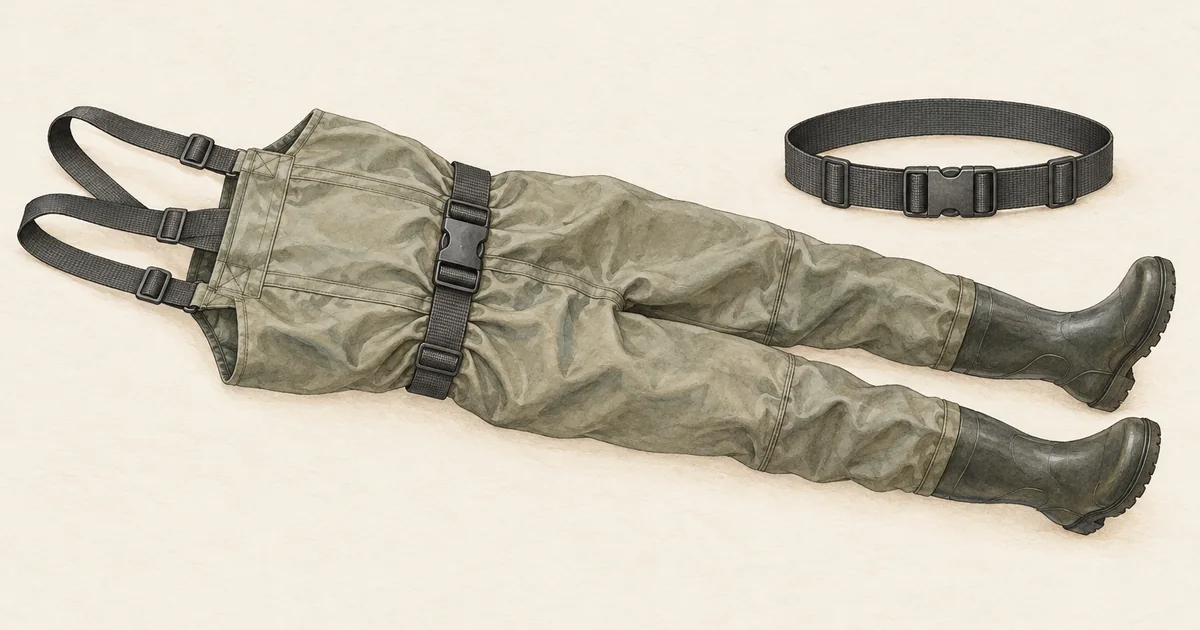
The British Royal Society for the Prevention of Accidents, RoSPA, describes the same effect a little more precisely in its safety code for anglers. The belt slows the inflow into the waders. As a result less extra weight hangs on your legs and it is easier to get out of the water.
Both sources speak of slowing and reducing, neither of sealing. A strap around the fabric is not a seal. None of the sources used here quantifies how much water still runs in despite a belt. Several bodies describe effect and fit in their own words:
| Where | Effect according to the body | Fit according to the body |
|---|---|---|
| RoSPA (United Kingdom) | slows the inflow, less weight on the legs, easier to get out | not stated |
| DOC (New Zealand) | keeps water out of the lower half of the waders, helps with floating | snug around waist or chest |
| University of Auckland | limits the amount of water that gets in during a fall | over the waders, waist or higher |
| Virginia DWR | stops the lower half filling if you go under | around the waist |
| Spoon | less water in the waders during a fall | fitted firmly |
Why full waders become dangerous
Water in the waders is heavy. Anyone who wants to get back on their feet or into the boat with waders full of water has to haul that weight with them. In its safety guidance the University of Auckland writes that filled waders become unwieldy and the risk of drowning is much higher than without waders. The Virginia fisheries authority compares flooded waders in fast current with a sail that can pull the wearer in any direction.
In connection with floods, the DLRG warns that inexperienced people can hardly free themselves from waders full of water. What that means for choice of bank and current is under Bank and waders. None of the sources names a procedure for getting rid of full waders in the water.
Buoyancy is also addressed in the sources. The DOC writes that a tightly drawn belt helps with floating. The University of Auckland advises that, if you fall into deeper water, you pull your knees to your chest, which traps air in the waders, and then roll onto your back. No source quantifies how much buoyancy this gives. Whether a wading belt prevents waders full of water from pulling the wearer down is likewise not stated by any source. When wading, RoSPA names the lifejacket first.
Fit and tension
The belt sits on the outside around the waist of the waders. The University of Auckland requires it over the waders at waist height or higher, and the DOC describes it as snug around waist or chest. What matters is that it sits firmly. A strap hanging loose over the stomach or stuffed open in a pocket slows hardly anything. No source quantifies exactly how tight, for example by fingers under the strap. So fasten it on the bank before you take the first step into the water, because after a fall there is no time for it.
If the waders do not fit, even the best belt helps little. The DOC requires the right boot size, a leg length that is neither too long nor too short, and the right chest circumference. According to the DOC, a jacket over the waders also limits water getting in; more on this under Wading jacket.
Accessories can also be secured to the belt. Sea trout anglers on the coast attach the landing net to the wading belt with a bungee cord so that it is ready when landing. The page Wading landing net explains the holder and the lanyard. The Virginia fisheries authority also names the wading staff, which can be attached to the belt, and advises a signalling device such as a whistle. Most wading belts have mounts for safety equipment, it writes.
Belt and life jacket
A belt does not carry you. For this reason RoSPA lists two separate points in its code for wading: first a lifejacket, because it can turn an unconscious person in the water face up, then the wading belt. The University of Auckland requires the jacket for its field work in water above knee height. The US National Park Service NPS advises anglers to keep the jacket on in, on and beside the water. If it lies on the bank or in the boat, you may not reach it after a fall, and in the water, according to the NPS, it can hardly be put on.
Which kinds of jacket there are and how to check an automatic jacket is under Lifejacket. When putting your kit together, the DGUV check point applies: with inflatable jackets, the interaction with other equipment can obstruct inflation. So try on the bank whether straps and accessories on the belt trap the buoyancy chamber. Anyone fishing from a boat in waders will find advice on weather and capsizing under Boat and lifejacket.
After a fall in the current
If you lose your footing in a river, you do not swim against the current. The DLRG calls this exhausting and rarely successful. It is better to let yourself drift and work your way diagonally with the water towards the bank, even if you drift quite a way. The DOC describes the same: turn onto your back, feet downstream, toes out of the water, paddle with your arms and aim for a place to get out.
When your strength fades, the DLRG advises lying on your back: feet and eyes pointing downstream, steering with your arms. You avoid bridge piers, rocks, bushes and trees in the water. Eddies form in front of and behind such obstacles, and according to the DLRG a branch can pull a swimmer in and push them under the surface.
The RoSPA code starts one step earlier. Anyone who falls into the water unexpectedly should first lie on their back with arms and legs stretched out until they calm down and have their breathing under control. Only then do they call for help or swim to safety. According to RoSPA, this explicitly applies in waders too.
Note: These rules of behaviour reflect what the DLRG, RoSPA and authorities recommend. They replace neither swimming or rescue training nor medical advice. In an accident at the water, call 112.
Obligation or recommendation
None of the sources on this page names a regulation on the wading belt. In guidance from the specialist press, authorities and associations it appears as a recommendation; the University of Auckland prescribes it for its own field work, a rule of the university and not a law. Whether a water by-law or your fishing permit requires anything about equipment at the water is stated there itself, more in Fishing permit. It is similar with the jacket: for recreational anglers there is no regulation requiring a lifejacket to be worn, the BSU wrote in 2017; more may apply locally.
Common mistakes
- Wearing the belt loose or open. It works only when fastened tightly, and that has to happen before you get into the water.
- Taking the belt for a buoyancy aid. RoSPA lists the life jacket and the wading belt as two separate points. Only the jacket keeps your head above water.
- Wading too deep. The Irish water safety organisation Water Safety Ireland advises at least 30 cm between the water surface and the top edge of the waders. If the water gets so deep that you float, you lose your footing, according to the DOC. Further guide values are under Waders.
- Going into the water alone and without a wading staff. RoSPA recommends fishing with a second person and considering a wading staff, which gives support and finds obstacles under the water.
- Swimming against the current. According to the DLRG that costs a great deal of strength and seldom gets you to the bank.
Frequently asked questions
Do I need the belt with hip waders too?
Blinker counts it as basic kit for hip waders as well as chest waders. Water can run in over the lower top too in a fall.
Does the wading belt make the waders watertight?
No. It reduces the amount of water coming in and, according to RoSPA, slows the inflow. You must therefore still expect some water in the legs and booties, as Fig. 1 on the right suggests.
What do I do if the waders have already filled up?
RoSPA advises first lying on your back and calming down, then calling for help or swimming to safety. In a current the DLRG names the diagonal route with the water to the bank. According to RoSPA, a bystander does not jump in after them but calls the emergency number and throws something that floats.
Do waders with a belt replace the life jacket?
No. RoSPA recommends both when wading. Only the jacket keeps your head above water.
How tight must the wading belt be?
Snug around waist or chest and over the waders, as the DOC and the University of Auckland describe it. They give no measure for the tension. It is always fastened before you enter the water.
Related
- Waders: the waders themselves, from design to material and safe wading depth
- Lifejacket: types of jacket, quick check and what matters when wearing one
- Bank and waders: a secure stance, current, high water and wading staff
- Boat and life jacket: life jacket, weather and what to do after capsizing
- Wading net: how the net hangs on the belt and how you land fish in the water
- Wading jacket: the jacket over chest waders
- Sea trout: profile of the fish that wading anglers pursue on the coast
- Line calculator: working out breaking strain and backing for the reel
Sources
- Blinker: Wathose kaufen, so finden Sie das richtige Modell (fest sitzender Watgürtel bei hüft- und brusthoher Wathose, verringert die eindringende Wassermenge)
- RoSPA: Angling Safety Code (PDF) (Gürtel bremst den Zustrom, weniger Gewicht an den Beinen, leichterer Ausstieg; Rettungsweste beim Waten; Rückenlage nach einem Sturz, auch in Wathose; Verhalten von Helfern, Notruf 112)
- Department of Conservation Neuseeland: Wading safety (Gürtel eng um Taille oder Brust, Passform, Aufschwimmen, Verhalten im Fluss)
- University of Auckland: Rivers, Streams, and Wading (PDF) (Gürtel über der Wathose, Weste ab Kniehöhe, volle Wathose, Knie anziehen)
- Virginia Department of Wildlife Resources: Wade Well (Gürtel an der Taille, geflutete Wathose, Watstock am Gürtel)
- DLRG: Selbstrettung aus Strömungen (nicht gegen die Strömung schwimmen, schräg zum Ufer, Rückenlage mit Füßen stromab, Hindernisse meiden) und DLRG: Hochwasser (vollgelaufene Wathose)
- Blinker: Das erste Mal auf Meerforelle (Kescher an der Expanderschnur am Watgürtel)
- U.S. National Park Service: Reel It In, Be Prepared for a Successful Fishing Day (Rettungsweste auf, im und am Wasser tragen, im Wasser kaum anzulegen)
- Water Safety Ireland: Angling (mindestens 30 cm zwischen Wasseroberfläche und Oberkante der Wathose)
- DGUV Information 212-004: Rettungswesten und Schwimmhilfen (Wechselwirkung aufblasbarer Westen mit anderer Ausrüstung)
- BSU: Untersuchungsbericht 262/14 (keine Vorschrift zur Rettungsweste für Sportangler)
Text AI-assisted, drawings AI-generated. Sources opened and checked in November 2026, no graphics taken from the sources.
All figures are guide values without guarantee. How safely you wade depends on the water, the current, the water temperature and your kit; the text does not replace medical advice, in an emergency call 112.