
Knowledge · Tackle
Fishing hook: Shapes, sizes and points
A fishing hook is a bent piece of steel wire that carries the bait and holds the fish. Here you can read what its parts are called, how the size numbers work and which shape suits which bait and fish. On top of that comes what going barbless does for the fish.
Structure from eye to point
The Fischereiverein Löningen equipment guide breaks the hook down into head, shank, bend, point and barb. The head is an eye, that is, a closed loop for the line, or a flattened spade end. Fly hooks always have an eye; for pole fishing, spade-end hooks are the rule. Suitable knots are the spade-end hook knot and the snell knot.
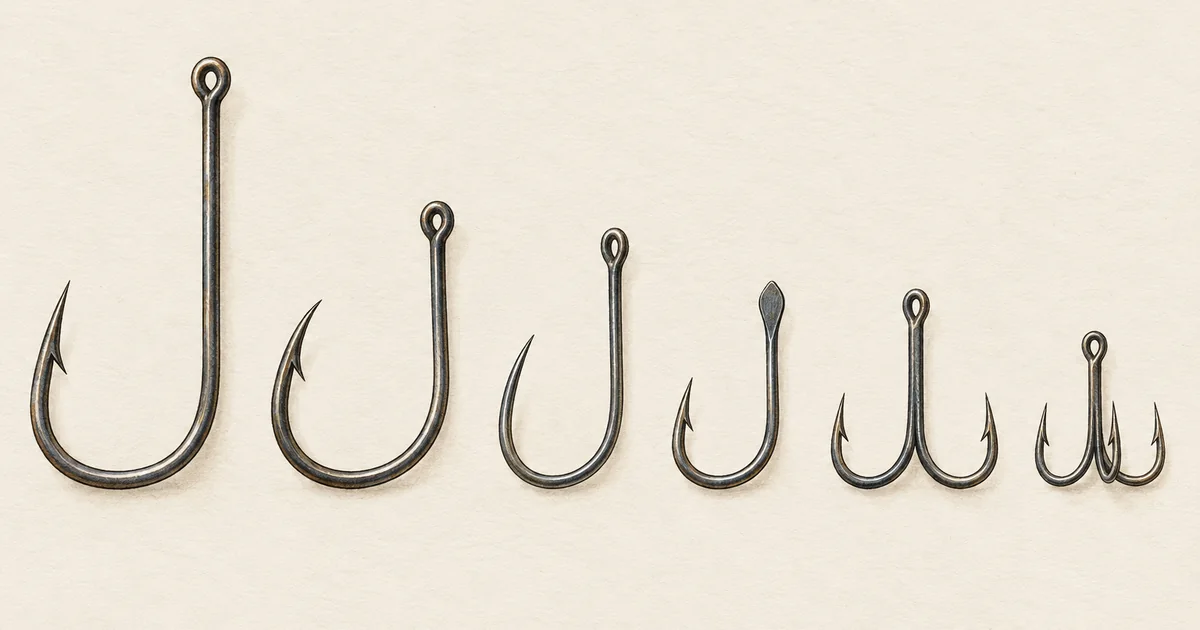
Behind the straight shank comes the bend, which runs out into the point. Shortly behind it, many hooks have the barb, a small spike pointing against the direction of penetration so that the fish cannot shake it off easily. Anglers call the distance between point and shank the gape; the DAFV eel brochure calls it the bend width. It determines how much bait and tissue from the fish’s mouth fits in. Hooks are made from round or flat steel, and the Löninger document names elasticity and a sharp point as the most important properties.
Single hook, double hook and treble
The single hook is what most often goes on the hooklength. Double hooks and trebles, that is, hooks with three bends and three points, are assigned to predator fishing in the exam materials. For cyprinids, the Bavarian exam questions require the single hook. A treble with potato or dough sits deep in the throat of undersized fish, it says there. How many hooks a rod may carry is set by state law. In Bavaria a treble counts as one biting point according to the official exam questions. See Law and permits.
Hook sizes: two number series
From 1 to about 20 the rule is: the higher the number, the smaller the hook. Above 1 it continues with 1/0, 2/0 and so on, and here the hook grows with the number. The Löninger document gives 5/0 to 2 as large, 3 to 10 as medium and 11 to 20 as small hooks. For the finest pole fishing for bleak there is even size 24.
There is no international standard. What one maker sells as 6/0 may be called 8/0 by the next. That is why there is no table of millimetres here; it would only be right for a single hook series. Compare numbers only within one series.
Which hook size for which fish?
The table collects what exam materials and the angling press give. Where several sources give figures, all of them are listed, because they are sometimes far apart. Take them as a starting point and go by the bait: for sweetcorn, a few maggots or a small worm the bend can be larger than for a bloodworm.
| Fish and fishing method | Hook size (source) |
|---|---|
| Bleak, dace, small roach when pole fishing | 16 to 22 (Blinker) |
| Bleak and gudgeon, ultra-fine pole fishing | up to 24 (Blinker) |
| Grayling on the fly | 18 to 20 (Bavaria) |
| Roach | 8 to 11 (Bavaria) 10 to 15 (Löningen) 12 to 18 (Saxony-Anhalt) |
| Perch with a small baitfish | 2 or 4 (Blinker) |
| Carp | 8 or larger (Bavaria) 4 to 8 (Löningen) 1 to 4 (Saxony-Anhalt) |
| Eel | large, closer to 1 than 6, or circle hook (DAFV) |
| Pike, dead baitfish on a treble | 2 to 5 (Löningen) |
| Pike on a treble, general | 1 to 3 (Saxony-Anhalt) |
| Pike, soft plastic on an offset hook | 5/0 as an example (Blinker) |
Without numbers, the question catalogue from Saxony-Anhalt divides fish into size classes: small single hooks for roach, rudd, common nase and grayling, medium ones for tench, chub, bream and barbel, large ones for trout, big carp and zander. It gives no numbers for these classes.
In principle, all agree: not smaller than necessary. Saxony-Anhalt gives as the reason that hooks that are too small are often swallowed too deeply.
Combining hook and line properly
A small hook belongs on thin line and a soft rod tip, a large one on strong line and a stiff tip. That is the rule in the question catalogue from Saxony-Anhalt. The Bavarian exam questions and the Löninger document give concrete pairs:
| Hook size | Line or hooklength (source) |
|---|---|
| 13 | Hooklength 0,12 mm (Bavaria) |
| 12 | Line 0,20 mm (Bavaria) |
| 10 to 15 (roach) | Line 0,15 to 0,20 mm (Löningen) |
| 5 | Line 0,30 mm (Bavaria) |
| 4 (carp among water lilies) | Hooklength 0,30 mm, mainline 0,35 mm (Bavaria) |
| 4 to 8 (carp) | Line 0,30 to 0,40 mm (Löningen) |
| 3 | Hooklength 0,35 mm (Bavaria) |
What the line still holds after the knot, you can work out in the line calculator.
Hook shapes and their uses
The best-known bend shapes are round bend and Limerick, both short- or long-shanked. The round bend describes a semicircle; the Limerick is slightly asymmetrical.
For bleak, dace and small roach, Blinker recommends long-shanked round-bend hooks made of very thin wire, usually 16 to 22. Bloodworms would leak out on thick wire. Big bream, carp, tench and barbel need heavy-wire hooks that do not open out in the fight, and short-shanked ones as well when fishing the feeder. The Bavarian exam questions also call for heavy-wire hooks for barbel and carp. The worm hook has small barbs on the shank that hold the worm in place.
With the offset hook, the shank is bent behind the eye. The soft plastic sits straight, and the point disappears into the material. It belongs to the Texas rig for weed and wood. For pike it should be heavy-wire with a wide bend, 5/0 in the example. Slim, soft lures release the point more easily on the bite than high-backed ones.
The circle hook has its point turned in sharply towards the shank. According to Rute & Rolle it comes from longline fishing, where nobody strikes. Instead of striking, you tighten the line by reeling briskly and raising the rod, and it then takes hold in the corner of the mouth. Petri-Heil cites a study on swordfish: with ordinary hooks the hook sat deep in 46 %, with circle hooks in 2 %. With the hair rig the bait hangs below the hook and the point stays free.
| Hook type | Typical bait | Example target fish |
|---|---|---|
| Long-shanked, very thin wire | Bloodworm, hemp seed | Bleak, small roach |
| Round bend, medium wire | Sweetcorn kernel, maggots, small worm | Roach, rudd |
| Short-shanked, heavy wire | Bait on the feeder | Bream, barbel |
| Offset hook | Twister, slim soft plastic | Pike, perch |
| Circle hook | Baitfish, worm | Pike, eel |
| Treble | dead bait | Pike |
| Barbless hook | Fly | Grayling, trout |
Without a barb: what the fish gets out of it
A hook without a barb is called a barbless or Jamison hook. Saxony-Anhalt considers it sensible for pole fishing and fly fishing. You can crimp down the barb of an ordinary hook with pliers.
Petri-Heil summarises an evaluation of mortality after capture: immediately after capture the type of hook plays a minor role; treble and single hook differed little. Barbed hooks, however, clearly did more damage. The bait had a stronger effect; figures on this are under Returning fish. The Bavarian exam questions take a stricter view of the treble and rate artificial lures with single hooks as gentler.
How much size matters is shown by studies by the Thünen-Institut on eel, described in the DAFV brochure on the 2025 Fish of the Year. Small single hooks of size 6 caught smaller eels, and these had swallowed the hook deeply more often than eels on size 1 or on the circle hook. The DAFV therefore advises large single hooks or circle hooks. With a bend width of more than 11 mm, the brochure says, at least every second eel caught can be made longer than 50 cm. If the hook is deep after all, you cut the line at the mouth: in the experiment, 41 % of the eels with a deeply swallowed size 6 had coughed it out after 163 days, and none with a size 2.
Rules: Whether barbless hooks are compulsory is governed by state law and the water rules. One example: the 2024 water rules of the Landesverband Sächsischer Angler allow only single-shank single hooks without a barb in salmonid waters, and even crimped barbs are expressly permitted there. What applies on your water is set out in the fishing permit (Erlaubnisschein).
Checking sharpness and touching up
New hooks are often chemically sharpened: after heating, an acid bath removes the thin point. If a hook stays in it too long, it becomes blunt and the shank can break in the fight. If it bends under even slight pressure, it belongs in the bin.
For the fingernail test, place the point on your fingernail. A sharp one catches, a blunt one slides off. Take care with a sudden jerk, Blinker warns, or the hook ends up in your finger, see Hook injuries and first aid. Rute & Rolle touches up blunt points with a whetstone or file, always towards the point and from all sides, under a magnifier and good light.
A hook usually gets bent open on a snag, especially on braided line. Many spinning anglers bend slightly bent hooks with a sharp point back with pliers; carp anglers replace them at once. A fully straightened hook cannot be saved.
Special hooks and accessories
Offset hooks for worms and soft plastics
All offset hooks have the Z-bend behind the eye, but otherwise they differ a great deal. A Blinker article on snag-free lure fishing names the points to look at when buying:
- Bend: narrow bends reminiscent of an eel hook are only meant for thin, worm-shaped soft plastics. For wide softjerks and swimbaits there is the wide-gap bend. The wider the lure, the wider the bend.
- Wire: strong wire does not open out when you pull a big fish out of timber or water lilies. But it makes the hook heavy, and delicate lures that are meant to sink slowly lose their action.
- Kirbed point: this is the sideways angle of the point, usually around 3 degrees on offset hooks. If the point only rests against the soft plastic, this means fewer missed bites. Delicate lures, on the other hand, tend to run a little unsteadily.
- Distance from eye to bend: short for small soft plastics, long for lures with a thick soft head such as tubes. A real lobworm also holds better on the long front shank.
- Eye and coating: if a hook has a large eye, very fine line can slip into the gap where the eye was bent closed. Under load it breaks there as if cut, which is why Blinker names closed eyes as an advantage for fine fishing. Uncoated hooks rust quickly; after a damp day’s fishing, condensation in the box is sometimes enough. For saltwater and scented lures, Blinker names a tin coating as more durable.
There are also offset hooks with lead on the shank. They weight swimbaits so that they do not rise when retrieved quickly. According to Blinker they do not belong on the Texas, Carolina or drop-shot rig. On the Texas rig the lead slides down to the hook, on the Carolina rig a swivel keeps it away. The sizes by lure length are on both rig pages. For the Texas rig Blinker recommends the wide-gap hook: the point rests against the soft plastic, and on the bite the soft body gives way into the wide bend. Do not confuse them: the worm hook further up with the small barbs on the shank is made for natural worms.
Care: Blinker advises leaving the hook box open in a dry room for at least 24 hours after every day’s fishing. That way rust sets in later.
Weedguards on hooks and jigs
Where the point cannot disappear into the lure, a weedguard covers it. Blinker describes a plastic clip or bristles that cover the point. On the wacky rig, which consists only of line and hook, a soft plastic lure with such a guard slips nicely through branches, according to the magazine. Jigs with a bundle of bristles are meant for dense weed. If the guard is too stiff, you cut off individual bristles. Even so, there is no completely snag-free lure: often it is the lead head that wedges, not the point. Rute & Rolle names lures with a weedguard for pike that lie deep in the reeds right after spawning.
A third solution is the shaky head, a lead head with a small wire spiral. You screw the soft worm on at the front, then push the hook through so that the point rests against the soft plastic or is only lightly embedded. If it sits too firmly, it will not penetrate the mouth on the bite. More lead heads are shown on the page Jig heads.
Stinger on a soft plastic
A stinger, also called an extra treble or trailing treble, is a second hook on a short trace. It sits in the rear part of the soft plastic shad and hooks fish that only just grab the lure. Blinker only uses it on lures from about 12 centimetres. Because the treble is waiting at the back, a short jig hook is enough at the front, and the lure moves more freely.
- Find the spot. Rule of thumb from Blinker: the jig hook comes out at the end of the first third, and the stinger sits at the end of the second. To be more precise: hold the lure vertically, tail up, and tilt it slightly to the side. Where the tail root bends is where the treble belongs. With very soft lures or lures that are thin at the back, go no further than the end of the second third.
- Choose the treble. Blinker names sharp trebles in size 6 or 8. Larger ones spoil the action, smaller ones hook less well. The magazine advises against old trebles from used lures.
- Steel trace. A pike can take even when you are fishing for zander, and according to Blinker only steel is truly pike-proof. If you make it yourself, you use crimps, as with the pike leader.
- Set it on the back. Push the treble into the back and leave the trace just long enough to lie straight and not stick out. That way the lure snags less often.
- Feather the line. Just before the lure hits the water, slow the line down. Otherwise the treble can catch in the trace.
Not every angler fishes it all the time. Another Blinker article considers it necessary only when zander nip at the lure and bites do not stick, because every extra hook also catches more snags. Blinker advises removing the stinger with disgorger pliers, otherwise it ends up in your own finger when the fish shakes. How many hooks and hook points a lure may carry is set out in state law, the water’s rules and the fishing permit (Erlaubnisschein).
Extra hooks on a dead baitfish
A dead baitfish often carries one or two trebles; how they are positioned is explained under the Baitfish rig. Blinker describes the downside: if the predator has swallowed deeply, a treble is stuck fast in the throat, and unhooking often ends fatally for the fish. A single hook is easier to remove or, if necessary, to cut off. It must, however, be a few sizes larger: where a size 1 or 2 treble would hang, for example, the magazine puts a 2/0 or 5/0 single hook on the hooklength. How to convert lures is explained under Treble or single hook.
Ready-tied hooks to nylon
Hooks to nylon are hooks with a ready-tied hooklength and a loop at the other end. They come coiled in the sleeves of a small hook wallet and save you tying small hooks at the water. If you do not trust factory-tied knots, tie your own, for example with the spade-end hook knot. A Blinker guide to zander on baitfish gives as an example a size 4 hook to nylon on mono of 0,25 to 0,32 millimetres.
Sometimes something goes wrong when unwinding them. Blinker puts index and middle finger into the coil of line, holds it taut and gently pulls the hook away to the side. If nothing comes loose, try from the loop end. If the coil pulls tight, knots form and the hooklength is usually ruined. Then cut off the new hook and tie it yourself. Connect the loop to the main line loop to loop; home-tied hooklengths can be stored in a rig box.
Hook guards for the box and transport
A hook guard is a small cover over the points. Crankbaits then no longer hook into each other, and the treble on a ready-rigged rod does not catch on your jacket or the car seat. Blinker has published readers‘ ideas for this: guards made from cork coasters with a drilled hole and a slit, or a small plastic capsule that holds a treble up to about size 2. More on keeping your lure box tidy and on rod transport.
Common mistakes
- Chosen too small. Small hooks are swallowed deeply more often; for eel the studies above show this.
- Treating the numbers of different makers as equal. Without a standard, one maker’s 6/0 can match another’s 8/0.
- Thin wire for strong fish. With carp or barbel, a fine-wire hook opens out in the fight.
- Hiding the point in the bait. It should stick out, even with a dead baitfish, otherwise it does not take hold reliably. Hidden in the soft plastic is right only for the offset hook.
- Striking on a circle hook. A strike pulls it out of the mouth; reeling and raising the rod are enough.
Frequently asked questions
What does 1/0 on the hook packet mean?
That is the next size above 1. From here the number and the hook grow together; a 2/0 is bigger than a 1/0.
Do I lose more fish without a barb?
Blinker reports comparisons from Europe in which the same number of fish were caught with and without a barb. According to Petri-Heil, the circle hook stays put in the mouth thanks to its shape alone.
Does a crimped barb count as barbless?
That is decided by the water rules concerned. The Saxon ones expressly name it as permitted.
Do I have to sharpen new hooks?
Usually not; they are sharpened during manufacture. Check them with the fingernail test all the same, especially after a snag.
From what lure size is a stinger worth it?
Blinker only fits extra trebles to soft plastic shads from about 12 centimetres. It is mainly needed when bites do not stick, because every extra hook also brings more snags.
Related
- Spade-end hook knot: tying the hooklength to a hook without an eye
- Texas rig: rigging an offset hook with a hidden point
- Hair rig: bait on the hair, hook sizes for carp
- Jig heads: hooks with a moulded lead head
- Returning fish: mortality by type of bait
- Treble or single hook: converting lures to single hooks
- Hook injuries and first aid: when the hook is in your finger
- Line calculator: breaking strain of hooklength and knot
- Circle hook: hooked in the corner of the mouth, not the throat
Sources
- Fischereiverein Löningen: Gerätekunde und Zusammenfassung Gerätekunde (Teile, Werkstoff, Formen, Schonhaken, Größenreihen, Beispielgrößen mit Schnurstärke)
- Bayerische Landesanstalt für Landwirtschaft: Prüfungsfragen 2023/2024 (Schonhaken, Wurmhaken, Größen, Haken-Schnur-Paare, Drahtstärke, Drilling, Einzelhaken an Kunstködern)
- Land Sachsen-Anhalt: Fragenkatalog zur Fischerprüfung (Drilling, zu kleine Haken, Schonhaken, Beispielgrößen, Größenklassen je Fischart, Regel Haken–Schnur–Rute)
- Deutscher Angelfischerverband: Der Europäische Aal, Fisch des Jahres 2025 (Hakengröße und Kreishaken beim Aal)
- Petri-Heil: Vom Haken zurück ins Wasser (Hakenart und Widerhaken nach Arlinghaus, Kreishaken)
- Landesverband Sächsischer Angler: Gewässerordnung 2024 (widerhakenlose Haken in Salmonidengewässern)
- Blinker: Stippangeln, die Sache mit den Angelhaken (Draht, Schenkel, Bogen, Größen), Schärfe eines Angelhakens testen (Säurebad, Nagelprobe), Aufgebogene Angelhaken, Texas-Rig und Offset mit Gummifisch (Offsethaken), Haken im Köder verbergen? (Spitze frei) , Die Widerhaken-Lüge (Fangvergleich) und Barschangeln mit Köderfisch (Hakengröße für Barsch)
- Blinker, Spezialhaken und Zubehör: Offset-Haken, hängerfrei Spinnfischen im Kraut (Bogen, Draht, Schränkung, Öhr, Beschichtung, bebleite Offsethaken), Wege durchs Hindernis (Krautschutz, Shaky Head, Wide Gap am Texas-Rig), Skirted Jigs (Borsten-Krautschutz), Angeln mit Stinger (Position, Drillingsgröße, Stahl, Wurf, Lösezange), 6 Tipps für Zander (Stinger nur bei spitzen Bissen), Nachteil der Drillingshaken (Einzelhaken am Köderfisch), Gebundene Vorfächer abwickeln, Der Knoten am Plättchenhaken (Vorfachhaken selbst binden), Zanderangeln mit Köderfisch und Pose (Vorfachhaken als Beispiel), Hakenschutz aus Korkuntersetzern und Drillingsschutz aus einer Kunststoffkapsel (Leserideen zum Hakenschutz)
- Rute & Rolle: Spinnfischen auf Hecht im Frühjahr (Köder mit Krautschutz im Schilf)
- Rute & Rolle: So schärft man Drillinge richtig, Circle Hooks, eine runde Sache und So vermeidest Du Fehlbisse (Nachschärfen, Kreishaken, Größen je Hersteller)
- Wikipedia: Angelhaken und Wikipedia (englisch): Fish hook (Bogenformen, Hakenweite, keine Norm; ergänzend)
Text AI-assisted, drawings AI-generated. Sources opened and checked in October and November 2026; no graphics taken from the sources.
All figures are guide values without guarantee. Which hook suits depends on bait and fish, and what is allowed depends on your water rules.