
Knowledge · Tackle
Circle hook: Hooked in the corner of the mouth, not the throat
On a circle hook the point faces back across towards the shank. If a fish swallows the bait, the hook slides out of the throat as it is pulled back and only takes hold in the corner of the mouth. This only works if you do not strike but let the line tighten steadily.
Design: point across the shank
On an ordinary J hook, the point runs parallel to the shank, the straight section between the eye and the bend. On a circle hook it stands roughly at right angles to it, and on some patterns it even points diagonally into the bend. That is how a review by Canadian fisheries biologists from 2004, which evaluates 43 studies on circle hooks, describes it. The whole hook is round and the shank short, hence the name, circle hook.
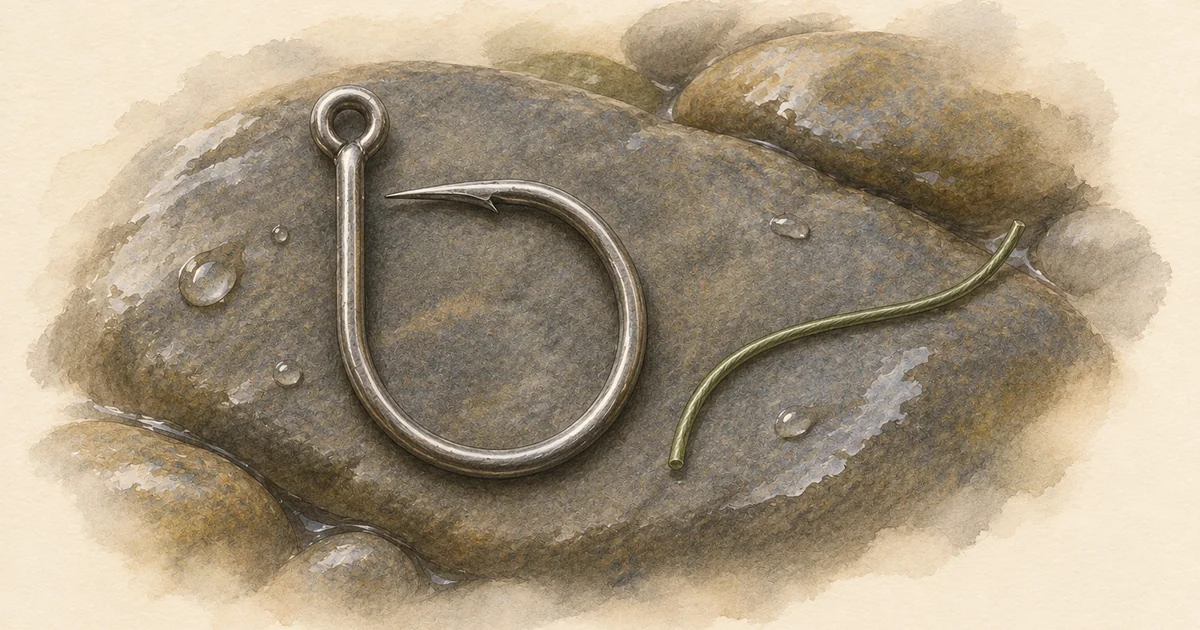
US federal law defines a circle hook as a hook designed and manufactured so that the point is turned back perpendicularly to the shank and the hook forms a generally circular or oval shape (50 CFR § 635.2).
With or without offset
On some circle hooks the end with the point is also bent to the side, known as offset. Lay the hook flat on its side: if the point does not lie in one plane with the shank and eye, it is offset. US law measures it the same way.
In the studies evaluated, offset circle hooks usually protected less well against hooking injuries than straight ones, as a review in the journal Fisheries Research summarised in 2016. In sailfish, hooks with a strong offset of 15 degrees were deeply set almost three times as often as straight or barely offset ones. Because the data were inconsistent, the 2004 review advises as a precaution to avoid circle hooks with more than 5 degrees of offset where possible.
How the hook takes hold in the corner of the mouth
The marine fisheries authority of the US state of Virginia describes the process like this: once the fish has swallowed the bait, the circle hook slides out of the throat under tension and catches in the corner of the mouth, the rear end of the mouth opening. It is set by the fish itself as soon as it tries to swim away. Because the point is curved inwards, according to an article in Rute & Rolle the hook can in theory only take hold around the edge of a jaw.
On the longlines of commercial fishermen, where today’s design comes from, nobody strikes: the fish swims off with the bait and hooks itself in the process. The researchers suspect the circle hook works best with species that turn away after the bite. With fish that pick at the bait while staying in one spot, some reports say it hooks poorly.
No strike: build up tension
With a J hook you lift the rod quickly and firmly. With a circle hook, exactly this jerk pulls it out of the mouth before it reaches the corner. The 2004 review instead describes gentle pressure through the rod once the fish has had enough time to take the whole hook into its mouth. According to the review, no study had compared striking methods up to then; the rules come from manufacturers, authorities and the angling press. This is how it works at the water:
- Do not strike. When you get a bite, the rod stays down, no upward sweep.
- Give the fish time. It should take the bait fully into its mouth. With halibut, according to Blinker, that means waiting until the fish pulls steadily and the rod tip bends clearly towards the water.
- Let the line tighten. Reel in under control and raise the rod steadily, without a jerk. The tension pulls the hook forward, where it turns into the corner of the mouth.
- Play the fish normally. From now on you play it as with any other hook.
The practical sources disagree on the pace of the third step: the article in Rute & Rolle reels in briskly with pike until the hook turns round the jaw, while Blinker expressly warns against reeling too fast with halibut. Anyone who reacts too early there often loses the fish straight away, because the hook has not yet taken a secure hold in the corner of the mouth.
Waiting only with circle hooks: For natural-bait fishing for pike, the Waidgerecht project of Humboldt University and the IGB generally recommends striking immediately; the recommendation does not cover circle hooks. The WWF guide to releasing fish explains why: fish swallow natural baits without suspicion and are hooked more deeply the longer you wait to strike. If you wait as patiently with a J hook as with a circle hook, you risk exactly that deeply swallowed hook.
What studies on mortality show
The overall picture from the reviews is under Fish-friendly tackle: with circle hooks, fish were hooked in the jaw more often and in the throat less often. Individual studies from the 2004 review show how differently the advantage turns out. The figures give the proportion of fish that died after release. Even for the same species, the numbers vary widely.
| Species | Circle hook | J hook | Fishing method |
|---|---|---|---|
| Chinook salmon, study A | 0 % | 15 % | Drifting, trolling |
| Chinook salmon, study B | 31 % | 46 % | Drifting with bait |
| Striped bass | 3 % | 15,5 % | Casting, bottom |
| Bluefin tuna | 4 % | 28 % | Sea, rod and reel |
| Rainbow trout | 10,4 % | 19 % | Casting |
| Silver perch (Australia) | 33,8 % | 35,3 % | Casting |
Not every species benefits. In bluegill, injuries with circle hooks were in some cases even more severe, and in largemouth bass it gave hardly any protection and hooked less well, according to the review. The 2016 paper finds the clearest effect with natural baits and soft baits. However, the authors also cite cases in which fewer fish were hooked or landed, or in which injuries were similar to those with other hooks.
Eel: angling diary study from Lower Saxony
For Germany there are figures for the eel, for which circle hooks had been rare here until then. For an angling diary study in Lower Saxony, volunteer test anglers were given small single hooks in size 6, large ones in size 1 and circle hooks in size 6, and recorded their catches. According to the German Angling Association’s (Deutscher Angelfischerverband) brochure on the Fish of the Year 2025, eels on small single hooks had swallowed the hook deeply considerably more often than eels on large hooks or circle hooks. However, the small circle hook caught eels just as small as the small single hook, on average 45 and 42 cm, the large hook 52 cm. As a result, more than half of the eels on the two small hooks were released, but less than a quarter on the large one. All three hooks caught takeable eels equally well. The association recommends large single hooks or circle hooks.
Pike: no direct comparison
No study comparing circle hooks and ordinary hooks for pike with a dead baitfish was found among the sources checked. The closest is a trial from Illinois on young muskellunge, North American relatives of the pike. With actively worked natural bait, J hooks hooked better there and were not set any deeper. In the researchers‘ view, circle hooks might bring advantages rather in static fishing, when the bait is often swallowed.
Use with natural bait
| If you … | Circle hook? | What to watch for |
|---|---|---|
| are fishing for eel on the bottom | yes, not too small | size 6 caught small eels |
| are targeting wels catfish with pellets on the hair | practical report: yes | hook stays free of bait |
| are catching pike with a dead baitfish | possible, no study | wide gape, steel trace |
| are after halibut or redfish with fish strips | widespread | patience on the bite |
| are catching flatfish with lugworm | practitioners sceptical | hard to bait |
| are actively working lures | hardly any proven advantage | single hook preferred |
Wels catfish: For fishing for wels catfish with pellets, Blinker gives circle hooks from 4/0 to 6/0. As with the hair rig, the pellets hang on a line below the hook, which itself stays free. A heavy weight and a rod under tight tension let the fish hook itself. This does not replace keeping watch over the rod. What applies in your federal state is under Fish-friendly tackle.
Pike: An article in Rute & Rolle, based on personal experience, gives circle hooks in 3/0 or 5/0 on a 60 cm steel trace, fixed with crimps. What matters, it says, is a wide gape so the powerful pike jaw fits into it, but not very thick wire that tears holes in the mouth. More on materials under Pike trace; you can work out what the trace and knots will hold in the Line calculator.
Sea: For halibut on natural bait, Blinker gives circle hooks from 12/0 to 16/0; in this experience, over 90 per cent of fish are hooked in the corner of the mouth with them. That is a practical figure, not a study. A smaller baitfish ends up fully in the mouth more quickly, while with large baits more fish come off shortly after the start of the fight. With redfish, sea anglers report that the fish hook themselves as they swim off and are lost less often on the long way up from the depths. How the side arms are built is shown in the Natural-bait rig for the sea. A practical report in the angling press on flatfish fishing with lugworm is sceptical: circle hooks are said to be hard to bait and do not reliably prevent deep swallowing.
Limits of the circle hook
- Slow drift: In a study on summer flounder, anglers reported more deeply hooked fish when the rig drifted slowly. The 2004 review considers it possible that the anglers noticed the bite later in that case.
- Actively worked lures: The protection is mainly documented for natural and soft baits. For lures, the Bavarian exam questions rate the single hook as gentler than the treble, see Treble or single hook.
- No free pass: Even with circle hooks a fish occasionally swallows deeply, writes the authority in Virginia. Tools for unhooking are covered under Disgorger pliers and artery clamp.
Barbless hooks and crushed barbs
A hook without a barb is called a barbless hook; the basics are under Fishing hook. According to Petri-Heil, the shape of the circle hook alone keeps it in the mouth, so a barb is not needed. The WWF guide, with technical advice from the IGB, lists the advantages of the barbless hook: fewer injuries, quicker unhooking, often while the fish is still in the water. On the other hand, more fish are lost. If you fish without a barb, you have to keep constant pressure on the hook during the fight; even a line that goes slack for a moment can free it.
You crush the barb of an ordinary hook with pliers. For pike, the British Pike Anglers‘ Club prefers hooks with a semi-barb or crushed barb in sizes 4 to 6. However, it stresses that they are no reason to let a pike swallow the bait.
Regulations: Which hooks are allowed is set by state law and the water rules. One example: the 2024 water rules (Gewässerordnung) of the Landesverband Sächsischer Angler only permit lures with a single-shank single hook without a barb in its salmonid waters; a barb you have crushed yourself is expressly allowed there (point 4.2.2). Under US federal law, for example: anyone taking part with a US permit in tournaments for marlin, sailfish and other billfish in the Atlantic may only use circle hooks without offset with natural bait (50 CFR § 635.21, accessed in November 2026). What applies on your water is stated in your fishing permit (Erlaubnisschein).
Common mistakes
- Striking out of habit. If you sweep the rod up, you pull the circle hook out of the mouth.
- Buying a strongly offset hook. Lay it on its side before tying it on. Better to avoid more than 5 degrees of offset.
- Choosing it too small. In the Lower Saxony study, the size 6 circle hook caught eels just as small as the small single hook did. With pike, the jaw needs room in the bend.
- Using too big a bait. With halibut, large baits lead to more fish coming off.
Frequently asked questions
Can I bend an ordinary hook into a circle hook?
Some anglers do this to imitate shop-bought circle hooks, the 2004 review says. US federal law only counts as circle hooks those that are designed and manufactured that way at the factory.
What size do I need?
Practical figures from the angling press: pike 3/0 or 5/0, wels catfish 4/0 to 6/0, halibut 12/0 to 16/0. With eel, size 6 caught small fish on average. How the size numbers work is explained in Fishing hook.
What do I do if the circle hook is set deep after all?
The authority in Virginia advises cutting the hooklength as close to the hook as possible and leaving the hook in the fish. Whether you are allowed to cut it off here and whether the fish may or must go back is set by state law and your fishing permit, see Disgorger pliers and artery clamp and Releasing a fish.
Related
- Fishing hook: parts, sizes, shapes
- Fish-friendly tackle: hooks, barbs and supervision
- Treble or single hook: converting lures to a single hook
- Disgorger: removing small hooks gently
- Baitfish rig: presenting a dead baitfish properly
- Eel fishing: rig and strike
- Line calculator: breaking strain of hooklength and knot
Sources
- Übersichtsarbeit zu Kreishaken im Freizeitangeln (Aquatic Conservation 2004, PDF) (Bauform, Versatz, Anschlag, Sterblichkeit)
- Übersichtsarbeit zu Gerät und Taktik beim Zurücksetzen (Fisheries Research 2016, PDF) (Versatz, Grenzen)
- Hakentypen bei jungen Muskellungen (North American Journal of Fisheries Management 2006, PDF) (Kreishaken bei Muskellungen)
- Deutscher Angelfischerverband: Der Europäische Aal, Fisch des Jahres 2025 (Broschüre, PDF) (Aal-Studie)
- WWF Deutschland: Fische angeln und wieder zurücksetzen (Stand 05/2024, PDF) (Schonhaken, Anhieb)
- Fachgebiet Integratives Fischereimanagement (Humboldt-Universität zu Berlin und IGB): Projekt Waidgerecht, Hecht (Anhieb beim Naturköderangeln)
- Virginia Marine Resources Commission: Circle Hooks for Striped Bass (Faltblatt, PDF) (Wirkweise, Anschlag)
- Electronic Code of Federal Regulations: 50 CFR § 635.2, Definitions und 50 CFR § 635.21, Gear operation and deployment restrictions
- Landesverband Sächsischer Angler: Gewässerordnung, Ausgabe 2024 (PDF) (Punkt 4.2.2) und Pike Anglers‘ Club of Great Britain: Faltblatt zum Hechtangeln (PDF)
- Bayerische Landesanstalt für Landwirtschaft: Staatliche Fischerprüfung in Bayern, Prüfungsfragen 2023/2024 (PDF) (Einzelhaken an Kunstködern, Prüfungsstoff)
- Petri-Heil: Vom Haken zurück ins Wasser und Rute & Rolle: Circle Hooks, eine runde Sache (Hecht)
- Blinker: Heilbutt angeln, Tipps vom Profi, Welsangeln mit Pellets, Angeln auf Rotbarsch, Schlucksperre für Plattfische, Angeln mit Schonhaken und Aal zurücksetzen
Text AI-assisted, drawings AI-generated. Sources opened and checked in November 2026, no graphics taken from the sources.
All information is a guide only, without guarantee. The study figures apply to the species and fishing methods examined and cannot be applied to every fish; which hooks are allowed on your water is set by state law and the water rules.