
Knowledge – Fish
Fishing for eel
Eel fishing means: on warm, dark nights, offering a natural bait on the bottom, close to the bank and to snags. Here is the way there in nine steps, each with a link to the detailed page.
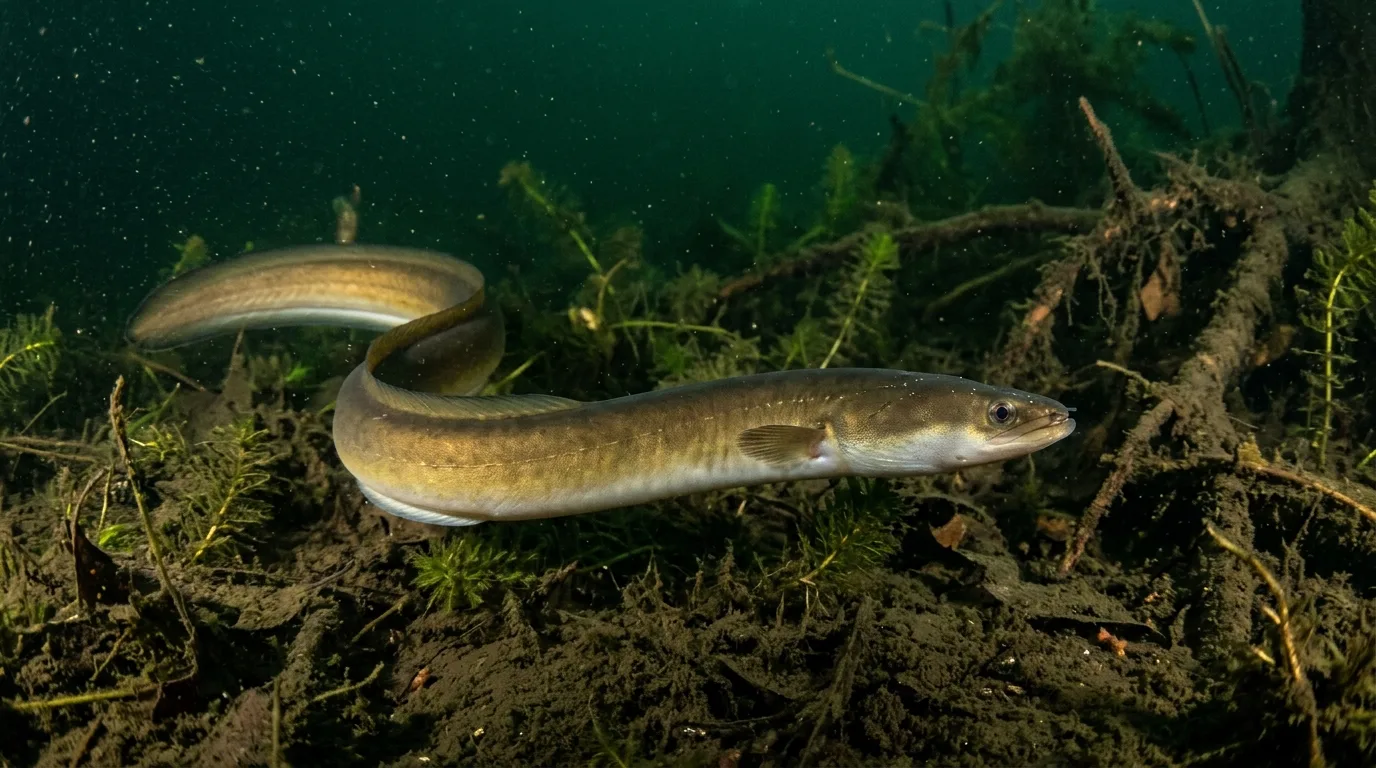
The European eel is considered critically endangered. At sea, including brackish waters such as estuaries and lagoons, recreational fishing for eel has been banned entirely under EU law since 2023; for 2026 this is governed by Regulation (EU) 2026/249 (as of October 2026), and in the Baltic Sea an eel caught unintentionally must also go straight back. Inland, the federal states (Bundesländer) decide whether and how you may catch it.
 Choose another fish117 fish with guides
- EelOff-peak season
 EelpoutPossible
 IdePossible
 ArapaimaGood
 GraylingPeak season
 Atlantic salmonSpawning time, please spare
 Brown troutSpawning time, please spare
 Brook troutSpawning time, please spare
 BarbelOff-peak season
 BarramundiSpawning season
 Greater amberjackGood
 Topmouth gudgeonOnly as bycatch
 Blue marlinSpawning season
 BonefishSpawning season
 BonitoGood
 BreamOff-peak season
 Dusky grouperOnly as bycatch
 CobiaPossible
 Spiny dogfishOnly as bycatch
 CodPeak season
 ChubPeak season
 MinnowOnly as bycatch
 European sturgeonOnly as bycatch
 FlounderPeak season
 PerchPeak season
 Largemouth bassGood
 Ballan wrasseOnly as bycatch
 Yellowfin tunaSpawning season
 Giant trevallyGood
 Prussian carpPossible
 BrillPossible
 Gilthead breamSpawning time, please spare
 Golden doradoSpawning season
 Golden mahseerOnly as bycatch
 Dolphinfish (mahi-mahi)Good
 Grass carpPossible
 Great barracudaGood
 GudgeonPossible
 White breamPossible
 DaceOff-peak season
 PikePeak season
 HalibutOff-peak season
 HerringPossible
 GarfishOut of season
 Huchen (Danube salmon)Possible
 Crucian carpOnly as bycatch
 CarpOff-peak season
 RuffeOff-peak season
 VendaceOnly as bycatch
 DabPeak season
 GurnardPossible
 Coley (saithe)Peak season
 Chinook salmonHardly any chance
 King mackerelSpawning season
 LingPeak season
 TuskOff-peak season
 MackerelPossible
 Bighead carpOut of season
 WhitefishPossible
 Conger eelOff-peak season
 Sea troutSpawning time, please spare
 Grey mulletPossible
 Murray codSpawning season
 MuskellungeGood
 Common nasePossible
 Nile perchPossible
 PayaraPossible
 Peacock bassPeak season
 PermitGood
 WeeverOnly as bycatch
 PollackOff-peak season
 BurbotOff-peak season
 AspPossible
 Red snapperSpawning season
 Rainbow troutPeak season
 RoosterfishGood
 RoachPeak season
 RedfishOut of season
 Bluefin tunaOnly as bycatch
 RuddPossible
 Russian sturgeonOnly as bycatch
 HaddockOff-peak season
 SnakeheadPossible
 TenchOff-peak season
 SpirlinOnly as bycatch
 PlaiceOff-peak season
 Greenland halibutOnly as bycatch
 Round gobyOnly as bycatch
 SwordfishGood
 Lake troutSpawning time, please spare
 HakeSpawning time, please spare
 Alpine charSpawning time, please spare
 MonkfishPossible
 SoleOff-peak season
 SailfishGood
 Silver carpOut of season
 SnookPeak season
 PumpkinseedOnly as bycatch
 SpratOnly as bycatch
 Atlantic wolffishSpawning time, please spare
 TurbotPeak season
 SterletOnly as bycatch
 SmeltOnly as bycatch
 Horse mackerelPossible
 TaimenGood
 TarponGood
 TigerfishSpawning season
 BleakPossible
 WahooGood
 Wels catfishOff-peak season
 WhitingPeak season
 Sea bassOff-peak season
 ZanderPeak season
 White-eye breamOnly as bycatch
 Blue breamOnly as bycatch
 Brown bullheadPossible
 VimbaOnly as bycatch
Season in October according to the catch calendar, an estimate and not a guarantee of a catch. The fish pictures are reduced natural-history plates and AI-generated.
Best time
From June to September, in the evening, at night and in the morning.
In January: Hardly any chanceIn February: Hardly any chanceIn March: PossibleIn April: GoodIn May: GoodIn June: Peak seasonIn July: Peak seasonIn August: Peak seasonIn September: Peak seasonIn October: GoodIn November: PossibleIn December: Hardly any chance
Good spot
- Lake: weed bed and sunken treeweed bed and sunken treeweed bed and sunken treeweed bed and sunken tree
- River: rock fill and undercut bankrock fill and undercut bankrock fill and undercut bankrock fill and undercut bank
Starter tackle
- Rod: 3–3,30 m, casting weight about 50–80 g, with a firm backbone
- Line: mono, 0,35 mm, about 8–9 kg breaking strain; on big rivers rather 0,38 mm
- Hook: size 1–2 for fish strips and deadbait, size 2–6 for worm; larger hooks are less often swallowed deeply
- Rod: carp rod around 3,60 m, test curve about 2,5 lb, not too soft
- Line: mono 0,35 mm at snags; on open, firm spots 0,22–0,26 mm is enough
- Hook: size 1–2 for deadbait, size 2–6 for worm
In short
In short: The best time to catch eel is June to September, in the evening, at night and in the morning. Good spots on a lake: weed bed and sunken tree; on a river: rock fill and undercut bank. Proven baits: worms, also several on one hook, or small dead baitfish on the bottom. The European eel is considered critically endangered, and its stock is protected by the EU eel regulation. Eel are subject to state rules (for example minimum sizes (Mindestmaße), closed seasons (Schonzeiten) and catch restrictions).
Quick to recognise
A bottom-dwelling fish that hatches in the Sargasso Sea, grows up here and migrates back to the Atlantic to spawn. It usually measures 40 to 80 centimetres, females reach up to 100 centimetres in length.
When
Peak season is June to September, April, May and October are good too. Below about 10 °C the eel becomes sluggish, and in cold water it falls into winter torpor. Dark, warm nights are better than a full moon.
- JanHardly any chance
- FebHardly any chance
- MarPossible
- AprGood
- MayGood
- JunPeak season
- JulPeak season
- AugPeak season
- SepPeak season
- OctGood
- NovPossible
- DecHardly any chance
Peak seasonGoodPossibleHardly any chanceSpawning season
Spring tactics
A first try is worthwhile when the nights stay frost-free and shallow ditches, ponds and bankside zones have a few sunny days behind them. Eels only become keen biters from a water temperature of about 12 °C; small waters reach it earlier than deep gravel pits and rivers. The eels are still plucking hesitantly now, short pieces of worm catch better than a whole lobworm.
Summer tactics
The main biting time runs from dusk until about 1 a.m., after which there is often a lull and a short phase again before sunrise. After a rain shower the chances rise; in a thunderstorm you pack your rods away at once. Eels also bite by day in the shade of trees or in dull weather.
Autumn tactics
In October you still catch well, especially after rain with slightly rising water and in dull weather earlier in the evening. As the water cools the bites get rarer, and in November sitting it out is only worthwhile on mild days.
Winter tactics
Below about 10 °C eels stay in their hiding places and hardly feed. A targeted session brings next to nothing now; the season starts again only in spring.
Is it biting today?
In January: Out of seasonIn February: Out of seasonIn March: PossibleIn April: Shoulder seasonIn May: Shoulder seasonIn June: Peak seasonIn July: Peak seasonIn August: Peak seasonIn September: Peak seasonIn October: Shoulder seasonIn November: PossibleIn December: Out of season
Today’s catch index needs JavaScript. Season and spawning time are in the catch calendar.
From the blog: Eel fishing ban: what applies in autumn 2026 on the coast and inland · Fishing at locks and weirs: what applies and what the signs mean · Fish of the Year 2027: the crucian carp and what anglers can do for it
Where it is now
In the lake
In a lake the eel stays close to the bank and the bottom, hidden in weed, under stones, in crevices or in the mud. Put the bait right up against these snags.
How to go about it: Look for points that carry on under water, ridges between the bank and an island, and bays that narrow towards the end. In spring eels are often in water less than a metre deep; otherwise they turn up anywhere from very shallow water down to about 10 metres. Change rods often, because bites often come from only a few metres of a bank.
| All year round | Weed bed, sunken tree |
|---|
In the river
On a river you fish close to the bank: at rock armouring and on rugged natural banks with undergrowth. Cloudy water after heavy rain is also considered favourable.
How to go about it: Besides rock armouring, look at eddies where food collects, shallow side channels and the mouths of small ditches, especially after heavy rain. The weight must stay put in the current, or the rig will drift into the stones. On tidal rivers many anglers do better on the rising tide, but that is not a fixed rule.
| All year round | Rock rubble, undercut bank |
|---|
Biting time: in the evening, at night and in the morning. What this looks like on the water is shown by the picture of the holding spots just below.
Waters with rules for eel
Holding spots in the picture
Choose a season and time of day: the picture shows where the species sits then. Tap a fish or a spot in the list to bring it closer. The picture is schematic and AI-generated, every water is different.
Chance of a catch in springgood
Catch chance in summerPeak season
Catch chance in autumngood
Catch chance in winterhardly any
- J
- F
- M
- A
- M
- J
- J
- A
- S
- O
- N
- D
Active time The eel is mainly active at dusk and at night, but big eels are also caught during the day.
Not a prime time The eel is mainly active at dusk and at night, but big eels are also caught during the day.
Active time The eel is mainly active at dusk and at night, but big eels are also caught during the day.
Active time The eel is mainly active at dusk and at night, but big eels are also caught during the day.
In the lake
Water lilies and weed bed
Eels are present here all year round.
Sunken tree
Eels are present here all year round.
In a lake the eel stays close to the bank on the bottom and hides among snags and in weed. It lies under stones, in crevices or buried in the mud.
Spring: chance of a catch according to the catch calendar possible in March, good in April and May. In lakes with distinct shallow zones the eels get moving as soon as the water near the bank reaches about 10 °C.
Summer: chance of a catch according to the catch calendar: peak season. Late spring and early summer are regarded as a good time, above all humid, warm, dark nights.
Autumn: chance of a catch according to the catch calendar peak season in September, good in October, possible in November. In autumn the silver eels migrate downstream. At water temperatures around 10 °C the remaining eels become sluggish.
Winter: chance of a catch according to the catch calendar hardly any. In much colder water the eel falls into winter torpor and rests on the bed of the water.
In the river
Undercut bank, overhanging branches, timber
Eels are present here all year round.
riprap, sheet piling, harbour
Eels are present here all year round.
On a river, rock rubble and rugged natural banks with undergrowth count as good spots. The eel hides among snags, in weed and between stones, and is fished for close to the bank on the bottom.
Spring: chance of a catch according to the catch calendar possible in March, good in April and May. The first warm weeks are worth a try on rivers with shallow zones, as soon as the water near the bank reaches about 10 °C.
Summer: chance of a catch according to the catch calendar: peak season. Late spring and early summer are regarded as a good time. Dark, warm nights and cloudy water after heavy rain are favourable.
Autumn: chance of a catch according to the catch calendar peak season in September, good in October, possible in November. In October and November the silver eels move off in the evening and at night, especially in storm and rain. In the big rivers they let themselves drift in mid-water.
Winter: chance of a catch according to the catch calendar hardly any. In much colder water the eel falls into winter torpor and rests on the bed of the water.
Depth: The eel lives on the bottom and is mostly fished for close to the bank. It also hunts small fish in mid-water and at the surface.
Size comparison: AI-generated drawing, schematic.
How
Usually the bait lies on the bottom on a running rig, with a weight that only just stays put. At night in still water a float rig with a light-up float also works.
Easiest way
To start with, a bottom rod of about 3 metres with 0,35 mm monofilament, a light running lead and a size 1 to 2 hook with half a lobworm is enough. On a warm, dark summer evening put the bait close in front of rock armouring or the edge of water lilies and clip on a bite indicator. If the line runs off steadily, you strike.
Worm on a running lead
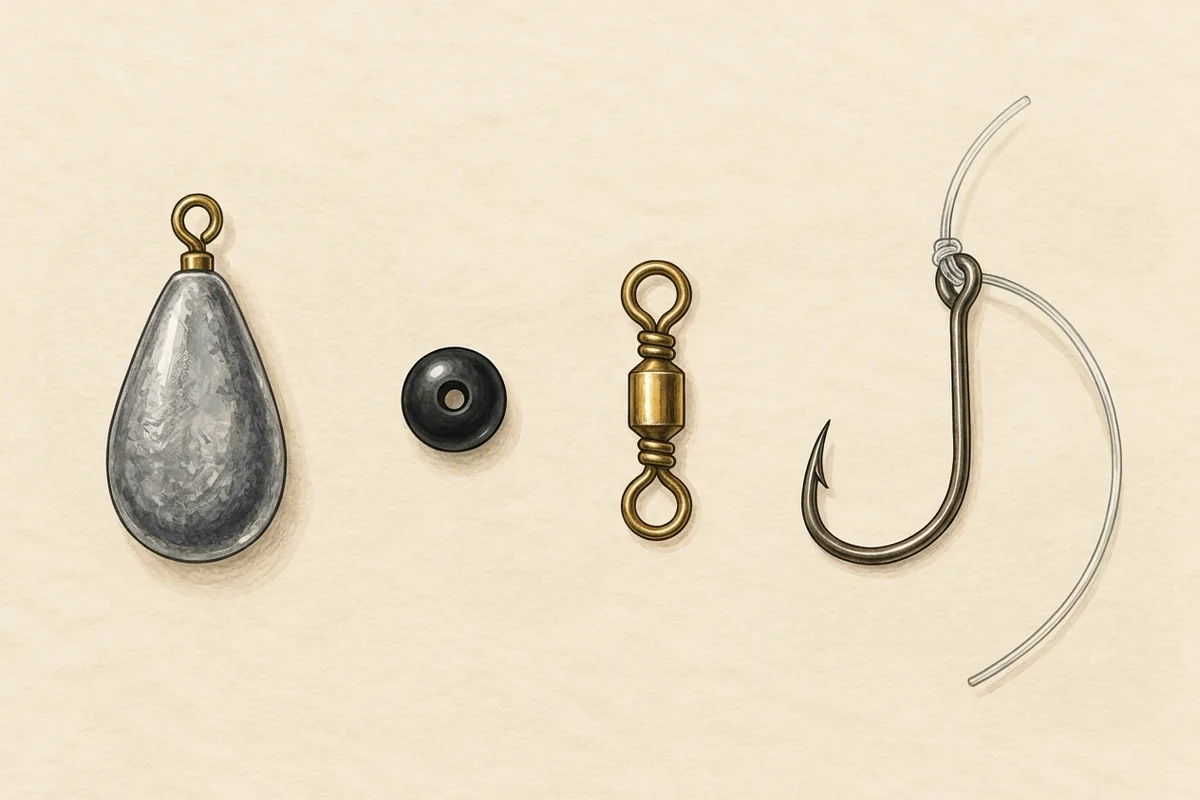
The standard for eel in lake and river: a natural bait lies quietly on the bottom at night in front of a hiding place.
- Cover at the bank
Set up in front of rock armouring, sunken trees, water lily edges or undercut root banks. The later and darker it gets, the closer to the bank the eels look for food.
- Weight, bead, swivel
Thread the running lead onto the main line, followed by a bead to protect the knot and a snap swivel for the hooklength. On mud or weed, a Tyrolean stick (Tiroler Hölzl) or an anti-tangle tube stops the rig from sinking in.
- Threading the worm
Pull half a lobworm, or two or three brandlings, onto the hooklength with the baiting needle. The head end stays free to move and the hook point sticks out.
- Quiet placement
Cast just short of the snag, not into it, and leave the weight lying. Open the bail arm, hang the slightly taut line in the bite indicator and do not shine a light on the water.
- Strike early
If the line pulls off steadily, close the bail arm and strike. An early strike keeps the hook in the mouth; waiting too long lets the eel swallow it deep.
- Away from the hiding place
Pull the eel in without a pause, using a stiff rod. If it wraps its tail round a branch or stone, it wedges itself and the hooklength often snaps.
- Landing net and cloth
Put the eel in the landing net and lay it on a wet cloth or mat. If the hook is deep, cut the line close to the mouth rather than pulling on the hook.
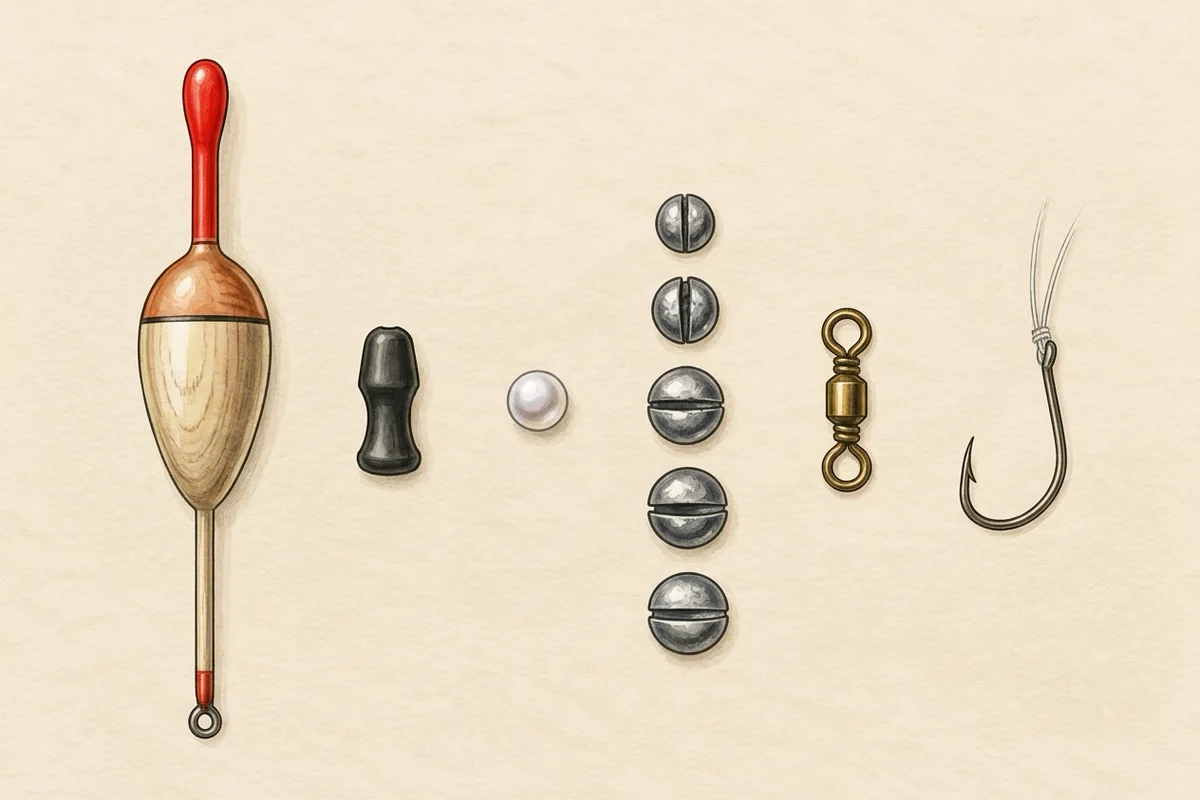
Float with a glow stick at snags
In still water the most sensitive bite indication: the float shows plucks and the direction of the pull, so you can fish close to trees and water lilies.
- Look for gaps
Good spots are gaps in water lily beds, branches of sunken trees and points that continue under water. If small fish jump at the surface at dusk, eels are often not far away.
- Set the depth
Plumb the depth and set the stop so the bait lies on the bottom or hangs at most a hand’s width above it.
- Light float
Use a glow-stick float with a carrying capacity of 3 to 6 grams, lighter in shallow spring water. A red glow stick spooks fish less than a yellow one.
- Worm or small fish
In front of dense snags a lobworm works; in more open spots, a slim dead baitfish of 5 to 10 centimetres. The hook bend must stand clear of the fish.
- Close to the wood
Cast the float just beside the edge of the snag and, if needed, mark narrow gaps with a second glow stick in a different colour.
- Wait for it to go under
You let small plucks go. If the float pulls towards the snag or disappears completely, strike at once.
- Triangle of light
Attach a glow stick to each of three corners of the landing net so you can see at night where you are pulling the eel. Lying on its back it often calms down, which makes unhooking easier.
What with
Worms are the standard: two or three brandlings or red worms on the hook, or pieces of lobworm. Finger-length dead baitfish and strips of fish also work, as do prawns, snails or liver. Keep the hooklength short and soft; a stiff one costs bites.
- Wormsthe whole season, in spring only for a short stretch
Earthworms are the most widely used eel bait; in spring a small piece works, in late summer a whole lobworm or a bunch.
- Baitfishsummer and autumn, when you are after bigger eels
Bigger eels eat mainly fish, so you catch fewer small eels that have to go back; a narrow strip fits well in the mouth and gives off plenty of scent.
- Snailswarm, humid summer nights
Slugs then fall into the water from the bank and from trees and are part of the natural diet; they bring fewer bites but often bigger eels.
Tackle
A bottom rod with a bite indicator, drag or bail arm open so the eel feels no resistance as it takes line. Add a long-shank hook, which is easier to remove from the small mouth.
Worm on a running lead
- Rod
- 3–3,30 m, casting weight about 50–80 g, with a firm backbone
- Reel
- fixed-spool reel holding at least 100 m of 0,35 mm line
- Line
- monofilament, 0,35 mm, about 8–9 kg breaking strain; 0,38 mm on big rivers
- Leader
- monofilament around 0,30 mm, usually 30–60 cm
- Hooks
- size 1–2 for fish strips and baitfish, size 2–6 for worm; bigger hooks are less often swallowed deep
- Weight, float, lead
- running lead that only just stays put: 5–15 g in still water, 40–90 g in current
Float with a glow stick at snags
- Rod
- carp rod around 3,60 m, test curve about 2,5 lb, not too soft
- Line
- monofilament 0,35 mm at snags; on open, firm spots 0,22–0,26 mm is enough
- Leader
- monofilament around 0,30 mm
- Hooks
- size 1–2 for baitfish, size 2–6 for worm
- Weight, float, lead
- glow-stick float 3–6 g, 1–4 g in shallow water
Common mistakes
- Hooks that are too small: With small hooks you catch more small eels, and they swallow the hook deep more often. Size 1 to 2 hooks or circle hooks catch bigger fish on average and more often sit at the front of the mouth.
- Pulling out a deeply swallowed hook: Attempts to remove it often injure the throat and stomach and clearly raise mortality. Cut the line close to the mouth.
- Light and noise at the bank: Eels shy away from light and feel footsteps on the bank. Never shine a light on the water, take a headtorch with a red light and move quietly.
- Soft tackle in front of snags: A big eel wedges its tail in wood or between stones and snaps the hooklength. Fish there with a stiff rod and 0,35 mm line and get it out at once.
- Packing up too early: Bites often do not start until around midnight. Stay at the water until about 1 am instead of packing up after the first quiet hour.
Rules
Each federal state (Bundesland) sets its own closed season (Schonzeit) and minimum size (Mindestmaß). Choose your state; the values come from our state pages.
Baden-Württemberg
- Minimum size
- 50 cm
- Closed season
- 15.9.–1.3.
- Note
- only in the Rhine and its river system
As of October 2026. All rules, exceptions and sources: Fishing in Baden-Württemberg.
Bavaria
- Minimum size
- 50 cm
- Closed season
- 1.10.–31.12.
- Note
- only the Elbe, Rhine and Weser catchments, e.g. the Main
As of October 2026. All rules, exceptions and sources: Fishing in Bavaria.
Berlin
- Minimum size
- 50 cm
- Closed season
- none
- Catch limit
- 3 eels and zander combined per day
Correct as of October 2026. All rules, exceptions and sources: Fishing in Berlin.
Brandenburg
- Minimum size
- 50 cm
- Closed season
- none
- Catch limit
- 3 per day
As of October 2026. All rules, exceptions and sources: Fishing in Brandenburg.
Bremen
- Minimum size
- 45 cm
- Closed season
- none
- Note
- Lower Saxony stretch of the lower Weser below Bremen: fishing ban until 31.3.2027
As of October 2026. All rules, exceptions and sources: Fishing in Bremen.
Hamburg
- Minimum size
- 45 cm
- Closed season
- none
- Catch limit
- 3 per day
- Note
- harvest slot 45–75 cm
As of October 2026. All rules, exceptions and sources: Fishing in Hamburg.
Hesse
- Minimum size
- 50 cm
- Closed season
- 15.9.–1.3.
- Note
- harvest slot (Entnahmefenster) 50–70 cm
As of October 2026. All rules, exceptions and sources: Fishing in Hesse.
Mecklenburg-Western Pomerania
- Minimum size
- 50 cm
- Closed season
- 1.12.–28.2.
- Note
- Coast: fishing ban 2026
As of October 2026. All rules, exceptions and sources: Fishing in Mecklenburg-Western Pomerania.
Lower Saxony
- Minimum size
- 35 cm
- Closed season
- none
- Note
- 28 cm in the coastal districts (Landkreis); fishing ban all year round in coastal waters
As of October 2026. All rules, exceptions and sources: Fishing in Lower Saxony.
North Rhine-Westphalia
- Minimum size
- 50 cm
- Closed season
- 1.10.–1.3.
- Note
- closed season (Schonzeit) only in the main Rhine channel, not in tributary waters
As of October 2026. All rules, exceptions and sources: Fishing in North Rhine-Westphalia.
Rhineland-Palatinate
- Minimum size
- 50 cm
- Closed season
- none
- Note
- observe the general closed seasons (Schonzeit)
As of October 2026. All rules, exceptions and sources: Fishing in Rhineland-Palatinate.
Saarland
- Minimum size
- 50 cm
- Closed season
- none
As of October 2026. All rules, exceptions and sources: Fishing in Saarland.
Saxony
- Minimum size
- 50 cm
- Closed season
- none
Correct as of October 2026. All rules, exceptions and sources: Fishing in Saxony.
Saxony-Anhalt
- Minimum size
- 50 cm
- Closed season
- none
As of October 2026. All rules, exceptions and sources: Fishing in Saxony-Anhalt.
Schleswig-Holstein
- Minimum size
- 50 cm
- Closed season
- none
- Note
- coastal waters 45 cm (including the Schlei); North Sea and Baltic Sea: fishing ban 2026, except the Lower Elbe, Lower Eider, Schlei and Trave
As of October 2026. All rules, exceptions and sources: Fishing in Schleswig-Holstein.
Thuringia
- Minimum size
- 50 cm
- Closed season
- 1.11.–28.2.
- Catch limit
- 2 per day
As of October 2026. All rules, exceptions and sources: Fishing in Thuringia.
The regulation and your fishing permit (Erlaubnisschein) are what count. Lake Constance, the Rhine and the coast, for example, have their own rules: Fishing waters in Germany.
After the catch
Playing and landing
Strike as soon as the bite is clear and pull the eel away from the snag without a pause; it needs no long fight. Lay it on a wet cloth or mat, free a hook sitting at the front with pliers and, if the hook is deep, cut the line at the mouth. Whether you may keep an eel is set by state law and your fishing permit (Erlaubnisschein): an eel you may take is stunned and killed at once; all others go back quickly. Eel blood must not get into the eyes or onto mucous membranes.
You decide before the session whether to keep an eel, as the stock is under serious threat. For releasing, a rig with a swallow guard helps: the hook then sits in the mouth and is easier to free. An eel you may keep is stunned and killed at once.
Frequently asked questions
What hook size for eel?
Usually size 1 to 2. In a study with test anglers, eels caught on size 1 averaged 52 centimetres in length, on size 6 only 42, and small hooks were swallowed deep more often.
When do eels bite best?
In warm, dark nights from dusk until about 1 am, and often shortly before sunrise as well. Full-moon nights bring less. Night fishing is banned in some states and waters, so check your fishing permit (Erlaubnisschein).
What line for eel fishing?
An abrasion-resistant monofilament of around 0,35 millimetres with a hooklength of around 0,30 millimetres. Braid is quickly damaged on rock armouring and wood.
At what water temperature do eels bite?
Below 10 °C it usually stays hidden. It becomes properly active from about 12 °C, which is why in spring small, shallow waters are worth trying first.
What to do if the eel has swallowed the hook deep?
Cut the line close to the mouth. In trials by the Thünen institute some eels later expelled small hooks, but large hooks hardly at all, so an early strike matters more than any unhooking technique.
Does a released eel survive?
Usually yes. For eels with the hook at the front of the mouth, mortality in a pond trial was about 10 percent; it was clearly higher for deeply hooked fish and after attempts to remove the hook.
Similar species
Anyone who catches eel can use similar tackle to fish for these species too:
 Burbot fishingSecondary season
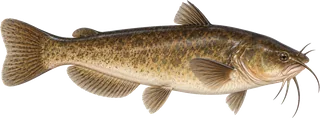 Brown bullhead fishingPossible
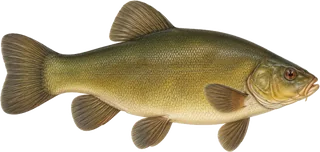 Fishing for tenchShoulder season
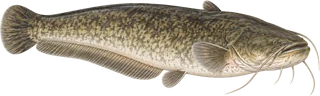 Wels catfish fishingSecondary season
Sources
As of October 2026. The practical knowledge comes from 8 sources, summarised in our own words.
View all 8 sources
- Aalangeln im Fokus der deutschen Wissenschaft (Broschüre Fisch des Jahres 2025: Der Europäische Aal) · Deutscher Angelfischerverband (DAFV), Beitrag von Thünen-Institut für Ostseefischerei und IGB
- Aalangeln: Mit diesen Tipps klappt's mit den Schlänglern · BLINKER (Redaktion, S. Kaufmann)
- Aal: So fangen Sie Schlängler im Stillwasser · BLINKER (Redaktion, A. Pawlitzki)
- Die 10 besten Tipps zum Aalangeln vom Ufer · BLINKER (Redaktion, Tipps von M. Wehrle)
- Aalangeln im Frühjahr: Der erfolgreiche Weg zum Fisch · BLINKER (Redaktion)
- Aalangeln im Herbst: 4 goldene Tipps · BLINKER (Redaktion, Tipps von F. Frenzel)
- Aalangeln mit Fischfetzen · BLINKER (Redaktion, A. Seiberlich)
- 10 Aaltipps von Matze Koch · FISCH & FANG (Redaktion, M. Koch)
Text written with AI support, based on the sources listed and these pages: Eel (profile), Bottom fishing, Night fishing, Worms, Bottom rod.