
Knowledge – Fish
Fishing for common nase
Fishing for common nase means: first check whether you are allowed to fish for it at all, then fish finely and quietly at the edge of the baited area. Here is the way there in nine steps, each with a link to the detailed page.
Seven federal states (Bundesland) protect the common nase all year round or almost everywhere, while the others give it a closed season (Schonzeit) in spring and set a minimum size (Mindestmaß). The values for each state are listed below under “Rules” (as of October 2026). Switzerland and Liechtenstein ban catching it. The steps below apply only where your state law allows them. A protected common nase goes straight back.
 Choose another fish117 fish with guides
 EelOff-peak season
 EelpoutPossible
 IdePossible
 ArapaimaGood
 GraylingPeak season
 Atlantic salmonSpawning time, please spare
 Brown troutSpawning time, please spare
 Brook troutSpawning time, please spare
 BarbelOff-peak season
 BarramundiSpawning season
 Greater amberjackGood
 Topmouth gudgeonOnly as bycatch
 Blue marlinSpawning season
 BonefishSpawning season
 BonitoGood
 BreamOff-peak season
 Dusky grouperOnly as bycatch
 CobiaPossible
 Spiny dogfishOnly as bycatch
 CodPeak season
 ChubPeak season
 MinnowOnly as bycatch
 European sturgeonOnly as bycatch
 FlounderPeak season
 PerchPeak season
 Largemouth bassGood
 Ballan wrasseOnly as bycatch
 Yellowfin tunaSpawning season
 Giant trevallyGood
 Prussian carpPossible
 BrillPossible
 Gilthead breamSpawning time, please spare
 Golden doradoSpawning season
 Golden mahseerOnly as bycatch
 Dolphinfish (mahi-mahi)Good
 Grass carpPossible
 Great barracudaGood
 GudgeonPossible
 White breamPossible
 DaceOff-peak season
 PikePeak season
 HalibutOff-peak season
 HerringPossible
 GarfishOut of season
 Huchen (Danube salmon)Possible
 Crucian carpOnly as bycatch
 CarpOff-peak season
 RuffeOff-peak season
 VendaceOnly as bycatch
 DabPeak season
 GurnardPossible
 Coley (saithe)Peak season
 Chinook salmonHardly any chance
 King mackerelSpawning season
 LingPeak season
 TuskOff-peak season
 MackerelPossible
 Bighead carpOut of season
 WhitefishPossible
 Conger eelOff-peak season
 Sea troutSpawning time, please spare
 Grey mulletPossible
 Murray codSpawning season
 MuskellungeGood
- Common nasePossible
 Nile perchPossible
 PayaraPossible
 Peacock bassPeak season
 PermitGood
 WeeverOnly as bycatch
 PollackOff-peak season
 BurbotOff-peak season
 AspPossible
 Red snapperSpawning season
 Rainbow troutPeak season
 RoosterfishGood
 RoachPeak season
 RedfishOut of season
 Bluefin tunaOnly as bycatch
 RuddPossible
 Russian sturgeonOnly as bycatch
 HaddockOff-peak season
 SnakeheadPossible
 TenchOff-peak season
 SpirlinOnly as bycatch
 PlaiceOff-peak season
 Greenland halibutOnly as bycatch
 Round gobyOnly as bycatch
 SwordfishGood
 Lake troutSpawning time, please spare
 HakeSpawning time, please spare
 Alpine charSpawning time, please spare
 MonkfishPossible
 SoleOff-peak season
 SailfishGood
 Silver carpOut of season
 SnookPeak season
 PumpkinseedOnly as bycatch
 SpratOnly as bycatch
 Atlantic wolffishSpawning time, please spare
 TurbotPeak season
 SterletOnly as bycatch
 SmeltOnly as bycatch
 Horse mackerelPossible
 TaimenGood
 TarponGood
 TigerfishSpawning season
 BleakPossible
 WahooGood
 Wels catfishOff-peak season
 WhitingPeak season
 Sea bassOff-peak season
 ZanderPeak season
 White-eye breamOnly as bycatch
 Blue breamOnly as bycatch
 Brown bullheadPossible
 VimbaOnly as bycatch
Season in October according to the catch calendar, an estimate and not a guarantee of a catch. The fish pictures are reduced natural-history plates and AI-generated.
Best time
From July to September, mostly in the morning and in the evening.
In January: Hardly any chanceIn February: Hardly any chanceIn March: Hardly any chance, spawningIn April: Possible, spawningIn May: Possible, spawningIn June: PossibleIn July: GoodIn August: GoodIn September: GoodIn October: PossibleIn November: Hardly any chanceIn December: Hardly any chance
Good spot
- River: main current, behind stones and in the rifflemain current and behind stonesmain current and behind stonespools
Starter tackle
- Rod: feeder rod from about 50 g casting weight, a stronger one with a firm tip of around 3 oz on big rivers
- Line: monofilament 0,16–0,20 mm
- Hook: single fine-wire hooks in size 14–20
- Rod: Bolognese rod of around 6 m
- Line: monofilament of around 0,25 mm, in case barbel may bite too
- Hook: sharp and fine-wire, for common nase rather size 14–16
In short
In short: You catch common nase best from July to September, mostly in the morning and in the evening. Good spots in a river: the main current and behind stones. Proven baits: maggots, worms, sweetcorn, hemp and paste balls, on a feeder or with the feeder rod. The common nase is on the near-threatened list of Germany’s Red List. Berlin, Brandenburg, Mecklenburg-Western Pomerania, Saxony-Anhalt and Thuringia protect it all year round, Lower Saxony allows catching it only in stocked waters, Saxony only in the Elbe.
Quick to recognise
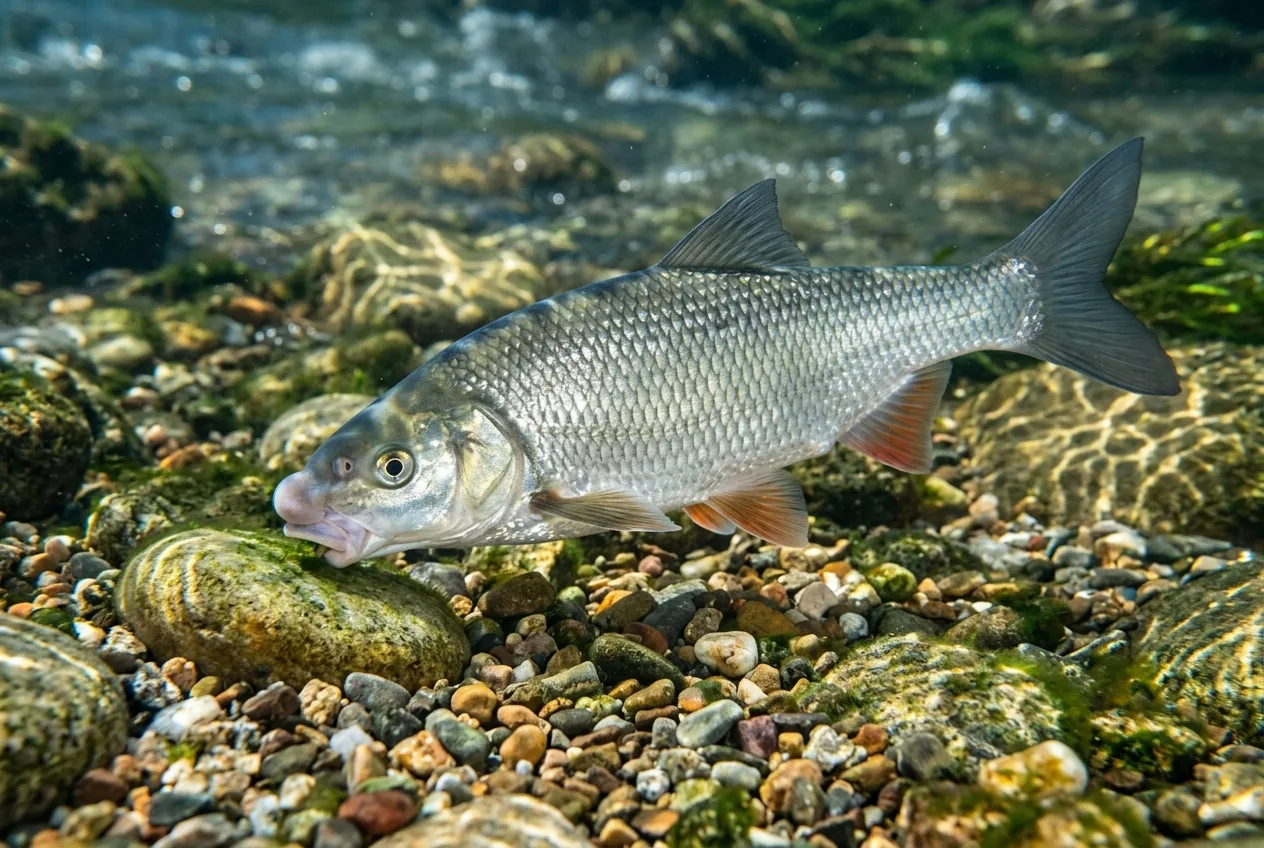
A bottom-dwelling shoaling fish of fast rivers with a blunt snout and a transverse mouth on the underside, whose horny lip scrapes algae off the stones. Most measure 25 to 40 centimetres, only rarely 50 or 60.
When
You are most likely to catch one from July to September, and only rarely from April to June and in October. It is active mainly at dusk. It spawns from March to May.
- JanHardly any chance
- FebHardly any chance
- MarSlim chances, spawning
- AprPossible, spawning season
- MayPossible, spawning season
- JunPossible
- JulGood
- AugGood
- SepGood
- OctPossible
- NovHardly any chance
- DecHardly any chance
Peak seasonGoodPossibleHardly any chanceSpawning season
Spring tactics
At spawning time the shoals move into the tributaries and stand densely on gravel with shallow water flowing over it. During this period six states protect it (Saarland, Rhineland-Palatinate, North Rhine-Westphalia, Hesse, Bavaria and Baden-Württemberg), and seven more states protect it all year round. In any case, leave the spawning shoals undisturbed.
Summer tactics
Now is when you are most likely to catch, mostly in the morning and in the evening. The common nase copes poorly with warmth: in very warm water play the fish briefly and hold fish that are going back in the air for a few seconds at most.
Autumn tactics
As the temperature falls, the shoals gradually leave the shallow grazing grounds and move to deeper stretches of the river. Then look for the transition from shallow to deep water.
Winter tactics
In winter the common nase crowd together in large shoals in deep wintering holes and are hardly ever targeted there. Leave them in peace, because at this time cormorants are already hitting them hard.
Are they biting today?
In January: Out of seasonIn February: Out of seasonIn March: Spawning, please spareIn April: Spawning, please spareIn May: Spawning, please spareIn June: PossibleIn July: Off-peakIn August: Off-peakIn September: Off-peakIn October: PossibleIn November: Out of seasonIn December: Out of season
Today’s catch index needs JavaScript. Season and spawning time are in the catch calendar.
From the blog: Freshwater fish in Germany: which species you catch where
Where it sits now
In the river
The common nase holds in strongly flowing runs over gravel and stone, often close beside the eddies behind bridge piers or large stones. In summer oxygen-rich water below weirs is worth trying, in winter the shoals crowd into deep pools.
How to go about it: In smaller, clear rivers the common nase hold on shallow gravel and trickling stretches where they graze algae. Because a large shoal quickly eats a grazing ground bare, it often changes place; if the bites stop, it may have moved on. On a big river, shallow zones with a strong flow within casting range are worth fishing, and close to stone revetments gobies often bite first there.
| Spring | main current, behind stones, riffle |
|---|---|
| Summer | main current, behind stones |
| Autumn | main current, behind stones |
| Winter | Pools |
Biting time: mainly in the morning and in the evening. What that looks like at the water is shown by the picture of the holding spots just below.
Waters with rules for the common nase
Holding spots in the picture
Choose the season and time of day: the picture shows where the species stands then. Spots outlined in red apply only in the chosen season. Tap a fish or a spot in the list to bring it closer. The picture is schematic and AI-generated, every water is different.
Catch chance in springpossibleSpawning season, observe closed seasons
Catch chance in summergood
Catch chance in autumnpossible
Catch chance in winterhardly any
- J
- F
- M
- A
- M
- J
- J
- A
- S
- O
- N
- D
Spawning season
Active time Common nase are mainly active at dusk.
No peak time Common nase are mainly active at dusk.
Active time Common nase are mainly active at dusk.
No peak time Common nase are mainly active at dusk.
In the river
Slack water behind rocks
Common nase are found here only in spring, summer and autumn.
Gravelly shallow (riffle)
Common nase are found here only in spring.
Pools, deep spot
Common nase are found here only in winter.
Free current in mid-river
Common nase are found here only in spring, summer and autumn.
As a bottom-dwelling shoaling fish the common nase holds in fast-flowing rivers with a gravel, stony or sandy bed. To feed, the shoal uses strongly flowing runs and grazes algae off the stones there. The fish often stand beside the eddies behind stones or bridge piers. On the Rhine anglers have also caught them over a sandy shallow in strong current.
Spring: catch chance according to the catch calendar is slim in March, possible in April and May. Spawning falls in this period, so observe the closed seasons. Between March and May large shoals of common nase migrate upstream to gravel bars with shallow water flowing over them, where they spawn. During this time the species is protected in many places.
Summer: catch chance according to the catch calendar is possible in June, good in July and August. Over the summer common nase usually roam in groups of 20 to 50 fish and often change their grazing ground.
Autumn: catch chance according to the catch calendar good in September, possible in October, hardly any in November.
Winter: catch chance according to the catch calendar is slim. In winter the fish stand packed together in deep, gently flowing pools and runs, often in the lower stretches of rivers.
Depth: On depth the sources differ. FishBase suggests rather shallow water with a strong current, the baseline report from Lake Constance deep runs of more than a metre.
Size comparison: AI-generated drawing, schematic.
How
Where it may be fished for, use coarse-fishing methods: the feeder on the feeder rod, the pole or a plain bottom rig. Stay quiet at the swim, because the common nase is wary.
Easiest way
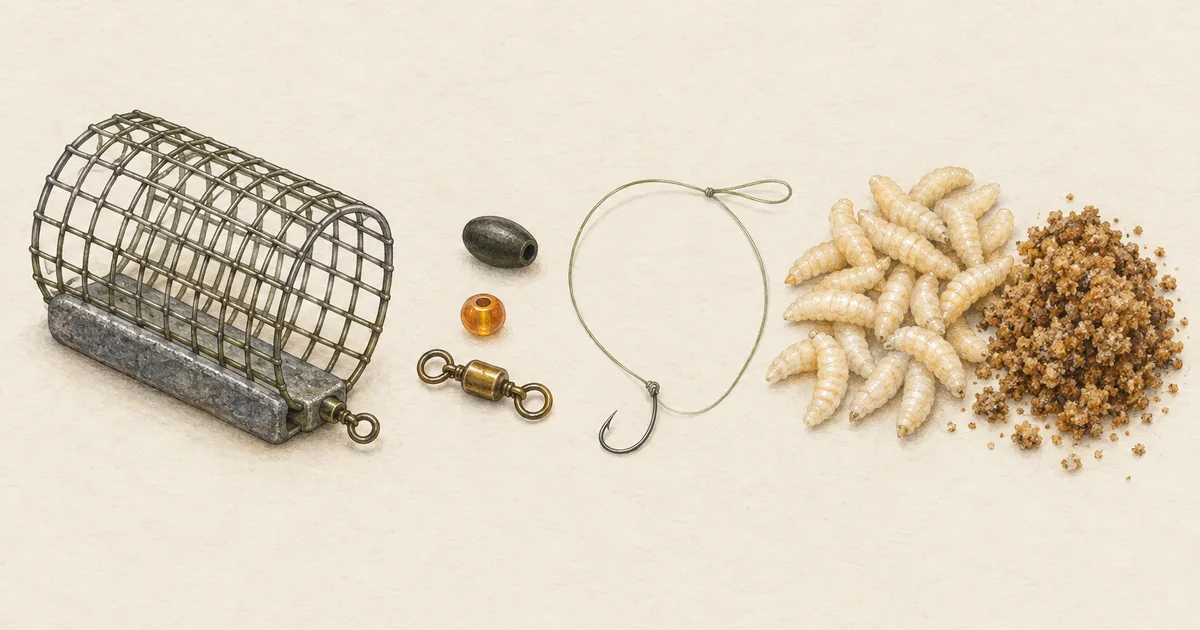
Take a feeder rod of around 50 g casting weight, monofilament of 0,16 to 0,20 mm and a wire feeder with groundbait, maggots and soaked hemp. On a river where the common nase may be fished for, pick a shallow spot with a strong flow over gravel or sand. Offer two maggots on a size 16 hook and stay quiet on the bank.
Feeder with a loop
The usual way in summer on larger rivers, when the common nase in clear water are too shy for the pole.
- Keep your distance
In clear, shallow water a long pole scares the common nase. So fish at a distance with the feeder, on the Rhine for example over a shallow zone with a strong flow at a depth of 1,5 to 2 m.
- Plumb the depth
Use a plumbing rod to check whether there is an edge down into deeper water and how the bottom runs. You transfer the distance you find to the feeder rod with the line clip.
- Fill in layers
First fill the feeder with a little groundbait, then with maggots and soaked hemp, with groundbait on top again to close it. To begin with, put in several full feeders in quick succession, then cast again every few minutes.
- Short loop
Hang the feeder on a short loop of about 12 cm, and then the common nase hooks itself against the feeder weight. Start with a hooklength of around 80 cm in 0,18 mm and a size 14 hook.
- Present lightly
If the fish bite hesitantly, switch to a size 16 hook. A piece of artificial maggot between two real ones almost cancels out the weight of the hook, so the bait drifts like free feed.
- Sharp plucks
Common nase bite very sharply, and you see quick, short movements. A tip with a pronounced tip action shows them well, while on a soft, through-action tip they get lost.
- Away from the shoal
Large common nase bore towards the bottom and shake their heads. Keep steady pressure and draw the fish away from the baited spot quickly so that the shoal carries on feeding calmly.
- Net gently
Take a large landing net with a soft, knotless or rubberised mesh. If the fish has to go back, it stays in the water while the hook is removed.
Drifting float over gravel
For smaller, clear rivers with shallow, trickling stretches where the common nase graze algae.
- Choose a trickling stretch
A clear trickling stretch about 1 m deep, with gravel and streaming weed, is suitable. The common nase often hold in the lower part, where they scrape algae off the stones.
- Put in maggots
Use the catapult to put in a few loads of maggots slightly upstream. After a lull in the bites one or two loads are usually enough to get the fish feeding again.
- Let the weight drag
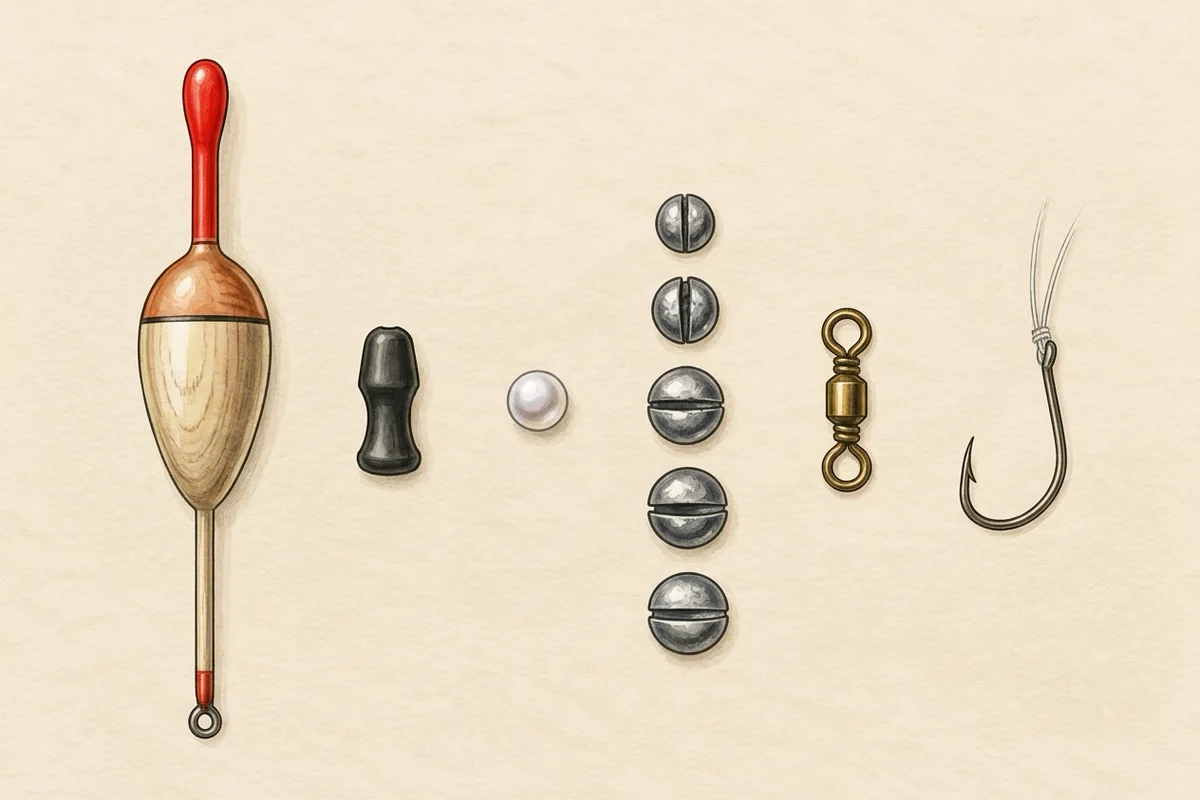
The float carries only a few grams and is weighted with a small stick weight that runs freely on the line. Set the depth so that the weight drags over the bottom and the short hooklength with the maggots follows behind.
- Far across
Cast the rig almost to the opposite bank. A long Bolognese rod helps to keep the float neatly in the line of the current there.
- Go with the fish
Walk along the bank with the float instead of just paying out line. That keeps it in its line, and you see every unusual movement.
- Feel and strike
If the float goes under, you check through the line whether the bait has snagged on the bottom or a fish has bitten. If you feel a fish, you strike at once.
- Quickly up
Bring the hooked fish up quickly and away from the shoal so that the others stay in the swim. If barbel turn up, the bites from common nase often stop, because the larger fish push them out.
What with
Sweetcorn, soaked hemp or wheat, paste balls, worms and maggots, all on small hooks. Put the bait on the outer edge of the baited area, where the common nase hold more readily than in the middle.
- Maggots & larvaesummer, on the feeder and the drifting float
Live maggots drift out of the feed and draw in fish from downstream, while dead maggots stay where they are.
- Sweetcorn & particlesas hemp in the feeder, sweetcorn also on the hook
Soaked hemp attracts common nase, probably because it resembles the small mussels on the bottom, but it must stay wet or it floats up.
- Wormsas a change from the maggot, especially small dungworms
Besides algae, common nase pick up insect larvae and small creatures from the bottom, and a small worm fits that picture.
Tackle
A feeder rod with thin line, an even finer hooklength and small single hooks has proved its worth. For pole fishing and bottom fishing the pages on the pole and the bottom-fishing rod will help.
Feeder with a loop
- Rod
- Feeder rod from about 50 g casting weight, a stronger one with a firm tip of around 3 oz on big rivers
- Line
- Monofilament 0,16–0,20 mm
- Leader
- 0,12–0,18 mm, at first about 80 cm, up to 1,60 m for wary fish
- Hooks
- fine-wire single hooks in size 14–20
- Weight, float, lead
- wire feeder that stays put, around 70 g on the Rhine
Drifting float over gravel
- Rod
- Bolognese rod of around 6 m
- Reel
- small fixed-spool reel
- Line
- Monofilament of around 0,25 mm, in case barbel may bite too
- Leader
- 0,22 mm, just under 40 cm long
- Hooks
- sharp and fine-wire, for common nase rather size 14–16
- Weight, float, lead
- Float with a carrying capacity of about 3 g, stick weight of around 2 g
More on tackle
- Feeder rod: classes, quivertips and set-up
- Bottom rod: length, casting weight and bite indicator
- Float rod: match, Bolognese and pole
- Line calculator
- Fishing line: monofilament, braid or fluorocarbon?
- Spooling a reel properly – without line twist
- Landing net: mesh, size and handle
- Disgorger: unhooking quickly and gently
Common mistakes
- Pole too close in: In clear, shallow water every movement of the long rod scares the fish. Fish at a distance with the feeder rod.
- Hooklength too short: Common nase wait at the very far end of the baited area for maggots drifting out. If the bites stop, lengthen the hooklength noticeably, if need be to twice the length.
- Soft tip: With through-action tips the quick plucks fizzle out. Use a tip with a pronounced tip action.
- Rig seen through: After a few catches the common nase avoid the fixed feeder. Then switch to a lighter rod with a ground weight that rolls slowly over the bottom.
- Playing too long in the heat: Warm water and a long fight raise the risk that a returned common nase will die. Fish in the cooler hours then, and leave protected fish in the water.
Rules
Each federal state (Bundesland) sets its own closed season (Schonzeit) and minimum size (Mindestmaß). Choose your state; the values come from our state pages.
Baden-Württemberg
- Minimum size
- 35 cm
- Closed season
- 15.3.–31.5.
As of October 2026. All rules, exceptions and sources: Fishing in Baden-Württemberg.
Bavaria
- Minimum size
- 30 cm
- Closed season
- 1.3.–30.4.
As of October 2026. All rules, exceptions and sources: Fishing in Bavaria.
Berlin
- Minimum size
- –
- Closed season
- protected all year round
Correct as of October 2026. All rules, exceptions and sources: Fishing in Berlin.
Brandenburg
- Minimum size
- –
- Closed season
- protected all year round
As of October 2026. All rules, exceptions and sources: Fishing in Brandenburg.
Bremen
Our overview for Bremen does not list the common nase. What applies there is covered on the page Fishing in Bremen, with places in the state.
Hamburg
Our overview for Hamburg does not list the common nase. What applies there is covered on the page Fishing in Hamburg, with places in the state.
Hesse
- Minimum size
- 25 cm
- Closed season
- 15.3.–30.4.
- Note
- harvest slot 25–40 cm
As of October 2026. All rules, exceptions and sources: Fishing in Hesse.
Mecklenburg-Western Pomerania
- Minimum size
- –
- Closed season
- protected all year round
- Note
- ban on keeping, return at once
As of October 2026. All rules, exceptions and sources: Fishing in Mecklenburg-Western Pomerania.
Lower Saxony
- Minimum size
- –
- Closed season
- protected all year round
- Note
- fishing only in stocked waters
As of October 2026. All rules, exceptions and sources: Fishing in Lower Saxony.
North Rhine-Westphalia
- Minimum size
- 30 cm
- Closed season
- 1.3.–30.4.
As of October 2026. All rules, exceptions and sources: Fishing in North Rhine-Westphalia.
Rhineland-Palatinate
- Minimum size
- 30 cm
- Closed season
- 15.3.–30.4.
- Note
- does not apply to the Rhine, Moselle and Lahn
As of October 2026. All rules, exceptions and sources: Fishing in Rhineland-Palatinate.
Saarland
- Minimum size
- 35 cm
- Closed season
- 15.3.–15.6.
As of October 2026. All rules, exceptions and sources: Fishing in Saarland.
Saxony
- Minimum size
- 40 cm
- Closed season
- protected all year round
- Note
- except the Elbe: closed season there 1.1.–15.6.
Correct as of October 2026. All rules, exceptions and sources: Fishing in Saxony.
Saxony-Anhalt
- Minimum size
- –
- Closed season
- protected all year round
- Note
- fishing ban under § 2 FischO LSA
As of October 2026. All rules, exceptions and sources: Fishing in Saxony-Anhalt.
Schleswig-Holstein
Our overview for Schleswig-Holstein does not list the common nase. What applies there is covered on the page Fishing in Schleswig-Holstein, with places in the state.
Thuringia
- Minimum size
- –
- Closed season
- protected all year round
As of October 2026. All rules, exceptions and sources: Fishing in Thuringia.
The regulation and your fishing permit (Erlaubnisschein) are what count. Lake Constance, the Rhine and the coast, for example, have their own rules: Fishing waters in Germany.
After the catch
Playing and landing
On the short loop the common nase usually hooks itself, and on the float you set a short strike at once. Large fish bore along the bottom and thrash their heads, so keep steady pressure and lead them away from the shoal quickly. Land with a large, soft landing net, wet your hands and unhook a protected common nase in the water without lifting it into the air.
You unhook a protected common nase in the water and release it carefully, and a disgorger helps with that. If you may keep one of legal size, you stun and kill it at once. The species is on the near-threatened list, and some states list it as endangered.
Frequently asked questions
May you fish for common nase?
Only where state law and the fishing permit allow it. Many states protect the common nase all year round, others mainly at spawning time, and in Switzerland catching it is banned. With protected fish, catching is limited to unhooking in the water.
Which bait for common nase?
Maggots, sweetcorn, paste, soaked hemp or wheat and small worms have proved their worth. Because the common nase is wary in clear water, present everything finely.
What hook size for common nase?
Sizes 14 to 20 are given. Start with a 14 and go smaller if the fish only tap the bait.
How does a common nase bite?
Very sharply, as quick plucks on the feeder tip. On a short loop it usually hooks itself, and with a rolling ground weight the tip vibrates a little longer on a bite than on mere contact with the bottom.
Can you catch common nase on the float?
Yes, on clear, shallow stretches with a drifting float whose weight drags over the bottom. The maggot bait then trails close to the bed, where the common nase feeds.
Similar species
Anyone who catches common nase can also fish for these species with similar tackle:
 Barbel fishingMinor season
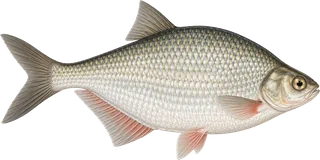 Fishing for silver breamPossible
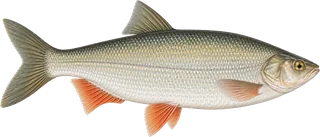 Ide fishingPossible
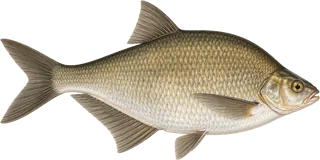 Fishing for breamShoulder season
Sources
Status: October 2026. The practical knowledge comes from 6 sources, summarised in our own words.
View all 6 sources
- Supernasen auf den Grund gegangen (in: Fisch des Jahres 2020 – Die Nase, Broschüre) · Deutscher Angelfischerverband (DAFV), Beitrag von BLINKER (André Pawlitzki)
- Steckbrief Nase: Wissenswertes über diesen Fisch · BLINKER (Jannik Westerkamp)
- Einfach auf Barben angeln am kleinen Fluss · BLINKER (André Pawlitzki)
- Fisch des Jahres 2020: Die Nase (Chondrostoma nasus) · Deutscher Angelfischerverband (DAFV) und Bundesamt für Naturschutz
- Was Hitze mit unseren Fischen macht · Deutscher Angelfischerverband (DAFV)
- Fische landen: Wie nutze ich Kescher, Lip-Grip und Co.? · BLINKER (Redaktion)
Text produced with AI support, based on the sources named and on these pages: Common nase (profile), Feeder fishing, Pole fishing, Bottom fishing, Sweetcorn & particles.