
Knowledge – Fish
Fishing for golden mahseer
You should not fish for golden mahseer deliberately: this large cyprinid of the Himalayan rivers is endangered. Here you can read how to recognise it, where it lives and what to do if one takes your bait anyway.
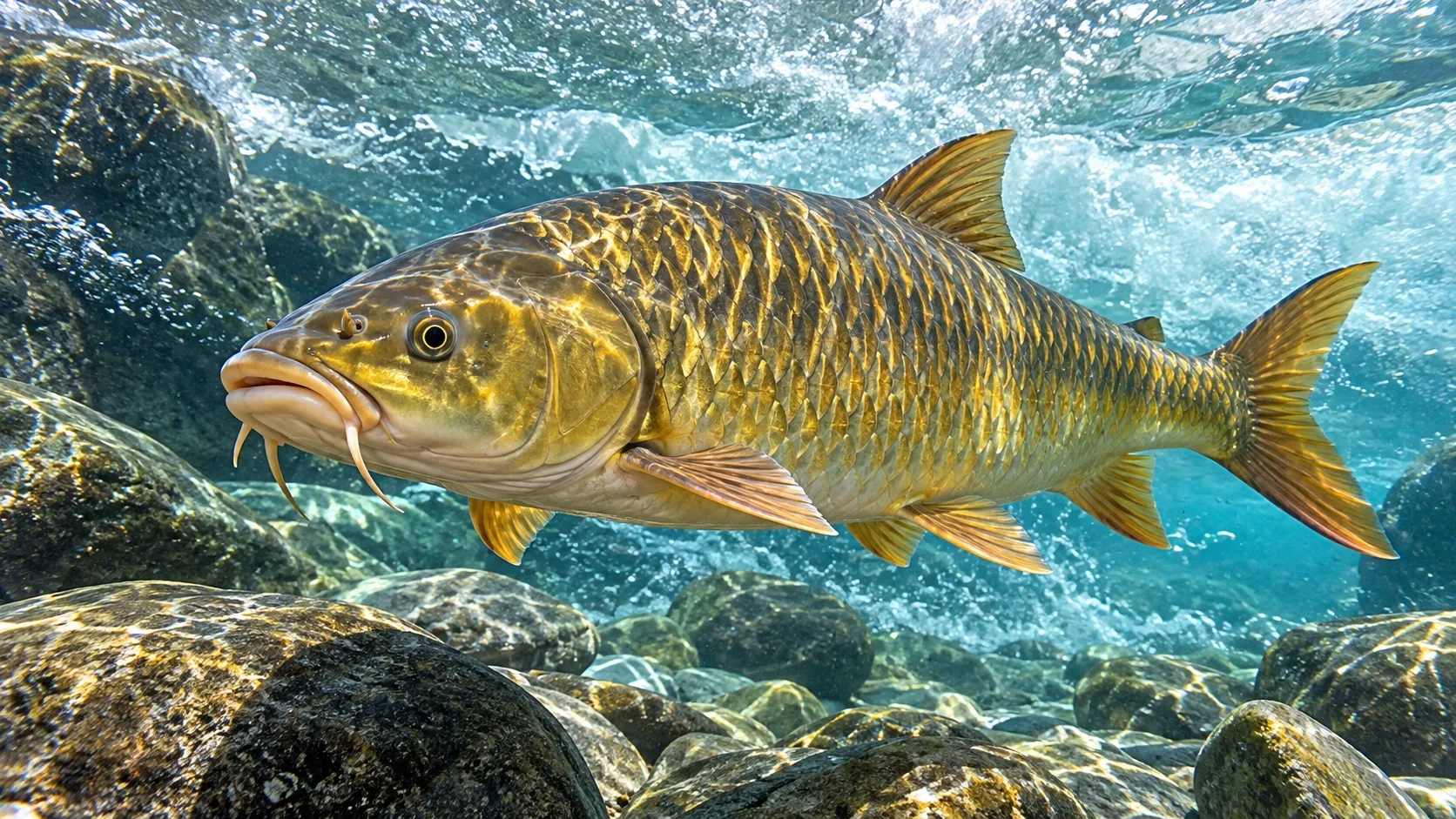
Since 2018 the golden mahseer has been listed by the IUCN as endangered, and it is not a target species. Catch rules, licences and protected areas are set by the countries where it lives.
Quick to recognise
A powerful, laterally flattened cyprinid with very large scales, fleshy lips, two pairs of barbels and golden-yellow fins. FishBase gives up to 54 kilograms; fish over 5 kilograms are rare today.
Why it is not a target fish
Overfishing, dams and the extraction of water and gravel are hurting it, as is illegal fishing with electricity, explosives, plant poison and fine-mesh nets. Dams and weirs split its rivers into sections, and researchers have found genetically separate sub-populations in tributaries of the Ganges. Researchers in India advise releasing every mahseer that is caught.
Where it lives
In the river
It lives in cool, clean mountain rivers of the Himalayas, in fast-flowing streams with stony beds, in river pools and in lakes. Outside the spawning season it stays in deep pools that hold water all year round; in the monsoon it moves up to the middle stretches of the rivers to spawn.
| All year round | Deep pools, behind rocks, riffle |
|---|
Holding spots in the picture
Choose a season and time of day: the picture shows where the species sits then. Tap a fish or a spot in the list to bring it closer. The picture is schematic and AI-generated, every water is different.
In the river
Slack water behind rocks
Golden mahseer (mahseer) is found here all year round.
Gravelly shallow (riffle)
Golden mahseer (mahseer) is found here all year round.
Pools, deep spot
Golden mahseer (mahseer) is found here all year round.
The golden mahseer inhabits cool, clean mountain rivers of the Himalayas: fast-flowing streams with stony beds, river pools and lakes. Outside the spawning season it stays in deep pools that hold water all year round. In the monsoon it moves into the middle stretches and spawns there over gravel and stones, while the young fish live among stones along the bank.
Summer: The spawning season falls in this period; observe the closed seasons (Schonzeiten).
Size comparison: AI-generated drawing, schematic.
Do not confuse
Mahseer is a collective name for at least 47 species in South and Southeast Asia, and even experts do not agree on how to divide them. Typical of the golden mahseer are very large scales, only 24 to 28 along the lateral line, and golden-yellow fins. At the waterside, though, it is hard to tell apart from related species with certainty.
If it bites anyway
If a golden mahseer takes while you are fishing for something else, it stays in the water: remove the hook quickly, let it swim off and do not lift it out for a photo. In the monsoon keep away from gravel bars in the middle reaches, where the spawning fish stand. Report illegal fishing to the authority or the local communities.
Rules
The rules of the country where you fish apply to the golden mahseer, not German fisheries law. Each country, and often each water, sets its own licence, closed seasons (Schonzeiten), minimum sizes (Mindestmaße) and rules on keeping fish.
What the profile says: Endangered according to the IUCN Red List. Not a target species; a hooked golden mahseer is released gently in the water at once.
The fisheries authority (Fischereibehörde) of the country you travel to is what counts. Ask about the current rules before the trip and read in the profile how threatened the species is.
Text AI-assisted, summarised from these pages: Golden mahseer (profile), Releasing a fish.