
Knowledge · Fish welfare and practice
Keeping fish and keepnets
Keeping fish (Hältern) means storing caught fish alive, at the fishing spot usually in a keepnet, a long net tube with rings. Whether this is allowed is decided by each federal state, ranging from precise size specifications to an outright no. Six states are listed below with references, along with the requirements for the net and how it is set up, and the alternative to keeping fish.
Keeping fish and animal welfare
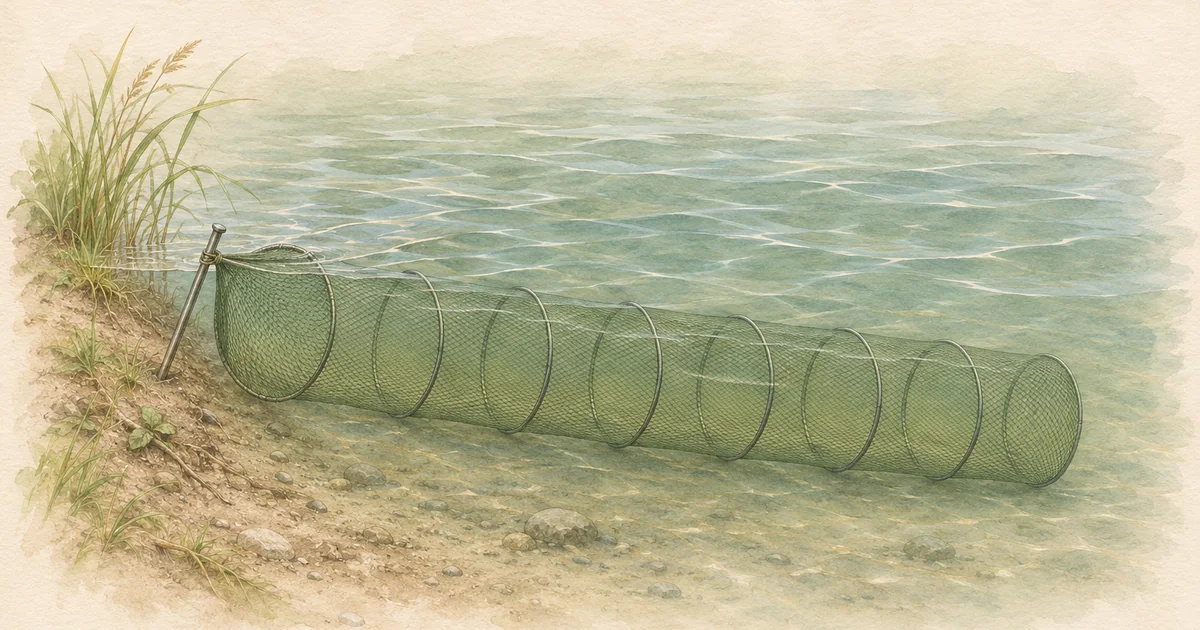
Brandenburg defines the term right in the regulation: keeping fish is the temporary storage of live fish without feeding them (§ 11 Fischereiordnung Brandenburg). At the water this is done in a keepnet. It shares only the netting with the landing net: one takes the fish out of the water, the other holds it in there.
The framework is set by § 1 of the Animal Welfare Act (Tierschutzgesetz): anyone who causes an animal pain, suffering or harm needs a sound reason for doing so. The leaflet from the Lower Saxony Ministry of Agriculture (as of 2019) measures the keepnet against this. Even a well-built keepnet triggers stress reactions, it says, and these are to be regarded as suffering. Fish for eating could be killed and chilled straight after capture without any significant loss of quality. On this reading, there is no reason to keep fish alive for eating.
The leaflet also mentions two court cases. In Düsseldorf an angler was fined in 1990 because of his keepnet, and his appeals failed in 1993. In 2000 the local court (Amtsgericht) in Rinteln acquitted two anglers on the basis of an expert opinion: a properly used fish-friendly keepnet (Schonsetzkescher) does not cause significant suffering. That is the leaflet’s term for keepnets that meet its minimum requirements. The leaflet gives no case numbers, and no rule for your own case follows from either.
State law: six examples with references
Fisheries law is state law. The table shows six states in highly condensed form; the others have not been checked here. What applies on your water is set by your federal state, and the details are in the fishing permit (Erlaubnisschein).
| State | Source | What applies there |
|---|---|---|
| Bavaria | § 20 AVBayFiG | allowed if roomy and knotless textile; as briefly as possible |
| Brandenburg | § 11 BbgFischO | until the end of the fishing day, only in calm water; not for trout, char, grayling, whitefish or salmon |
| Saxony | § 16 SächsFischVO | only fish-friendly devices, enough oxygen, limited duration |
| Schleswig-Holstein | § 11 LFischG-DVO | catch for food or stock-management fishing; at least 3,50 m long, ring 0,50 m |
| Saarland | § 8 Landesfischereiordnung | only for eating or restocking, max. 5 or 7 kg respectively |
| Lower Saxony | 2019 leaflet on the Animal Welfare Act | generally not permitted, except stock-management fishing for stocking |
One point recurs: Bavaria (§ 20 AVBayFiG), Brandenburg, Schleswig-Holstein (state leaflet) and Saarland (§ 8 Landesfischereiordnung) prohibit releasing fish that have been kept. Anyone who puts a fish in the keepnet has already decided to take it.
Separate rules apply to stock-management fishing (Hegefischen), i.e. fishing as part of the statutory duty of stock care, for example to obtain fish for stocking. Schleswig-Holstein allows the keepnet for this. Lower Saxony only tolerates it if the fish are moved to another water and the measure has been agreed in advance with the veterinary authority.
Requirements for the net and how it is set up
Where keeping fish is allowed, the regulations describe the keepnet in fairly similar terms. The figures apply only where they are stated.
- Size: at least 3,50 metres long with a ring diameter of 50 centimetres in Schleswig-Holstein and Saarland, as in the annex to the Lower Saxony leaflet. Bavaria requires a sufficiently roomy net without giving a figure.
- Material: knotless and textile, as stated in Bavaria, Schleswig-Holstein and Saarland, and as taught by the Landesfischereiverband Baden-Württemberg for its state.
- Mesh: Lower Saxony wants it as wide as possible so that water flows through, but no larger than the head height of the smallest fish minus about 30 per cent. The net should be soft yet strong.
- Position: secured against collapsing along its entire length and laid out parallel to the surface (Schleswig-Holstein, Saarland), so that, according to Schleswig-Holstein, the fish can swim freely. Lower Saxony also requires the net to be firmly anchored, kept taut at all times and laid out in the direction of the current.
- Depth and waves: Lower Saxony requires the net to stay completely below the surface even when there are waves, Schleswig-Holstein largely so. Saarland prohibits it in wave action, and Brandenburg allows it only in areas sheltered from the current and not from a moving boat.
- Quantity: Saarland allows at most 5 kilograms of fish for eating and 7 kilograms for restocking. Lower Saxony gives about 15 kilograms per cubic metre of usable volume. A keepnet with the minimum dimensions holds, by calculation, just under 0,7 cubic metres, which would be about 10 kilograms, or rather less.
- Duration: as briefly as possible (Bavaria, Brandenburg) or limited to what is necessary (Saxony), at most until the end of the fishing day (Brandenburg, Schleswig-Holstein). The Lower Saxony leaflet sets a maximum of eight hours for stock-management fishing.
- Which fish: In Schleswig-Holstein only uninjured ones. If they show clear stress or unusual behaviour, keeping them ends immediately. Incompatible species do not belong together, such as pike and silver fish.
Stress, slime coat and oxygen
A report by England’s environment agency, published in 1997 together with the national anglers‘ association there (Pottinger, Environment Agency), names three stresses. Putting fish in and taking them out can rub off skin, strip the protective slime layer and cost scales. The water in the net can deteriorate if it is overcrowded or too little water flows through. On top of that comes the stress reaction to capture, handling and confinement.
On water quality, the report refers to an earlier series of measurements on carp: in the keepnet, oxygen fell and ammonia and carbon dioxide rose, but the limits that freshwater fish tolerate were not exceeded. In the report’s own trial, carp stayed in the keepnet for four hours. Cortisol, a stress hormone in the blood, rose because of the capture but not additionally because of the keepnet, and was back to normal after 4 to 24 hours. The study did not assess injuries; fish species, size, stocking density and water temperature should be investigated further. Why warm water holds less oxygen is explained under Water temperature and oxygen.
From the physical response alone, the author saw little reason to restrict keepnets. Lower Saxony, by contrast, already regards the stress reaction in a fish-friendly keepnet as suffering, and Schleswig-Holstein wants fish to be kept only in exceptional cases because of stress and the risk of injury.
The alternative: kill and chill straight away
For a fish you want to eat, Schleswig-Holstein and Lower Saxony point to the same route: stun it, kill it and keep it chilled straight away. The Bavarian angling exam asks exactly this. For a carp slaughtered on a summer morning, the cool box with ice packs counts as the right answer there and the keepnet in cool water as the wrong one. The handling is described under Stunning and killing fish, the cold chain under Storage and hygiene.
If a fish is going back, it goes straight into the water after unhooking, not into the keepnet first. In the four states that ban release, the detour would be final: kept there means taken. How to release fish gently is described in Returning fish.
Use a keepnet only if your state law and the fishing permit allow it and there is a genuine reason, such as stock-management fishing expressly provided for by your state’s rules. For your own fish for the table, Schleswig-Holstein and Lower Saxony point to killing and chilling immediately.
Bucket, tub and the way home
The Schleswig-Holstein leaflet considers ordinary buckets unsuitable. If storing fish cannot be avoided, they belong in containers with room to move and oxygen-rich water, ideally covered: in the dark they are calmer and don’t jump out. For transporting live fish, the Bavarian exam requires enough water and oxygen; Brandenburg and Saxony regulate transport and keeping together. More on the container under Angling bucket.
In Schleswig-Holstein, live baitfish may not be kept in any form, see Live bait and animal welfare. Whether you may take fish home alive or to another water is governed by state law and your fishing permit; Bavaria, for instance, deals with stocking in a separate section of its regulation. Why this matters is explained in Not spreading species and diseases.
Frequently asked questions
Are keepnets banned in Germany?
There is no nationwide rule. According to its leaflet, Lower Saxony considers them generally impermissible; Bavaria, Brandenburg, Saxony, Schleswig-Holstein and Saarland allow them subject to conditions. What counts is your state and your fishing permit.
May I release kept fish again in the evening?
Not in Bavaria, Brandenburg, Schleswig-Holstein and Saarland; there, releasing kept fish is expressly prohibited. If you only want to weigh and release, return the fish directly after capture.
Is a wire keepnet good enough?
No. Where the regulations specify the material, they require knotless textile netting. That applies in Bavaria, Schleswig-Holstein and Saarland, and Baden-Württemberg teaches the same in its angling exam.
Related
- Stunning and killing fish: blow to the head, check and gill cut
- Returning fish: duty, state law and gentle handling
- Cool box and cool bag: keeping the killed catch fresh
- Storage and hygiene: cold chain from catch to kitchen
- Landing net: mesh, size and handle
- Whip fishing: fishing with a whip, without a reel
- Fight, heat and depth: what already takes its toll on the fish during capture
- Law & permits: overview of state law and the fishing permit (Erlaubnisschein)
- Carp sack and retainer: keep fish briefly and gently
Sources
- Bundesministerium der Justiz: Tierschutzgesetz § 1 (vernünftiger Grund)
- Niedersächsisches Landwirtschaftsministerium: Merkblatt zur Verwendung von Setzkeschern in der Angelfischerei, Stand 17.06.2019 (PDF) und LAVES: Zusammenfassung des Merkblatts (Bewertung, Hegefischen, Gerichtsverfahren, Anforderungen)
- Freistaat Bayern: Verordnung zur Ausführung des Bayerischen Fischereigesetzes, § 20 (Setzkescher, Dauer, Zurücksetzen, Besatz)
- Land Brandenburg: Fischereiordnung, § 11 (Begriff, Dauer, Arten, Strömung, Zurücksetzen)
- Freistaat Sachsen: Sächsische Fischereiverordnung, § 16 (Vorrichtungen, Sauerstoff, Dauer)
- Landwirtschaftsministerium Schleswig-Holstein: Merkblatt zum Urlauberfischereischein, Stand Februar 2026 (PDF) (§ 11 LFischG-DVO, Kühlbox, Eimer, Köderfische)
- Fischereiverband Saar: Saarländisches Fischereirecht, Landesfischereiordnung § 8 (PDF) (Zweck, Maße, Höchstmengen)
- LfL Bayern: Staatliche Fischerprüfung, Prüfungsfragen 2023/2024 (PDF) (Kühlbox, Transport)
- Landesfischereiverband Baden-Württemberg: Gerätekunde, März 2022 (PDF) (knotenloses Netzmaterial)
- Environment Agency, T. G. Pottinger: Effects of Retention of Fish in Keepnets, 1997 (PDF) (Verletzungen, Wasserqualität, Cortisol)
Text AI-assisted, drawing AI-generated. Sources opened and checked in November 2026; no graphics taken from the sources.
All information is indicative, without guarantee, and does not replace legal advice. Whether and how you may keep fish alive is determined by the fisheries regulation of your federal state and your fishing permit in their current versions.