
Knowledge · Nature & environment
Not spreading species and diseases
If you fish several waters, you often carry more in your bucket, in a wet landing net and on your waders than you can see: small fish, mussel larvae, bits of plants and pathogens. This is how invasive species and fish diseases spread. Between two waters, three steps are enough: check, empty, dry.
How animals, plants and pathogens travel
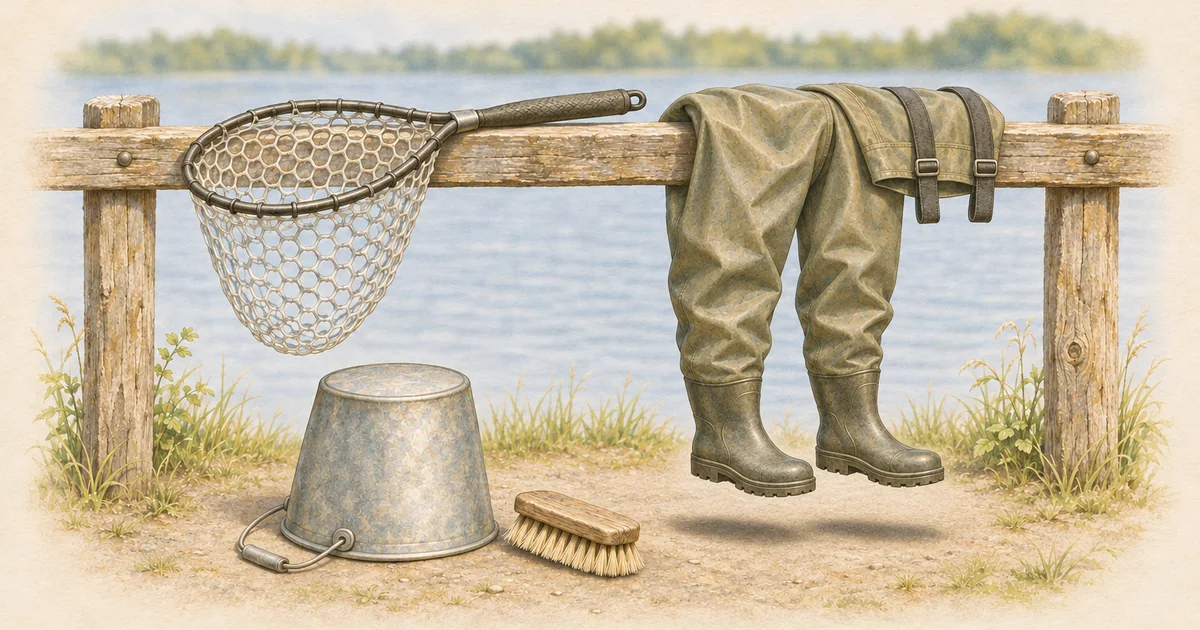
Many pathogens don’t need a living fish to move. According to the Bayerisches Landesamt für Umwelt, crayfish plague spores remain infectious without a host for up to two days when dry and for up to two weeks in damp conditions. Among the carriers the office names wet wading boots, transport water from stocking fish, boats, fishing tackle and nets. For anglers, these routes matter most:
- Baitfish and fish remains: Fish also spread crayfish plague, writes the Saxon fisheries authority. According to the Swiss Bundesamt für Umwelt, gobies from the Black Sea region also reach new waters as illegal baitfish.
- Water in the bucket: Quagga mussel larvae can only be seen under a microscope. According to the Landratsamt Starnberg, they survive in leftover water much longer than the five days they stay attached to dry surfaces.
- Landing nets, nets, boots: According to the LALLF in Mecklenburg-Western Pomerania, koi herpesvirus in carp also spreads indirectly, via landing nets, nets, transport containers, water and boots. What difference a felt sole makes is explained under Waders.
- Boats: Quagga larvae cling to hulls, paddleboards and fishing tackle and sit in hoses (Landratsamt Starnberg).
- Bits of plants: According to the states‘ management sheet (Maßnahmenblatt), Nuttall’s waterweed hitches a ride on fishing and angling gear into waters it could not reach on its own.
Documented cases from Germany
Round goby. According to the Swiss information sheet, it probably reached the Rhine at Basel in the ballast water of cargo ships. It and related gobies have multiplied massively in the Rhine, Weser and Oder, and in 2016 the Saxon state office caught the first specimens in the Elbe near Schmilka (LfULG Sachsen). How to recognise it is described in the profile of the round goby.
Stone moroko. According to the states‘ management sheet, this small cyprinid from East Asia came to Germany between the 1960s and 1980s, probably with imported grass carp. Fish farms, the ornamental fish trade and angling spread it further, which is why stocking with mixed small fish should be checked. More under Stone moroko.
Crayfish plague. The pathogen, a water mould, was most probably brought to Europe by introduced North American crayfish. Spiny-cheek crayfish and signal crayfish carry it without falling ill; for noble crayfish and stone crayfish the infection is usually fatal. There is no cure (Bayerisches Landesamt für Umwelt).
Quagga and zebra mussel. The quagga mussel has lived in Lake Constance since 2016 and has now also been found in the Starnberger See and the Ammersee. It filters so much plankton that other species go short of food. The similar zebra mussel already colonises the Starnberger See (Landratsamt Starnberg).
Aquatic plants. The EU list of invasive species includes Nuttall’s waterweed, curly waterweed and New Zealand pigmyweed, among others, all three established in Germany (Bundesamt für Naturschutz). According to the management sheet, dense stands of Nuttall’s waterweed crowd out native aquatic plants.
Fish diseases. Koi herpesvirus (KHV) affects carp, and a whole stock can die of it. According to the LALLF, goldfish, grass carp, crucian carp and tench can carry the virus without falling ill themselves. The viral diseases VHS and IHN affect salmonids such as brown trout and rainbow trout. According to the LGL Bayern, grayling and pike also transmit VHS. Both diseases pass from fish to fish, with water from affected farms and via contaminated equipment.
| Species or pathogen | Danger | What anglers do |
|---|---|---|
| Round goby | eats spawn, competes with bottom fish | never as baitfish, never take it away alive |
| Topmouth gudgeon | eats fish spawn, competes for food | check baitfish, remove catches |
| Crayfish plague | kills noble and stone crayfish | dry tackle, don’t move crayfish |
| Quagga mussel | filters out the plankton | empty leftover water, dry the boat |
| Waterweed, pigmyweed | crowds out native plants | check and clean tackle |
| KHV, VHS, IHN | fish kills in carp and trout | clean tackle, don’t move fish |
What the law requires
For species on the Union list, Article 7 of Regulation (EU) No 1143/2014 applies: no one may intentionally keep, transport, use or release them into the environment. According to the Bundesamt für Naturschutz, the list currently covers 114 species and was last extended on 7 August 2025. Stone moroko, spiny-cheek crayfish, signal crayfish and the aquatic plants mentioned are on it; round goby and quagga mussel are not.
Regardless of the list, under § 40 of the Federal Nature Conservation Act (Bundesnaturschutzgesetz) anyone who releases animals into the wild needs a permit. Exempt is the introduction of species covered by fisheries law that have occurred there within the last 100 years. Stocking is reserved for those entitled to do it, in Saxony for example those entitled to exercise fishing rights and the fisheries authority (§ 12 Abs. 1 SächsFischVO). For VHS and IHN, EU animal health law applies, Regulation (EU) 2016/429 (LGL Bayern).
Baitfish and returning fish are regulated by the states. Four examples with references:
- Brandenburg: baitfish only in the water or water system they come from; frozen, chemically preserved and dead sea fish are exempt (§ 6 Abs. 2 BbgFischO).
- North Rhine-Westphalia: baitfish only in the water they come from or in a water connected to it (§ 6 Abs. 1 LFischVO).
- Saxony: fish caught with a fishing permit may only go back into the water where they were caught and may only be used as baitfish there. You may neither stock nor return species on the Union list (§ 12 Abs. 2 and 3 SächsFischVO).
- Berlin: baitfish only in the water or water system they come from; non-native and alien fish do not go back into the water after capture (§ 12 Abs. 2 and § 9 Abs. 4 LFischO).
As of November 2026, examples from four states. What applies to you is set out in the state regulation, the water rules (Gewässerordnung) and the fishing permit (Erlaubnisschein); all state regulations are linked from Closed season and minimum size explained.
Between two waters: check, empty, dry
The Landratsamt Starnberg names four steps. Check whether the tackle has been in another water in the last five days. Empty leftover water from all parts and cavities, but not into the lake you are just arriving at. If possible, rinse at home with clean, hot water. Then leave everything to dry for at least five days. For boats, the office names hosing down the hull with water at 60 °C or hotter.
According to the Saxon leaflet, complete drying for more than 48 hours is enough against crayfish plague. The periods apply to different organisms; five days cover both.
- Check landing net and hooks: Bits of plants and mud do not belong in the next water. Care tips for the net are under Landing net.
- Empty the bucket at the water you fished: If you move on the same day, take a second, dry angling bucket with you.
- Baitfish from the water you are fishing: Several states require this anyway. Live baitfish are banned in Brandenburg and North Rhine-Westphalia, among others; more under Live bait and animal welfare.
- Plan the order: For fish survey teams, the LAVES Niedersachsen advises fishing small streams before large rivers, upper reaches before lower reaches, and waters with noble crayfish first. This can be applied to a fishing day on several waters.
Reporting catches and finds
According to the states‘ management sheet, stone moroko taken as by-catch during fishing operations or in fisheries management should be removed. In Switzerland, the rule for Black Sea gobies is: kill immediately, never keep alive, do not use as bait (BAFU). How to do this humanely is explained under Stunning and killing fish.
For gobies, the Saxon state office asks for the place of capture, date, number and ideally a photo, and also accepts reports of invasive crayfish. If dead crayfish are lying in the water, the first contacts in Bavaria are the police and the district administrative authority (Kreisverwaltungsbehörde) (Landesamt für Umwelt). If fish deaths pile up or there are signs of VHS, the veterinary office must be informed immediately, according to the LGL. Crayfish plague is harmless to humans (LfU Bayern), and according to current knowledge KHV is not considered infectious to humans (LALLF).
Frequently asked questions
May I take baitfish to another lake?
Not in the four example states. There, baitfish belong in the water they came from, in Brandenburg and Berlin also in the same water system, and in North Rhine-Westphalia in a connected water. Brandenburg exempts frozen and preserved baitfish as well as dead sea fish. Further states are summarised under Baitfish rig.
How long does the tackle have to dry?
Against crayfish plague, the Saxon fisheries authority gives more than 48 hours. Because of the quagga mussel, the Landratsamt Starnberg advises at least five days. The longer period meets both recommendations.
Can my dog spread crayfish plague?
The Bayerisches Landesamt für Umwelt expressly lists dogs running free among the animals that move from water to water and can carry spores. A dog that swims in two streams on the same day is therefore a possible route.
Related
- Round goby: features, spread and state rules
- Stone moroko: how it differs from sunbleak and gudgeon
- Live bait and animal welfare: why live baitfish are banned
- Waders: felt or rubber, drying after use
- Angling bucket: water, bait and the second bucket
- Nature conservation on the bank: reeds, breeding seasons and protected areas
Sources
- Bayerisches Landesamt für Umwelt: Die Krebspest (PDF, 2025) (Erreger, Sporen, Übertragungswege, Meldung)
- Sächsische Landesstiftung Natur und Umwelt: Invasive Krebse, Hinweise für Angler (PDF) (Fische als Überträger, 48 Stunden Trocknen)
- Landratsamt Starnberg: Infotafeln zur Quagga-Muschel (PDF) (Larven, Vorkommen, vier Schritte)
- BAFU Schweiz: Merkblatt invasive Grundeln (PDF) (Ballastwasser, Köderfisch, Verhalten nach dem Fang)
- LfULG Sachsen: Schwarzmundgrundel, Bitte um Meldungen (PDF) (Elbe 2016, Meldeangaben)
- LANA, beim LfU Rheinland-Pfalz: Maßnahmenblatt Blaubandbärbling und Maßnahmenblatt Schmalblättrige Wasserpest (Ausbreitungswege, Beifang)
- LALLF Mecklenburg-Vorpommern: Merkblatt Koi-Herpesvirus (PDF, 2007) (Übertragung, Trägerarten)
- LGL Bayern: VHS und IHN (Arten, Übertragung, Meldung, Rechtsgrundlagen)
- LAVES Niedersachsen: Fischkrankheitsprävention bei Untersuchungen (PDF) (Reihenfolge der Gewässer)
- Bundesamt für Naturschutz: Unionsliste; Verordnung (EU) Nr. 1143/2014, Artikel 7; Bundesnaturschutzgesetz, § 40 (Liste, Verbote, Ausbringen)
- Landesrecht: BbgFischO, LFischVO NRW, SächsFischVO, LFischO Berlin (Köderfische, Besatz, Zurücksetzen)
Text AI-assisted, drawing AI-generated. Sources opened and checked in November 2026; no graphics taken from the sources.
All information is indicative and without guarantee. What you must do with baitfish, catches and tackle is determined by the law of your federal state, the water rules and the fishing permit; the information on pathogens does not replace veterinary or medical advice.