
Knowledge · Tackle
Angling bucket: Water, bait and groundbait at the bank
A fishing bucket brings water for the unhooking mat and your hands to the swim, holds groundbait and small items, and as a folding bucket on a rope it can be lowered into the water from a jetty or quay wall. This explains which design suits what, where scooping up water gets risky and what doesn’t belong in the bucket.
Water for the mat, your hands and the fish
The Bavarian question catalogue for the angling exam (Fischerprüfung) is clear about the reason: a fish that is to go back is handled only with wet hands so its skin isn’t damaged. The same applies to what it lies on. According to Blinker, an unhooking mat can essentially never be too wet before the catch lands on it.
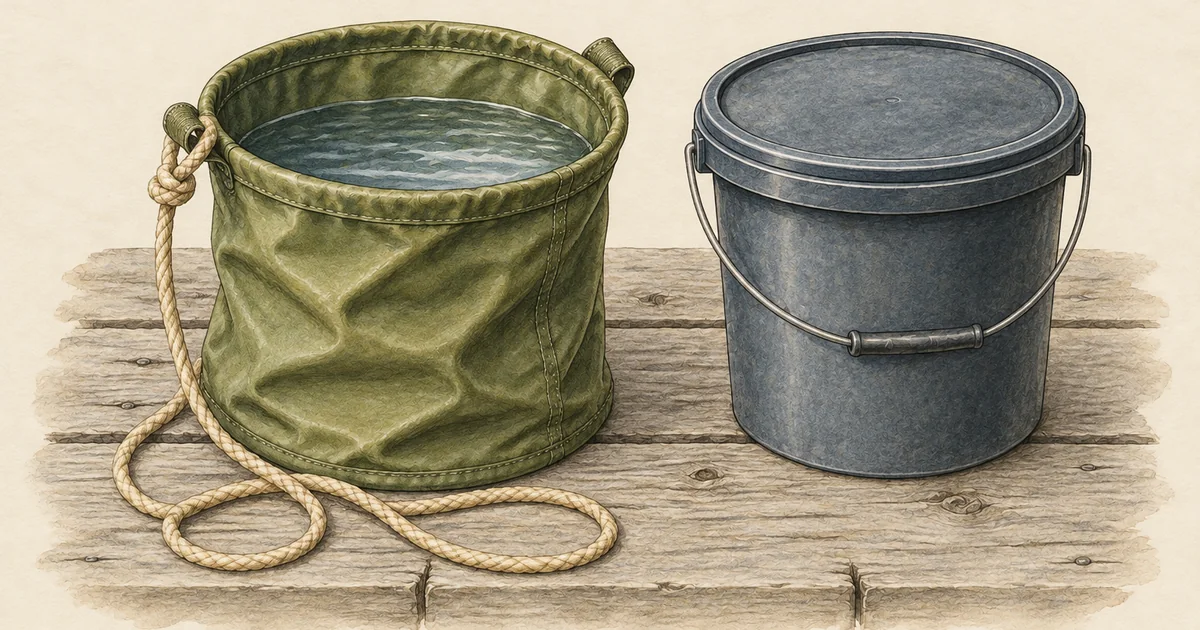
So that water is ready when the fish is in the net, you fill the bucket as soon as you set up. Fisch & Fang advises carp anglers on night sessions to keep the filled water bucket close to the mat at all times, together with scales, tape measure and a wet weigh sling. If unhooking takes longer, a splash from the bucket helps. The gentlest approach, though, is not to lift the fish out of the water at all if possible. How to do that is explained in Landing and unhooking a fish.
Designs: rigid bucket, folding bucket, rope
The rigid plastic bucket stands firm, can be closed with a lid and stays reliably shut at the swim overnight too. Against rats the rule is: anything that gives off a scent belongs in a bucket, well sealed.
The folding bucket folds flat when empty. In winter, when little groundbait is enough, a small folding bucket holding about 3 litres of groundbait does the job. With a rope on the handle it becomes a scoop, and that is how it appears on equipment lists for herring fishing too. Where even that is too bulky, a sponge on a string helps: throw it in, pull it back, wet your hands. With small fish wet hands are especially important because the delicate scales come off more easily.
| Design | Use |
|---|---|
| Rigid bucket with lid | keep groundbait and anything that smells closed |
| Small folding bucket | little groundbait, water (about 3 litres for a winter day) |
| Folding bucket with rope | water from quay, breakwater, jetty |
| Sponge on a string | wet hands at high spots, rinsing tackle |
Scooping water from a jetty, quay and breakwater
At the sea, according to Blinker, you often stand on a high quay wall or on large rocks, and water is hard to reach from there. Breakwaters often have steep, slippery ways down to the water. Inland it is no better. The DLRG names steeply sloping banks at lakes and ponds as a hazard and warns that the banks of gravel pits can give way.
That is exactly what the rope is for: you stay up on firm ground and only the bucket goes down. Kneel down to scoop, as in Fig. 1, instead of bending over the edge standing up. If the edge is wet, mossy or undercut, leave the bucket and use the sponge on a string.
Safety: The advice on banks comes from the DLRG and the specialist press; it is no substitute for instruction on site. What to do with current, waders and a fall into the water is explained in Banks and waders. In an emergency, call 112.
Groundbait, bait and what doesn’t belong in the water
Separate buckets are used for mixing groundbait, see Groundbait bucket and mixing whisk. Maggots and worms have their own boxes, see Maggot box and worm tub. The fishing bucket is the container for everything else: water, a little leftover groundbait, bait in its box, small items at night.
At the end of the day there is often groundbait left over. Don’t tip it into the water. The Bavarian exam question catalogue treats excessive baiting as harmful: it can promote eutrophication, i.e. the over-fertilisation of a water, because nitrogen and phosphorus get into the water and water quality drops. Blinker adds, for carp sessions, that a lot of groundbait at high temperatures can lead to oxygen depletion. What is left over, you take home with you.
State law also applies to dead bait fish. One example: § 12 paragraph 3 of the Sächsischen Fischereiverordnung (version of 1 June 2022) reads: “Persons holding a fishing permit (Erlaubnisschein) may only return fish they have caught to the water or use them as bait fish only in the water in which the fish were caught.” How it is regulated in your federal state (Bundesland) is set out in the state fisheries regulation (Landesfischereiverordnung) and in your fishing permit.
Not a holding tank for live fish
For transporting live fish the Bavarian exam question catalogue requires a container with a sufficiently large volume of water and sufficient oxygen supply. A fishing bucket with a few litres of water is not designed for that. Why warm water holds less oxygen is explained in Water temperature and oxygen.
A fish that is to go back goes straight into the water. A fish you may keep, you stun and kill straight away, see Stunning and killing fish. Whether and how fish may be kept alive is regulated by your federal state (Bundesland), and the conditions in the fishing permit (Erlaubnisschein) apply on top. Many federal states expressly ban live bait fish, for example Bavaria, Hesse and North Rhine-Westphalia; in Brandenburg the fisheries authority (Fischereibehörde) can allow an exception in individual cases, more on this under Bait fish.
For a dead catch too, the bucket is a stopgap. If you use it without ice or cool packs, you should at least keep closing it or cover the fish with a damp cloth. A cool box keeps things cooler.
Dry it before the next water
A wet bucket carries water from one water to the next, and possible pathogens with it. The best known is crayfish plague. A leaflet from the Saxon fisheries authority (Fischereibehörde) names introduced, invasive crayfish species as carriers, which are themselves immune. Anglers are supposed to disinfect waders, boots and net fishing gear before moving to another water. According to the leaflet, thorough drying for more than 48 hours is enough for that.
The bucket isn’t expressly mentioned there. But the Lower Saxon state office LAVES counts it, in its guidance for fish survey teams, among the equipment that is cleaned and disinfected when changing waters, along with boots, waders, landing nets and nets. For anglers that means: empty the bucket at the water and let it dry at home. If you move on the same day, take a dry bucket for the second water.
Common mistakes
- Only filling the bucket once the fish is in the net. Then the mat stays dry or the fish lies in the air for longer. Fill it when you set up.
- Bending over a slippery edge while standing. Kneel down or, at high, wet spots, use the sponge on a string.
- Tipping leftover groundbait into the water at the end. That fertilises the water, as the Bavarian exam question catalogue explains. Take the rest home.
- Making a fish wait in the bucket. The container has too little water and oxygen. Return it or deal with it straight away.
- Carrying on with the wet bucket at the next water. Pathogens travel with the leftover water. Let it dry or pack a second bucket.
Frequently asked questions
How big should a fishing bucket be?
The sources don’t give a fixed size. For a winter day’s feeder fishing, a small folding bucket holding about 3 litres of groundbait is enough. For water at the mat, what matters more is that the bucket stands beside it full.
May I take dead bait fish in a bucket to another water?
Each federal state (Bundesland) regulates this itself. In Saxony, holders of a fishing permit (Erlaubnisschein) may, under § 12 paragraph 3 of the Sächsischen Fischereiverordnung, use fish they have caught as bait fish only in the water where they were caught. For other states, what the state fisheries regulation and the fishing permit say applies.
Can I take water from the fishing water to clean the catch?
The water from the fishing water is meant for wetting the mat and your hands. For rinsing the killed catch, the Bavarian exam question catalogue advises using drinking water you have brought with you, details under Cool box and cool bag.
Related
- Unhooking mat: designs and how to lay the fish on it
- Landing and unhooking a fish: landing net, grips and releasing the hook in the water
- Banks and waders: a safe footing, current and what helps after a fall
- Groundbait bucket and mixing whisk: the big bucket for mixing groundbait
- Maggot box and worm tub: the container for maggots and worms
- Cool box and cool bag: getting the killed catch home fresh
- Natural animal baits: worms, maggots and dead bait fish at a glance
- Line calculator: breaking strain after the knot, so the fight stays short
- Aeration pump: oxygen for baitfish in the bucket
- Worm box: keep your own bait worms fresh
Sources
- Bayerische Landesanstalt für Landwirtschaft: Staatliche Fischerprüfung in Bayern, Prüfungsfragen 2023/2024 (PDF) (Fragen 3.030, 3.127, 4.110, 4.129, 4.174: nasse Hände, Anfüttern, Transportgefäß, Trinkwasser)
- Sächsische Landesstiftung Natur und Umwelt: Invasive Krebse, Hinweise für Angler (PDF) (Krebspest, Trocknen über 48 Stunden)
- Freistaat Sachsen: Sächsische Fischereiverordnung (REVOSax) (§ 12 Absatz 3, Köderfische nur im Fanggewässer)
- LAVES Niedersachsen: Hinweise zur Fischkrankheitsprävention bei fischereilichen Untersuchungen (PDF) (Eimer beim Gewässerwechsel desinfizieren)
- DLRG: Gefahren in stehenden Gewässern (steil abfallende Ufer, abrutschende Ufer an Kiesgruben)
- Blinker: Abhakmatte: Richtig einsetzen und schonend releasen (Matte gut anfeuchten, Fisch möglichst im Wasser lassen) und Fisch & Fang: Nachtangeln auf Karpfen (Wassereimer bei der Matte, Eimer als Ablage, Ratten)
- Blinker: Meeresangeln: 6 Tipps für die erfolgreiche Artenjagd an der Küste (hoher Kai, Schwamm am Seil, nasse Hände bei kleinen Fischen), Blinker: Brandungsangeln (steile, glitschige Abgänge an Molen) und Blinker: Silber satt, 18 Profitipps zum Angeln auf Hering (Falteimer mit Seil zum Wasserholen)
- Blinker: Feederangeln: Tipps vom Deutschen Friedfisch-Meister (Falteimer mit etwa 3 Litern, flach zusammenfalten), Blinker: Karpfen-Kickstart (Sauerstoffmangel durch Anfüttern bei Wärme) und Blinker: Die beste Kühlung, Fische richtig lagern (Eimer ohne Kühlung verschließen oder Fisch feucht abdecken)
Text AI-assisted, drawing AI-generated. Sources opened and checked in October 2026; no graphics taken from the sources.
All figures are guide values without guarantee. What you may carry at the water, take away or keep alive is governed by state law, the water rules (Gewässerordnung) and the fishing permit (Erlaubnisschein); this page is no substitute for legal advice.