
Knowledge · Tackle
Aeration pump for baitfish: Oxygen in the bucket
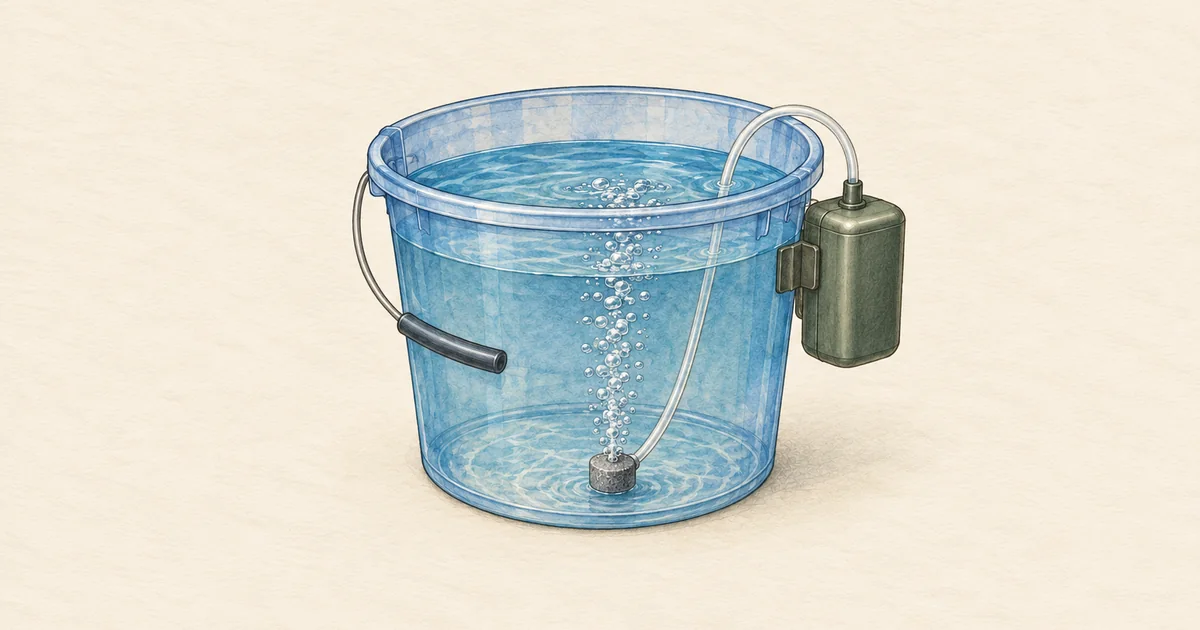
An aeration pump pushes air through a thin tube to an air stone at the bottom of the bucket and so keeps oxygen in the water, which quickly runs short on warm days. Whether baitfish may stay alive in the bucket at all is regulated by your federal state. On the hook, many federal states expressly ban the live baitfish, such as Bavaria, Hesse and North Rhine-Westphalia; in Brandenburg the fisheries authority can allow an exception in an individual case.
Warm water holds less oxygen
Fish breathe the oxygen dissolved in the water through their gills. How much fits in depends strongly on temperature. The Leibniz Institute of Freshwater Ecology and Inland Fisheries (IGB) gives about 14 mg/l for water at 0 °C, but only about 9 mg/l for water at 20 °C. According to the IGB, most fish species need more than 3 mg/l. The Landesanstalt für Umwelt Baden-Württemberg (LUBW) describes values below 4 mg/l as critical for fish and other aquatic animals.
In a water body, oxygen is replenished from the air and from aquatic plants. In a bucket, current and plants are largely missing. The fish use up the small supply themselves, and in warmth their metabolism runs faster. The Bayerische Landesanstalt für Landwirtschaft (LfL) therefore advises cool water when transporting live fish: metabolism and oxygen consumption fall, and cold water takes up more oxygen. The need differs greatly by species. In an overview by the LfL, a trout needs about 2,8 times as much oxygen as a carp, and a tench a little less than it. How temperature and oxygen interact in lakes and rivers is covered under Water temperature and oxygen.
Pump, tube and air stone
The device consists of three parts. The small air pump hangs from a clip on the outside of the bucket rim and stays dry. It draws in ambient air and pushes it down through a thin air tube. At the end sits the air stone, called a diffuser stone in aquarium keeping: a porous body from which the air emerges in many small bubbles, setting the water in motion as it does so.
The finer the bubbles, the greater their total surface and the more gas passes into the water. For transport containers the LfL describes fine-pored diffusers made of ceramic or of rubber and plastic tubing. As the simplest form of such an open system it names a container with an aeration stone.
There is no socket at the water. The pump therefore runs on batteries or a rechargeable pack; for transport Blinker also mentions devices with a solar cell. Take spare batteries, because you only notice a pump that has stopped when the bubbles stop rising. A lid on the bucket helps too: according to Blinker, baitfish jump hard, and the darkness underneath calms them. The page Angling bucket shows folding and other buckets.
Temperature in the bucket: shade instead of ice cubes
The pump brings air but no cooling. On the contrary: the LfL points out that the water can warm up if air rather than pure oxygen is blown in at high outside temperatures. The surroundings heat it too, and insulated containers reduce this. So put the bucket in the shade, not next to you in full sun.
For transporting native species the LfL gives as a guide value to avoid water above 18 °C and below 3 °C. On the way, the temperature should change by no more than 1 to 2 °C if possible, because temperature changes trigger a considerable stress reaction in fish. A handful of ice or a gush of cold tap water contradicts this guide value.
Law: many states ban live baitfish, keeping is regulated by the state
Many federal states expressly ban the live baitfish, such as Bavaria, Hesse and North Rhine-Westphalia; in Brandenburg the fisheries authority can allow an exception in an individual case. Details are on the page Baitfish. A pump changes nothing about that. Whether, and under what conditions, you may keep caught baitfish alive until use is set out in the fisheries law of your federal state. Specialists call this keeping in holding (Hältern). The table gives the wording of four states in abridged form.
| State | Baitfish | Keeping and transport | Source |
|---|---|---|---|
| Bavaria | Fishing with live baitfish banned | in the water where caught, limit to the shortest possible time | AVBayFiG §§ 15, 20 |
| Saxony | kill in a sporting and humane way before putting on the hook | enough oxygen, limit the time to what is necessary | SächsFischVO §§ 6, 16 |
| Brandenburg | live fish as bait banned, exception possible in an individual case by the fisheries authority | enough oxygen and water, at most until the end of the fishing day | BbgFischO §§ 6, 11 |
| North Rhine-Westphalia | neither carry nor use live baitfish | see baitfish column | LFischVO § 6 |
Brandenburg expressly excludes trout, char, grayling, whitefish and salmon from holding until the end of the fishing day. Lower Saxony goes further with the keepnet, the net tube for holding fish in the water: according to the state’s leaflet, it is in principle not permitted there on animal welfare grounds.
Status October 2026: The examples come from five states. What applies in your state and at your water is in the state fisheries regulation, the water rules and the fishing permit. If in doubt, ask the fisheries authority. The section Law and licence gives an overview.
Kill humanely before baiting
Under § 4 of the Animal Welfare Act (Tierschutzgesetz), a vertebrate is in principle killed under effective stunning, that is, when it no longer perceives or feels anything; for fish, the Tierschutz-Schlachtverordnung regulates the details and exceptions, for instance for eels. For baitfish Saxony expressly requires that they be killed in a sporting and humane way before being put on the hook. How stunning, killing and the check afterwards work is covered under Stunning and killing fish. The page Fish stunner shows the right tool. How the dead baitfish then gets onto the hook is explained by the baitfish rig.
No fish and no leftover water into the next water
Several states tie the baitfish to its water of origin. In North Rhine-Westphalia it may only be used there or in a connected water. Brandenburg requires the same water or water system, with deep-frozen or preserved baitfish and dead sea fish excepted. In Saxony, anglers with a fishing permit may use baitfish they have caught themselves only in the water where they were caught.
The reason is disease and non-native species. The Swiss Federal Office for the Environment counts the prohibited use as baitfish among the routes by which the round goby and related gobies spread further. The central Swiss cantons warn that larvae and juveniles of non-native species can be so tiny that you overlook them in the bucket. Using baitfish only in the water of origin also helps, according to their notice, against the kidney disease PKD, which is deadly for trout, and against crayfish plague. So pour the leftover water from the bucket out where it came from.
Also for lugworms
Anyone who digs lugworms themselves can, depending on the amount, keep them in a bucket or tub, according to Blinker filled no more than a third with sea water and kept in a cool, dark place. A small oxygen pump keeps them fresh noticeably longer. The magazine gives three to four weeks in the cold season and one to two weeks when it is warm.
Common mistakes
- Expecting the pump to replace cooling. Air from a hot day is more likely to warm the water than to cool it.
- Too many fish in too little water. The Bavarian exam catalogue requires a sufficiently large volume of water with enough oxygen when transporting live fish. Better to take fewer fish.
- Ice straight into the water. The jump in temperature means stress; the LfL advises keeping the temperature as constant as possible.
- Tipping fish or leftover water out elsewhere. That carries pathogens and non-native species with it, and several states tie baitfish to their water of origin.
- Taking them along alive where it is banned. In North Rhine-Westphalia even carrying live baitfish is prohibited. Check the rules of your state before you pack the pump.
Frequently asked questions
May I fish with a pump on the bucket with live baitfish?
In many federal states not: Bavaria, Hesse and North Rhine-Westphalia, for example, expressly ban live baitfish, and in Brandenburg the fisheries authority can allow an exception in an individual case. The regulation of your state is what counts. The table above shows examples from state law. It goes on the hook dead, stunned beforehand in line with animal welfare rules.
Is the pump enough on hot days?
Not on its own. Warm water takes up less oxygen, and the air blown in can warm it further. Shade, a lid, few fish and a short time in the bucket are part of it.
May I put leftover baitfish back at the end?
The state regulates that. Brandenburg bans putting held fish back into the water, and Bavaria bans it for fish from the keepnet. Saxony allows anglers with a fishing permit to put them back only into the water where they caught the fish. For other states, look in the state fisheries regulation and the fishing permit.
Related
- Baitfish dip net: design of the net and the rules of the states
- Angling bucket: water, bait and feed at the bank
- Baitfish: suitable species and how to present them
- Baitfish rig: hooklength, hook and state law in detail
- Water temperature and oxygen: stratification and oxygen in the water
- Stunning and killing fish: the procedure under the Animal Welfare Act
- Line calculator: breaking strain and backing for the predator rod
Sources
- Leibniz-Institut für Gewässerökologie und Binnenfischerei: Sauerstoff-Sättigung, Messstation Müggelsee (Löslichkeit bei 0 und 20 °C, Bedarf der meisten Fischarten)
- LUBW: Sauerstoffgehalt sinkt an einzelnen Flussabschnitten des Neckars auf kritische Werte (unter 4 mg/l kritisch)
- Bayerische Landesanstalt für Landwirtschaft: Praktische und rechtliche Aspekte beim Transport lebender Fische (PDF) (Belüftungsstein, feinporige Ausströmer, Erwärmung durch Luft, Temperatur-Richtwerte, Sauerstoffbedarf je Art) und Prüfungsfragen 2023/2024 (PDF) (Wasservolumen beim Transport, Herkunft des Sauerstoffs)
- Blinker: Köderfische: Diese 4 Tipps sollte jeder kennen (Sprudelstein, Solarpumpe, Deckel) und Blinker: Wattwurm selber beschaffen und richtig hältern (Pumpe bei Wattwürmern, Haltedauer)
- Freistaat Bayern: Ausführungsverordnung zum Fischereigesetz (§§ 15, 20), Sächsische Fischereiverordnung (§§ 6, 12, 16), Fischereiordnung des Landes Brandenburg (§§ 6, 11), Landesfischereiverordnung Nordrhein-Westfalen (§ 6)
- LAVES Niedersachsen: Merkblatt zur Verwendung von Setzkeschern (Setzkescher grundsätzlich nicht zulässig) und Tierschutzgesetz, § 4 (Töten nur nach Betäubung)
- Schweizer Bundesamt für Umwelt: Merkblatt invasive Grundeln (PDF) (Ausbreitung über Köderfische) und Zentralschweizer Kantone: Problemfische am Haken? (PDF) (Larven im Eimer, PKD, Krebspest, Restwasser)
- Wikipedia: Ausströmerstein (Begriff Sprudelstein, Anschluss an die Luftpumpe, nur ergänzend)
Text AI-assisted, drawing AI-generated. Sources opened and checked in October 2026; no graphics taken from the sources.
All figures are guide values without guarantee and do not replace legal advice. Whether baitfish may be kept alive or transported is determined by the law of your federal state, the water rules and the fishing permit.