
Knowledge · Tackle
Baitfish dip net: Design and the rules of the federal states
A baitfish dip net is a square net stretched by two crossed arms, which you lower on a rope all the way to the bottom. Lift it briskly and small fish are lying in it. How big the dip net may be, when it has to rest and which species must go back into the water is laid down by each federal state itself.
Design: net, arms, rope and pole
The heart of it is a square net stretched over four arms. In a home-made version presented by Blinker, these are flexible rods running diagonally from corner to corner and crossing over the middle of the net. The rope is attached at the top, where the arms meet. The usual size is 1 × 1 metre.
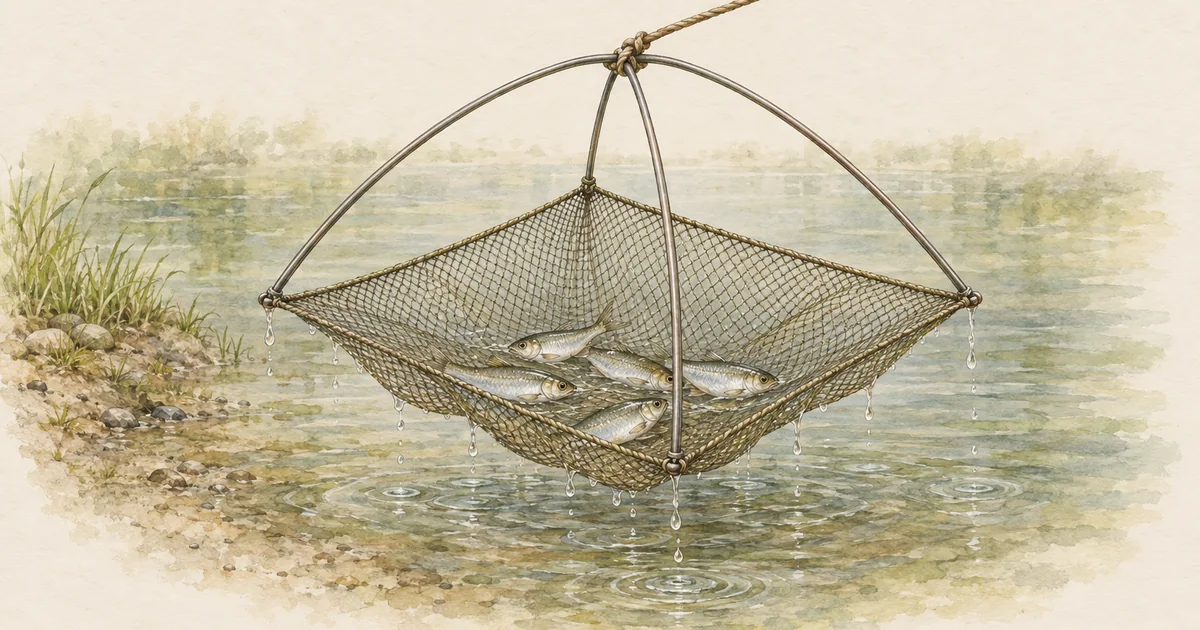
For the rope, Blinker gives a thickness of around 5 millimetres. It is held by a pole; as a substitute Rute & Rolle names a broom handle, a landing-net handle or a worn-out beachcaster. The pole must be sturdy in any case, because when lifting, the full net with the water in it presses hard on it.
The sources give no fixed value for the mesh size. It depends on the size of the fish you want, and there is a catch: the finer the mesh, the more the water slows the net as you lift.
Use at the water
The rope length depends on the depth. For around 2 metres of water Blinker gives a good 3 metres of rope, as a rule of thumb about as long as the pole or a little longer. At a sheet-piling wall or from a boat you can often manage without a pole, and then you pull the dip net up by hand.
- Lowering: Let the net sink slowly until it lies on the bottom. A handful of groundbait over it draws small fish in.
- Waiting: Check at intervals of one to three minutes.
- Lifting: briskly and evenly. A jerk with full force makes the taut net shoot out of the water, and the fish fly out again.
- Sorting: Look through every lift straight away and put protected species back before you lower again.
Why the fish do not simply swim off sideways is explained by their escape behaviour. In danger, small fish seek cover on the bottom. As the net is lowered, however, the threat comes from below, so the fish flee towards it and end up in the hollow the net forms when lifted.
Dip net size and closed periods in the states
Whether and how you may use a dip net is state law. The regulations give the side length of the net, not the area. Three examples with their source:
- Brandenburg: Under § 6 paragraph 3 of the fisheries regulation (BbgFischO, last amended on 24 August 2026), a sinking net with sides of up to 120 centimetres may be used to catch baitfish.
- Saxony: The Sächsische Fischereiverordnung of 22 April 2022 gives up to 150 centimetres of side length in § 6 paragraph 2. From 1 February to 30 April, fishing with the sinking net is prohibited there.
- Berlin: According to the Landesfischereiordnung (§ 18 paragraph 3, last amended on 27 October 2025), as reproduced by the Fischereiamt Berlin, baitfish dip nets and predator-fish lures are off limits from 1 January to 30 April. The extract gives no size.
For all other states the rule is: your federal state decides, and it is in the state fisheries regulation and the fishing permit. The regulations of all 16 states are linked on the page Closed seasons and minimum sizes explained. On top of that comes the individual water: sinking nets are not permitted everywhere, and on club waters it is in the statutes. So read Fishing permit and water rules before you unpack the dip net.
Protected small fish and bycatch
The dip net catches everything that happens to be over the net, including species that are protected all year round. Which ones those are differs from state to state. The table shows four small species according to the regulations of three states.
| Species | Brandenburg | North Rhine-Westphalia | Bavaria |
|---|---|---|---|
| Bitterling | protected all year round | protected all year round | protected all year round |
| Minnow | protected all year round | protected all year round | Closed season 1 May to 30 June |
| Stone loach | protected all year round | protected all year round | no protective provision |
| Gudgeon | protected all year round | not listed | no protective provision |
Status: BbgFischO, annex; LFischVO NRW, § 1 in the version from 3 July 2026; AVBayFiG, annex, text valid from 1 June 2025. In Saxony the fisheries regulation likewise lists bitterling, minnow and stone loach as protected all year round.
With sticklebacks it depends on the species. The nine-spined or dwarf stickleback is protected all year round in Brandenburg, North Rhine-Westphalia and Saxony, and the Bavarian annex lists it the same way with a restricted geographical scope. The Bavarian regulation, on the other hand, lists the three-spined stickleback among the species without a protective provision. The sunbleak is protected all year round in Brandenburg and North Rhine-Westphalia.
What may not be taken goes straight back. Brandenburg requires undersized or protected fish caught in gear other than the hand-held rod to be freed and returned without delay, as long as they are viable (§ 3 paragraph 2 BbgFischO). In § 9 of its Landesfischereiordnung Berlin requires such fish to be put back into the water they were caught in without delay and gently. The commotion over the net often attracts larger fish as well. Closed season and minimum size apply to them just the same; the gentle way to proceed is described in Returning fish.
After the catch: kill and leave at the water
Many federal states expressly ban the live baitfish, such as Bavaria, Hesse and North Rhine-Westphalia; in Brandenburg the fisheries authority can allow an exception in an individual case. More on the page Baitfish. What the dip net delivers is therefore killed before baiting. Saxony expressly requires this in § 6 paragraph 1 of its fisheries regulation: baitfish are to be killed in a sporting and humane way before being put on the hook.
Animal welfare law also applies to the smallest baitfish. Under § 4 of the Animal Welfare Act (Tierschutzgesetz), a vertebrate may only be killed under stunning, and only by someone with the necessary knowledge and skills. The Tierschutz-Schlachtverordnung requires in § 12 paragraph 10 that a fish be stunned immediately before being killed. The procedure is explained in Stunning and killing fish, the tool in Fish stunner.
North Rhine-Westphalia: Under § 6 paragraph 2 of the state fisheries regulation, live baitfish may neither be carried nor used for fishing there. Have a priest and a knife ready before you lift the dip net for the first time.
Baitfish belong to the water they come from. In Brandenburg that means the water or water system where they were caught; exceptions apply to deep-frozen or chemically preserved baitfish and to dead sea fish (§ 6 paragraph 2 BbgFischO). North Rhine-Westphalia also permits waters that are permanently or temporarily connected with the water where they were caught (§ 6 paragraph 1 LFischVO). In Saxony, holders of a fishing permit may use fish they have caught themselves as bait only in the water where they were caught (§ 12 paragraph 3 SächsFischVO).
Where a state allows live fish to be kept briefly, it sets narrow limits: Berlin (§ 14 paragraph 1 LFischO) and Brandenburg (§ 11 paragraph 1 BbgFischO) require roomy containers with enough oxygen and water and the shortest possible duration.
Crayfish trap and bait trap
Traps work differently from the dip net. The question catalogue for the angling exam (Fischerprüfung) in Saxony-Anhalt lists the fyke trap as a device of passive fishing: it is set and left in place instead of being lifted after a few minutes. The regulations have their own sections for traps. Three examples with references:
- Brandenburg: For traps, § 5 BbgFischO sets 15 millimetres as the lower limit, both for the mesh size and for the clear spacing of slats. The mesh is measured wet between two knots. § 10 para. 2 requires them to be checked and emptied at intervals that rule out the fish dying.
- Bavaria: § 17 para. 2 AVBayFiG requires traps in which caught fish are not injured more than is unavoidable, and a mesh size of at least 10 millimetres. The district administrative authority can approve exceptions to the minimum size, and under para. 3 it does not apply to enclosed waters.
- Saxony: When setting it, under § 7 para. 1 SächsFischVO the foremost hoop at the entrance must lie completely under water, and a set trap must be tended in accordance with proper fishing practice.
With crayfish there is also the question of who is allowed to catch them at all. In the Bavarian exam catalogue 2023/2024, to the question of who may catch crayfish in Bavaria, “the person entitled to exercise the fishing right” counts as the correct answer (No. 5.006). A leaflet for anglers, published by the Sächsische Landesstiftung Natur und Umwelt and edited by the environment ministry and the state office, states for Saxony: invasive crayfish can only be removed with crayfish traps, and this is reserved for the holder of the fishing rights. Whether you may set a trap or a small bait trap with your fishing permit, these sources don’t answer. That is stated in the fishing permit (Erlaubnisschein); if in doubt, ask the fishery manager or the fisheries authority (Fischereibehörde).
In several states, the native species are protected. Brandenburg, Saxony and North Rhine-Westphalia list the noble crayfish as protected all year round, and Saxony, North Rhine-Westphalia and Bavaria the stone crayfish. For the noble crayfish, Bavaria gives a minimum size (Schonmaß) of 12 centimetres and, for females, a closed season (Schonzeit) from 1 October to 31 July. Brandenburg expressly puts crayfish on a par with fish regarding closed season and minimum size (Mindestmaß) (§ 2 para. 1 BbgFischO). According to the Saxon leaflet, if you see crayfish while fishing, they are usually non-native species. Signal crayfish and noble crayfish are still easy to confuse, as both have red undersides to their claws. According to the leaflet, crayfish should only be removed if they have been reliably identified as an invasive species. Why crayfish don’t belong on the hook is explained on the page Crustaceans and mussels.
Crayfish plague: According to the Bayerisches Landesamt für Umwelt, the pathogen is spread by fishing tackle, nets and traps, among other things. The Saxon leaflet advises disinfecting net gear, waders and boots before moving to another water. Drying completely for more than 48 hours is sufficient for this, and the dip net is such a piece of net gear. According to the leaflet, crayfish are neither moved nor released. Bavaria prohibits releasing decapod crayfish that are not listed in the annex to its regulation into waters of any kind (§ 22 para. 4 AVBayFiG); only the district administrative authority can allow exceptions. Because fish also transmit the disease, the leaflet refers to the Saxon fisheries regulation: fish should not travel from water to water either alive or dead, not even as baitfish. What your state says about where baitfish come from is covered further up. All routes and time periods are under Not spreading species and diseases.
Common mistakes
- Treating the size from the shop as valid everywhere. Each state regulates the side length itself; Brandenburg and Saxony, for instance, differ.
- Lowering in spring without checking. Saxony and Berlin close the dip net until the end of April.
- Tipping the whole lift into the bucket. Protected species such as bitterling or minnow must go straight back.
- Taking baitfish to a different water. Several states tie them to the water where they were caught.
- Using the wet dip net straight away at the next water. Nets carry crayfish plague onwards, so disinfect them first or let them dry completely for more than 48 hours.
- Lifting by force. A hard jerk flings the fish out of the net, and a weak pole will not bear the load.
Frequently asked questions
How big may a baitfish dip net be?
Each state decides for itself. Brandenburg gives up to 120 centimetres, Saxony up to 150 centimetres of side length. For your federal state, look in the state fisheries regulation and the fishing permit.
How often do I lift the dip net?
The guide value is checks at intervals of one to three minutes. At least as important is the lifting itself: briskly and evenly, without a jerk.
Does the dip net come up in the angling exam?
The question catalogue for the angling exam in Saxony-Anhalt (status 28 April 2022) asks what a dip net is. The correct answer there is: a net for catching baitfish. A device for measuring water depth and a net for keeping baitfish are marked as wrong.
Can the dip net transmit crayfish plague?
Yes, that is possible. The Bayerisches Landesamt für Umwelt counts nets and traps among the routes by which the pathogen travels. The Saxon leaflet for anglers advises disinfecting the net before moving on, or letting it dry completely for longer than 48 hours.
Related
- Baitfish: how the dead fish is presented and for which predators
- Baitfish rig: mounting it step by step
- Line calculator: the right breaking strain for the predator rig afterwards
- Closed seasons and minimum sizes explained: terms and the regulations of all states
- Fishing permit and water map: what the permit says for your water
- Stunning and killing fish: the procedure under the Animal Welfare Act
- Roach and bleak: profiles of two whitefish that are often used as baitfish
- Aeration pump: oxygen for baitfish in the bucket
- Cast net: what it is and what applies to anglers
Sources
- Land Brandenburg: Fischereiordnung des Landes Brandenburg (BbgFischO) (Senknetz bis 120 cm, Herkunftsgewässer, Zurücksetzen, Hältern, geschonte Arten, Reusen, Krebse in der Schonvorschrift)
- Freistaat Sachsen: Sächsische Fischereiverordnung (SächsFischVO) (Senknetz bis 150 cm, Sperrzeit, Töten vor dem Anködern, Fanggewässer, geschonte Arten, Aufstellen von Reusen)
- Fischereiamt Berlin: Mindestmaße und Schonzeiten gemäß Fischereirecht (Sperrzeit für Köderfischsenken, Zurücksetzen, Hälterung)
- Land Nordrhein-Westfalen: Landesfischereiverordnung (LFischVO) (ganzjährig geschonte Arten einschließlich Edel- und Steinkrebs, Herkunftsgewässer, Verbot lebender Köderfische)
- Freistaat Bayern: Verordnung zur Ausführung des Bayerischen Fischereigesetzes (AVBayFiG) (Schonzeiten von Bitterling, Elritze, Schmerle, Gründling und Dreistachligem Stichling, Edel- und Steinkrebs, Reusen, Aussetzverbot für fremde Krebse)
- Bundesministerium der Justiz: Tierschutzgesetz § 4 (Töten nur unter Betäubung, nötige Kenntnisse) und Tierschutz-Schlachtverordnung § 12 (Fisch unmittelbar vor dem Töten betäuben)
- Ministerium für Wirtschaft, Tourismus, Landwirtschaft und Forsten Sachsen-Anhalt: Fragenkatalog zur Fischerprüfung (PDF) (Senke als Netz zum Köderfischfang, Reuse als Gerät der stillen Fischerei)
- Sächsische Landesstiftung Natur und Umwelt: Invasive Krebse, Hinweise für Angler (PDF, 2020) (Krebsreusen, Verwechslung, Entnahme, Trocknen über 48 Stunden, keine Krebse umsetzen)
- Bayerisches Landesamt für Umwelt: Die Krebspest (PDF, Stand Juli 2025) (Netze und Reusen als Übertragungsweg)
- Bayerische Landesanstalt für Landwirtschaft: Prüfungsfragen zur staatlichen Fischerprüfung 2023/2024 (PDF) (Frage 5.006, wer Krebse fangen darf)
- Blinker: Wie kann man Köderfische mit der Senke fangen? (Aufbau, Standardmaß, Seil und Stock, Einsatz, Fluchtverhalten, Beifang, Vereinsstatuten) und Blinker: Bastel-Tipp: Die Eigenbau-Senke (diagonale Stangen, Maschenweite)
- Rute & Rolle: Der Köderfisch (Maß, Ersatz für den Senkstock, Kontrollabstand, nicht überall erlaubt)
Text AI-assisted, drawing AI-generated. Sources opened and checked in October and November 2026, no graphics taken from the sources.
All figures are guide values without guarantee and do not replace legal advice. Whether, when and with which dip net you may catch baitfish is determined by the fisheries law of your federal state in its current version, the water rules and your fishing permit.