
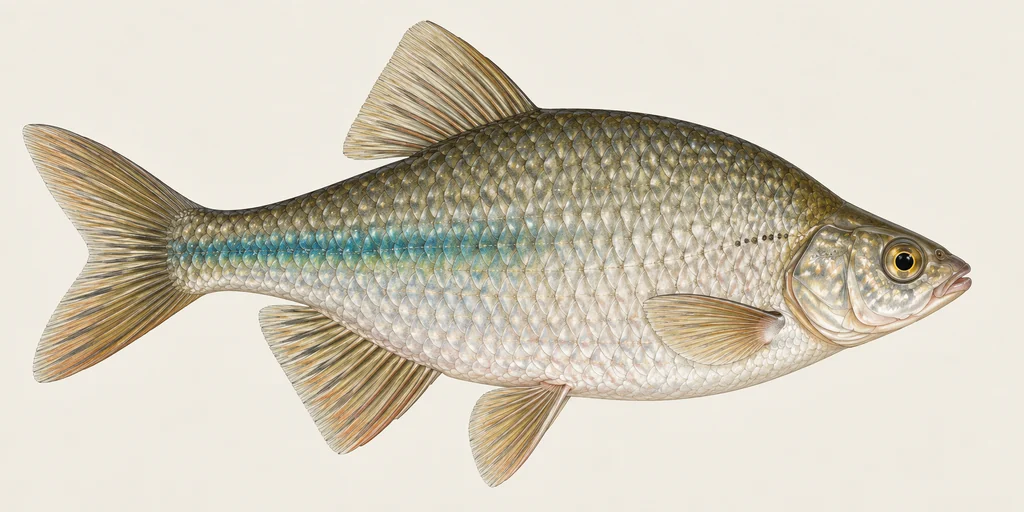
Knowledge – Fish
Bitterling: Features, mussel spawning and protection
The bitterling (Rhodeus amarus) is a small, deep-bodied carp relative of quiet, plant-rich waters. It lays its eggs in living freshwater mussels and cannot raise young without them. The species is listed in Annex II of the Habitats Directive (FFH Directive) and is not a target fish.
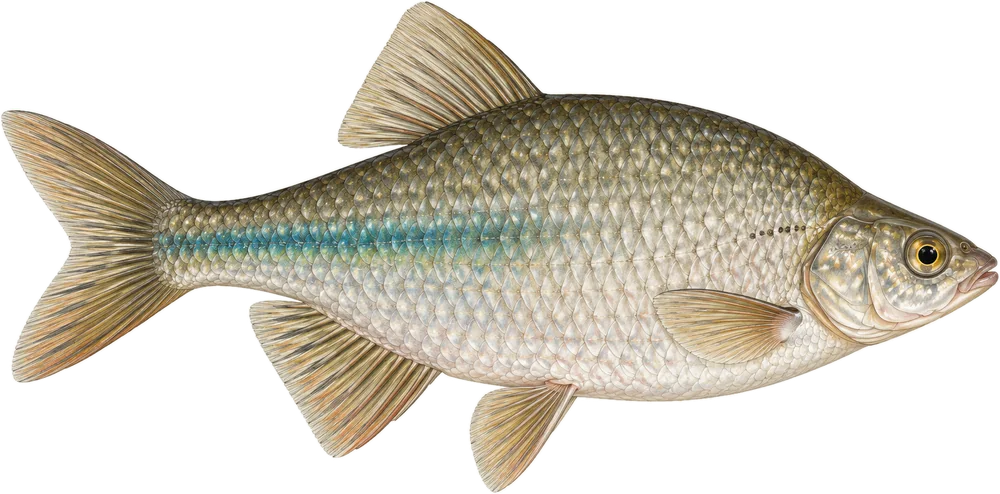
In brief: FFH species that depends on large freshwater mussels to reproduce; protected all year round in Bavaria. Not a target fish; return any bycatch gently at once.
- Blue-green shimmering longitudinal band from the base of the tail to about the middle of the body
- Short lateral line, visible only on the first scales behind the head
- Small, deep body with large scales and a small mouth
Catch chances through the year
- Hardly any chance
- Possible
- Good
- Peak season
- Spawning (observe the closed season)
Editorial assessment for waters in Germany, not a measured value and no guarantee. Spawning time is not the same as the legal closed season.
Species profile and sources in the catch calendarAll species compared month by monthThe rules of your federal state
How to recognise it
The bitterling usually grows 5 to 7 centimetres long. The Landesfischereiverband Bayern gives 9 centimetres as the maximum, FishBase 11,2 centimetres. The body is deep with large scales, and the mouth is small.
The surest way to recognise it is by a blue-green shimmering longitudinal band. It begins at the base of the tail and reaches only about to the middle of the body. The lateral line is short: its pores are visible only on the first four to seven scales behind the head. The dorsal and anal fins are comparatively long.
Outside the spawning season it looks plain: grey-green above, silvery on the flanks and belly. In spring the males change colour. The throat and breast as far as the front of the belly turn reddish, while the back and rear of the body gleam green. Spawning tubercles, small skin nodules, appear above the eyes and mouth. At this time the females grow an egg-laying tube up to 6 centimetres long.
You are most likely to confuse the bitterling with the sunbleak. The sunbleak also has an incomplete lateral line and a bluish longitudinal stripe. But it is slim, its mouth points steeply upwards, and between the pelvic and anal fins the scales form a keel. The deep body shape points to the bitterling.
It is harder to tell from the Asian bitterling. This one is sold in the trade and has been released in places. The Federal Agency for Nature Conservation (Bundesamt für Naturschutz, BfN) points out that occurrences of the native bitterling may therefore be overestimated.
Side by side
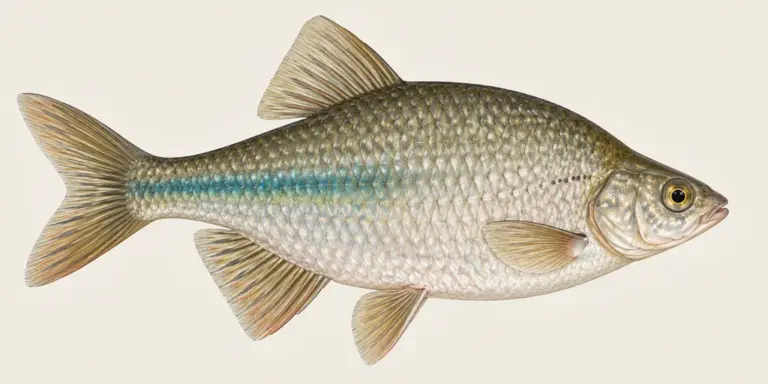
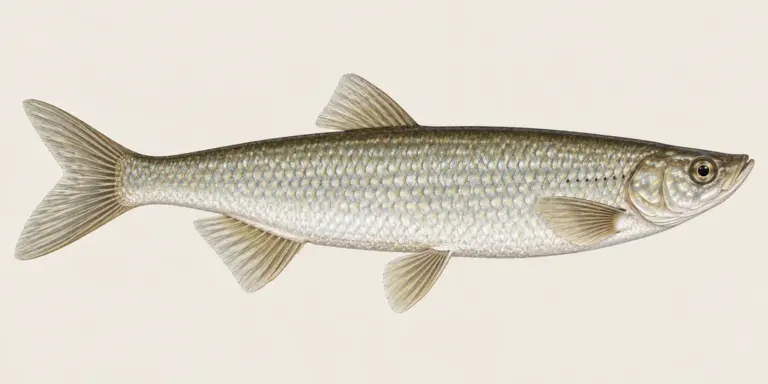
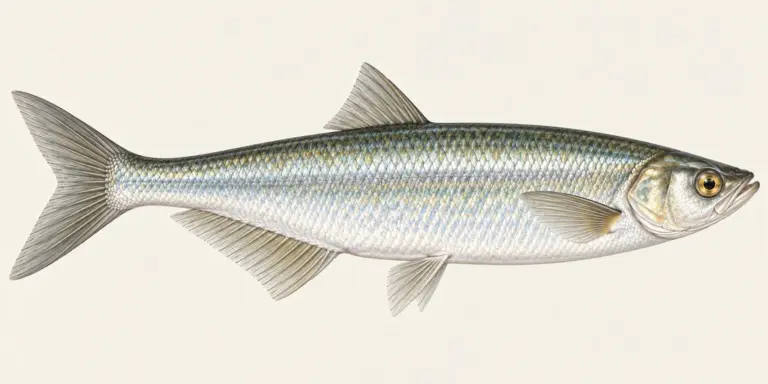
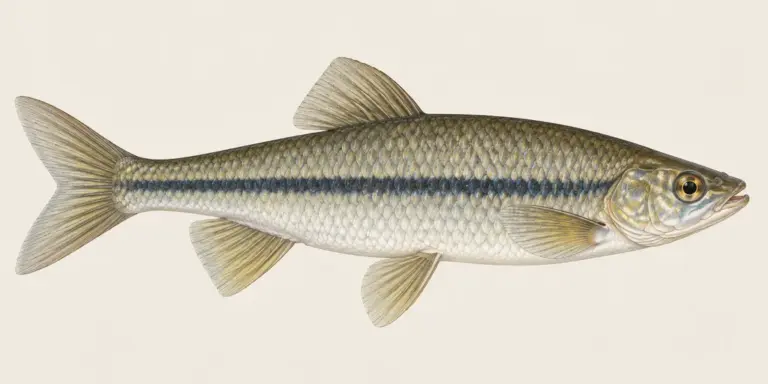
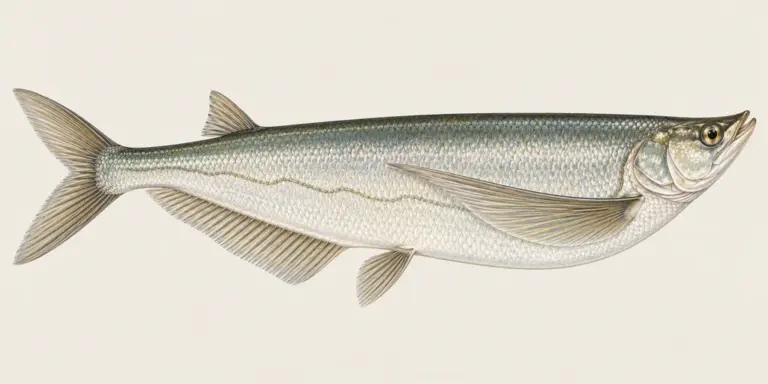
AI-generated illustrations.
Where it lives
The bitterling lives in small, slow-flowing and still waters with plant-rich banks. FishBase names lowland ponds, canals, slow rivers, backwaters and oxbows with a sandy or muddy bed. The BfN describes the waters as warm in summer and rich in plants. In Germany the species occurs in many regions, mainly in the plains and river lowlands.
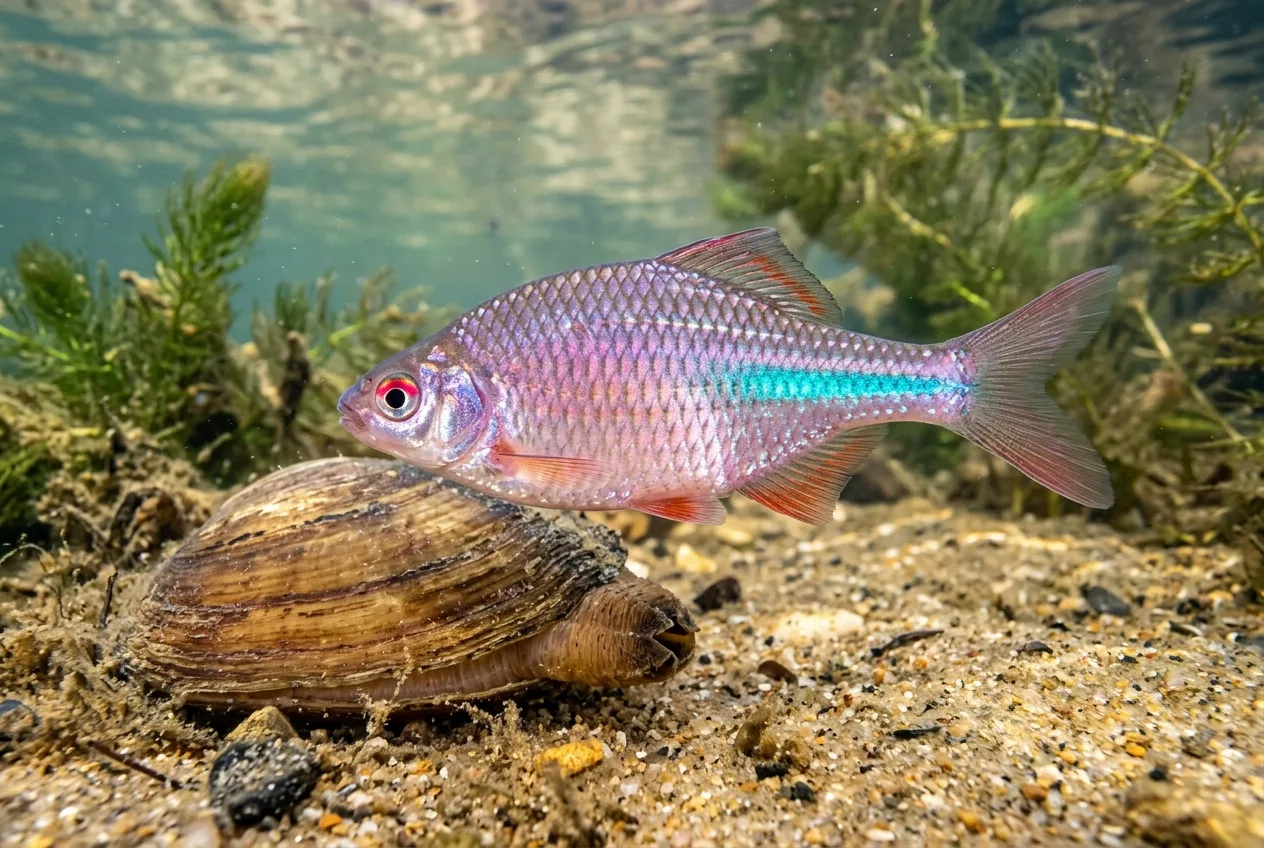
What matters, though, is not the water alone but the mussel. Without large freshwater mussels such as the swan mussel or the painter’s mussel, the bitterling cannot reproduce. If the mussels decline, so does the bitterling.
The BfN names the destruction of backwaters, the clearing out of watercourses and the decline of large freshwater mussels as the main causes of population loss. The Landesfischereiverband Bayern adds the infilling of small waters, foul mud, silting up and introduced mussel species that displace the native ones.
Holding spots in the picture
Choose a season and time of day: the picture shows where the species sits then. Tap a fish or a spot in the list to bring it closer. The picture is schematic and AI-generated, every water is different.
In the lake
reed edge
Bitterling is present here all year round.
Water lilies and weed bed
Bitterling is present here all year round.
The bitterling stays in groups close to the bank, where plants grow thickly. It lives in ponds, small lakes and oxbows that warm up in summer, with a sandy or muddy bottom. It only occurs where swan mussels and painter’s mussels live.
Spring: This is the spawning period, so observe the closed seasons (Schonzeit). From April to June the brightly coloured males guard a few large mussels in the shallows, into which the females lay their eggs.
In the river
Undercut bank, overhanging branches, timber
Bitterling is present here all year round.
Calm bay with aquatic plants
Bitterling is present here all year round.
In canals and slow-flowing rivers you will find it in calm, weedy bank zones. It avoids the current; a soft bottom and a stock of large mussels are what matter.
Spring: This is the spawning period, so observe the closed seasons (Schonzeit). At spawning time in late spring the males stay over their mussels in shallow, quiet bays.
Size comparison: AI-generated drawing, schematic.
How it reproduces with mussels
Bitterlings live in groups and mostly stay close to the bank. The specialist sources describe their diet differently: the BfN names mainly animal plankton and midge larvae, the Landesfischereiverband adds algae, plant matter, worms and small crustaceans. FishBase even classes plants as the main food.
At spawning time the male takes a territory with several mussels and defends it. He keeps nudging the mussels with his snout until they no longer close when touched. Then the female pushes her egg-laying tube into the gill cavity of a mussel and lays the eggs one at a time. The male releases his sperm over the mussel’s intake opening, and it reaches the eggs with the breathing water.
The young fish grow up well protected inside the mussel and leave it after three to four weeks. According to the BfN, a female lays only about 30 to 40 eggs per spawning period. Bitterlings become sexually mature in their second year. The BfN gives an age of three to four, rarely eight years. According to FishBase, most do not survive the year of their first reproduction, so populations fluctuate strongly.
A curiosity on the side: females injected with the urine of pregnant women extended their egg-laying tube. FishBase therefore notes that the bitterling used to be used for pregnancy tests.
Is there a season?
There is no angling season for the bitterling. It is not fished for deliberately and is protected all year round in Bavaria.
It is most conspicuous at spawning time. The Landesfischereiverband Bayern gives April to June, the BfN May and June. The males then wear their colourful breeding dress and stand over their mussels in the shallows. For anglers the bitterling is above all an indicator: where it spawns, large freshwater mussels live too.
You will find the monthly overview of all species and the water temperature check in the catch calendar.
From the blog: Freshwater fish in Germany: which species you catch where
What to do with a bycatch
The bitterling is not a target fish. You do not fish for it deliberately and do not take it.
If a bitterling does end up on the hook while pole fishing, unhook it with wet hands or directly in the water and return it at once. Do not keep it in a keepnet or a bucket.
Also never release aquarium fish. According to the BfN, released Asian bitterlings are already making it harder to survey the native species.
Look for the short band: A blue-green band that reaches only from the base of the tail to about the middle of the body, together with a deep body shape: that points to the bitterling.
Leave mussels alone: Do not collect large freshwater mussels in the shallows, and do not tread on mussel beds when wading. Without them the bitterling cannot reproduce.
Suitable lures
We deliberately show no baits for this species.
FFH species, protected all year round in Bavaria: do not target it, return any bycatch gently at once.
What you need to observe
The bitterling is listed in Annex II of the Habitats Directive (FFH Directive). In the 2023 Red List of Germany’s freshwater fish it is rated as of least concern. In the long term its numbers have declined moderately, in the short term they have increased markedly.
How to deal with it when angling is regulated by the federal states. In Bavaria the bitterling is protected all year round under the Ausführungsverordnung zum Bayerischen Fischereigesetz. Viable fish caught during the closed season must be returned promptly and carefully to the same stretch of water there.
Closed seasons (Schonzeit), minimum sizes (Mindestmaß) and fishing bans are set by the federal states (Bundesland). They differ by state and water. We give figures only with a date and a source; what counts is always the fisheries regulation of your federal state and your fishing permit (Erlaubnisschein). You will find a list of links to the official sources in the Fishing calendar.
What closed season, minimum size and harvest slot mean and where to find them is explained on the page Closed season and minimum size explained.
What state law says about the closed season (Schonzeit) and minimum size (Mindestmaß) for this species is in the “At a glance” box on the state page for Bavaria. Our overview does not list this species for the other states; the state fisheries regulation applies there.
Frequently asked questions (FAQ)
May I catch bitterlings?
Not deliberately. The bitterling is an FFH species and is protected all year round in Bavaria. You return any bycatch gently at once. The rules of your federal state (Bundesland) are binding.
Why does the bitterling need mussels?
The female uses an egg-laying tube to place her eggs in the gill cavity of large freshwater mussels. The young fish develop there for three to four weeks before they leave the mussel.
How big does the bitterling get?
Usually 5 to 7 centimetres. The Landesfischereiverband Bayern gives 9 centimetres as the maximum, FishBase 11,2 centimetres.
Sources
The rating of catch chances is an editorial assessment. The facts come from these sources, and the text is worded in our own words. The illustration is an original design by Angel Momente in the style of a natural history plate (AI-generated, see the AI notice).
- Landesfischereiverband Bayern: Fischlexikon – Bitterling (Länge, Laichzeit, Kennzeichen, Fortpflanzung in Muscheln)
- Bundesamt für Naturschutz: Artenporträt Rhodeus amarus (FFH-Anhang II, Verbreitung, Biologie, Gefährdung)
- Rote-Liste-Zentrum: Bitterling (Rote Liste der Süßwasserfische Deutschlands 2023: ungefährdet)
- FishBase: Rhodeus amarus, European bitterling (Größe, Alter, Lebensraum)
- Wikipedia: Bitterling (Fischart)
- LAWA-Projekt O 10.20 (Leibniz-IGB, 2021): Temperaturempfindlichkeiten der Fischgemeinschaften
- Bayern.Recht: Verordnung zur Ausführung des Bayerischen Fischereigesetzes (AVBayFiG) mit Anlage Schonzeiten
Created with AI support from the sources listed. Figures only appear in the text if a source gives them. Last updated: 8 November 2026. Found a mistake? Write to us. Who is behind this site: About me.
More in the lexicon
- All fish species at a glance
- Catch calendar – month, water temperature and profile for 93 species
- Line calculator – breaking strain after the knot, drag guideline, backing
- Angling methods