
Knowledge · Tackle
Waders: Types, fit and safety
Waders keep you dry when you step into the water to fish, up to the crotch, hip or chest depending on the design. Here you will find how material, boots, soles and fit differ, how deep you can wade safely, how to find and repair holes, and what the DLRG, RoSPA and authorities say about wading.
Three heights: hip, waist and chest waders
The shortest form, the hip wader, is really a pair of wading boots with a long leg reaching to the crotch. The proper waders protect either to the hip, which are the waist waders, or to the chest. Chest waders hang from braces.
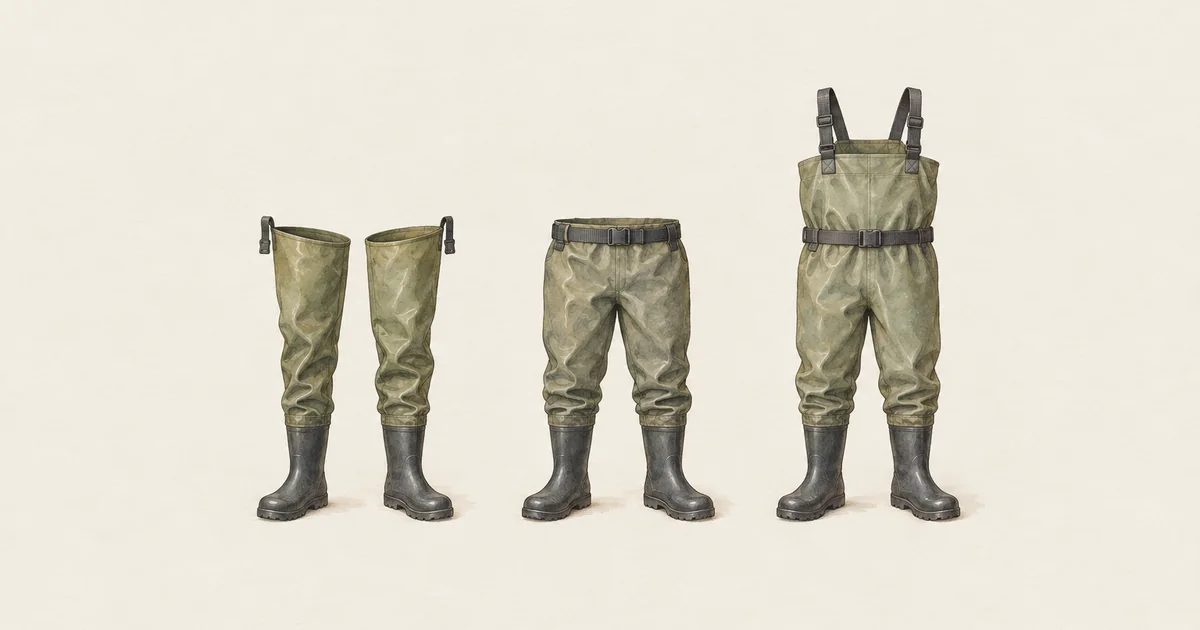
An elastic drawcord pulls the top edge snug to the body so that hardly any spray gets in. More height does not mean that you go into the water almost up to the edge. A firmly fastened wading belt belongs with waist-high and chest waders, because less water gets in if you fall. How it sits is explained on the page Wading belt. A jacket over the waders also keeps water away from the edge, as the New Zealand Department of Conservation DOC writes too. More on this under Wading jacket.
Neoprene, membrane or coated fabric
Neoprene is a foam with many small closed gas cells and therefore insulates. Thicker neoprene keeps you warmer but weighs more. It lets no water vapour through, and anyone who sweats on the walk in cools down faster in the water. For standing for hours in winter, Blinker named neoprene of 5 mm or more in a practical article, a guide value from the specialist press.
Breathable waders are made of a laminate, that is several bonded layers. The membrane in it keeps out liquid water and lets part of the water vapour out, but it does not completely prevent sweating. More layers make them tougher and heavier. The water column gives the water pressure the material withstands: 10.000 mm corresponds to ten metres of water. It is measured with a pressure test described for textiles in the ISO 811 standard. For durability, seams, membrane protection and fit count just as much as this laboratory value.
There are also waders made of nylon fabric with a PU coating and of PVC sheeting. No reliable comparison values for these types were found in the sources checked. For very cold water and little movement, neoprene remains the choice. The breathable wader is considered more versatile and, with suitable functional underwear, is also suited to the cold season.
What you wear underneath
Waders keep water out but only keep you warm through what is underneath. For winter the New Zealand Department of Conservation DOC recommends quick-drying thermal underwear made of polypropylene, fleece or merino wool under the waders so that you do not get chilled when wet. The Virginia fisheries authority advises a base layer and an insulating layer and synthetic, breathable fabrics. You should avoid cotton and jeans: they hold moisture and become heavy when the waders fill.
Why warmth matters is explained by the DLRG in a training document on lakes: at the same temperature, a person in water cools about three to four times faster than on land. In warm weather and warm water, the Virginia authority names wading without waders as an option, then with non-slip wading shoes.
Stocking foot with wading boot or welded-on boot
At the bottom the waders end in a neoprene stocking foot, over which a separate wading boot goes, or in a rubber boot welded on permanently. The comparison in brief:
| Feature | Stocking foot and wading boot | Welded-on boot |
|---|---|---|
| Fit on the foot | laced, fits more firmly | usually less precise |
| Putting on | takes longer | quick |
| Suits | long walks, difficult terrain | short walks, frequent change of spot |
| Purchase | the wading boot is bought separately | everything in one piece |
Despite built-in gravel guards, gravel can get into the wading boot and abrade the stocking foot, and friction also loosens seam tapes. More about footwear under Fishing boots.
Soles and ground
Felt soles grip well on smooth, algae-covered stones but are of little use on mud, snow and wet grass, and dry slowly. Patterned rubber is more versatile and easier to clean. The Virginia fisheries authority writes that most wading boots have soles of grippy rubber, and that for especially slippery surfaces studs or felt can be an advantage. Studs can damage boat floors.
On rock the articles contradict each other: in 2018 Blinker considered patterned rubber slippery there, in 2026 the magazine writes that rubber soles developed specially for wading can also grip well there. The DOC describes the bottom like this: sand gives good footing and indicates weak current, large stones hold well if they are cleanly worn smooth, and are treacherous as soon as algae cover them. The DOC advises not to cross where you cannot see the bottom. The Angling Trust adds that water and silt can be deeper than they look.
Felt is also a water issue: a fisheries authority in Alaska explained that fibrous soles pick up pathogens and invasive species more easily than other materials and stay damp for days. For German waters the sources checked name no rule on wading soles. What applies to you is in the water by-law and your fishing permit.
The right fit
Waders that do not fit break sooner. If they are too tight, the material stretches over knee and seat when kneeling, and the crotch seam is under strain on a big step. That stresses seams, bonding and laminate. If they are too loose, creases rub against each other when walking, especially at the knees and inner legs. The DOC gives as a yardstick the right boot size, a leg length that is neither too long nor too short, and a suitable chest circumference.
- Try them on in the clothing you will later wear underneath.
- Squat, kneel and take a few long strides.
- Besides the size, pay attention to body circumference, inside leg length and the size of the stocking foot or boot.
Wading safely: depth, current, exit
Current, undercut banks and floods are covered on the page Bank and waders. The DLRG advises doing without waders entirely in a flood, and warns that even knee-deep current can sweep a person away. The University of Auckland describes why: if the waders fill, they become heavy and unwieldy, and the risk of drowning is well above that without waders. The Virginia fisheries authority compares flooded waders in fast current with a sail that can pull the wearer in any direction.
None of the DLRG sources gives a German figure for safe depth. Foreign bodies give differing guide values:
| Where | Specification | Note |
|---|---|---|
| Water Safety Ireland | at least 30 cm between the water surface and the top edge of the waders, one foot stays on the bottom | Advice for anglers |
| University of Auckland | waders only for shallow water, no deeper than the hip; lifejacket from knee depth | University field work rule |
| Virginia DWR | alone, no deeper than mid-thigh | Fisheries authority recommendation |
| DOC New Zealand | if unsure, fish from the bank or with high wading boots up to knee depth | Advice for trout anglers |
The figures differ because the bodies and situations differ. The common line is: the faster the water and the softer the bottom, the shallower you wade, and the top edge stays well above the waterline.
In its safety code for anglers, the British accident prevention society RoSPA names these points for wading:
- Wear a life jacket and a wading belt when wading.
- Go into the water slowly and decide on a safe exit beforehand.
- Shuffle your feet along in the water instead of lifting them, so that you keep contact with the bottom.
- Use a wading staff: it gives support and shows obstacles under the water.
- Fish with a partner, tell someone where you are and when you will be back, and carry your phone on your body in a waterproof case.
When crossing, the DOC advises going diagonally downstream through shallow places and keeping your body side-on to the current, which reduces the water pressure. According to the DOC and the DLRG, anyone who falls in turns onto their back, keeps their feet downstream and steers to the bank with their arms, without swimming against the current. According to Virginia DWR you can attach the wading staff to the wading belt.
On the coast too, for example when wading for sea trout, the rule applies: keep a gap to the top edge and keep an eye on the water level.
In an emergency: call 112. The advice reflects what the DLRG, RoSPA and authorities publish, and replaces neither medical advice nor local knowledge. If in doubt, stay on the bank.
Drying, washing, patching
After every trip the waders must dry completely, inside and out. For waders with built-in boots, turn them inside out and hang them up somewhere airy. If they stay damp, they soon smell, and mould can loosen the seams. One to three hours wet is considered acceptable if they dry straight afterwards. After the sea, rinse waders and wading boots with fresh water, because salt attacks the membrane.
You wash breathable waders according to the care label, because dirt, sweat, sun oil and insect repellent weaken the membrane. A delicate or hand wash without fabric softener and without spinning is recommended. You refresh the water-repellent finish on the outside, DWR for short, with a spray after four to six washes. Neoprene does not belong in the tumble dryer.
Holes are torn by thorns, barbed wire and sharp stones, mostly at the knees, inner legs and stocking feet. You can find a small leak like this: turn the waders inside out, clean and dry, and spray the suspect spot with isopropanol, that is, alcohol from the chemist. A tiny hole then shows up as a dark spot. For as long as it is visible, rub in a little urethane-based repair adhesive with your finger. After that the waders need at least twelve hours to dry.
Accessories: socks, gravel guards, repair kit
Socks under and over the stocking foot
The stocking foot is itself a neoprene sock, and your own socks go underneath. According to Blinker, feet give off about 3 to 15 ml of moisture per hour, and wool wicks this moisture away from the skin. The magazine recommends two layers: a thin, close-fitting pair inside and a thicker pair outside that holds a lot of air. The rubbing then happens mainly sock against sock rather than against the skin, which helps prevent blisters. Only put on fresh socks shortly before you set off, because then they are drier.
Two layers need room. For warm feet, Blinker’s yardstick is that you can still move your toes in the boot. Even so, the stocking foot mustn’t be too big: then it sits badly in the wading boot, creases or slips, according to the buying guide in the same magazine. So when trying them on, wear the socks you will later wade in.
A second sock can also go on the outside, over the stocking foot. An older practical tip from Blinker recommends large wool or cotton socks between the stocking foot and the wading boot. They absorb the rubbing and pressure of the boot, which would otherwise wear the neoprene and seam tapes. Here the cotton lies on the outside against the neoprene, not on the skin. Under the waders it remains the worse choice, as described above.
If you go into the water in summer without waders, you still need protection and grip on your feet. For fishing from rocky shores on the Mediterranean, Blinker recommends neoprene shoes of the kind known from swimming and diving, with a sole that grips on rock. Getting wet doesn’t harm them. More on soles and shoes is under Fishing shoes.
Gravel guards and gaiters
Gaiters are familiar from hiking and mountaineering: cuffs without a foot section that sit over the shoe and sock and are meant to protect the leg and ankle from dirt, wet and injury. On waders, the counterpart is the gravel guard: a cuff on the lower trouser leg that falls over the shaft of the wading boot and covers the gap between boot and stocking foot from above. On waders with neoprene stocking feet, according to Blinker, it is usually built in.
This cuff isn’t completely tight; small stones still get into the boot. So after wading, shake out your boots and check the stocking feet before the waders go on the line to dry.
Repair kit and finding leaks
Many small holes you don’t even notice while fishing, for example from a bramble as you walk past. Blinker names your own fly hook catching in the waders as one of the most common causes. According to Blinker, manufacturers usually include a small repair kit. An older article in the same magazine considers urethane glue, i.e. polyurethane-based adhesive, generally suitable, including for re-bonding loose seam tapes on the stocking foot. But it admits that not every repair holds, and sometimes the only option left is new waders.
The alcohol test from the section above is described for breathable waders with a membrane. For neoprene waders the instructions give no method of their own. For repairing membrane waders at home, have ready:
- the repair kit supplied or a small tube of urethane glue
- isopropanol from the chemist’s, decanted into a small spray bottle, for finding leaks
- Time: because the glue has to dry for at least twelve hours, do the patching no later than the day before you go fishing, not just the evening before
Protecting waters: dry to the next water
Wet waders can carry pathogens from one water to the next. The Bavarian Environment Agency names crayfish plague as the main danger for native crayfish, a fungal disease spread by non-native crayfish species. Among the routes of transmission the agency expressly lists damp footwear, especially wellies and wading boots, plus mud left on the soles. According to the LfU, without a host the spores stay infectious for up to two days in dry conditions and up to two weeks in damp surroundings. The Edelkrebsprojekt NRW, run by the Fischereiverband NRW and NABU, also names wet waders as possible carriers.
The agency advises disinfecting or fully drying fishing tackle and clothing that has been in contact with the water. The Angling Trust sums up the same thing as the rule “Check, Clean, Dry” and expressly names waders. The Alaskan authority adds detail on cleaning: remove mud and plant remains with a stiff brush and take apart the pieces of wading boots and waders before you leave the water. Felt soles are tricky here, because small organisms, algae and pathogens stay caught in damp felt. Before a fishing trip it is worth checking the local rules on wading soles. What applies at your water is also in your fishing permit.
Common mistakes
- Bought too tight. Waders that pull when kneeling are the first to leak at the seams.
- Left wet in the boot of the car. Mould dissolves the seams.
- Going into the water without a fastened belt. If you fall, more water then runs into the waders.
- Wading almost up to the top edge. If the water rises or a wave comes, there is no margin left. Water Safety Ireland names at least 30 cm.
- Cotton under the waders. It gets wet and heavy and chills you.
- Damp to the next water. Wading boots and felt soles carry pathogens on if they could not dry.
Frequently asked questions
Neoprene or breathable for winter?
If you stand still for a long time in very cold water, neoprene keeps you warmer. If you walk a lot, you sweat in it. The breathable wader with functional underwear is also considered usable in winter.
Can the waders go in the washing machine?
Breathable ones usually can, according to the care label on a delicate or hand-wash cycle, without fabric softener and without spinning. They are dried hanging inside out.
Do filled-up waders pull you under water?
The DLRG warns of exactly this: inexperienced people can hardly get out of waders that have filled up, and in the worst case they pull you under water. So fasten the belt, wade with a gap to the top edge and stay out in high water.
How deep can I wade in waders?
The sources checked give no German rule. Water Safety Ireland names at least 30 cm clearance to the top edge, Virginia no deeper than mid-thigh when alone, and the University of Auckland no deeper than the hip.
Felt or rubber: which sole is better?
It depends on the bottom. Felt grips on smooth, algae-covered stones, rubber on mud and grass. Felt dries slowly and carries organisms more easily, so before a fishing trip it is worth checking the local rules.
Related
- Bank and waders: current, high water, a secure footing
- Wading belt: fit and effect in a fall
- Lifejacket: buoyancy levels and quick check for wading
- Fishing shoes: soles and boots for bank and jetty
- Wading jacket: the jacket to go with your waders
- Wading net: a landing net that hangs at your body while you wade
- Coast and surf fishing: wind, waves and water level
- Line calculator: breaking strain and drag for playing a fish while wading
- Wading staff: support and safe depth checks while wading
Sources
- Blinker: Wathose kaufen, so finden Sie das richtige Modell (Material, Wassersäule, Sitz, Füßling und Stiefel, zu große Füßlinge, Sohlen, Filz, Pflege, Watgürtel)
- Blinker: Wathose, welche passt zu mir? (Sohlen, Stiefel, Lecksuche, Flicken, mitgeliefertes Reparaturset, Ursachen kleiner Löcher)
- Blinker: Pflege der Wathose, darf die Hose in die Waschmaschine? (Lagern, Waschen, Imprägnieren), Blinker: Schutz unserer Wathose (Kiesschutz, Nahtbänder, Urethankleber, Grenzen der Reparatur, Socken über dem Füßling) und Blinker: Spinnangeln im Winter (Neopren ab 5 mm)
- DLRG: Hochwasser (Wathosen im Hochwasser, knietiefe Strömung) und DLRG-Ausbildungsunterlage: Gefahren an Seen, 6. Auflage 2017 (Auskühlung im Wasser)
- Department of Conservation Neuseeland: Wading safety (Gürtel, Passform, Thermowäsche, Untergrund, Queren, Sturz)
- University of Auckland: Rivers, Streams, and Wading (PDF) (Wattiefe, Rettungsweste, volle Wathose)
- Virginia Department of Wildlife Resources: Wade Well (Unterwäsche, Sohlen, Wattiefe allein, geflutete Hose)
- Water Safety Ireland: Angling (Abstand zum oberen Rand der Wathose, ein Fuß am Grund) und RoSPA: Angling Safety Code (PDF) (Rettungsweste, Watgürtel, Watstock, Begleitung, Rufmittel)
- Angling Trust: Best Practice Guide for Freshwater Angling (PDF) (Check, Clean, Dry; Wassertiefe schwer erkennbar)
- Alaska Department of Fish and Game: Felt-soled Wader FAQ (PDF), 2012 (Filz als Träger von Organismen, Reinigung)
- Bayerisches Landesamt für Umwelt: Die Krebspest, eine kaum bekannte Gefahr für die heimischen Krebse (PDF) (Übertragungswege, Sporen, Trocknen) und LfU: Krebse (Krebspest als Hauptgefahr), Edelkrebsprojekt NRW: Gefährdung des Edelkrebses (nasse Wathosen als Träger)
- ISO 811:2018: Textilien, Bestimmung des Widerstandes gegen Wasserdurchtritt, Druckversuch (Prüfverfahren hinter der Wassersäule)
- Blinker: 10 Tipps für warme Füße beim Angeln (Feuchtigkeit der Füße, Wollsocken, zwei Lagen, Platz im Schuh, Sockenwechsel) und Blinker: Angeln am Mittelmeer, 10 Tipps vom Ufer (Neoprenschuhe auf Felsufern)
- Wikipedia: Wathose (Höhen, Materialien, Gummizug, nur ergänzend) und Wikipedia: Gamasche (Begriff, Zweck und Verbreitung, nur ergänzend)
Text AI-assisted, drawings AI-generated. Sources opened and checked in November 2026, no graphics taken from the sources.
All figures are rough guides with no guarantee. How deep and where you wade depends on the water, the current and the weather on the day, and this text is no substitute for medical advice or local knowledge.