
Knowledge · Tackle
Wading staff: Support and checking depth when wading
A wading staff is a pole you lean on while wading and use to feel the bottom ahead of you. It gives you extra support in the current and tells you about holes, ledges and stones before your foot finds them. Here you will find what authorities, associations and the angling press write about its use, design and attachment, and where its limits lie.
One more point on the bottom
When you wade, you stand on two legs on a bottom you often cannot see. The fisheries authority of the US state of Virginia (Virginia DWR) describes the wading staff as a tool with two jobs: it creates an extra point of contact for balance, and you can use it to judge the water depth. The English anglers‘ body Angling Trust advises checking the depth with the staff and leaning on it. It warns that water and silt can be much deeper than they look.
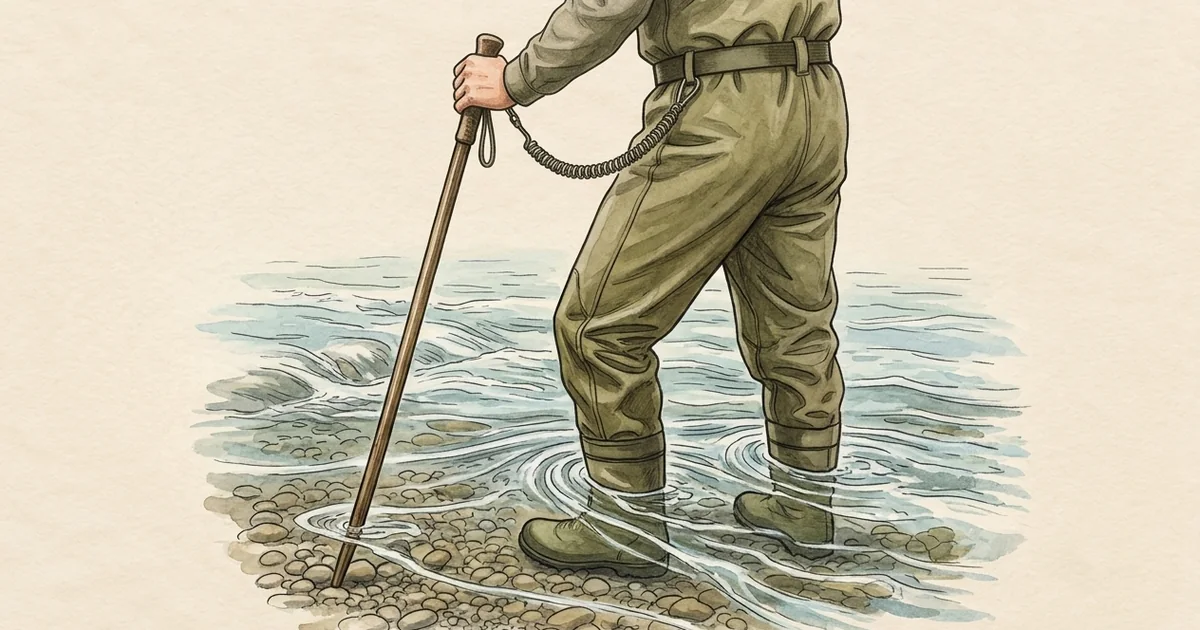
You feel the benefit with every step. When you move one foot, the other leg and the staff are still firmly on the bottom, so two points instead of one. The British accident prevention society RoSPA calls the wading staff an aid to stability and to spotting hazards under water in its safety code for anglers. It also advises shuffling your feet along the bottom instead of lifting them, because contact with the bottom makes you more stable. In strong current, Blinker also counts the wading staff, alongside boots with good grip, as recommended equipment.
Feel before you step
In an article on wading in winter, Blinker advises anyone who does not know a water well to use a wading staff from the very first step. With it you search the area ahead of your feet for holes and drop-offs, because some stretches of bank shelve quickly into deep water. According to the magazine, a long landing-net handle can do the same job. The article explicitly calls an unplanned dip in cold water dangerous.
In a river this applies especially when the water is murky. New Zealand’s Department of Conservation (DOC) advises against crossing where you cannot see the bottom and recommends polarised glasses, because they cut out reflections and show obstacles below the surface. So the staff does not replace seeing; it adds to it where your view ends.
Plant it upstream, move sideways
On which side the staff goes, the DOC is clear: when crossing a river, it gives support if you hold it upstream. None of the authorities and associations checked here recommends a different side. You turn your body sideways to the current. That way you brace yourself against the water and offer it less surface. According to the DOC, the best way to cross is at an angle downstream over shallow, fast-flowing stretches with a broken surface.
The advice from these bodies adds up to a routine for every step:
- Check depth and bottom with the staff before each step (Virginia DWR, Angling Trust).
- Plant the staff on the upstream side (DOC).
- Stand sideways to the current and move at an angle downstream, not against the water (DOC).
- Shuffle your feet along the bottom instead of lifting them (RoSPA).
Designs, length and tip
A wading staff does not have to be a specialist item. The DOC names a piece of wood lying by the river as the simplest form, and as the second a metal pole with a grip, similar to a ski pole. Blinker mentions the long landing-net handle as a substitute. None of the specialist sources checked compares fixed, telescopic or folding staffs.
For length, material, tip, weight and buoyancy, the authorities, associations and specialist articles checked give no figures. So there is no rule of thumb in centimetres here. Only the basics follow from the job: the staff must reach from your hand to the bottom, even where it gets deeper, and it must carry your weight without giving way. Try this in shallow water before you rely on it in the current.
On buying second-hand, a Blinker article on used fly fishing tackle advises buying a wading staff and other safety-related accessories new. With such items, it says, you should not take any risks.
Attached to the wading belt
Virginia DWR writes that wading staffs can be attached to the wading belt and that most wading belts have holders for safety equipment. If the staff hangs from the belt, it does not drift away when you let go of it to cast or land a fish. In Fig. 1 a safety cord runs from the staff to the wading belt for this purpose.
How long this cord should be, and whether it tangles with line, landing net or legs, is not covered by the specialist sources checked. So test on the bank whether the staff and cord get in the way when casting, playing and landing a fish before you go into the water. If you also carry a wading net on your belt, check both together.
Coast and estuary compared with the river
In a river, the water pushes from the side, so the staff goes upstream. At estuaries and on the coast, the danger lies more in front of your feet. The DOC describes river and stream mouths as places that change quickly and become soft and boggy after heavy rain. It advises probing the sand for the drop-off with a stick during the day. According to the DOC, such edges are very soft and give way if you stand right at the rim. If you want to wade at night, look at the spot in daylight first and, according to the DOC, push a tall stick into the sand as a marker.
Virginia DWR points out that tides and changing water movement can turn ankle-deep water into chest-deep water or deeper. For a stony Baltic Sea coast with rock and slate slabs, Blinker considers the wading staff necessary in many places, because stones covered in wrack are very slippery there. Where you wade for sea trout on the coast and what to watch for with wind and water level is explained under Fishing on the coast and in the surf. For the Wadden Sea, the sources checked had no specific advice on the wading staff; notes on the region are under North Sea coast.
What the staff does not replace
A staff does not keep you afloat after a fall. For wading, RoSPA lists the lifejacket first, which can turn an unconscious person face up, then the wading belt and wading staff. Water Safety New Zealand recommends a wading belt and lifejacket for wading in rivers. An instructional video published by the fisheries authority of the Australian state of Victoria (VFA) says: tread carefully in fast current on a slippery bottom, use a wading staff and wear a lifejacket in dangerous water. Types of lifejacket are explained on the Lifejacket page.
The DLRG warns that even knee-deep current can sweep a person away, and asks people not to go through the water alone during floods if at all possible. Water Safety New Zealand advises never fishing alone. Virginia DWR recommends wading no deeper than mid-thigh when you are alone. How to judge current, bank and water level is explained under Bank and waders.
Note: This page reflects what the DLRG, RoSPA, authorities and the angling press publish on wading. It does not replace safety instruction, a rescue course or local knowledge. If you are unsure, stay on the bank. In an emergency, dial 112.
Common mistakes
- Wading blind into murky water. Where you cannot see the bottom, the DOC advises against crossing. If you stand there anyway, check every step with the staff.
- Pushing against the current. The DOC recommends moving at an angle downstream, sideways to the water, with the staff upstream.
- Taking the staff for a life-saver. RoSPA lists the lifejacket as a separate, first point.
- Going too deep alone. Virginia DWR advises wading no deeper than mid-thigh when alone.
- Buying a used staff. For safety-related accessories, Blinker advises buying new.
Frequently asked questions
On which side does the wading staff go?
The DOC names the upstream side: there the staff gives support when crossing. Keep your body sideways to the current as you do so.
How long should a wading staff be?
None of the specialist bodies checked gives a length in centimetres. The staff must reach from your hand to the bottom, even in deeper places. The DOC describes the metal version as a pole with a grip, similar to a ski pole.
Is a wading staff worth it on still water too?
If you wade there, yes. According to Blinker, some stretches of bank shelve quickly into deep water, and the Angling Trust warns that silt can be deeper than it looks. With the staff you find such spots before you step into them.
Does a wading staff replace a lifejacket?
No. RoSPA lists the lifejacket, wading belt and wading staff as separate points, with the lifejacket first. Only the lifejacket keeps you at the surface after a fall.
Related
- Bank and waders: current, floods and a secure footing
- Waders: types, fit and guide values for wading depth
- Wading belt: fit and effect in a fall
- Lifejacket: buoyancy levels and quick check for wading anglers
- Wading net: the small landing net that hangs on your body
- Fishing on a river: current and spots from an angler’s point of view
- Fly fishing: the method that involves wading most often
- Line calculator: breaking strain and backing for playing fish while wading
Sources
- Department of Conservation Neuseeland: Wading safety (Stock stromauf, Holz oder Metallstange mit Griff, seitlich und schräg flussab queren, Grund nicht sichtbar, Polarisationsbrille, Mündungen, Abbruchkante ertasten, Wegmarke)
- Virginia Department of Wildlife Resources: Wade Well (zusätzlicher Kontaktpunkt, Tiefe abschätzen, Befestigung am Watgürtel, Halterungen, Gezeiten, allein höchstens bis Oberschenkelmitte)
- RoSPA: Angling Safety Code (PDF) (Watstock für Halt und Gefahren unter Wasser, Füße schieben, Rettungsweste zuerst)
- Angling Trust: Best Practice Guide for Freshwater Angling (PDF) (Tiefe mit dem Stock prüfen und abstützen, Wasser und Schlick tiefer als gedacht)
- Blinker: Spinnangeln im Winter, die besten Tipps zum Watangeln (Watstock an unbekannten Gewässern, Löcher und Abbruchkanten, Kescherstiel als Ersatz) und Blinker: Wathose kaufen (Watstock in starker Strömung)
- Blinker: Angeln auf Bornholm (Watstock an steiniger Küste, glatte Steine mit Tang) und Blinker: Gebrauchtes Gold (Watstock lieber neu kaufen)
- DLRG: Hochwasser (knietiefe Strömung, nicht allein durchs Wasser)
- Water Safety New Zealand: How to stay safe while fishing (Watgürtel und Schwimmweste beim Waten, nie allein angeln) und Victorian Fisheries Authority: Wader Safety Training for Anglers, Transkript (Watstock und Weste in schneller Strömung)
Text AI-assisted, drawing AI-generated. Sources opened and checked in November 2026; no graphics taken from the sources.
All figures are guide values without guarantee. How deep and where you wade with the staff depends on the current, bottom and weather on the day, and this text does not replace safety instruction.