
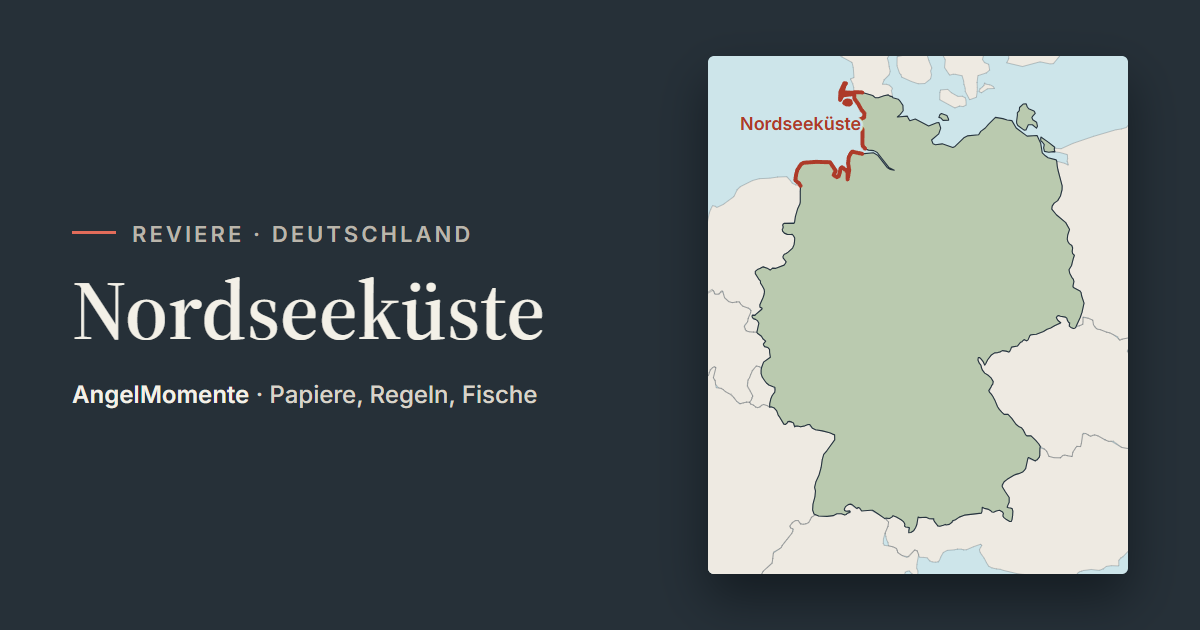
Waters · Germany
Fishing on the North Sea coast
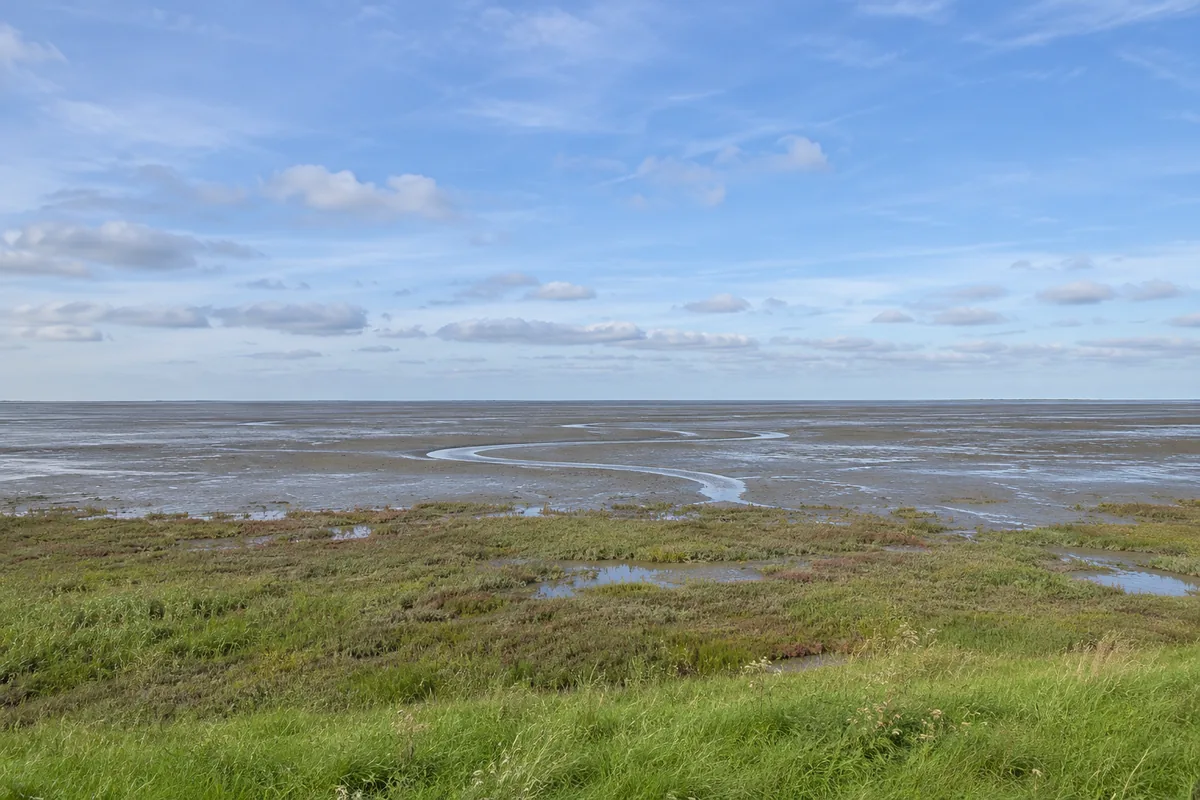
The German North Sea coast stretches from the Dollart on the Dutch border via the Jade, Weser and Elbe to the Danish border. In front of it lies the Wadden Sea (Wattenmeer), which largely dries out at low water. On many stretches fishing is free, but papers and minimum sizes are regulated by each state separately.
- Papers
- Fishing licence (Fischereischein); in SH and HH also the fishing levy (Fischereiabgabe)
As of October 2026
At a glance
- Papers
- Fishing licence (Fischereischein); in SH and HH also the fishing levy (Fischereiabgabe)
| Fish | Minimum size | Closed season | Catch limit | Note |
|---|---|---|---|---|
| Sea bass | 42 cm | 1.2.–31.3. catch and release only | 3 per day | EU rule 2026; Fischereiamt NI and state SH: no targeted angling in February and March |
| Plaice | 27 cm | none | – | SH: females protected 1.2.–30.4. |
| Sole | 24 cm | none | – | NI (EU minimum size) and SH |
| Turbot | 30 cm | none | – | NI and SH |
| Herring | 20 cm | none | – | NI and SH |
| Mackerel | 30 cm | none | – | NI and SH |
| Cod (Kabeljau) | 35 cm | none | – | NI and SH |
| Sea trout | 40 cm | 1.10.–15.2. | – | SH: 1.10.–31.12., only fish in spawning colours |
| Atlantic salmon | 60 cm | 1.10.–15.3. | – | SH: 1.10.–31.12., only fish in spawning colours |
| Eel | – | Fishing ban 2026 | – | NI and SH; on the Lower Weser until 31.3.2027 |
Values for Lower Saxony (Küstenfischereiordnung and EU minimum sizes), deviations in Schleswig-Holstein in the note. For Bremerhaven and Neuwerk ask the fisheries authority (Fischereibehörde) of Bremen or Hamburg. Correct as of October 2026. What counts are the regulation and your permit.
Location and waters Wadden Sea between the Dollart and the Danish border
Three national parks protect the Wadden Sea. The Lower Saxon one runs from the Dollart to the Elbe estuary near Cuxhaven, includes the East Frisian Islands outside the villages and covers around 3.450 km² (Nationalpark Niedersächsisches Wattenmeer). The Hamburg national park in the Elbe estuary includes Neuwerk (Nationalpark Hamburgisches Wattenmeer). North of the Elbe to the Danish border follows the Schleswig-Holstein national park with 4.380 km², without the islands of Sylt, Amrum, Föhr and Pellworm (Nationalpark Schleswig-Holsteinisches Wattenmeer).
The tidal range is between roughly one and over four metres (BSH). In terms of fisheries law in Lower Saxony the lower reaches of the Elbe, Oste, Weser, Hunte, Ems and Leda also count as coastal waters (Staatliches Fischereiamt Bremerhaven).
Fish and best time Plaice, flounder, turbot, sea trout and salmon
- Flatfish: plaice, dab, flounder, turbot and sole make up almost two thirds of the fish in the Wadden Sea in summer (Nationalparkverwaltungen).
- Young fish: plaice, herring, whiting and garfish use the tidal flats as a nursery in their first year (Schutzstation Wattenmeer).
- Sea trout and salmon: Between October and early January they run up from the sea into the tributaries of the big rivers (Fischereiamt). The closed seasons for both species fall in this period.
- Sea bass: Little is known about the stock in the German part of the North Sea, so the Thünen-Institut surveys anglers on the subject (DAFV).
The catch calendar shows when each species is in season.
Papers and permit Fishing licence on the coast in four federal states
Four federal states share the coast, and each regulates the paperwork itself. How to get the fishing licence (Fischereischein, colloquially Angelschein) is explained on the pages for the individual states. For the coast the following applies:
- Lower Saxony: In coastal waters, fishing for fish and crayfish is free (§ 16 Nds. FischG). Under the implementing provisions of the Fisheries Act, however, the duty to hold a fishing licence (Fischereischein) still applies on the coast. Guests fishing on a paid angling trip are exempt (AB-Nds.FischG, Abschnitt V). Take your licence with you and check with the Staatliches Fischereiamt Bremerhaven what applies to you. On the Weser and Hunte the fisheries authority sells fishing permits (Erlaubnisschein), the Weserkarte. For this you need a fishing licence or an angling exam (Fischerprüfung) passed in Germany (Informationen zum Fischfang in Weser und Hunte 2026).
- Bremen: On the Weser in the Bremerhaven area, fishing is free. You must carry a fishing licence in your own name; licences from other federal states and from the EU are valid (Bremisches Fischereigesetz, §§ 10, 11 und 34).
- Hamburg: Fishing licence (Fischereischein) and proof of payment of the fishing levy (Fischereiabgabe) for the current year (Umweltbehörde Hamburg). If you do not live in Germany and are entitled to fish at home, you can get a tourist fishing licence (Touristenfischereischein) at the Hamburger Angelzentrum. It is valid until the end of the year and costs 45 euros (Umweltbehörde Hamburg, Touristenfischereischein).
- Schleswig-Holstein: A fishing licence (Fischereischein) is required on every water; without one there is the holiday fishing licence (Urlauberfischereischein) for 28 days. On commercial angling cutters and at commercial angling ponds, the operator can let you fish without a fishing licence if he takes over supervision. Ask beforehand. You pay the state’s fishing levy (Fischereiabgabe) in any case, even if you have already paid elsewhere (Land Schleswig-Holstein, FAQ). The levy and the holiday licence are available through the state’s online services or from the public order, harbour and citizens‘ offices. On the North Sea you need a fishing permit (Erlaubnisschein) only on the Untereider (Merkblatt zum Urlauberfischereischein).
How sea trips work is explained under Fishing from a cutter and a boat.
Special rules Sea bass limit and minimum sizes by state
Minimum sizes and closed seasons are shown in the box “At a glance”, with the values from Lower Saxony and the deviations in Schleswig-Holstein. What the terms mean is explained under Closed season and minimum size explained. EU law also applies along the whole coast:
- Sea bass 2026: In January and from 1 April to 31 December you may keep at most three sea bass per day, each at least 42 cm long. From 1 February to 31 March the EU allows only catch and release (Verordnung (EU) 2026/249, Art. 10 Abs. 5). Because animal welfare law stands in the way, angling for sea bass is banned in this period in Lower Saxony (Fischereiamt) and Schleswig-Holstein (Land Schleswig-Holstein). Put a sea bass caught as bycatch back straight away and gently.
- Eel: Recreational fishing for eel is banned all year in the coastal waters of Lower Saxony (Fischereiamt), and likewise in Schleswig-Holstein (Merkblatt). The basis is Article 14 of Verordnung (EU) 2026/249.
- Reporting with RecFishing: Since 10 January 2026 you have to register if you fish at sea and report certain catches through the “RecFishing” app. This includes every sea bass and every eel, even if you put it back.
In the national parks each state decides for itself where you may go:
- Lower Saxony: You enter the quiet zone only on approved paths, the intermediate zone also away from them, except in the breeding areas of the salt marshes from 1 April to 31 July. In the recreation zone, angling is expressly allowed (§ 15 NWattNPG).
- Hamburg: You may enter Zone I only with a special permit or on a guided tour.
- Schleswig-Holstein: Zone 1 is closed near the coast, apart from exceptions. You fish where you are allowed to enter the area (Nationalpark Wattenmeer).
As of October 2026. The sea bass rules apply for 2026 only, the eel ban on the Lower Weser until 31 March 2027. According to the state, the list from Schleswig-Holstein is not exhaustive.
Safety
DLRG rules for the tidal flats (DLRG Meldorf, DLRG St. Peter-Ording):
- Never go out on the tidal flats alone, and tell someone beforehand.
- Check the tides and allow time for the way back before you set off.
- On the rising tide the tidal channels fill first, with a strong current. Avoid them while the water is coming in.
- At dusk, in the dark, in a storm, in fog or in a thunderstorm you stay off the flats.
See also Shore and waders, Tides, ebb and flow and Weather at the water.
Related
- Fishing on the coast and in the surf, Fishing in the harbour and from the pier and Surf rig
- Fishing in Germany and Fishing licence and angling exam
- In the fish lexicon: plaice, flounder, whiting, mackerel, sea trout, gurnard
Sources
- Verordnung (EU) 2026/249 des Rates vom 26. Januar 2026: Art. 10 Abs. 5 (Wolfsbarsch) und Art. 14 (Aal), Abdruck beim Staatlichen Fischereiamt Bremerhaven
- Staatliches Fischereiamt Bremerhaven: Rechtlich gebotene Einschränkungen, Informationen zum Wolfsbarsch, Die niedersächsischen Küstengewässer, Ausgabe der Weserkarten, Fischfang in Weser und Hunte 2026
- Niedersächsisches Fischereigesetz, § 16; Ausführungsbestimmungen zum Nds. FischG, Abschnitt V Fischereischein; Gesetz über den Nationalpark „Niedersächsisches Wattenmeer“, § 15
- Land Schleswig-Holstein: Fragen und Hinweise zur Angelfischerei (26.02.2026), Wolfsbarsch 2026 (16.02.2026), Merkblatt zum Urlauberfischereischein (Februar 2026); Serviceportal Gemeinsam-Online: Fischereiabgabe, Urlauberfischereischein
- Bremisches Fischereigesetz; Hamburg, Behörde für Umwelt, Klima, Energie und Agrarwirtschaft: Fischerei, Touristenfischereischein
- Nationalparkverwaltungen: Lower Saxony, Hamburg, Schleswig-Holstein, Erlaubt, verboten, Plattfische
- Bundesamt für Seeschifffahrt und Hydrographie: Gezeiten
- DLRG: Sicherheit im Watt, Gefahren im Watt
- Schutzstation Wattenmeer: Fische; Fischereiamt: Meerforellen-Monitoring; DAFV: Wolfsbarschangler an der Nordsee gesucht (07.09.2026)
Guide without guarantee, as of October 2026. The authoritative texts are the fisheries acts and coastal fisheries regulations of Lower Saxony, Bremen, Hamburg and Schleswig-Holstein, the national park acts and the EU regulation on fishing opportunities in their current versions.