
Knowledge – Fish
Atlantic salmon: Features, migration, Baltic Sea rules
The Atlantic salmon (Salmo salar) grows up in the sea and runs up into the gravelly upper reaches of rivers to spawn. In Germany it is considered critically endangered, and there are no self-sustaining populations here. It is fished mainly in the Baltic under strict conditions and in the salmon rivers of Denmark and Norway.
In short: You catch Atlantic salmon best from February to May, in the morning, during the day and at night. Good spots on the coast: just under the surface and deep water; in the river: pools. Proven baits: spoons, spinners and crankbaits when trolling and spinning, at the river salmon flies and tube flies. Critically endangered in Germany and, in inland waters, protected all year round in many places. The grades apply to trolling in the Baltic; off Rügen the season runs from mid-December to early June. Step by step: fishing for Atlantic salmon.
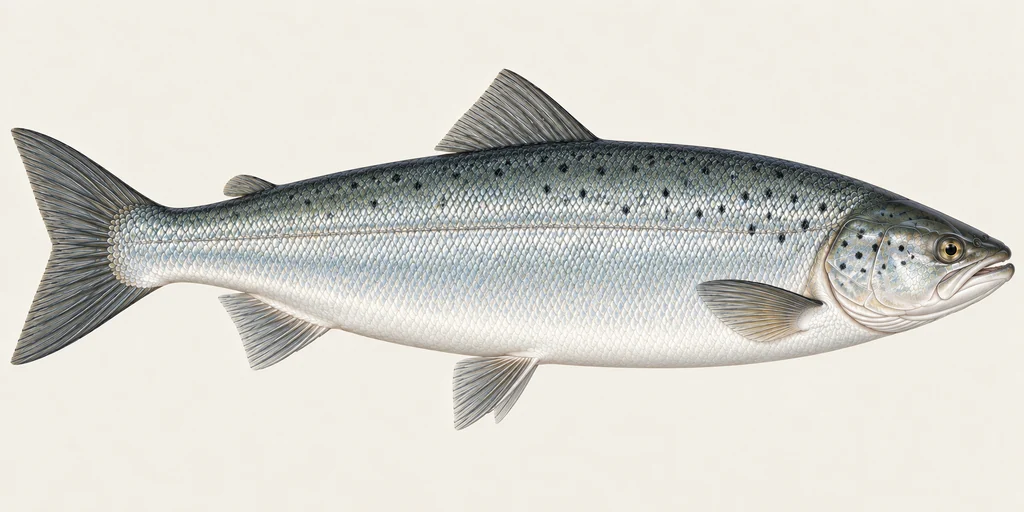
- Slim caudal peduncle with a clearly set-off, notched tail fin
- The gape reaches only to below the rear edge of the eye
- Black spots mainly above the lateral line, tail fin usually unspotted
Catch chances through the year
- Hardly any chance
- Possible
- Good
- Peak season
- Spawning (observe the closed season)
Editorial assessment for waters in Germany, not a measured value and no guarantee. Spawning time is not the same as the legal closed season.
Species profile and sources in the catch calendarAll species compared month by monthThe rules of your federal state
How to recognise the salmon
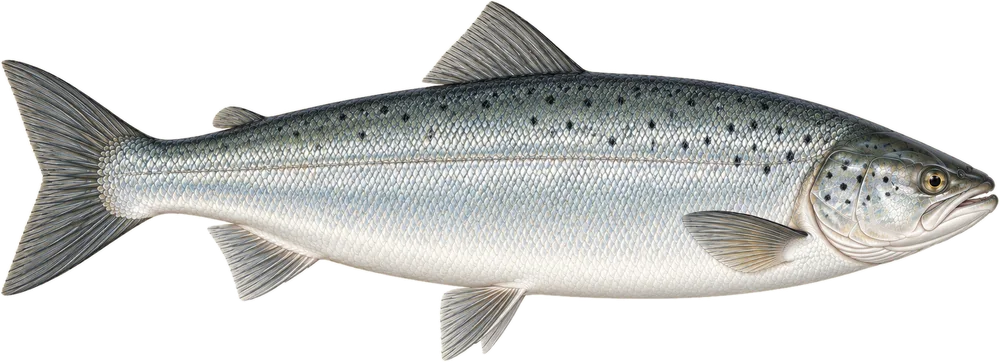
The salmon is slim and elongated, with a pointed snout and an adipose fin. The thin caudal peduncle with a forked tail fin is striking. At sea the back is blue-green and the flanks gleam silver. The few black spots sit above the lateral line; below it they are missing in sea-run salmon, and the tail fin is mostly unspotted.
On average it grows 50 to 100 centimetres long; the males (Milchner) grow larger. As maximum values FishBase gives 150 centimetres, the fisheries authority of Lower Saxony (Fischereibehörde) 140 centimetres. At spawning time the lower jaw of the males curves upwards, the so-called spawning hook, and the animals lose their silvery sheen.
Young salmon in the river are called parr and carry dark vertical stripes. Before migrating to the sea they turn silvery at about 15 to 20 centimetres and are then called smolt. One that returns after just one winter at sea is a grilse.
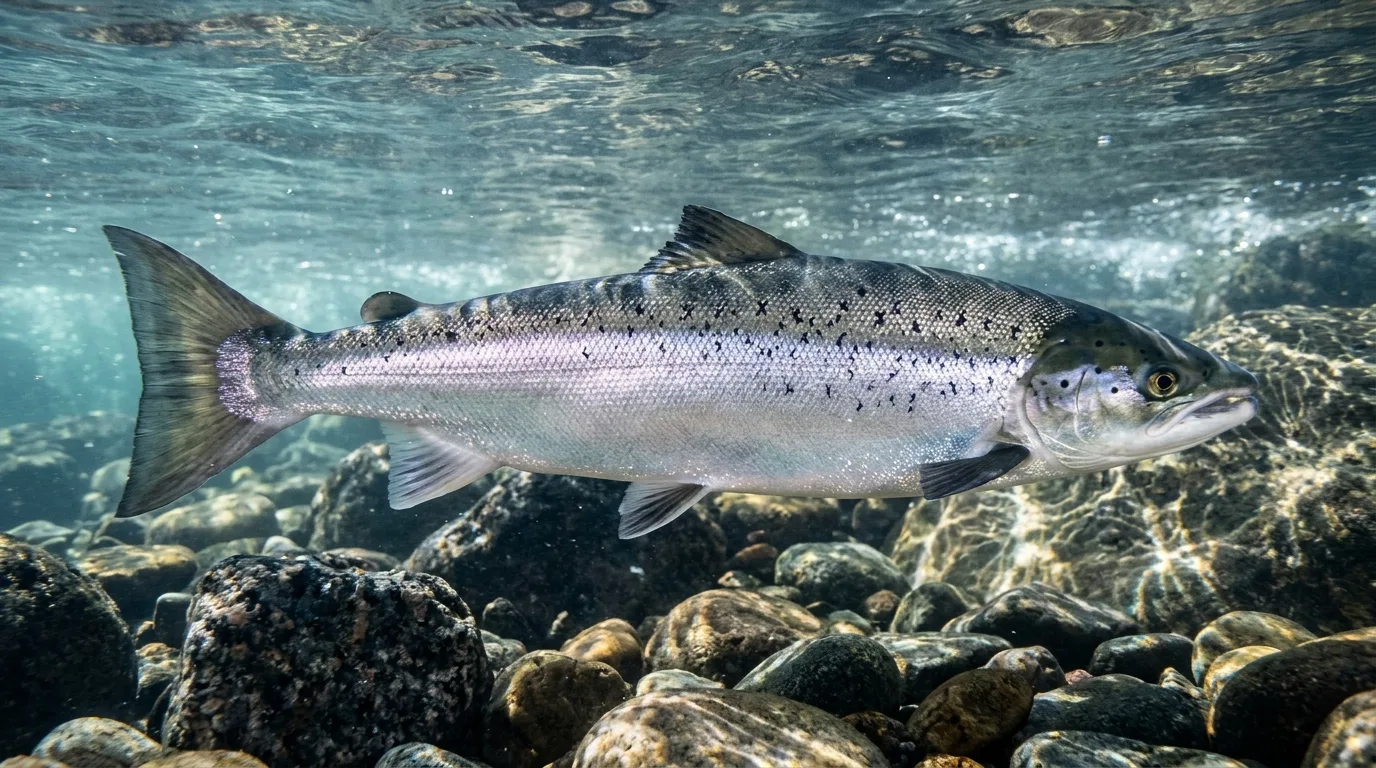
You are most likely to confuse the salmon with the sea trout. In the salmon the mouth reaches only to below the rear edge of the eye, in the sea trout clearly beyond it. Between the adipose fin and the lateral line the salmon has 10 to 13 scales. You see the difference fastest at the caudal peduncle, which is strikingly thin in the salmon, and at the forked tail fin. Salmon and trout can interbreed, so hybrids are not ruled out. If you are unsure, release the fish gently.
Side by side
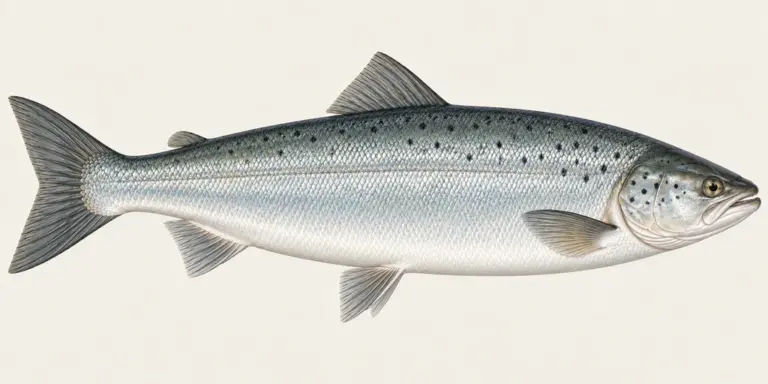
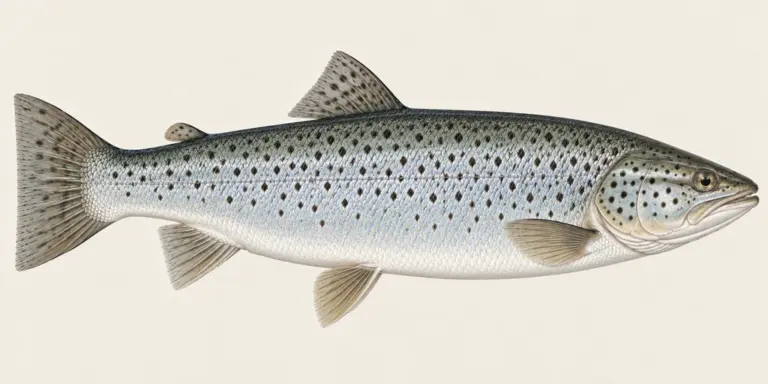
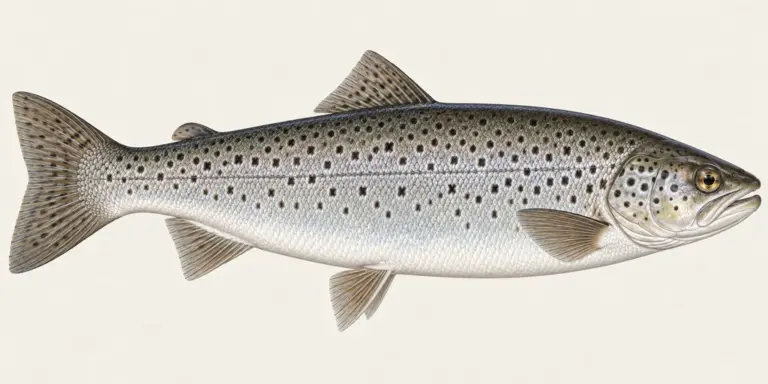
AI-generated illustrations.
Where the salmon lives and spawns
The salmon lives in the North Atlantic and its marginal seas, and also in the North Sea and the Baltic. At sea it stays in the surface region. Salmon from rivers around the Baltic stay in the Baltic according to DTU Aqua, while animals from Atlantic rivers travel to the North Atlantic to feed.
For spawning it needs rivers that stay cool in summer, flow quickly and have loose gravel. The females prefer to dig their redds at the end of a calmer stretch, shortly before a strongly flowing riffle, that is, a shallow spot over which water flows quickly. In their first years the young salmon stand in such shallow stretches over coarse gravel.
In the past the salmon occurred in almost all rivers flowing into the North Sea and the Baltic. River engineering, pollution and weirs made it disappear by about 1950. Since the early 1980s fisheries associations have been releasing salmon again. Natural reproduction has been demonstrated in the Rhine, Elbe and Weser, but according to the Bundesamt für Naturschutz there is so far no population that sustains itself without stocking.
Holding spots in the picture
Choose the season and time of day: the picture shows where the species stands then. Spots outlined in red apply only in the chosen season. Tap a fish or a spot in the list to bring it closer. The picture is schematic and AI-generated, every water is different.
Chance of a catch in springgood
Catch chances in summerpossible
Catch chance in autumnhardly anySpawning, observe the closed seasons (Schonzeit)
Catch chance in winterpossible
- J
- F
- M
- A
- M
- J
- J
- A
- S
- O
- N
- D
Spawning season
Active time In the river, running salmon usually rest by day in deep pools or behind obstacles and tend to move on at night. For fishing, a report from southern Norway names sunrise; in high water and darkness larger tube flies catch. At sea, salmon feed mainly by day, and bright, stable weather patterns are considered favourable for trolling.
Active time In the river, running salmon usually rest by day in deep pools or behind obstacles and tend to move on at night. For fishing, a report from southern Norway names sunrise; in high water and darkness larger tube flies catch. At sea, salmon feed mainly by day, and bright, stable weather patterns are considered favourable for trolling.
No main time In the river, running salmon usually rest by day in deep pools or behind obstacles and tend to move on at night. For fishing, a report from southern Norway names sunrise; in high water and darkness larger tube flies catch. At sea, salmon feed mainly by day, and bright, stable weather patterns are considered favourable for trolling.
Active time In the river, running salmon usually rest by day in deep pools or behind obstacles and tend to move on at night. For fishing, a report from southern Norway names sunrise; in high water and darkness larger tube flies catch. At sea, salmon feed mainly by day, and bright, stable weather patterns are considered favourable for trolling.
On the coast
Deep, colder water
Atlantic salmon are found here all year round.
Just below the surface
Atlantic salmon are found here all year round.
At sea the salmon lives in open water and often near the surface. Off Rügen the fishing grounds lie over deep water, 10 to 15 kilometres from the coast. The fishing depth changes from day to day: sometimes just below the surface, sometimes at more than 20 metres.
Spring: catch chances according to the fishing calendar good. Until mid-May the sea area off the north coast of Rügen is considered promising.
Summer: catch chances according to the catch calendar are possible.
Autumn: catch chances according to the fishing calendar possible in September, hardly any in October and November. This is spawning time, so observe the closed seasons (Schonzeit).
Winter: catch chances according to the fishing calendar possible in December and January, good in February. From mid-December salmon are found off the north coast of Rügen. Herring are their main prey there.
In the river
Gravelly shallow (riffle)
Atlantic salmon are found here only in autumn and winter.
Pools, deep spot
Atlantic salmon are found here all year round.
Running salmon rest in the deep parts of the river, in pools, scour holes and current channels. In high water they move further upstream, at low water they stay in the lower stretches. Once the migration begins, the salmon stops feeding.
Spring: catch chances according to the fishing calendar good. In April and May the young salmon migrate down to the sea.
Summer: catch chances according to the fishing calendar possible. The spawning run begins in May and continues into November.
Autumn: catch chances according to the fishing calendar possible in September, hardly any in October and November. This is spawning time, so observe the closed seasons (Schonzeit). Most salmon run from September to November. They spawn on gravel bars covered by flowing water, preferably at the transition from a calmer glide to a riffle.
Winter: catch chances according to the fishing calendar possible in December and January, good in February. Spawning lasts into December. After that most of the parent fish die, and a small proportion return to the sea. In inland waters the salmon is protected in many places.
Depth: FishBase gives mostly 10 to 23 metres for the sea. When trolling off Rügen the baits run at depths between 3 and 25 metres or just below the surface.
Size comparison: AI-generated drawing, schematic.
From the gravel bed to the sea and back
The eggs lie in the gravel, and the fry hatch in spring. Young salmon stay in fresh water for about two to three years and eat insect larvae, freshwater shrimps and other small animals. In April or May they migrate downstream to the sea within a few weeks.
At sea salmon eat mainly crustaceans and fish such as sand eels and herring, and gain up to three kilograms a year. After one to four years they usually return to the water in which they hatched.
According to the fisheries authority of Lower Saxony (Fischereibehörde), the spawning migration runs from May to October or November, with the strongest runs in autumn. North German salmon spawn from mid-September to November and thus earlier than sea trout; the Landesfischereiverband Bayern gives October to December. Spawning takes place at 6 to 10 °C. A female digs several redds one after another. Many spawners die after spawning; some return to the sea as kelts, that is, spent fish.
When and where salmon are caught
In rivers the season follows the run upstream, which starts in early summer and peaks in autumn. In 2024 Norway temporarily closed numerous rivers completely because only a few salmon returned from the sea.
Off Rügen, trolling took place between December and early June according to a 2016 Blinker basic course; herring was the salmon’s main prey there. Whether the fish sit high or deep changes from day to day. Which salmon you may keep in the Baltic Sea today is explained in the section on the law.
Today’s catch index needs JavaScript. Season and spawning time are in the catch calendar.
You will find the monthly overview of all species and the water temperature check in the catch calendar.
From the blog: Fishing at locks and weirs: what applies and what the signs mean · Catch advice, catch quotas, angling bans: how to read fisheries news correctly · Baltic Sea catch quotas 2027: what the agreement means for anglers
What you catch salmon with
Step by step: Fishing for Atlantic salmon: tips on bait, rigs and tackle — season, spots, baits, tackle and rules on one page.
In the Baltic Sea salmon are trolled; more under Sea fishing. Several rods with metal lures, crankbaits or flies run at different depths behind the boat. The lures hang from downriggers, which are booms that take them to a depth of 3 to 25 metres with a weight, or from otter boards just below the surface. Trolling lures of around 15 centimetres are usual. When the salmon are feeding on smaller prey, lures of around 11 centimetres often catch better according to the basic course, because large ones bring many missed bites on small fish.
On the river you fish with a spinning or fly rod. For spinning, the Blinker profile suggests rods of around 2,70 metres with a casting weight of 40 to 80 grams, a size 4000 reel and monofilament line no thinner than 0,35 millimetres. Anglers use spinners, spoons, crankbaits and tube flies. For fly fishing, single-handed rods of class 7 or 8 are often enough; on large rivers double-handed rods of class 9 or 10 come into play. Salmon flies, tube flies and streamers are fished.
Salmon fight to the very end. Right in front of the landing net they often make long runs, and that is where many fish are lost. Have the net ready before the fish arrives and let the drag work until the last moment. How to land the fish safely and unhook it is described under Landing and unhooking a fish.
Check the adipose fin: In the Baltic Sea, anglers may only keep salmon with a clipped adipose fin. The fin is removed before stocking, so if it is missing the salmon is marked. Salmon with an intact adipose fin you return gently.
Read the rules before every season: Quotas, closures and catch restrictions change from year to year for this species, in Norway sometimes even during the season. The pages of the responsible authority are binding, not older catch reports.
Release protected fish properly: Even salmon you may not keep survive only if you release them quickly and gently. How to do this is described on the page Releasing fish.
Suitable lures
Spoons, spinners and crankbaits when trolling and spinning; on the river salmon flies and tube flies.
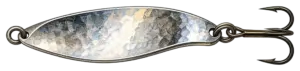
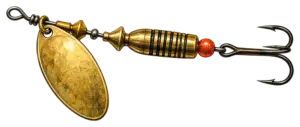
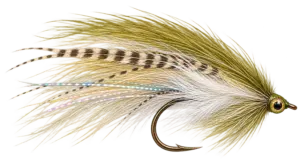
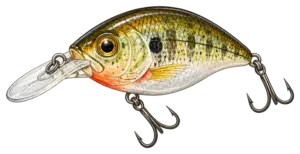
AI-generated illustrations. A click opens the lure’s page.
In German inland waters protected all year round in many places. Check the fishing rules for the Baltic Sea, Denmark and Norway afresh before every trip.
What you need to observe
In Germany the salmon is on the Red List in category 1 (threatened with extinction) and in Annexes II and V of the Habitats Directive (FFH). In inland waters it is protected all year round in many places, in Baden-Württemberg explicitly by the state fisheries regulation.
For the Baltic Sea the EU sets the rules afresh every year. Under Verordnung (EU) 2025/2454, Article 11, angling for salmon is in principle prohibited in 2026 in Baltic Sea subdivisions 22 to 31, and salmon caught by accident must go straight back into the sea. An exception is allowed for salmon with a clipped adipose fin, limited per angler per day. After the first salmon kept, salmon fishing ends for that day. Special rules apply to the north of the Baltic Sea. Stricter national rules remain unaffected.
Closed seasons, minimum sizes and harvest slots are set by the federal states (Bundesländer) and by the fisheries authorities of the neighbouring countries on the coast (Denmark, Norway, Poland). They vary by type of water, stretch of coast and time of year. We only give figures together with the date and source; the fisheries regulation of your federal state and your fishing permit (Erlaubnisschein) are always what is binding. You will find a list of links to the official sources in the catch calendar.
A fish of legal size that you want to keep you stun and kill at once, in line with animal welfare rules. Protected, undersized fish or fish too large under a harvest slot you unhook, if possible still in the water and with wet hands, and release gently. What exactly applies is regulated by state law and your fishing permit (Erlaubnisschein).
In Denmark and Norway the authorities set quotas, closures and tackle requirements for each river. Information is provided by DTU Aqua with Fiskepleje.dk for Denmark and the Miljødirektoratet for Norway.
What closed season, minimum size and harvest slot mean and where to find them is explained on the page Closed season and minimum size explained.
What state law prescribes on closed season (Schonzeit) and minimum size (Mindestmaß) for this species is in the “At a glance” box on the state pages for Baden-Württemberg, Hamburg, Hesse, Mecklenburg-Western Pomerania, North Rhine-Westphalia, Rhineland-Palatinate and Saarland. For the other states our overview does not list this species; there the state fisheries regulation is what counts.
Frequently asked questions (FAQ)
May I keep a salmon in the Baltic Sea?
Under the EU regulation for 2026 only one marked stocked salmon with a clipped adipose fin, limited per angler per day. Salmon with an adipose fin you put back. State law may be stricter.
Why are there hardly any wild salmon in Germany?
Weirs, river engineering, pollution and overfishing drove the salmon out by around 1950. Today’s stocks come mainly from stocking. Natural reproduction has been recorded in the Rhine, Elbe and Weser, but a self-sustaining population is missing.
When do salmon run up the rivers?
The spawning run lasts from May to October or November, with the strongest runs in autumn. Salmon in northern Germany spawn from mid-September to November.
Sources
The rating of catch chances is an editorial assessment. The facts come from these sources, and the text is worded in our own words. The illustration is an original design by Angel Momente in the style of a natural history plate (AI-generated, see the AI notice).
- Landesfischereiverband Bayern: Fischlexikon (Laichzeit, Lebensraum, Nahrung, Aktivität)
- FishBase: Salmo salar (Höchstalter, Bestimmungsmerkmale)
- Bundesamt für Naturschutz: Artenporträt Salmo salar (Rote Liste 2023, FFH-Anhänge, Bestand)
- DAFV: Die Rückkehr der Lachse (Wiederansiedlung, natürliche Vermehrung in Elbe, Rhein und Weser)
- DAFV: Fangregeln für Angler in der Ostsee 2026 (Lachs, Dorsch)
- Landesfischereiverordnung Baden-Württemberg (Stand 2022): Arten mit ganzjähriger Schonzeit
- Blinker: Atlantischer Lachs, Steckbrief (Wiederansiedlung, Angelmethoden)
- Blinker: Grundkurs Trolling auf Lachs (Fangtiefen vor Rügen, Hering als Beute)
- DTU Aqua, Fiskepleje.dk: Laksekvote i Skjern Å (jährlich festgelegte Lachsquote)
- Norwegian Environment Agency: Salmon fishing in Norway in 2024 (Sperrungen und Beschränkungen je Fluss)
- LAVES Niedersachsen: Vollzugshinweise Atlantischer Lachs (Lebensweise, Wanderung, Bestand, Schutzstatus)
- Europäische Union: Verordnung (EU) 2025/2454, Fangmöglichkeiten Ostsee 2026 (Artikel 11, Freizeitfischerei auf Lachs)
- DTU Aqua, Fiskepleje.dk: Laks (Lebensräume, Gydning, Smoltifizierung)
- Wikipedia: Atlantischer Lachs (Merkmale, Lebenszyklus, Situation in Deutschland)
- LAVES/NLWKN Niedersachsen: Vollzugshinweise Fischarten, Atlantischer Lachs (Lebensraumansprüche, Laichwanderung, Laichplätze)
- Internationale Kommission zum Schutz des Rheins: Rhein Lachs 2020 (Bericht Nr. 148, Lebensraum)
- Blinker: Lachsangeln, Schritt für Schritt zum Silber (Reviere vor Rügen, Saison, Lauftiefe)
- Danmarks Sportsfiskerforbund: Skjern Å, lær din å at kende (Ruheplätze der Lachse, Wasserstand)
- Sportvisserij Nederland: Kennisdocument Atlantische zalm, Salmo salar (de Laak 2007; Wanderung, Ruhephasen, Nahrungssuche nach Tageszeit)
- Blinker: Fliegenfischen in Südnorwegen, von Lachs bis Lippfisch (Lachssaison am Fluss, Sonnenaufgang, Tubenfliegen bei Dunkelheit, 2023)
Created with AI support from the sources listed. Figures only appear in the text if a source gives them. Last updated: 20 November 2026. Found a mistake? Write to us. Who is behind this site: About me.
More in the lexicon
- All fish species at a glance
- Catch calendar – month, water temperature and profile for 93 species
- Line calculator – breaking strain after the knot, drag guideline, backing
- Angling methods