
Knowledge · Lures
Spoon
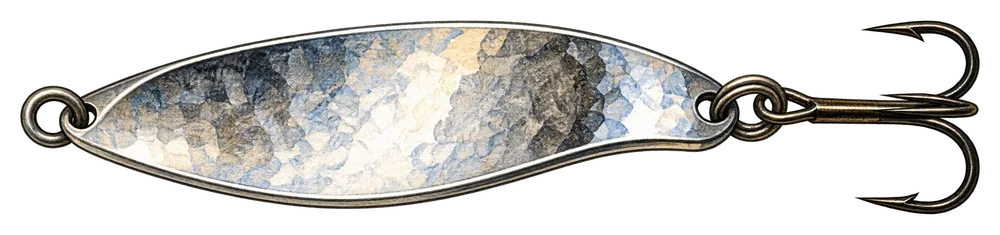
Metal lures · Spin fishing
A spoon is a curved piece of metal that tumbles and flashes from side to side on the retrieve. It is compact and heavy, flies far even in wind and can be worked at any depth. You fish it for pike in fresh water just as for sea trout on the coast.
- Water depth
- All depths, depending on weight
- Retrieve
- Active: reel in tumbling, vary speed and stops
- Fishing method
- Spinning
- Category
- Metal lures
PikeSea troutZanderGarfishMackerelEelpoutGurnardHorse mackerelSea bassAspBrown troutBrook troutHuchen (Danube salmon)Rainbow troutLake troutAlpine char
How a spoon works
The spoon does not rotate around an axis like a spinner, but tumbles. The Bavarian exam questions call it a tumbling metal attractor lure, a tackle guide from the Fischereiverein Löningen a spoon-like metal blade that tumbles and flashes on the retrieve. It sends out a pressure wave familiar to the predator, imitates easy prey with little colour and needs no rattle.
How it runs depends on the speed. Very slowly, it lies flat on its side and hardly swings. A little faster, it tumbles evenly. At even more speed it tumbles lively and at times breaks out in all directions. According to reports from practice, this is the most productive range. If it gets faster still, it rotates uncontrollably, catches nothing and twists the line.
Spoons are compact, heavy and offer little surface to the wind. They fly further than a crankbait and land more quietly than a soft plastic shad. The Löninger Gerätekunde (tackle guide) gives casting weights of 10 to 50 grams. Straight, streamlined models fly furthest; strongly curved ones start to flutter in flight. Thin-plate spoons run more easily, heavy ones made of thick plate rather sluggishly. The metal is robust and survives pike bites.
How to work the lure
Active: reel in tumbling, vary speed and stops
Schematic illustration, AI-generated.
- Cast
- dives on the retrieve
- keeps running steadily
- Reached the bank
Anatomy
The points on the picture above explain the most important parts – on hover or tap.
- Front eye: This is where the snap with the trace attaches.
- Curved body: The curve makes it tumble and flash from side to side.
- Split ring: Connects the hook to the spoon so that it can move.
- Treble hook: Sits at the tail end. The number of hooks and treble hooks is regulated by the state and the water regulations.
Rig in three steps
- 1. Tie on the hooklengthFor pike you add a steel or titanium leader. One practitioner ties a titanium tip of about 40 cm behind fluorocarbon for this.
- 2. Swivel with snapA swivel on the hooklength catches the twist. A strong snap is the link to the lure. If the spoon rotates, wind more slowly.
- 3. Hook into the eyeletAttach the snap to the front eyelet. The spoon must be able to move freely.
Drawings: AI-generated, schematic.
When the target fish are in season
Hardly any chancePossibleGoodPeak seasonValues from the catch calendar.
When and where
The spoon is a search bait: you cast far, cover a lot of water and reach edges that other lures cannot get to. That works even in tight, overgrown spots. On heavily fished waters it can have an advantage, because few anglers still fish metal and the predators barely know its action. In trials on a 25-hectare water in Brandenburg, soft plastics still caught more pike over the long run than a spoon 85 mm long weighing 22 g.
On the coast the spoon is a standard lure for sea trout. Coastal models are slimmer than freshwater spoons and usually weigh 10 to 35 grams, up to 20 grams in autumn. You often work them just under the surface, because the typical stretches are only two to three metres deep and full of weed and stones. Pauses in the retrieve let the lure flutter down on a tight line and often bring the bite. The warmer the water, the faster you wind.
How to choose weight, shape and colour
- Tie on the leader For pike, steel or titanium goes in front of the spoon.
- Swivel with snap A swivel on the leader absorbs the rotation, and a strong snap connects to the lure. If the spoon spins, reel in more slowly.
- Into the front eyelet The snap goes into the front eyelet so that the spoon can move freely.
Start with the weight your rod casts cleanly. One pike angler caught many big pike on a spoon of 9,5 cm; on the coast 10 to 35 grams is usual. Slim, straight spoons fly far and take a high pace. Broad, curved ones flutter more and work well at close range. Thin metal runs in the shallows, thick metal is more sluggish.
When it comes to colour, the rules of thumb contradict each other. The Löninger Gerätekunde advises dark lures in sun and clear water and bright ones under cloud and in murky water. An old coastal rule says the opposite: bright weather, bright lures. In murky water anglers report good catches on garish colours and strong pressure waves. More important than colour is usually the retrieve.
The number of hooks, treble hooks and barbs are governed by the federal state (Bundesland), the water rules and the fishing permit (Erlaubnisschein). For pike, put a steel or titanium leader between lure and main line.
These designs run differently
With a through-line spoon the line runs through the body and the hook hangs on the hooklength behind. It follows the lure in one line, and a hooked fish shakes free less often because the lure slides up the hooklength. Slim models take a higher pace.
For weedy stretches there are special weedless spoons. For trolling from a boat, mother-of-pearl spoons are recommended, which are also used for lake trout.
How to work it and make the most of bites
After the cast, let the spoon sink on a tight line. It already flutters on the way down, and the first bite often comes here. Count it down, then you can offer the same depth again later. Add winding pauses and short sprints. If you put two short rod twitches into a slow retrieve, the lure darts sideways.
A rod held high keeps it shallow, a lowered one takes it deeper. Faster winding makes it run shallower. Thick braid has buoyancy and lifts the lure as you wind it in.
If a fish follows, it often bites just when you lift the lure and knock it out of its steady run. So fish it out right to your feet. In pike, hooks in spoons sat in the gills more often. Keep a pair of disgorgers and an unhooking mat ready.
Which colour?
Starting points to try, not rules. Depth and speed are usually more important than colour.
Spoon or another lure instead?
| Baits and lures | Depth | Retrieve | Take this lure if … |
|---|---|---|---|
| Spoon | All depths, depending on weight | Active: reel in tumbling, vary speed and stops | this page |
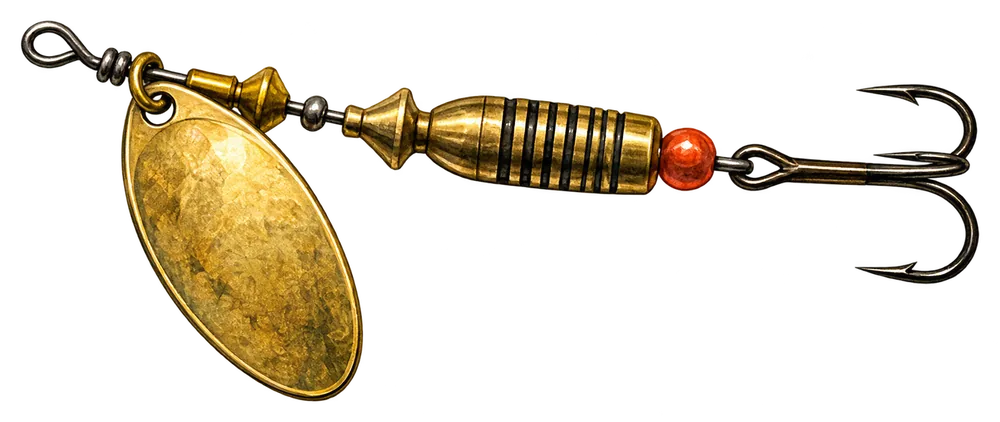 Spinner | Near the surface to mid-water | Active: retrieve steadily, speed up when fish follow | you want a steady, shallow retrieve and the lure should run at the slightest pull |
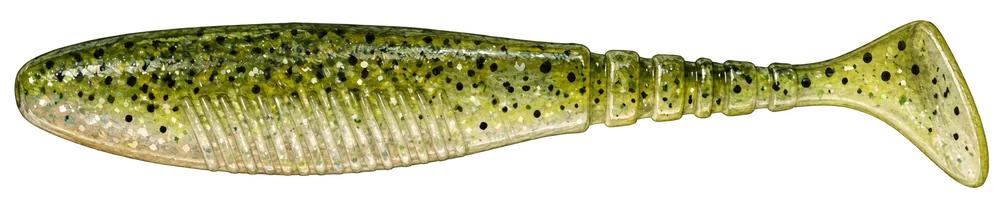 Soft plastic (shad) | Bottom to mid-water | Active: jigging with the rod or lift-and-drop with the reel, bites usually come on the drop | you want to fish slowly and close to the bottom |
 Jig | Bottom to mid-water | Vertical: drop to the bottom, lift, let it fall; from a boat it can also be cast a long way | you are fishing vertically from a boat |
What you need
- Spinning rodFor pike and the coast, lengths from 2,70 to 3,15 m suit. Long rods cast further and control the running depth precisely. More
- LineBraid hardly stretches and flies far, but it is buoyant. A thin, well-sealed line lets the lure run deeper. More
- Pike leaderWhere pike lie, put steel or titanium between lure and main line. More
- Disgorger pliersThey remove hooks sitting deep in the mouth without you having to hold the fish for long. More
More on the method: Spin fishing and Trout fishing at a pond.
At a glance
Editorial assessment, not measured values.
If it does not work
Retrieve more slowly until it wobbles again. Above a certain speed it only spins and catches nothing.
Build in reeling stops, sprints and sinking phases. Two short rod twitches make it dart off to the side.
Lower the rod tip, wind more slowly or count the lure down to the depth you want.
Retrieve it higher, take a thin-plate model or a weedless spoon. On the coast you usually fish just under the surface.
Choose a straight, streamlined model. Strongly curved spoons flutter in flight and land in the water sooner.
Add a steel or titanium leader, because only these materials protect reliably after a bite. Check the leader regularly for damage.
Frequently asked questions
How deep does a spoon run?
You control that yourself. Sink time, retrieve speed, line thickness and rod position decide the depth. A high rod and fast winding keep it shallow; a lowered tip and slow winding take it deeper.
Spoon or spinner?
The spoon is clearly heavier, flies further and flutters. The spinner weighs little and spins at a light pull. The weight decides which rod you need and how far you cast.
Does the spoon still catch fish today?
Yes, but it is not the best everywhere. In Brandenburg soft plastics caught more pike over the long run. Where few anglers fish metal, on the other hand, predators hardly know its action.
Which weight for sea trout?
Usually 10 to 35 grams, up to about 20 grams in autumn. Light-tackle anglers fish lighter models. Straight, slim coastal spoons fly further than strongly curved ones.
Do I need a swivel?
It protects against line twist when the spoon rotates. Some pike anglers deliberately do without it and use a strong snap. More important is a pace at which the spoon flutters instead of spinning.
Before fishing, the current permits, state rules and water rules apply: bait bans, number of hooks, closed seasons, protected species and catch limits can differ. Many federal states expressly ban live baitfish. Take bait remains and packaging away with you. All details are guide values without guarantee and do not replace legal advice.
Sources
- Blinker: Hecht mit Blinker, ein fängiger Klassiker
- Blinker: Meerforellenblinker, diese Faktoren entscheiden über den Fangerfolg
- Blinker: Durchlaufblinker, der Meerforellenköder bei Wind und Wetter
- Rute & Rolle: Der gute, alte Blinker
- Rute & Rolle: Meerforelle, Tipps für weite Würfe
- Bayerische Landesanstalt für Landwirtschaft: Prüfungsfragen Staatliche Fischerprüfung 2023/2024
- Fischereiverein Löningen: Gerätekunde
- Deutscher Angelfischerverband: Fisch des Jahres 2016, der Hecht (Broschüre)
- Carleton University und IGB Berlin: Bait type, bait size and hooking injury in northern pike
- Fisch & Fang: Zielfisch Hecht, Stahl der Wahl
The sources explain terms and basic principles. Retrieve, colour choice and values are editorial starting points and depend on water, weather and lure.
More metal lures
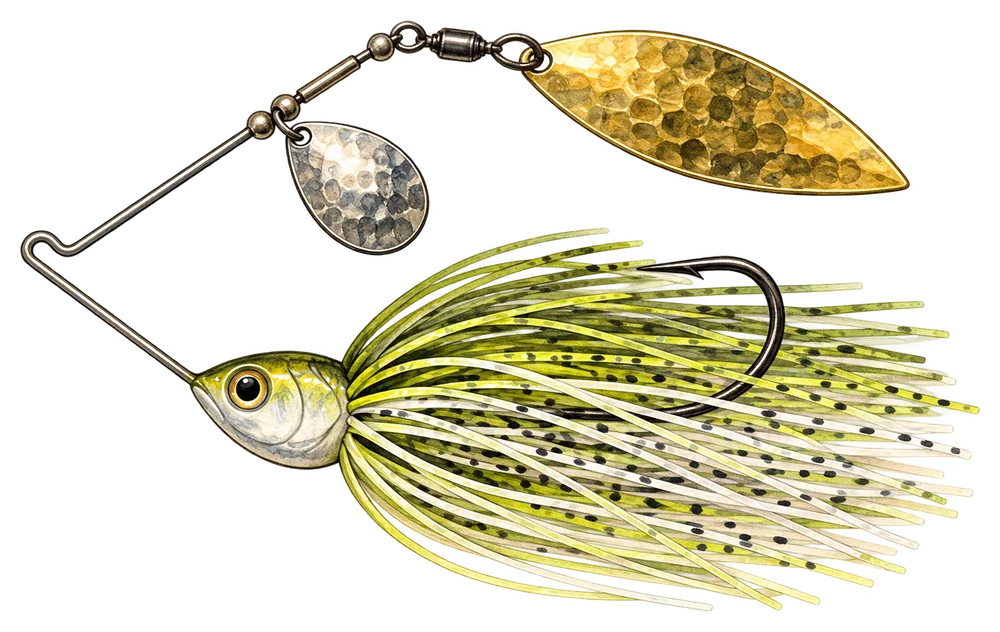 Spinnerbait
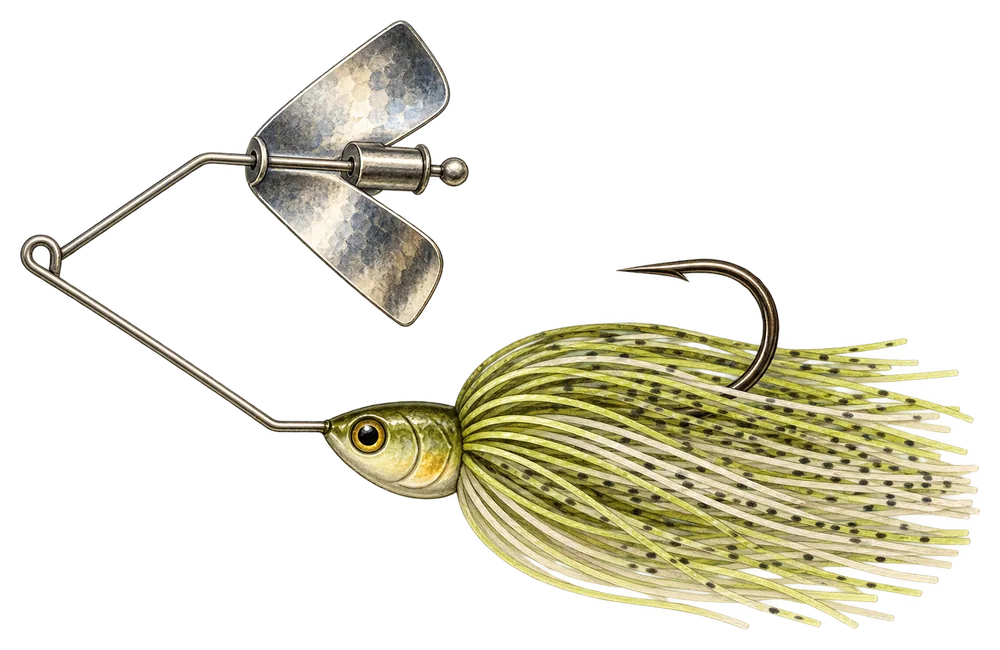 Buzzbait
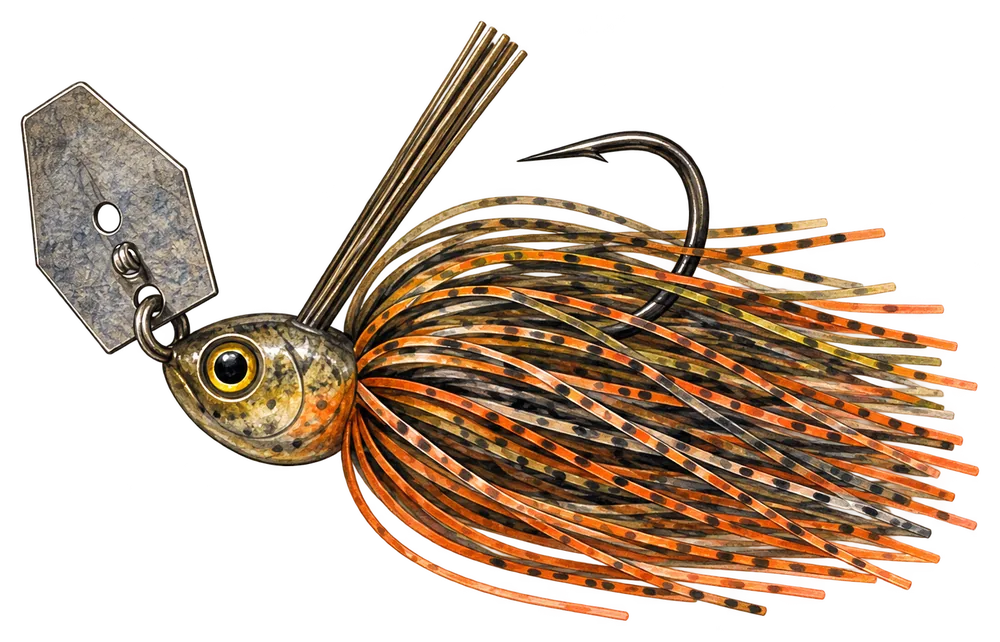 Bladed Jig
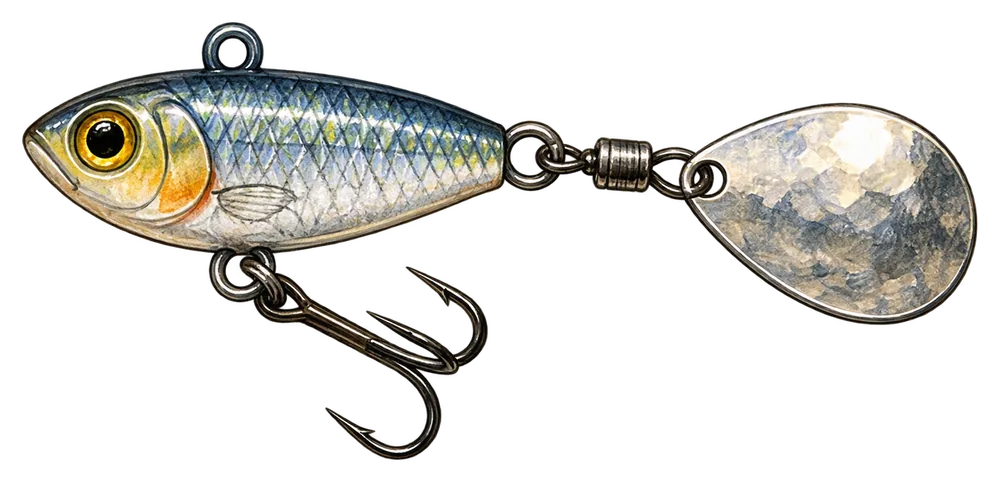 Tailspinner
Created with AI support from the sources listed (AI notice). Last updated: 31 October 2026. Found a mistake? Write to us. Who is behind the site: About me.