
Knowledge – Fish
Huchen (Danube salmon): Features, lures, fishing in winter
The huchen (Hucho hucho), also called Danube salmon, is a large salmonid that never migrates to the sea and occurs naturally only in the Danube catchment. In Germany it is regarded as highly endangered and is listed in the annexes of the Habitats Directive (FFH). It is fished, where permitted, under special conditions and above all in winter.
In short: The best time to catch huchen is December to January, especially in the morning and evening. Good spots on the river: pools, undercut banks and places behind stones. Proven baits: Huchenzopf, large soft plastics, large plugs, spoons or a dead baitfish on a rig. Specialist articles name December and January as the best huchen time. The huchen spawns in spring and is hardly to be caught in summer. Step by step: Huchen fishing.
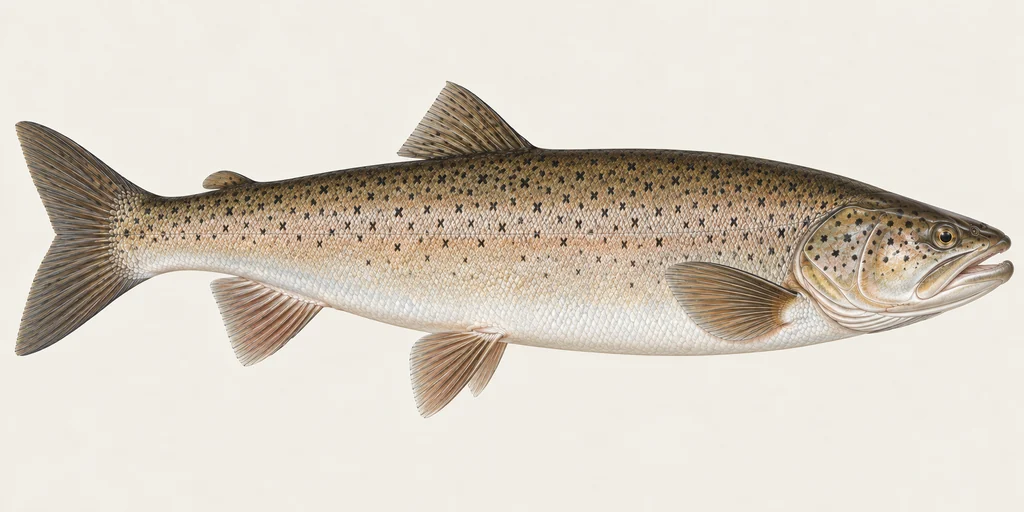
- Elongated body, almost round in cross-section, with copper-coloured flanks
- Wide gape reaching behind the eye, very hard mouth
- Many small dark spots on the back and flanks, no red spots
Catch chances through the year
- Hardly any chance
- Possible
- Good
- Peak season
- Spawning (observe the closed season)
Editorial assessment for waters in Germany, not a measured value and no guarantee. Spawning time is not the same as the legal closed season.
Species profile and sources in the catch calendarAll species compared month by monthThe rules of your federal state
How to recognise it
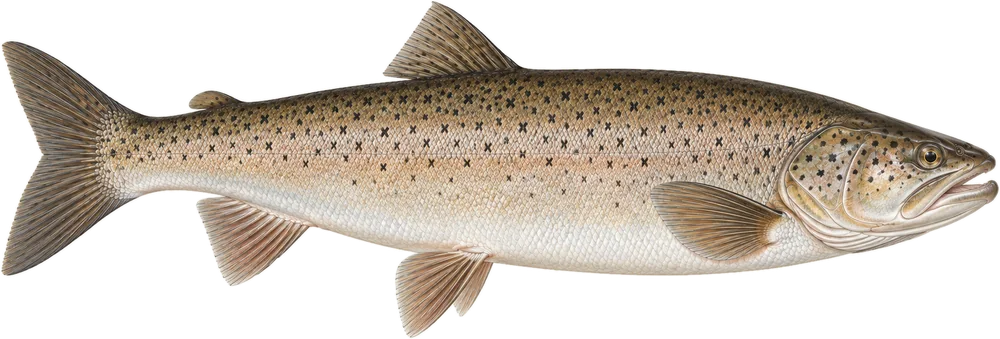
The huchen has an elongated, almost cylindrical body. Its head is long and flattened on top, and the wide gape reaches back beyond the eye. All fins are relatively small and unspotted, plus an adipose fin. The dorsal and tail fins usually carry no black spots.
The body is grey-brown to greenish-grey, and the flanks shimmer coppery to reddish and are dotted with small black spots. Red spots and white fin edges are absent. Among anglers it is also called “Donausalm” or “Rotfisch”.
50 to 100 centimetres is usual. The Landesfischereiverband Bayern gives 150 centimetres as the maximum, and the BfN usually gives 130 to 140 centimetres and 25 to 30 kilograms as the maximum for Germany. FishBase lists 52 kilograms as the heaviest published fish and 20 years as the highest age. According to the BfN the average age is 13 to 16 years.
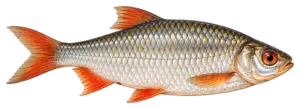
Young and small huchen can be mistaken for trout. The brown trout usually carries red spots with pale rings. The huchen lacks them, its body is round in cross-section, its head long and flattened on top, and its fins small and unspotted. Where the huchen occurs, it shares the water with grayling and trout, which are among its prey.
Side by side
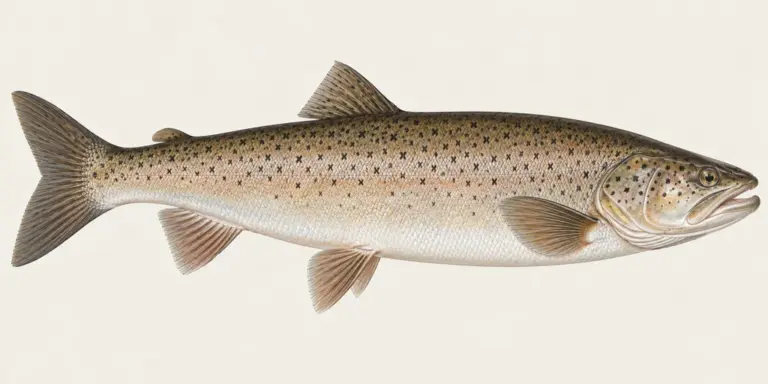
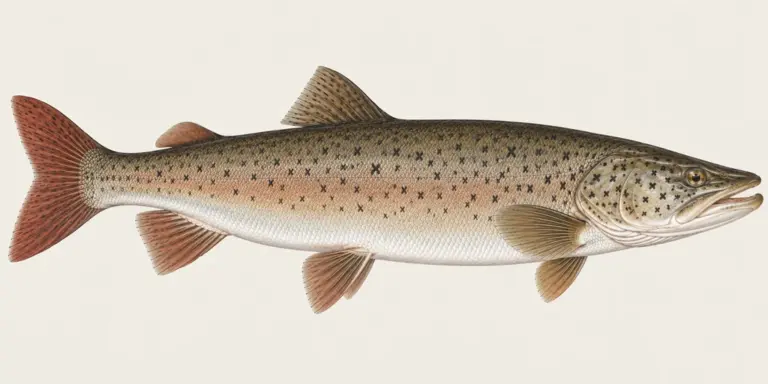
AI-generated illustrations.
Where it holds
By nature the huchen lives only in the Danube catchment. In Germany it originally occurred in Bavaria and Baden-Württemberg. Today, according to the BfN, it is found in only about half of its former waters, and in Baden-Württemberg it is regarded as largely extinct. Only a few stocks sustain themselves, and the rest depends on stocking. The Red List cites studies by the Landesfischereiverband Bayern, according to which only three populations are known that sustain themselves entirely under their own power.
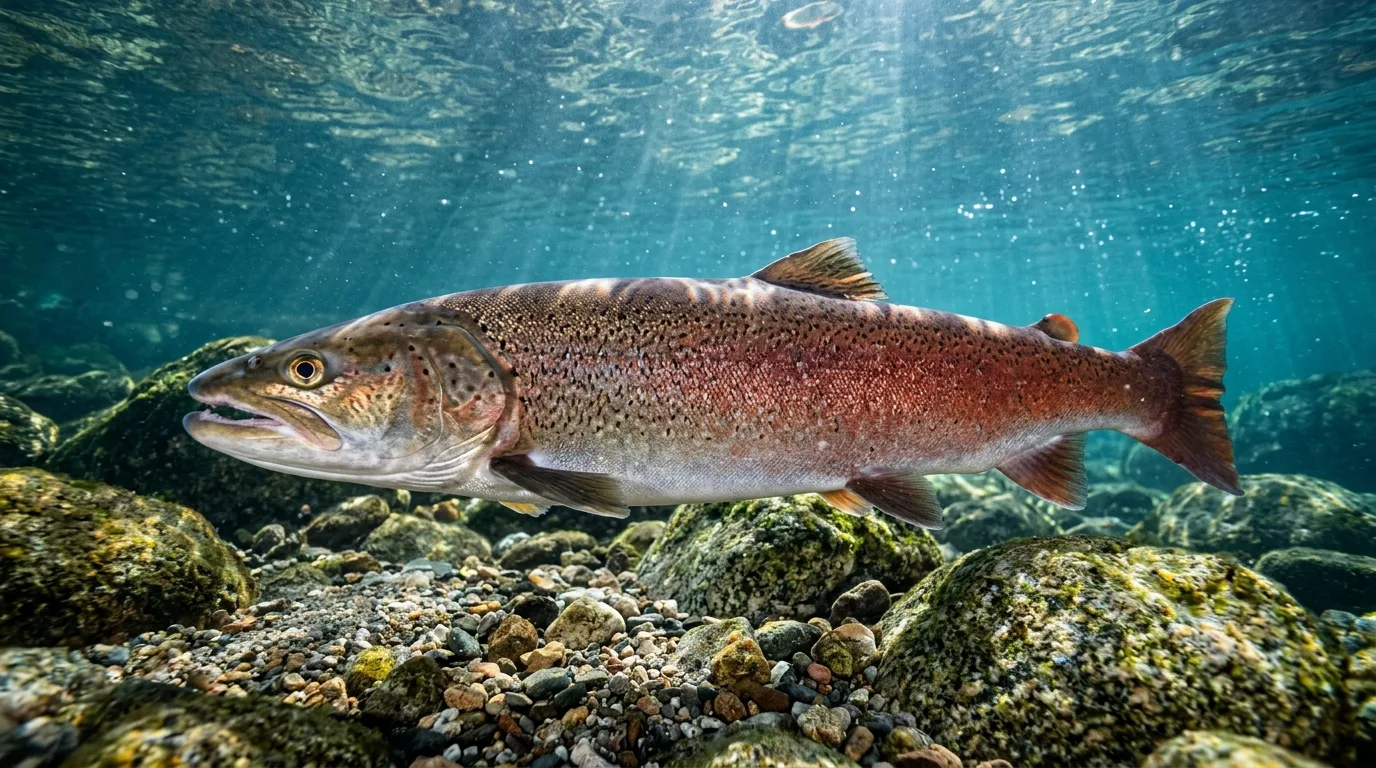
The huchen inhabits fast-flowing, cool and oxygen-rich waters of the grayling and barbel zones. As its lies, this territorial loner chooses deep, shady spots: undercut banks, deep pools, bridge piers and areas behind weirs. According to Blinker it prefers hard ground of rock or coarse gravel and needs two things nearby: prey fish and cover. It hunts at weirs, stream inflows and the outlets of deep pools. Shallows at the inflows and outlets of pools, current seams and eddies are also promising. More on river waters is under River fishing.
It occurs in rivers from cool to fairly warm. Extreme values above 25 °C must not occur there, and for the development of the eggs the water must not get warmer than 14 °C. As the upper lethal temperature of adult fish the LAWA project gives 30 °C.
As threats the BfN names pollution, river engineering, cross-channel structures, hydropeaking from hydropower plants, fine sediments in the gravel and warming of the waters. The Landesfischereiverband adds gravel extraction and the decline of prey fish.
Holding spots in the picture
Choose the season and time of day: the picture shows where the species stands then. Spots outlined in red apply only in the chosen season. Tap a fish or a spot in the list to bring it closer. The picture is schematic and AI-generated, every water is different.
Catch chances in springhardly anyspawning season, observe the closed seasons (Schonzeit)
Catch chance in summerhardly any
Catch chance in autumnpossible
Catch chance in winterMain season
- J
- F
- M
- A
- M
- J
- J
- A
- S
- O
- N
- D
Spawning season
Active time The huchen likes to hunt best at twilight, and by day too when the water is not too clear.
Not a main time The huchen likes to hunt best at twilight, and by day too when the water is not too clear.
Active time The huchen likes to hunt best at twilight, and by day too when the water is not too clear.
Not a main time The huchen likes to hunt best at twilight, and by day too when the water is not too clear.
In the river
Undercut bank, overhanging branches, timber
Huchen are present here all year.
Slack water behind rocks
Huchen are present here all year.
Gravelly shallow (riffle)
Huchen are present here only in spring.
Pools, deep spot
Huchen are present here all year.
The huchen is a solitary fish that stays loyal to its spot and holds in deep, shaded places: in pools, under scoured banks, under bridges and behind weirs. Large boulders and sunken wood also give cover. It lies in wait for prey below weirs, at stream mouths and where deep pools shallow out.
Spring: catch chances according to the catch calendar slim. Spawning falls in this period, so observe closed seasons (Schonzeit). From March to May the huchen moves upstream to spawn, often into the upper reaches of tributaries. The female digs the redd in gravel at a water depth of about 20 to 60 centimetres.
Summer: catch chances according to the catch calendar slim. In summer the huchen is hardly to be caught. Where it holds then is little known.
Autumn: catch chances according to the catch calendar possible in September and October, good in November.
Winter: catch chances according to the catch calendar peak season in December and January, good in February. Winter is the main time, with December and January considered best: the colder it gets, the more the huchen is out looking for prey. Experience differs on the weather; clear, low water and severe cold are named just as much as slightly coloured, rising water at temperatures around freezing.
Depth: It mostly stays in the deeper sections of fast-flowing rivers and prefers a hard bottom of rock or coarse gravel.
Size comparison: AI-generated drawing, schematic.
How it hunts and spawns
Young huchen eat small invertebrates, adults mainly fish. According to anglers‘ reports, trout, grayling, whitefish and lampreys are on the menu, along with amphibians, reptiles, waterfowl and small mammals. As the top predator of the grayling and barbel zones, the huchen sits at the top of the food chain.
The spawning season is from March to May. The spawners travel as medium-distance migrants into the upper reaches of the tributaries and into smaller, shallow streams. The males are at the site first. The female beats a shallow redd in gravelly ground, usually at a water depth of 20 to 60 centimetres, and lays about 1.100 to 1.500 eggs per kilogram of body weight. Both sexes cover the eggs with gravel and guard the site for up to two weeks. The eggs hatch after 25 to 40 days, and the larvae stay in the gravel for another eight to 14 days.
Males mature at three to four years, females at four to five. Because the average age is 13 to 16 years, a huchen can spawn up to 10 to 15 times.
When it bites
Huchen fishing concentrates on winter, and December and January are regarded as the best months. As the temperature falls, hunger grows. Experiences differ on the weather: some anglers value clear, low water, fog and great cold, others consider slightly clouded, rising water after a long period of low levels, light snowfall and temperatures around freezing ideal. In hard frost, according to one specialist, hardly anything goes.
During the day, morning and evening with less light are regarded as the best times, and you will find the huchen most active at dusk. Experienced huchen anglers report good catches at full and new moon and with a rising water level, before the water becomes too cloudy.
In spring the spawners run up into the tributaries. In Bavaria the huchen is protected from 15 February to 30 June, and the minimum size (Mindestmaß) is 90 centimetres (AVBayFiG, as of October 2026). Stricter conditions in the fishing permit (Erlaubnisschein) often apply to individual huchen stretches.
Today’s catch index needs JavaScript. Season and spawning time are in the catch calendar.
You will find the monthly overview of all species and the water temperature check in the catch calendar.
From the blog: Freshwater fish in Germany: which species you catch where
What you catch it with
Step by step: Huchen fishing: tips on bait, rigs and tackle – season, spots, baits, tackle and rules on one page.
Where the huchen may be fished, spinning is the rule. According to Blinker, fly and streamer usually bring only smaller huchen. Robust tackle is needed: a spinning rod of around three metres with a casting weight of 80 to 150 grams and large rings that do not ice up so quickly, a reel with 200 to 300 metres of line and a leader of 1,5 to 2 metres of monofilament in 0,40 to 0,50 millimetres. Many huchen anglers swap the treble hooks on plugs, spoons and Huchenzopf for strong, sharp single hooks, for example in sizes 1/0 to 3/0: they hold more reliably in the hard mouth and spare fish that have to go back. The huchen crushes weak hooks in its glass-hard mouth.
The classic bait is the Huchenzopf, a lead head of 20 to 30 grams with fringes of leather and rubber, formerly tied from lampreys. You work it slowly and close to the bottom. Alongside it, soft plastics of 12 to 20 centimetres on a heavy jig head catch fish, plus plugs in trout or grayling patterns and spoons of 10 to 15 centimetres, preferably in silver. Plugs must run so slowly that you can hardly feel their action.
A dead baitfish of 15 to 25 centimetres on two treble hooks can be worked particularly slowly through the pools; whether it is allowed is stated in the fishing permit. Many federal states expressly prohibit live baitfish.
The baits belong on the bottom. According to Blinker, around 90 per cent of huchen stand there, usually at two to five metres depth. Cast slightly upstream, let the bait sink and retrieve it with bottom contact. Huchen bites often take a very long time to come.
The bite comes as a pluck, a nudge with the nose or a hard blow. Strike hard at any irregularity, as the mouth is hard and bony. In the fight the huchen often charges downstream, shakes its head and rolls around its own axis. A fight that is too gentle lets it vanish into the current, while too much pressure straightens the hook. Landing and unhooking a fish describes landing and handling, and you will find a landing net under Landing net.
A few casts, then move on: According to Blinker, seven to ten casts per spot are enough. Change spot, wait a few minutes and then cast once more, instead of working one spot for hours.
Stalk quietly: Footsteps, rumbling stones and the beam of a lamp scare large huchen. Move calmly and never shine a light on the water.
Permit and rules first: Huchen stretches are managed with their own conditions. Before the first cast, clarify the closed season, minimum size, bait rules and taking in the fishing permit (Erlaubnisschein).
Suitable lures
Huchenzopf, large soft plastics, large crankbaits, spoons or a dead baitfish on a rig.
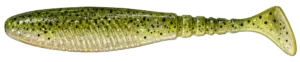
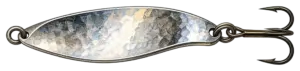
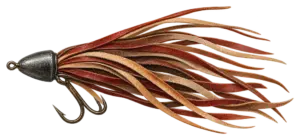
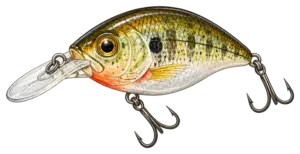
AI-generated illustrations. A click opens the lure’s page.
Rigs for these lures: float rig, running ledger rig.
Whether a dead baitfish is allowed is set by the fishing permit (Erlaubnisschein).
What you need to observe
The huchen is listed as endangered in Germany’s Red List of 2023. The stock situation is rated very rare, the long-term trend a very strong decline and the short-term trend stable. It is listed in Annexes II and V of the Habitats Directive (FFH), and according to the BfN Germany bears a particularly high responsibility for the species. It may be fished for only with a fishing permit (Erlaubnisschein) and under the conditions of the stretch of water in question.
Closed seasons (Schonzeit), minimum sizes (Mindestmaß) and harvest windows are set by the federal states (Bundesland), and on many waters additionally by the club or leaseholder. They differ depending on the water and the time of year. We give figures only with a date and a source; always binding are the fisheries regulation of your federal state and your fishing permit (Erlaubnisschein). You will find a list of links to the official sources in the catch calendar.
A fish of legal size that you want to keep you stun and kill immediately, in line with animal welfare (stunning and killing a fish). Protected fish, undersized fish or fish too large under a harvest window you unhook if possible in the water and with wet hands, and release gently (releasing a fish).
What closed season, minimum size and harvest slot mean and where to find them is explained on the page Closed season and minimum size explained.
What state law says about the closed season (Schonzeit) and minimum size (Mindestmaß) for this species is in the “At a glance” box on the state page for Bavaria. Our overview does not list this species for the other states; the state fisheries regulation applies there.
Frequently asked questions (FAQ)
Why is the huchen called the Danube salmon?
Because it naturally lives only in the Danube catchment. Unlike the salmon, it does not migrate to the sea but stays in fresh water permanently.
How many huchen are left in Germany?
According to the BfN they now occur in only about half of their former waters. According to studies by the Landesfischereiverband Bayern, cited in the Red List, only three populations are known that sustain themselves entirely unaided. The rest are stocked.
How long does it take for a huchen to bite?
Often a very long time. Blinker speaks of up to 1.000 casts before a bite. The fish usually sit near the bottom and rarely chase a lure far, so the lure has to run exactly through their feeding zone.
Sources
The rating of catch chances is an editorial assessment. The facts come from these sources, and the text is worded in our own words. The illustration is an original design by Angel Momente in the style of a natural history plate (AI-generated, see the AI notice).
- Bundesamt für Naturschutz: Artenporträt Hucho hucho (Rote Liste 2023, FFH-Anhänge, Bestand, Biologie)
- Landesfischereiverband Bayern: Fischlexikon (Laichzeit, Lebensraum, Nahrung, Aktivität)
- Rote-Liste-Zentrum: Huchen (Rote Liste der Süßwasserfische Deutschlands 2023: stark gefährdet)
- FishBase: Hucho hucho (Höchstlänge, Höchstalter, Bestimmungsmerkmale)
- LAWA-Projekt O 10.20 (Leibniz-IGB, 2021): Temperaturempfindlichkeiten der Fischgemeinschaften
- Blinker: Steckbrief Huchen (Standplätze, Winterangeln, Köder, Gerät)
- Blinker: Mythos Huchen, im Winter auf den König der Flüsse (Fangplätze, Köderführung, Biss, Drill, Gerät)
- Blinker: Abenteuer Huchenangeln, was beim Donaulachs wichtig ist (Standtiefe, Anpirschen, Wasserstand, Drill)
- KEA-BW, Kompetenzzentrum Wasser und Boden: Steckbrief Bachforelle (Größe, Färbung, Laichplatz, Deckung)
- Fisch & Fang: Geduldsspiel im eisigen Huchenrevier (beste Zeit Dezember und Januar, Wetter, Tageszeit)
- Fisch & Fang: Huchen, König der Kälte (Huchenwetter, Einzelhaken statt Drilling)
- Blinker: Spinnfischen auf Huchen mit Wobbler und Gummifisch (Einzelhaken statt Drillinge, Köderführung, 2020)
- Bayern: AVBayFiG, Anlage 1 (Schonzeiten und Schonmaße, Fassung ab 1.6.2025)
- Wikipedia: Huchen (Merkmale, Verbreitung, Lebensweise, Gefährdung, Angelfischerei)
Created with AI support from the sources listed. Figures only appear in the text if a source gives them. Last updated: 7 November 2026. Found a mistake? Write to us. Who is behind this site: About me.
More in the lexicon
- All fish species at a glance
- Catch calendar – month, water temperature and profile for 93 species
- Line calculator – breaking strain after the knot, drag guideline, backing
- Angling methods