
Knowledge – Fish
Taimen: Features, threats, season in Mongolia
The taimen (Hucho taimen), also called the Siberian huchen, is regarded as the largest salmonid in the world. It lives in cold rivers of Siberia and northern Mongolia. The IUCN lists it as vulnerable. In fly-fishing waters in northern Mongolia it is caught on barbless single hooks and released.
In short: According to the catch calendar the best time is August to October. Good spots in the river: deep holes, behind rocks and undercut bank. Proven baits: flies on a barbless single hook. Vulnerable according to the IUCN, on the Red List in Mongolia; in Russia several stocks are in the Red Book and may not be fished. In fly-fishing waters in northern Mongolia it is caught on barbless single hooks and released. Step by step: Fishing for taimen.
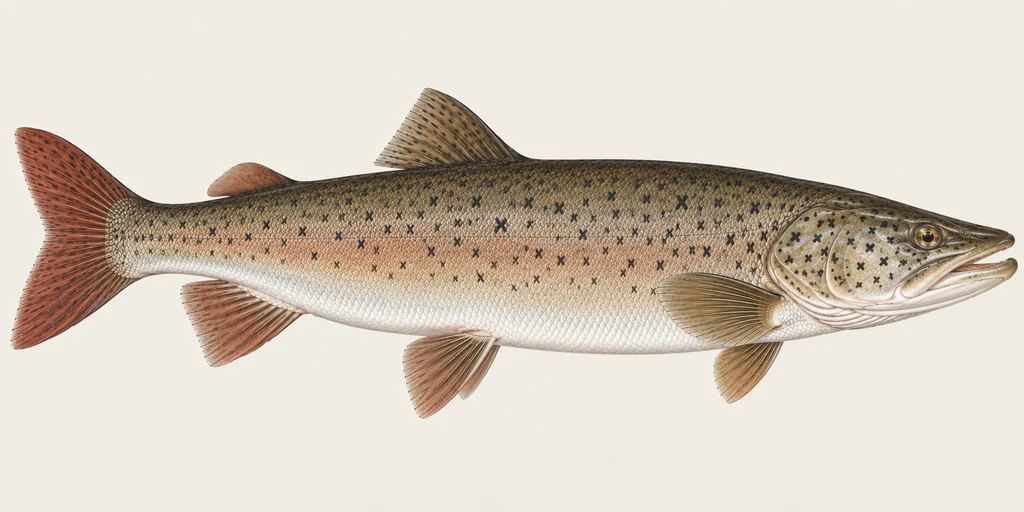
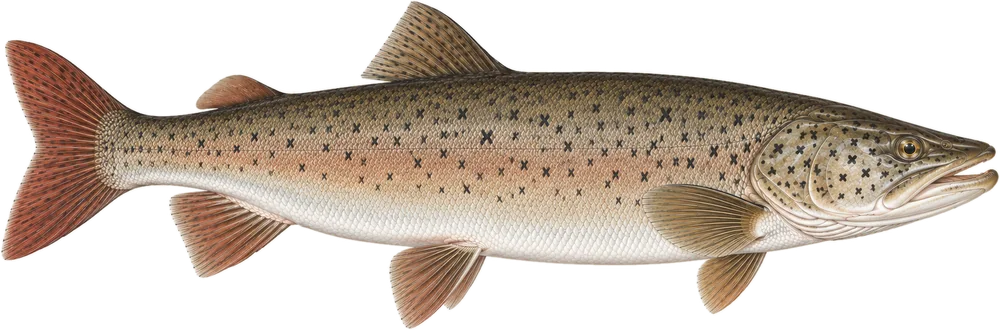
- Small dark spots shaped like an X or a half-moon on the head and flanks
- Long head, flattened on top, with the upper jaw reaching behind the eye
- Reddish tail fin in adult fish, strong adipose fin
Catch chances through the year
- Hardly any chance
- Possible
- Good
- Peak season
- Spawning (observe the closed season)
Editorial assessment for the home water (northern Mongolia and Siberia), not a measured value and not a guarantee. The rules of the country you travel to are what count.
How to recognise it
The taimen has a long body that is round in cross-section. The head is long and flattened on top, the jaws are very long, and in adult fish the upper jaw reaches back beyond the eye. Small dark spots cover the head and flanks, often X-shaped or crescent-shaped on the body. The adipose fin is well developed, and the tail fin of adults is reddish. The scales are very small.
FishBase gives maximum values of 200 centimetres standard length, 105 kilograms and 55 years. It reaches such sizes only in undisturbed waters, and it grows slowly: a taimen needs at least ten years to reach a metre in length.
The most similar is the European huchen from the Danube basin. Both belong to the genus Hucho. Because their ranges do not overlap, the place where it was caught usually tells you the species.
The lenok, also a salmonid, lives in the same river. You recognise the taimen by its long head, flattened on top, and by its upper jaw, which reaches back beyond the eye.
Side by side
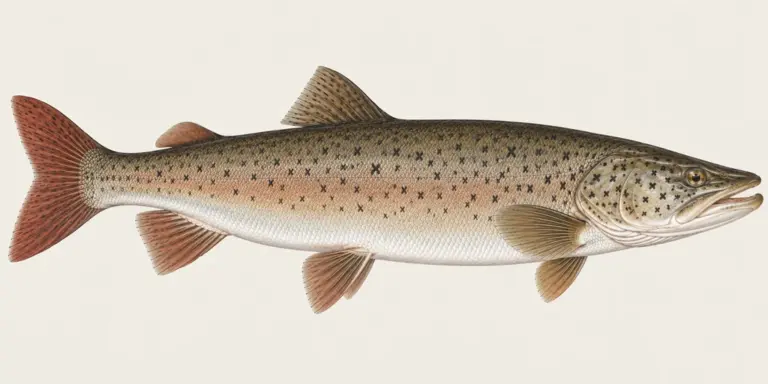
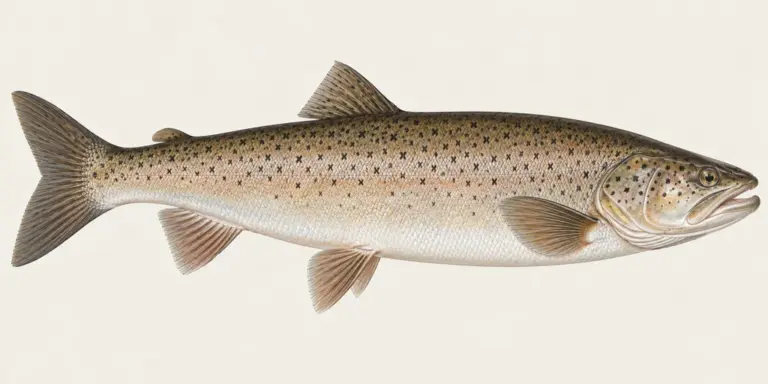
AI-generated illustrations.
Where it holds
The range runs from the tributaries of the Pechora and Kama in the Volga basin across Siberia from the Ob to the Yana and into the Amur basin. It used to descend as far as the Volga. In the Volga, Ural and Pechora, stocks are now considered probably extinct. Healthy stocks still exist in remote rivers of northern Mongolia and Siberia.
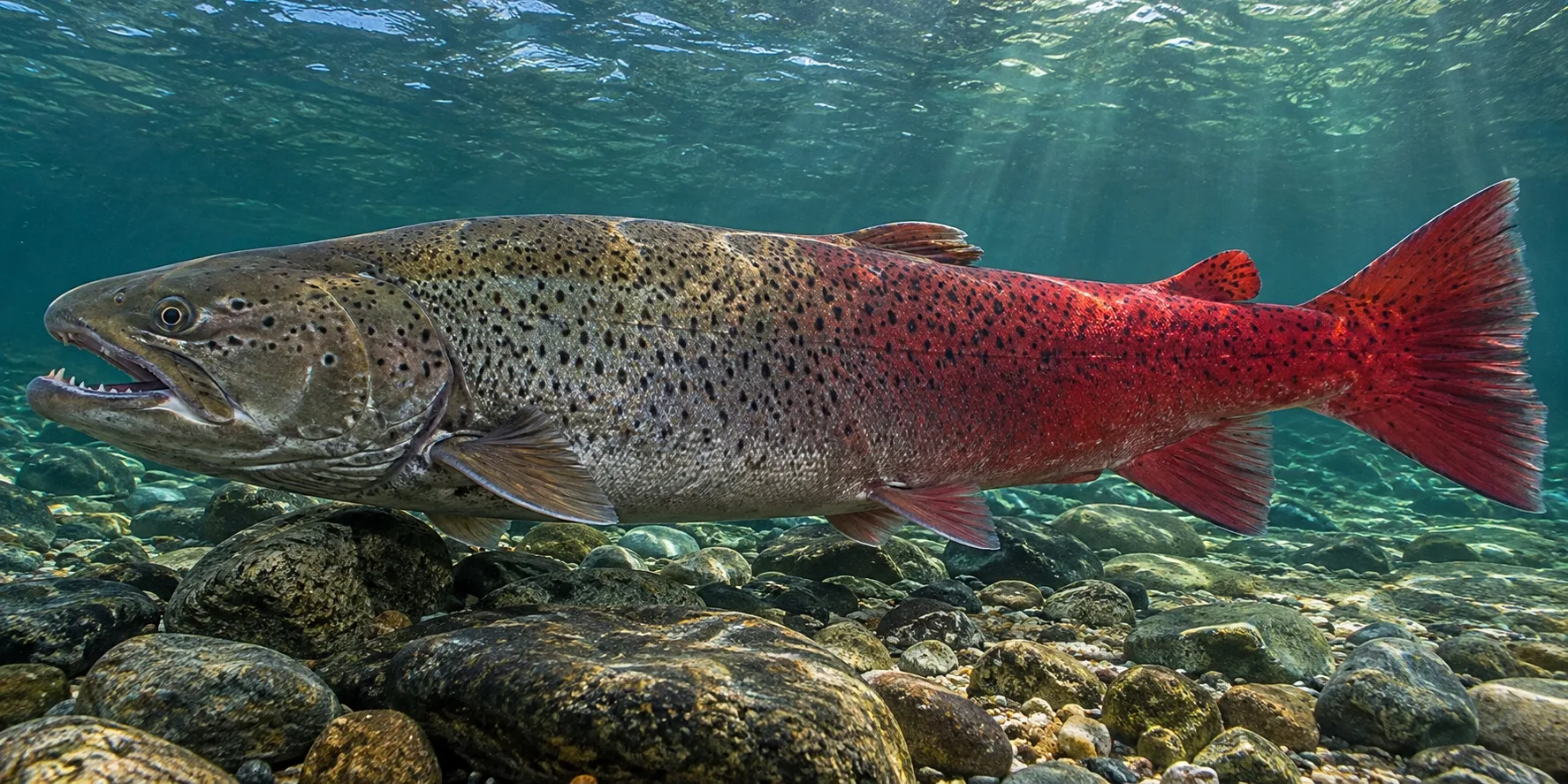
Adult taimen live in cold, oxygen-rich rivers of mountain and hill country, more rarely in lower reaches, cold lakes and reservoirs. They keep a fixed territory: deep pools below rapids and waterfalls, the mouths of small tributaries, spots behind large rocks or bridge piers and scoured banks. By day and in winter they rest in deep pools with little current. In the Eg and Uur rivers in northern Mongolia the territory averages 23 kilometres, and individual fish use almost 100 kilometres.
Holding spots in the picture
Choose the time of day: the picture shows where the species holds. We do not show German seasons for travel fish; the bars give the chance of a catch for each month. Tap a fish or a spot in the list to bring it closer. The picture is schematic and AI-generated, and every water is different.
Chance of a catch per month according to the catch calendar
- J
- F
- M
- A
- M
- J
- J
- A
- S
- O
- N
- D
Spawning season
Time of day By day the taimen mostly rests in deep, calm pools.
In the river
Undercut bank, overhanging branches, timber
The taimen is here all year round.
Slack water behind rocks
The taimen is here all year round.
Pools, deep spot
The taimen is here all year round.
Current seam
The taimen is here all year round.
In cold, oxygen-rich rivers the taimen holds a fixed territory that is often many kilometres long. Good spots are deep pools below rapids and waterfalls, the mouths of small tributaries, the shadow of big boulders or bridge piers, and washed-out banks. After the ice melts it moves up into the upper reaches of tributaries to spawn.
Size comparison: AI-generated drawing, schematic.
How it lives and spawns
Juveniles hold in fast current and eat drifting invertebrates, and after one to three years they switch to fish. Adults eat fish and land vertebrates. In the Eg and Uur the taimen sits at the top of a community of a few cold-water species, mainly lenok, Arctic grayling, minnow and Arctic cisco.
Spawning takes place in spring. Taimen form pairs weeks to months beforehand and then move upstream into the upper reaches of tributaries. The female digs a spawning redd 1 to 1.5 metres across on shallow gravel bottom with fast-flowing water, usually directly below deep pools. The eggs hatch after 28 to 38 days. In the Eg and Uur males become sexually mature at about four years and females at about five.
When and where the season is
The rivers of northern Mongolia usually freeze over at the end of November and thaw at the beginning of May. The taimen spawns after that, over large parts of the country clearly before mid-June. A study therefore recommended opening the fishing season only from the end of May to mid-June, depending on the region, so that the fish are protected while spawning.
The fishing season therefore lies between early summer and autumn. In July and August the rivers often carry clearly more water. In their field study the researchers fished in spring until the end of June or beginning of July and in autumn from the end of August to mid-October.
How to fish gently
Step by step: Fishing for taimen: tips on bait, rig and tackle – season, spots, bait, tackle and rules on one page.
On the Eg and Uur during the study almost only fly anglers fished, with strict release of all taimen and barbless single hooks. Under these conditions, according to the model, fishing reduced the stock by less than ten per cent.
If, on the other hand, all caught taimen were kept, as happens elsewhere in Mongolia, the probability of the stock disappearing for good would be 57 per cent. The authors warn that even more harmful tackle such as live baitfish or lures with several barbs can seriously endanger the stock.
Taimen also hunt small mammals. Researchers at the University of Wisconsin describe how the fish strike at small mammals at the surface.
Barbless single hook: Fish only with a single hook with the barb pressed down. Live baitfish and treble hooks with several barbs increase mortality after release.
Not during spawning: The fish spawn shortly after the ice melts. Fish only once the season in your region is open.
Suitable lures
Flies on a barbless single hook.
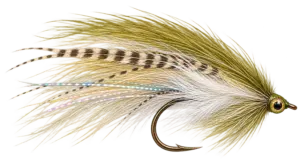
AI-generated illustrations. A click opens the lure’s page.
Vulnerable (IUCN): release gently, no live baitfish, observe the local rules.
Protection, licences and rules
The IUCN classes the taimen worldwide as vulnerable. In Mongolia, in parts of Russia, in Kazakhstan and in China it counts as threatened or endangered, and Mongolia lists it on its Red List of fish. The main causes are overfishing, poaching, mining, pollution and river engineering.
In Mongolia you need a permit to fish for taimen, and commercial catch is officially banned. According to a 2007 study the regulations give 15 June as the start of the season, but according to a 2009 study there was hardly any enforcement. In Russia the taimen of the European part, western Siberia (except the Altai Republic and the Tom in Kemerovo Oblast), the Angara basin with Lake Baikal and Sakhalin have been in the Red Book of the Russian Federation since 2020, where catching them is banned. Release every taimen, even where keeping one would be allowed. What counts is the current regulations of the responsible authorities in Mongolia or Russia, which you must ask about before every trip. As of October 2026.
Frequently asked questions (FAQ)
How big does a taimen get?
FishBase gives up to 200 centimetres and 105 kilograms. It needs at least ten years to reach a metre in length.
Is it allowed to fish for taimen?
In Mongolia only with a permit and only from the start of the season. In Russia catching it is banned where the stocks are in the Red Book, including in the European part, large parts of western Siberia and at Lake Baikal (as of October 2026). In waters such as the Eg and Uur in northern Mongolia it is caught on barbless single hooks and released. The local rules are what count.
When does the taimen spawn?
In spring after the ice melts, in Mongolia usually from May to early June, in many places before mid-June.
Sources
The rating of catch chances is an editorial assessment. The facts come from these sources, and the text is worded in our own words. The illustration is an original design by Angel Momente in the style of a natural history plate (AI-generated, see the AI notice).
- FishBase: Hucho taimen, Siberian taimen
- Jensen et al. 2009, Can. J. Fish. Aquat. Sci.: Evaluating recreational fisheries for an endangered species, taimen in Mongolia (Universität Wisconsin)
- Scientific Reports 2021: Hierarchical genetic structure and implications for conservation of the world’s largest salmonid, Hucho taimen (Volltext, Europe PMC)
- Ecology and Evolution 2019: Fish conservation in the land of steppe and sky (Salmoniden der Mongolei, Volltext Europe PMC)
- Vander Zanden et al. 2007, Ecological Applications: Modeling spawning dates of Hucho taimen in Mongolia (Abstract, Europe PMC)
- University of Wisconsin–Madison News: From Madison to Mongolia, the crusade for a giant fish
- Ministerium für Naturressourcen der Russischen Föderation: Prikas Nr. 162 vom 24.03.2020, Liste der Tiere im Roten Buch der Russischen Föderation (Nr. 175 Hucho taimen; Kopie in FAOLEX)
Created with AI support from the sources listed. Figures only appear in the text if a source gives them. Last updated: 27 October 2026. Found a mistake? Write to us. Who is behind this site: About me.
More in the lexicon
- All fish species at a glance
- Catch calendar – month, water temperature and profile for 93 species
- Line calculator – breaking strain after the knot, drag guideline, backing
- Angling methods