
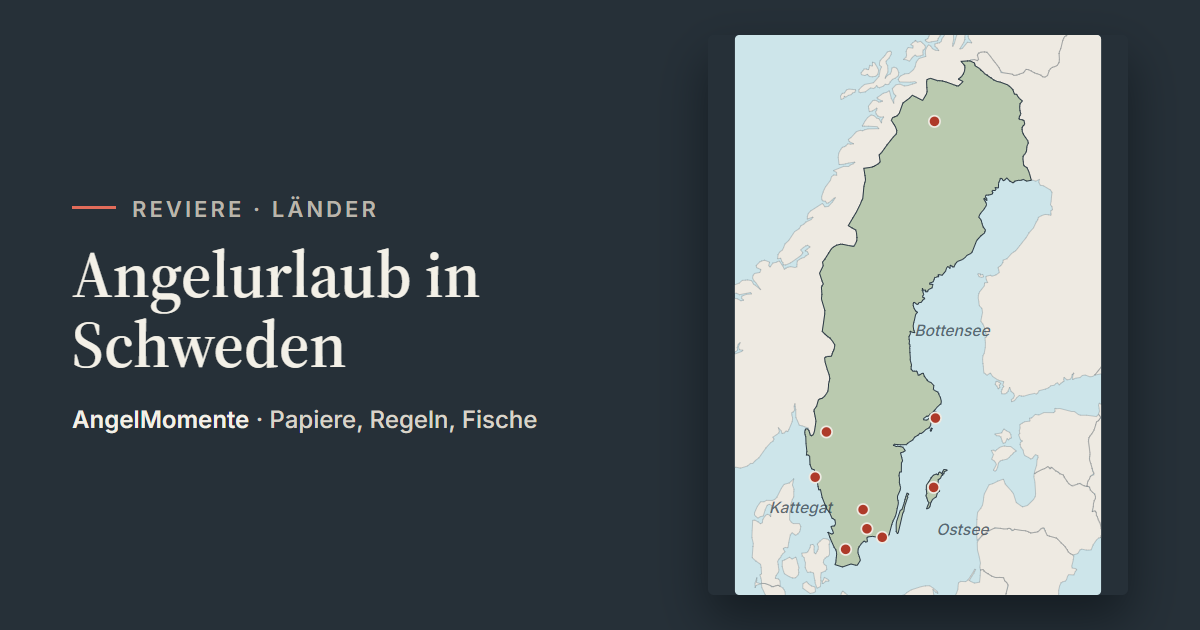
Fishing waters · Sweden
Fishing holiday in Sweden
An angling holiday in Sweden needs no fishing card on the coast and in the five largest lakes as long as you fish with hand tackle. For all other waters you need the permission of the rights holder.
- Rivers
- 3.125
- Streams
- 6.262
- Lakes and reservoirs
- 47.746
- Canals
- 161
- Regions in the water atlas
- 21
As of October 2026 · waters with a name in OpenStreetMap, as of 3 October 2026
The key points in brief
Without a fishing card
The coast and the five largest lakes, hand tackle only, for guests from abroad too.
All other waters
fiskekort or permission from the rights holder.
Baltic 2026
Cod is banned, and as a rule you may take one salmon per day with a clipped adipose fin.
Eel and wels catfish
Eel is banned in the sea and almost everywhere in fresh water, wels catfish everywhere.
Lobster
only for Swedes and people permanently resident in Sweden, guests fish with hand tackle only.
Right of public access
The allemansrätten does not cover fishing (Naturvårdsverket).
As of October 2026. Sizes, closed seasons and protected areas change and differ locally. The linked regulations are authoritative, not this overview.
Which papers where?
On the left is where you fish, on the right what you need for it. The details are further down this page.
- The coast and the five largest lakesNo fishing permit, but hand tackle only. This also applies to guests from abroad.
- All other watersFiskekort or permission from the rights holder.
Find fishing ponds
21 angling ponds and 0 fish farms offering fishing for guests in Sweden, 19 of them individually confirmed. Enter a postcode or place and the pond finder sorts all sites by distance. All 6 checked fish farms, including those without fishing, are in the fish farm finder.
At sea
Sizes and catch limits on the coast
For hand tackle on the coast, only the sizes for pike, zander, grayling, salmon, sea trout and cod apply (the authority’s table). The sizes for plaice and flounder concern other gear. Perch has no minimum size in the Baltic.
Baltic and the Gulf of Bothnia
- Pike: 40 to 75 cm in the Baltic up to Bottenviken (Pike in the Baltic). FIFS 2004:36 is authoritative and draws the boundary at the county border between Västernorrland and Västerbotten.
- Salmon: 60 cm.
West coast with the Skagerrak and the Kattegat
- Salmon and sea trout: 45 cm each, two fish together per day and angler (Salmon).
Regions and waters
Individual coasts, lakes and rivers have their own profiles: where they are, which fish are documented there, and which protected areas and rules apply locally.
West coast: Bohuslän and Halland
Skagerrak and Kattegat, fjords and skerries
Scania and the Øresund
South coast, the Sound and the border at Kullen
Blekinge skerries
Baltic coast in the south, no fishing in private waters that requires a boat
Mörrumsån
Salmon and sea trout, with hand tackle from 1 March to 30 September
Småland
Inland lakes with fiskekort, on the coast the Kalmarsund
Gotland
Coast with a spring closed season (Schonzeit) for pike and perch
Stockholm archipelago
Brackish water with pike, perch and zander
Vänern and Vättern
The two largest lakes with salmon, trout and char
Lapland
Fjäll with a fishing card and the Torne älv on the border
Location maps: AI-generated, outlines from Natural Earth (public domain)
Fishing without a fishing licence
On the sea coast and in Vänern, Vättern, Mälaren, Hjälmaren and Storsjön in Jämtland you need neither a fishing licence nor a fishing card for a rod and pilker. This applies in public and private waters alike (Länsstyrelsen Stockholm, Svenska fiskeregler). Foreigners have the same rights as Swedes here (Fiskelag, § 13).
- Water is generally private up to 300 m from the shore (Havs- och vattenmyndigheten).
- In the private waters of the five lakes, on the Baltic coast from Östhammar to Blekinge and around Gotland, the method must not require a boat (Fiskelag, annex). This mainly affects trolling.
- Nets and traps are not freely permitted for guests without residence in Sweden, and they may not set a lobster pot at all.
- Länsstyrelse Skåne summarises the rules in a leaflet in German.
Fiskekort: the fishing permit for lakes and rivers
In all other lakes and rivers you need the permission of whoever owns the fishing right. You usually buy a fiskekort for this, otherwise you ask the rights holder directly (Havs- och vattenmyndigheten). Which fisheries management areas (fiskevårdsområden) exist and where they issue permits is shown by fiskekartan.se, which the fisheries authority (Fischereibehörde) refers to. See also Fishing permit and water map.
- Buy online: For the state waters in the Fjäll, the Länsstyrelser point to online sales through NatureIT, and there are also outlets on site (Länsstyrelsen Norrbotten, Länsstyrelsen Dalarna). You can load the permit onto your phone; a printout helps where there is a poor signal.
- Children: In the state Fjäll waters of Jämtland and Dalarna, an adult’s permit also covers accompanying children under 16 (Länsstyrelsen Jämtland, Länsstyrelsen Dalarna). In Västerbotten, children up to 16 fish there free of charge if an adult with a permit is present (Länsstyrelsen Västerbotten). On other waters, ask whoever issues the permit.
- Rules: Closed seasons (Schonzeiten) and other rules for a lake or river are printed on its fishing permit. It is your own responsibility to know them (Länsstyrelsen Skåne).
When you need a fiskekort: three steps
Whether you need a fishing permit depends on the water, not on where you live. This is how I check it before the trip:
- Sea or large lake: On the coast and in the five large lakes, hand-held gear without a permit is enough. The details are above under “Fishing without a fishing licence”.
- All other waters: Public water (allmänt vatten) essentially exists only on the coast and in the large lakes, in each case from 300 m off the mainland (Havs- och vattenmyndigheten). Small lakes, streams and rivers are therefore as a rule private water (enskilt vatten). The fishing rights there belong to the landowner (Fiskelag, § 9), and you need their permission.
- Finding the issuer: The county administrative board (Länsstyrelse) lists waters, rules and permit sales on its fishing page. Local rules are often also on the pages of the municipality (kommun). The fisheries authority links to all counties on its recreational fishing page.
Right of public access when fishing
The right of public access (allemansrätten) does not allow you to fish as such. But it does allow you to cross other people’s land to get to the water (Naturvårdsverket). There are limits to this that often matter when fishing:
- Distance from houses: Around homes and holiday houses lies the private zone (hemfridszon), and you have no business there without permission. There is no fixed number of metres; often a fence, hedge or path marks the boundary. Someone who stays put and fishes is more of a disturbance than someone walking past, and so keeps a greater distance (Naturvårdsverket: hemfridszon).
- Boat and jetty: You may land and anchor at a shore outside a property, and briefly use a jetty there. If the owner needs the jetty, you make room. Jetties and boathouses that belong to a property are private (Naturvårdsverket: on the water).
- Launching a boat: The right of public access does not cover launching a boat with a car and trailer. For that you ask the landowner.
- Car: Driving and parking off-road are prohibited, including on the beach, in the forest or on the meadow by the shore. The Off-Road Driving Act (terrängkörningslagen) applies even to the owner; they cannot permit it for you (Naturvårdsverket: vehicles).
- Tent: You may pitch a tent for a short time; one night is the rule of thumb. For several nights or a group with several tents you need the landowner’s consent.
- Fire: There is no fixed right to a campfire. Whether a fire ban (eldningsförbud) is in force you can find out from the Länsstyrelse or the municipality (Naturvårdsverket: fire).
- Protected areas: National parks and nature reserves can have their own bans, for example on boats, dogs or fire. The Länsstyrelse tells you when you may not enter bird and seal sanctuaries (Naturvårdsverket: protected areas).
- At the water: Take line remnants and hooks away with you. Deliberately obstructing or disturbing others while they fish is prohibited.
What counts as hand tackle
- Hand tackle means a rod, pilker or similar gear with a line and no more than ten hooks (Fiskelag, § 7).
- Snagging is prohibited (FIFS 2004:36).
- When trolling in the public waters of the large lakes, no more than ten lures per boat are allowed (FIFS 2004:37).
Closed seasons and fishing bans
- Cod in the Baltic: banned in 2026 in subdivisions 22 to 32, including the Öresund. Only in subdivisions 27 to 32 may unintended bycatch be kept (Verordnung (EU) 2025/2454, Artikel 10).
- Salmon in the Baltic: One salmon with a clipped adipose fin per person and day may be kept, after which salmon fishing ends for the day. Retained fish stay whole until landed. North of 59°30′ N, salmon fishing from 1 May to 31 August within four nautical miles of the coast is allowed without these conditions (Article 11). When trolling, every salmon with an adipose fin goes back all year round (FIFS 2004:36).
- Salmon and sea trout: closed on the west coast from 1 October to 31 March, between Kullen and Torhamn from 15 September to 31 December, in the Bottenviken from Nordmaling from 1 October to 31 December (the authority’s closed seasons).
- Pike and perch: from 1 March to 31 May on the coast of Gotland and in the Kalmarsund and around Öland. Between the north of Uppsala län and Kalmar län, protected areas for pike are added. For lakes and rivers outside the five large lakes, ask whoever issues the fiskekort whether a closed season applies.
- Cod on the west coast: from 1 January to 31 March inside the trawl limit of the Skagerrak and Kattegat.
- Flatfish: flounder from 15 February to 15 May in subdivisions 26 to 28 and 29 South, halibut on the west coast from 20 December to 31 March.
- Eel: Banned at sea since 2007 (Eel). The ban applies in fresh water as well. Exceptions are individual waters above named migration barriers, where every eel under 70 cm goes back (FIFS 2004:37).
- Wels catfish (mal) may not be fished for in Sweden (Fischereiverordnung, Kap. 2 § 5).
Anything too small, too large, protected or over the daily limit goes straight back, alive or dead (Svenska fiskeregler). See Releasing fish.
Protected areas at river mouths
Off many river mouths there are protected areas (fredningsområden). On the west coast, fishing there is suspended from 1 October to 31 March. In the Gulf of Bothnia (subdivisions 30 and 31), all fishing within 200 m of the mouth is banned from 1 September to 31 December, unless the river has rules of its own. Locations and dates are shown on the map from Svenska fiskeregler.
Lobster, crayfish, baitfish and crayfish plague
- Only Swedish citizens and people with a permanent residence in Sweden may catch lobster. The season starts on the first Monday after 20 September at 7 a.m., so on 21 September in 2026, and ends for recreational anglers on 30 November. Only the lobster pot is allowed, no more than six per person (Havs- och vattenmyndigheten).
- The general public may catch crayfish only in Vättern: on three weekends from the fourth Friday in August, no more than 60 crayfish per person and day. Otherwise the rights holder decides (Havs- och vattenmyndigheten).
- You may move fish to another water only with the permission of the Länsstyrelse (Fischereiverordnung, Kap. 2 § 16).
- Take your baitfish from the same water or freeze it for at least a day (the authority’s page on crayfish plague). In plague and protected areas, baitfish from other waters is banned.
- Disinfect your tackle, boat and waders before every move to another water, as the fisheries authority requires. The regulation prescribes this for crayfish gear, and in plague and protected areas for all gear.
Taking fish home
You may not sell fish caught at sea; this ban does not apply to lakes and rivers (Havs- och vattenmyndigheten). Anyone fishing for salmon in the Baltic lands all retained fish whole (Verordnung (EU) 2025/2454, Artikel 11). In the five large lakes this applies to every fish of minimum size (Mindestmaß), as set out in FIFS 2004:37. So only fillet on land. Länsstyrelse Skåne asks you to catch only as much as you can eat with your family.
At German customs, goods from an EU country stay duty-free if they are intended for personal use (zoll.de). Conversely, you may not bring live or uncooked freshwater crayfish into Sweden. How to cool and store fish is covered under Storage and hygiene.
In the boat
- At the helm, the limit is 0,2 per mille on boats that do 15 knots or more or are at least 10 m long (Sjölag, Kap. 20 § 4).
- Everyone on board should have a life jacket of the right size (Transportstyrelsen).
- Sweden requires a skipper’s certificate for boats over 12 by 4 m (Transportstyrelsen).
More on this: Boat and life jacket.
The parts of the country
- West coast with Skagerrak and Kattegat: In Svinesund and Idefjord on the Norwegian border, no more than two rods per person are allowed for salmon and sea trout.
- Southern Sweden and Scania: The Öresund counts as part of the Baltic, so the cod ban applies. Information from the Länsstyrelse: Fishing in Scania.
- East coast with skerries: In the Stockholm skerries, fishing in 62 bays is banned in spring, in nine of them all year (Länsstyrelsen Stockholm).
- The large lakes: In Vänern only salmon and trout with a clipped adipose fin may be kept, three per day in total. In Vättern it is three fish from salmon, trout and char. Zander must be at least 45 cm in Vänern, Vättern, Mälaren and Hjälmaren.
- Norrland and Lapland: In the Fjäll you need a fishing permit (Erlaubnisschein) for the state waters. In Norrbotten, 35 cm applies there for trout and grayling, and five fish per day in total.
Related
- Water atlas: Sweden: all rivers, streams and lakes on one map
- Find fishing ponds in Sweden: put-&-take waters and fish farms by postcode, province and fish species
- Other countries: Norway, Denmark, Poland and Germany
- Fishing on a lake, Fishing on the coast and in the surf and Fishing from a charter boat and a boat
- Spinning and sea fishing with Drop-shot rig and Natural bait rig
- Closed season and minimum size, bank and waders and Thunderstorms and weather
- Catch calendar
Sources
- Svenska fiskeregler: Regeldienst mit Karte (abgerufen 04.10.2026) und Recht zu angeln im privaten Wasser
- Havs- och vattenmyndigheten: Regeln für die Freizeitfischerei, Maße, Schonzeiten, Hummer und Eel (abgerufen 04.10.2026)
- Fiskelag (1993:787) und Verordnung (1994:1716) über die Fischerei
- FIFS 2004:36: Fischerei in Skagerrak, Kattegat und Ostsee (Fassung 01.07.2026) und FIFS 2004:37: Süßwasser (Fassung 12.06.2026)
- Verordnung (EU) 2025/2454: Fangmöglichkeiten Ostsee 2026
- Länsstyrelser: Stockholm, Skåne (Faltblatt „Angeln in Skåne“), Norrbotten, Jämtland, Västerbotten und Dalarna
- Sjölag (1994:1009) und Transportstyrelsen: Rettungsweste
- Naturvårdsverket: Jagd und Fischen im Jedermannsrecht (19.06.2025) und Zoll: Reisen innerhalb der EU
- Naturvårdsverket: hemfridszon (28.05.2026), auf dem Wasser, Fahrzeuge im Gelände, Feuer (26.05.2026) und Schutzgebiete
Guide without guarantee, as of October 2026. The Swedish regulations and EU regulations in their current versions are authoritative.