
Fishing waters · Sweden
Fishing in Småland
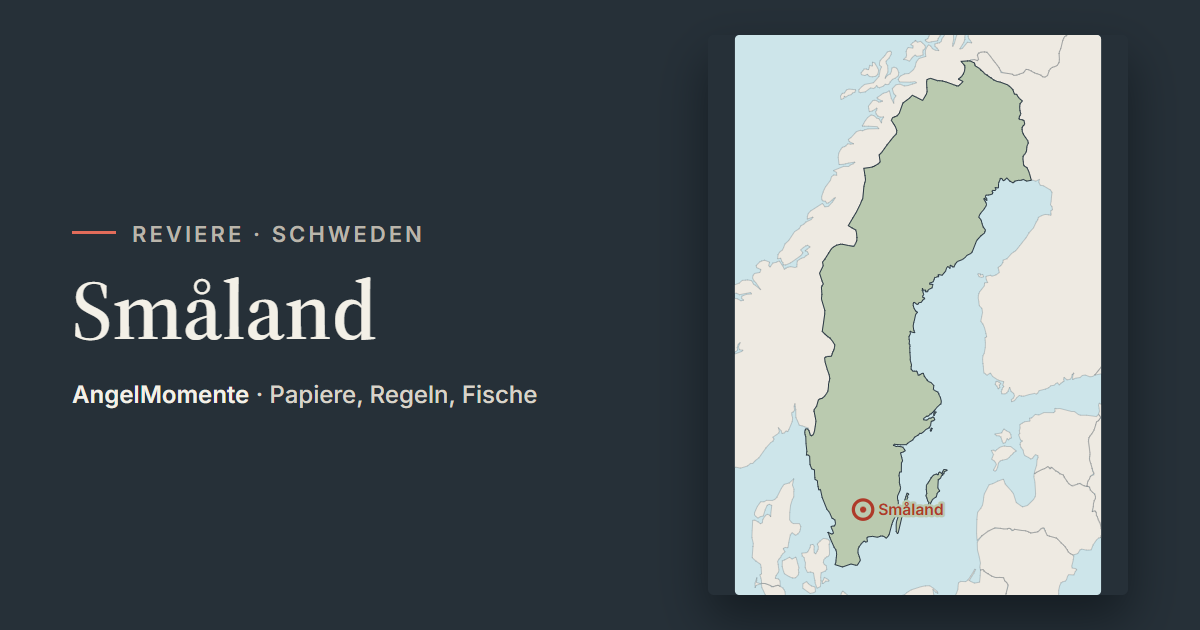
Småland is the lake district in the south of Sweden. In the counties of Kronoberg, Jönköping and Kalmar, pike, perch and zander live in thousands of lakes. Unlike on the coast, you need a fishing permit from the rights holder almost everywhere here.
- Papers
- fiskekort from the fishing club or permission from the rights holder
As of October 2026
At a glance
- Papers
- fiskekort from the fishing club or permission from the rights holder
| Fish | Minimum size | Closed season | Note |
|---|---|---|---|
| Pike | – | none | no nationwide rule; size and closed period are set by the fishing club |
| Perch | – | none | no nationwide rule; local rules on the fiskekort |
| Zander | – | none | local rules on the fiskekort; in the Vättern 45 cm |
| Bream | – | none | local rules on the fiskekort |
| Wels catfish | – | protected all year round | targeted fishing banned |
| Eel | – | protected all year round | Exception in waters listed in Annex 6 of FIFS 2004:37: from 70 cm, not for sale |
Swedish national law (FIFS 2004:37, Fischereiverordnung 1994:1716). On the lakes the rules of the fishing club on the fiskekort also apply. Correct as of October 2026. What counts are the regulation and your fishing permit (Erlaubnisschein).
Location and waters Bolmen, Åsnen, Möckeln and the lakes in the highlands
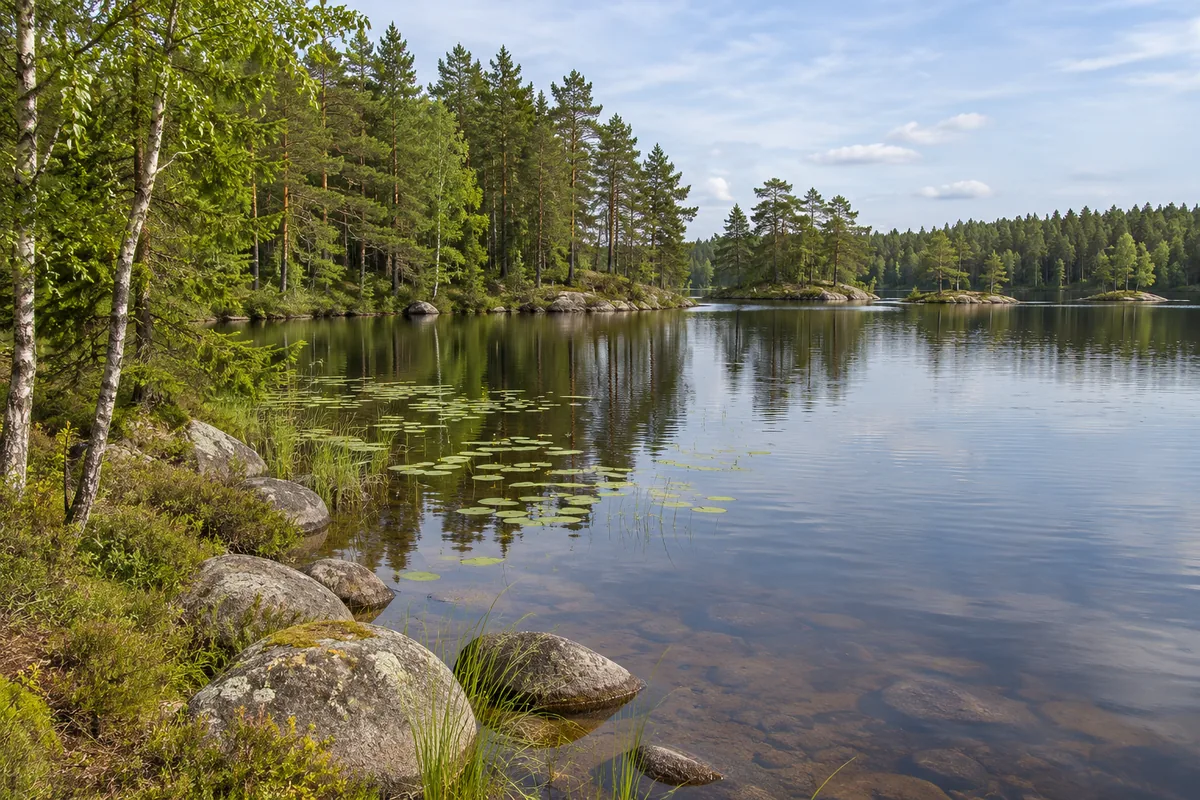
On the Småland highlands lie many large lakes, and on its slopes many small ones. Towards the east, on the plain around Kalmar, lakes become rare (SMHI). Kronoberg has around 1200 lakes larger than one hectare, Jönköping more than 2000. The typical lake in Kronoberg is rather low in nutrients, slightly brown and surrounded by forest. Its most common fish is the perch (Länsstyrelsen Kronoberg).
- Bolmen: At 173 km² it is one of the largest lakes in the country. It lies on the border of Kronoberg, Jönköping and Halland, is up to 36 m deep and has several hundred islands. Through a tunnel it supplies drinking water to Scania (Länsstyrelsen Jönköping).
- Åsnen: A national park since 2018, three quarters water. The lake forms an inland archipelago with around a hundred large islands and small skerries (Sveriges nationalparker).
- Möckeln: Most of the wels catfish of Kronoberg live here, by one estimate about 600 of roughly 800 animals. Kronoberg is one of only three areas in Sweden where the wels catfish still occurs.
Fish and the best time Pike, perch and zander
In the county of Jönköping, pike, perch and zander are among the most important species for anglers (Länsstyrelsen Jönköping). For Kronoberg the Länsstyrelse describes the three species as follows:
- Pike: It lives in almost all waters. After spawning it bites well from April to mid-June, usually worse in high summer and better again in autumn. In winter it is also caught from the ice.
- Perch: Of 348 lakes surveyed it was missing in only four. It takes most methods all year round.
- Zander: It is not native here and comes from stocking. Today it lives in 80 lakes with about 60 per cent of the lake area and bites best in warm water. In the Bolmen it made up the largest part of the fish biomass in a test fishing in 2012.
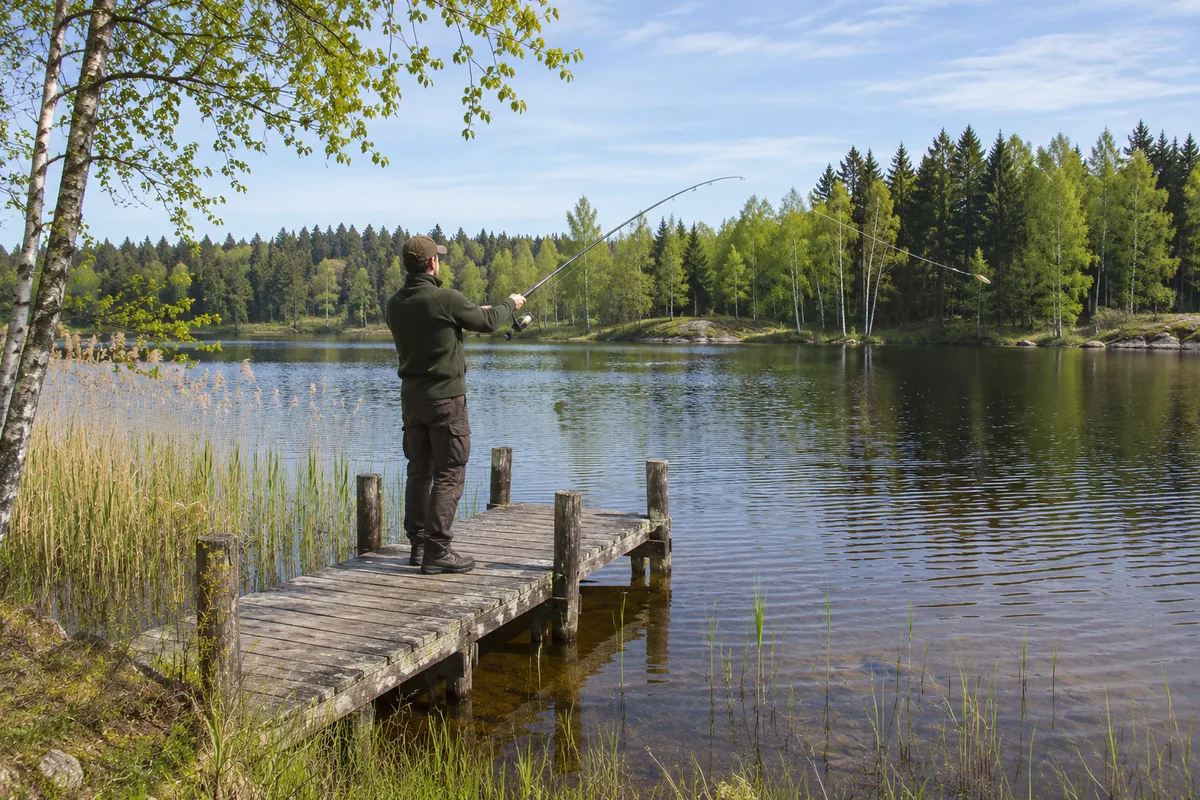
The catch calendar shows the year for other species. You can hire a boat in many places, and the details are usually on the fishing club’s page. On the Åsnen you can borrow canoes and boats (Nationalpark Åsnen: Bootstouren).
Papers and permit A fishing permit (fiskekort) for every lake
In Sweden you may fish freely with a rod only on the coast and in the five big lakes. In all other lakes you need the permission of the rights holder, usually as a fishing permit (fiskekort). If there is no card, you ask the rights holder directly (Länsstyrelsen Kalmar). The fiskekort is therefore your fishing licence for that one water. In fresh water the same rules apply to visitors from abroad as to Swedes.
- Fishing club: The rights holders of a lake usually form a fishery conservation area (fiskevårdsområde) with its own club, which sells the cards. Kronoberg has 148 such clubs, Jönköping 214. Many sell online.
- Who is responsible: The boundaries of all areas, the fish species and links to the card sellers are shown on fiskekartan.se, the register of the Länsstyrelser (Länsstyrelsen Kronoberg).
- Exception Vättern: In the county of Jönköping it is the only place where you need no permit. What applies on the Vättern is covered under Vänern and Vättern.
Special rules Rules of the fishery conservation areas, wels catfish protected
For pike, perch and zander in these lakes there is no nationwide minimum size (Mindestmaß). Often, however, the rights holders themselves set sizes, fishing times and protected areas, and you must find out about them beforehand (Länsstyrelsen Kalmar). Each fishery conservation area has its own rules: closed periods, minimum sizes, catch limits and permitted methods. Nationwide the following also applies:
- Wels catfish: It is protected throughout the country, and you must not fish for it deliberately (Fischereiverordnung 1994:1716).
- Eel: Fishing in fresh water is banned. Exceptions apply above certain barriers to migration, which Annex 6 of the regulation FIFS 2004:37 lists. There you may keep eels from 70 cm for yourself, not for sale.
- Bait fish: Against crayfish plague the authority recommends taking bait fish from the same water or freezing it first for at least a day (Havs- och vattenmyndigheten). You may release fish only with the permission of the Länsstyrelse.
- Åsnen National Park: From 1 April to 31 July you must not enter the north of the islands of Bergön and Södra Aspö or many other islands. Signs on site show the boundaries.
- Coast near Kalmar: The rules of the Baltic Sea apply here. In the Kalmarsund pike and perch are protected from 1 March to 31 May. More under Blekinge and the archipelago.
Correct as of October 2026. The fishing clubs change the local rules themselves. What counts is what is written on your fiskekort. If something is missing there, ask the seller of the card.
Safety
Perch, pike, zander and burbot can contain a lot of mercury. Pregnant women, breastfeeding mothers and anyone planning a child should eat them no more than two to three times a year, everyone else no more than once a week. Values for individual lakes are known to the Länsstyrelse and the municipality (Livsmedelsverket). In a boat everyone should wear a lifejacket of the right size (Transportstyrelsen). More under Boat and lifejacket.
Related
- Fishing on lakes, fishing holiday in Sweden and the neighbours Scania and the Øresund and Blekinge and the archipelago
- Pike, perch and zander in the fish encyclopaedia
- Fishing permit and water map and releasing fish
Sources
- Länsstyrelsen Kronoberg: Fiskar och fiske i Kronobergs län (2019) und Fiskevårdsområden
- Länsstyrelsen Jönköping: Fiske, Fiskevårdsområden und Nätprovfiske i Bolmen 2012
- Länsstyrelsen Kalmar: Fiske und das Register fiskekartan.se der Länsstyrelser (abgerufen 04.10.2026)
- Havs- och vattenmyndigheten: FIFS 2004:37 (Fassung 12.06.2026) und Krebspest; Förordning 1994:1716
- Sveriges nationalparker: Åsnen, SMHI: Sveriges sjöar, Livsmedelsverket: Kvicksilver und Transportstyrelsen: Flytväst
A guide without guarantee, correct as of October 2026. What counts are the Swedish fisheries regulations, in particular FIFS 2004:37, the fisheries ordinance and the rules on the fiskekort of the fishery conservation area concerned, in their current version.