
Knowledge – Fish
Pike: Features, swims, bait and leader
The pike (Esox lucius) is an ambush predator of the bank zones and is widespread in fresh and brackish water of the northern hemisphere. It stands motionless under cover and strikes in a flash. In 2016 it was Fish of the Year in Germany.
In short: The best time to catch pike is from October to December, especially in the morning and evening. Good spots in a lake: a reed edge, a weed bed and a sunken tree; in a river: a quiet bay and an undercut bank. Proven baits: lures for spinning or a dead baitfish. Step by step: Pike fishing.
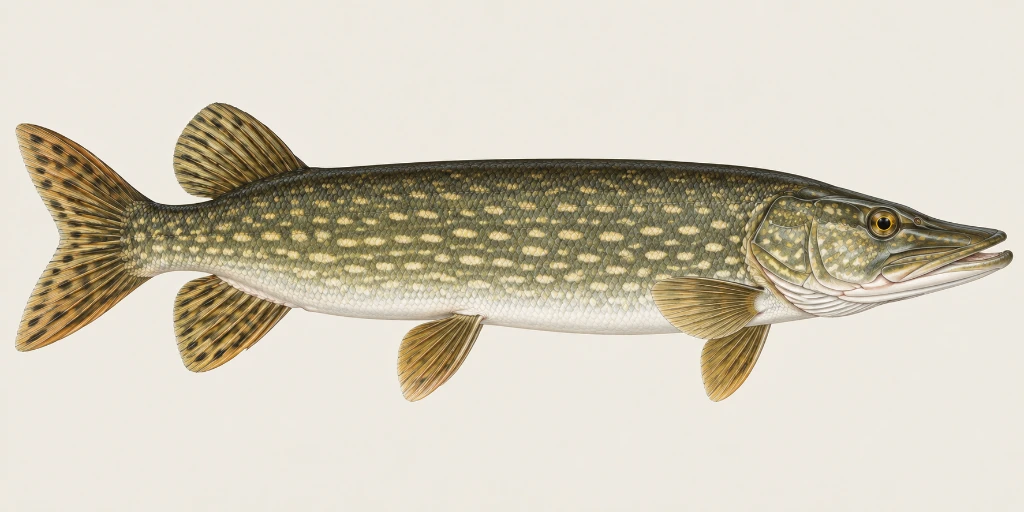
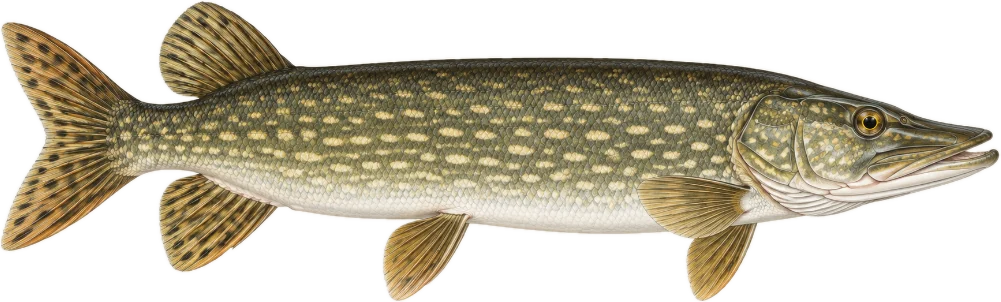
- Duck-bill-like, superior mouth with fangs and brush-like teeth
- Dorsal and anal fins set far back
- Back greenish-brown, getting lighter towards the white belly
Catch chances through the year
- Hardly any chance
- Possible
- Good
- Peak season
- Spawning (observe the closed season)
Editorial assessment for waters in Germany, not a measured value and no guarantee. Spawning time is not the same as the legal closed season.
Species profile and sources in the catch calendarAll species compared month by monthThe rules of your federal state
How to recognise a pike
The body is elongated and almost cylindrical, the head flat, the mouth duck-billed and upturned. The dorsal and anal fins are set far back and stand almost opposite each other, and all fins are supported only by soft rays.
There are over 700 sharp, backward-pointing teeth in the mouth. Those in the upper jaw can be folded down, so that hardly any prey escapes. The colouring adapts to the water: it varies between yellow-green, olive and brownish tones, with pale spots or stripes across the body. The belly is white. Young pike glow bright green and are called grass pike.
Pike rarely grow longer than 130 centimetres, and only females manage that, at weights of over 20 kilograms. Males mostly stay under one metre. The Landesfischereiverband Bayern gives an average of 50 to 80 centimetres, and 70 to 140 for females. FishBase gives 30 years as the highest reported age.
Pike or zander?
| Feature | Pike | Zander |
|---|---|---|
| Dorsal fins | one, far back | two, the front one with spiny rays |
| Mouth | duck-billed and upturned, over 700 teeth | terminal, gape reaching to the back edge of the eye, large fangs |
| Colour | yellow-green to brownish with pale spots or cross stripes | greenish grey with blurred dark cross bars |
In native fresh water the pike is hard to mistake: the long, flat snout, big mouth and far-back dorsal fin do not, according to FishBase, occur in this combination in any other European freshwater fish. The nearest thought is the zander, which however has two dorsal fins and a pointed head. In southern France and Italy there are pike species of their own.
Side by side

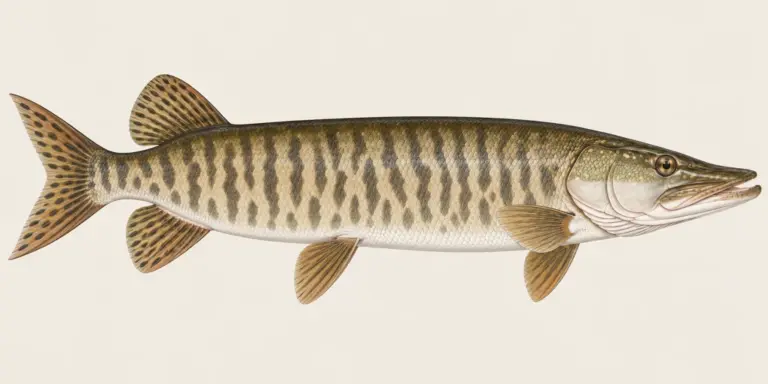
AI-generated illustrations.
Where the pike holds
The pike is undemanding. Its main habitat is the weedy zones of still and slow-flowing waters. It colonises almost all still waters and occurs in rivers up to the grayling region, there at calm banks. In the mountains it climbs to 1.600 metres. As a site-faithful loner it stands motionless among water plants, in water lilies and at sunken trees, but also at jetties and sailing boats. It likes to stand where the monotony of the bottom is broken, for example at a perch hump or a depression.
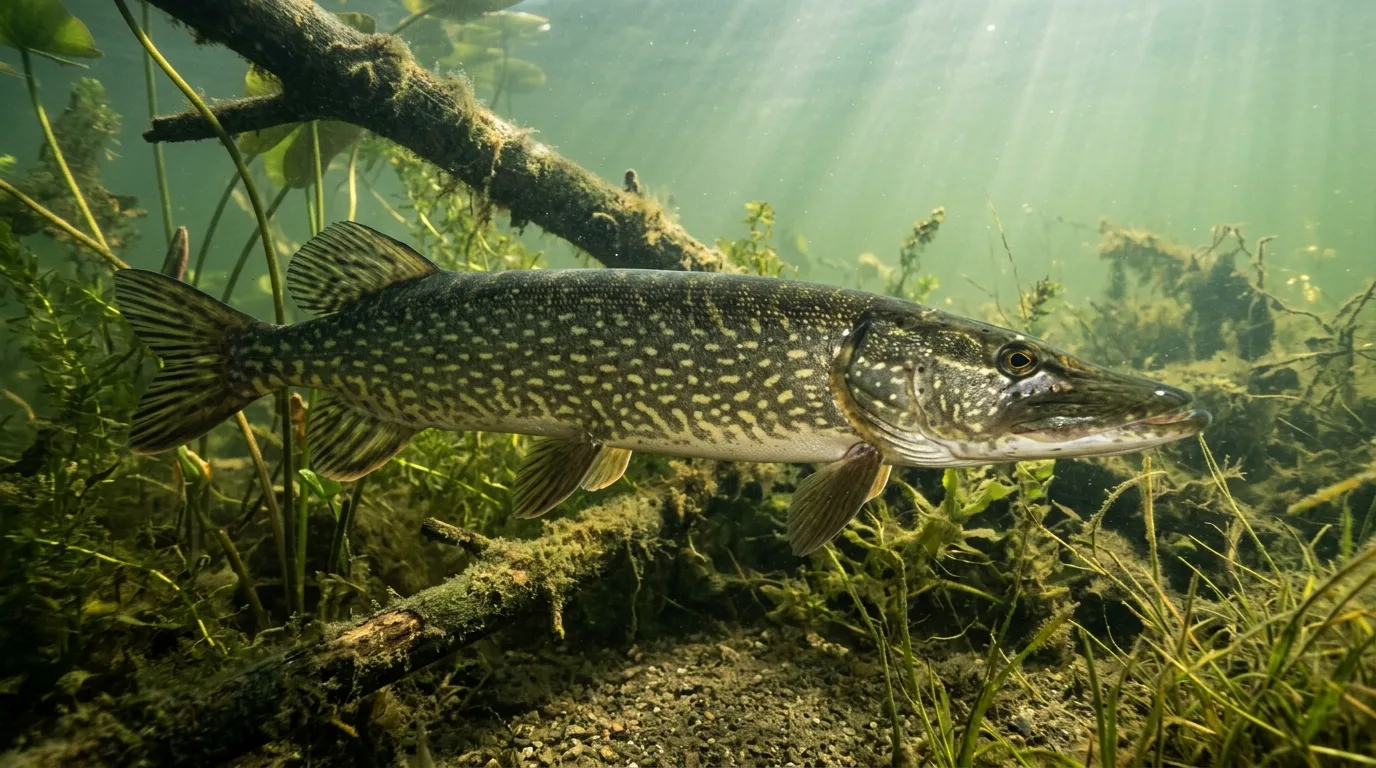
In deep lakes some big pike live in open water and follow shoals of whitefish. A LAWA report gives the upper lethal temperature of adult pike as 34 °C, the DAFV brochure as 29,4 °C.
It also tolerates brackish water: it can reproduce successfully up to a salinity of 7 parts per thousand. In the lagoons of Mecklenburg-Western Pomerania, which contain less than 8 parts per thousand of salt on average, pike grow very fast according to IGB studies. There live resident lagoon pike all year round, migratory pike that run up into tributaries to spawn, and transitional pike. More on these waters under Fishing in lagoons and fjords.
Holding spots in the picture
Choose the season and time of day: the picture shows where the species stands then. Spots outlined in red apply only in the chosen season. Tap a fish or a spot in the list to bring it closer. The picture is schematic and AI-generated, every water is different.
Catch chance in springpossibleSpawning season, observe closed seasons
Catch chances in summerpossible
Catch chance in autumnPeak season
Catch chance in wintergood
- J
- F
- M
- A
- M
- J
- J
- A
- S
- O
- N
- D
Spawning season
Active time The chance of a catch is highest at dusk and dawn.
Not a prime time The chance of a catch is highest at dusk and dawn.
Active time The chance of a catch is highest at dusk and dawn.
Not a prime time The chance of a catch is highest at dusk and dawn.
In the lake
reed edge
Pike are found here all year round.
Water lilies and weed bed
Pike are found here all year round.
jetty, sheet piling, harbour
Pike are found here all year round.
Sunken tree
Pike are found here all year round.
Open water
Pike are found here only in summer.
plateau, underwater hump
Pike are found here all year round.
The pike lurks as a loner in cover: at reed edges, among water lilies and water plants, at sunken trees, under jetties and wherever rises or hollows break up the bottom. In some lakes large pike move out into open water.
Spring: catch chance according to the catch calendar possible. This is when the spawning season falls, so observe the closed seasons (Schonzeit). From the end of spawning until mid-June the pike feeds most.
Summer: catch chance according to the catch calendar good in June, possible in July and August. In high summer the hunger fades. From June many large pike leave the cover along the bank and move into open water, mostly at 2 to 5 metres‘ depth. Baits are then offered in mid-water.
Autumn: catch chance according to the catch calendar good in September, main season in October and November. Hunger rises again, with a second peak in October. Baits now run just above the bottom.
Winter: catch chance according to the catch calendar main season in December, good in January, possible in February. The colder the water, the more sluggish the pike.
In the river
Undercut bank, overhanging branches, timber
Pike are found here all year round.
Calm bay with aquatic plants
Pike are found here all year round.
In a river the pike keeps to the bank zones of slow-flowing stretches: quiet bays with water plants and sunken wood at the bank.
Spring: catch chance according to the catch calendar possible. This is when the spawning season falls, observe closed seasons.
Summer: catch chance according to the catch calendar good in June, possible in July and August.
Autumn: catch chance according to the catch calendar good in September, main season in October and November.
Winter: catch chance according to the catch calendar main season in December, good in January, possible in February.
Size comparison: AI-generated drawing, schematic.
How it hunts and spawns
The pike feeds mainly on fish, including its own kind, plus waterfowl, frogs and small mammals. From a size of 2 to 4 centimetres it switches from zooplankton to fish fry. From cover it briefly accelerates to up to 4 metres per second. The Anglerverband Niedersachsen calls it a sight hunter with very mobile eyes and a wide field of view. Pike often overestimate themselves and grab fish they can hardly swallow.
Spawning takes place in spring, from February to May depending on water temperature. As early as late autumn the milters push into the females‘ territories and fight over them. The eggs stick to water plants in weedy bank zones and on flooded meadows, about 40.000 per kilogram of the female’s body weight. The larvae hatch after 10 to 30 days. If water plants are missing, reproduction can fail altogether. After about three years pike measure around 50 centimetres and weigh just under a kilogram.
When it bites
According to Blinker the pike eats half of its annual food in spring, between the end of spawning and mid-June. In high summer its appetite falls, from September it puts on winter fat, and in October there is another peak. In January it still bites well, but more sluggishly than in autumn: the colder the water, the more sluggish the pike.
The DAFV summarises studies from Brandenburg: at low water temperatures and strong wind catches were highest, and dusk was especially productive. Air pressure and rain had no significant influence. The greatest influence came from fishing pressure before the fishing day. Over the year catches were high in autumn and spring and tended to fall in summer.
Today’s catch index needs JavaScript. Season and spawning time are in the catch calendar.
You will find the monthly overview of all species and the water temperature check in the catch calendar.
From the blog: Fishing in November: which fish bite now and where I look for them · Fishing spots in autumn: where I cast the spinning rod first · Pike follows right to the bank: what to change before your next cast
What you catch it with
Step by step: Pike fishing: tips on bait, rigs and tackle – season, swims, bait, tackle and rules on one page.
In spinning jerkbaits, swimbaits and streamers are among the best lures, along with spoons, plugs and soft plastics. In controlled trials soft plastics caught more pike in the long run than a classic spoon. Lures over 15 centimetres brought larger, mostly legal-sized pike, and the bigger the lure, the less often the hook sits deep in the throat or gills.
The colder the water, the slower and deeper you work the lure. Big lures catch in the cold, small ones in summer. It should alternately flee upwards and sink, which imitates a sick fish. Fish the bank lies first, then the deeper water. Weakly weeded edges are particularly good: in dense weed and with no plants at all the anglers caught clearly fewer. A suitable pike rod is usually 2 to 2,70 metres long, and the fixed-spool reel is size 2500 to 4000.
A dead baitfish catches on a float or a bottom rod, and so do strongly scented sea fish such as herring or sardine. You present it, for example, on the baitfish rig. Many federal states (Bundesland) expressly ban live baitfish.
Pike teeth cut through braid and thin monofilament instantly. Only metal leaders are considered 100 per cent bite-proof, and for targeted pike fishing Blinker gives steel from about 9 kilograms. More on this: Pike leader.
Pike are hard to land: the mouth is full of teeth, and the gill arches are razor-sharp. So play the fish out completely first. A fine-meshed landing net with coated mesh lets you free treble hooks more easily and spares the fish, and a one-metre frame is enough even for big pike. For a hand landing you grip with four fingers behind the gill cover. More under Landing a fish and unhooking it.
Weed edges instead of thickets: In very dense weed and in places with no plants at all, the trial on the Brandenburg lake produced clearly fewer pike than at transitions with little growth. That is where the first cast pays off.
Big lures in the cold: In cold water the pike saves energy, and then big lures catch. From 15 centimetres in length, according to the DAFV, the catch changes too: the pike are larger on average and more often of legal size.
Allow for fishing pressure: The weather explains only part of the differences in catches. In the studies the greatest influence came from fishing pressure before the fishing day, more than any weather factor.
Suitable lures
Lures for spinning or a dead baitfish.
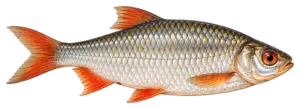 Baitfish
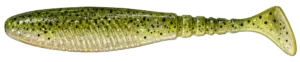 Soft plastic (shad)
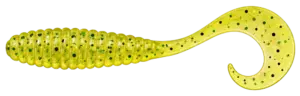 Twister
 Pintail (No-Action-Shad)
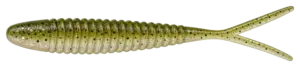 V-Tail
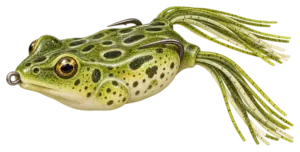 Soft plastic frog
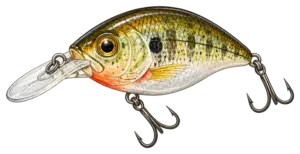 Crankbait
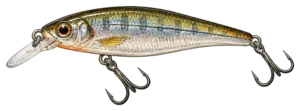 Twitchbait
AI-generated illustrations. A click opens the lure’s page.
Also suitable: Jerkbait, Stickbait, Popper, Swimbait, Lipless crankbait, Spinner, Spoon, Spinnerbait, Buzzbait, Bladed jig, Streamer.
Rigs for these baits: Baitfish rig, Jig head rig, Float rig, Running lead rig, Dropshot rig.
Pike in the kitchen
The pike has firm, lean and aromatic flesh and counts among the most valuable native food fish. Many anglers still do not particularly like it, because it has a distinct smell and taste of its own. The flesh is dry because it contains little fat.
There are numerous Y-bones in the fillet, and in pike from about 65 centimetres they are large enough to find easily. They are arranged in two rows, so with skilful cutting they can be removed before cooking. The Bayerische Landesanstalt für Landwirtschaft gives instructions for boneless filleting. Classically the fillets are minced into a forcemeat for pike dumplings, which are often on the menu in Brandenburg and Mecklenburg-Western Pomerania.
What you need to observe
Closed seasons (Schonzeit), minimum sizes (Mindestmaß) and harvest windows are set by the federal states (Bundesland), and on many waters additionally by the club or leaseholder. They differ depending on the water and the time of year. We give figures only with a date and a source; always binding are the fisheries regulation of your federal state and your fishing permit (Erlaubnisschein). You will find a list of links to the official sources in the catch calendar.
A fish of legal size that you want to keep you stun and kill at once, in line with animal welfare rules. Protected, undersized fish or fish too large under a harvest slot you unhook, if possible still in the water and with wet hands, and release gently. What exactly applies is regulated by state law and your fishing permit (Erlaubnisschein).
In the Red List of Germany of 2023 the pike counts as not threatened, but nationwide its stock is significantly declining in the quantitative analysis. The LFV Bayern names missing spawning opportunities through the loss of floodplains as a threat. Many federal states (Bundesland) expressly ban live baitfish. Water regulations and fishing permits are provided by the state associations, for example the Landesanglerverband Brandenburg.
What closed season, minimum size and harvest slot mean and where to find them is explained on the page Closed season and minimum size explained.
What state law specifies on the closed season (Schonzeit) and minimum size (Mindestmaß) for this species can be found in the “At a glance” box on all 16 state pages: Baden-Württemberg, Bavaria, Berlin, Brandenburg, Bremen, Hamburg, Hesse, Mecklenburg-Western Pomerania, Lower Saxony, North Rhine-Westphalia, Rhineland-Palatinate, Saarland, Saxony, Saxony-Anhalt, Schleswig-Holstein and Thuringia.
Frequently asked questions (FAQ)
When does the pike bite best?
Dusk is especially productive. Over the year autumn is the best time. After spawning, pike also feed heavily in late spring, but then a closed season (Schonzeit) still applies in many places, in Bavaria for example from 15 February to 30 April (AVBayFiG, as of October 2026). In a Brandenburg study most pike were caught at low water temperatures and strong wind.
How big and how old does a pike get?
On average 50 to 80 centimetres, females 70 to 140. They rarely reach over 130 centimetres and 20 kilograms, and only females do. FishBase gives 30 years as the maximum age.
Do I need a steel leader when fishing for pike?
Yes, if you want to be sure. Pike teeth cut thin line instantly, and only metal leaders are considered 100 per cent bite-proof.
Sources
The rating of catch chances is an editorial assessment. The facts come from these sources, and the text is worded in our own words. The illustration is an original design by Angel Momente in the style of a natural history plate (AI-generated, see the AI notice).
- Landesfischereiverband Bayern: Fischlexikon (Laichzeit, Lebensraum, Nahrung, Aktivität)
- FishBase: Esox lucius (Bestimmungsmerkmale, Höchstalter)
- Blinker: Steckbrief Hecht (Merkmale, Fresszeiten im Jahr, Köder, Gerät)
- Rote-Liste-Zentrum: Hecht (Rote Liste der Süßwasserfische Deutschlands 2023: ungefährdet)
- Deutscher Angelfischerverband: Fisch des Jahres 2016, der Hecht (Broschüre)
- Anglerverband Niedersachsen: Hecht (Fische in Niedersachsen)
- Leibniz-Institut für Gewässerökologie und Binnenfischerei: Boddenhecht, Ökologie, Nutzung und Schutz von Hechten in den Küstengewässern Mecklenburg-Vorpommerns (Bericht 33, 2023)
- Bayerische Landesanstalt für Landwirtschaft: Anleitung zur Herstellung grätenfreier Hechtfilets (Merkblatt)
- Blinker: Hecht landen, risikofrei und ohne Verletzungen zum Fisch
- Blinker: Bissfeste Monovorfächer beim Hechtangeln, worauf man achten muss
- Blinker: Was kommt vorneweg, Raubfischvorfächer im Vergleich
- LAWA-Projekt O 10.20 (Leibniz-IGB, 2021): Temperaturempfindlichkeiten der Fischgemeinschaften
- Landesanglerverband Brandenburg
- Bayern: AVBayFiG, Anlage 1 (Schonzeiten und Schonmaße, Fassung ab 1.6.2025)
- Wikipedia: Hecht
- Blinker: Die 10 größten Fehler beim Hechtangeln (große Hechte im Sommer im Freiwasser)
Created with AI support from the sources listed. Figures only appear in the text if a source gives them. Last updated: 15 November 2026. Found a mistake? Write to us. Who is behind this site: About me.
More in the lexicon
- All fish species at a glance
- Catch calendar – month, water temperature and profile for 93 species
- Line calculator – breaking strain after the knot, drag guideline, backing
- Angling methods