
Knowledge · Lures
Buzzbait
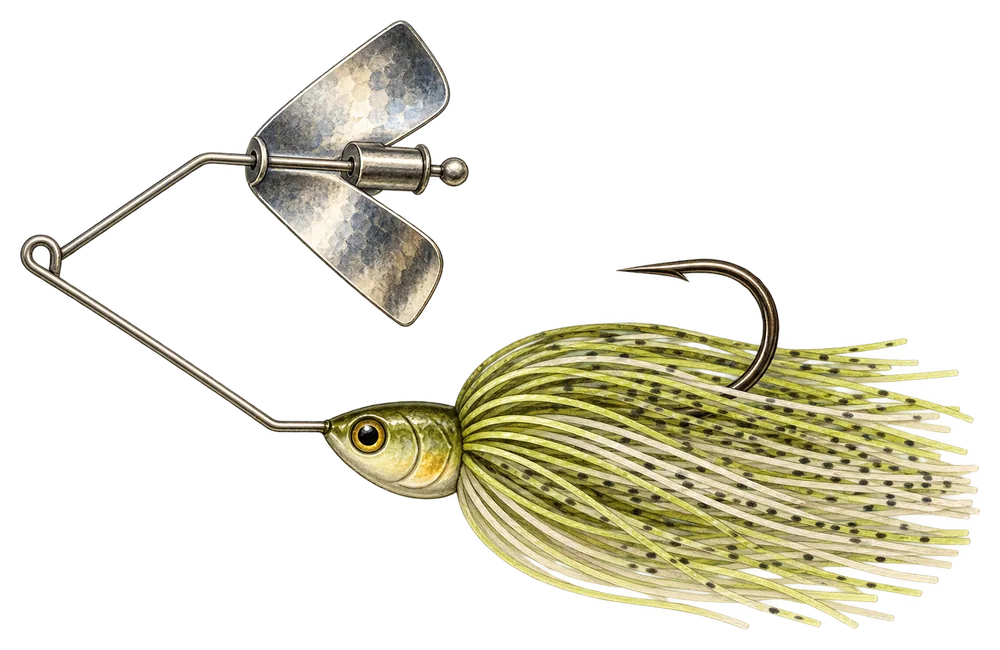
Metal lures · Spin fishing
A buzzbait is similar to a spinnerbait, but instead of a spinner blade it carries a propeller. It runs high, leaves a splashing trail of bubbles at the surface and makes noise as it does so. Pike hunting just below the surface react to it, even over weed.
- Water depth
- Surface
- Retrieve
- Active: retrieve briskly at the surface
- Fishing method
- Spinning
- Category
- Metal lures
How a buzzbait works
On a buzzbait the propeller sits on the shaft, also called a delta blade. The two-winged blade has angled ends and turns around the shaft that runs through its middle. Unlike on a spinnerbait, no blade turns on a hinge. The propeller churns the water strongly and drives the lure upwards. Like the spinnerbait, the buzzbait is an American development.
The buzzbait runs high and leaves a splashing trail of bubbles on the surface. Its propellers work with great force. That is why it is used where predators attack prey just below the water surface. For the fish, noise and pressure count, not the silhouette. The buzzbait is therefore an attractor lure that you pull through the water steadily, rather than working it with jerks and pauses.
The designs differ. There are simple models with a propeller in place of the spinner blade, models with two propellers or with a blade and a propeller. Others are built like a spinnerbait, with one or two wire arms that carry the propellers. You find single-shaft and double-shaft models.
When buying, there is one peculiarity: if the propeller sits rigidly on the shaft, it causes missed bites. A model in which it stays movable on the wire is better. On a bite it gives way, so the hook grips better. If you attach a soft bait as a trailer, a long trailer can encourage missed bites. An extra hook, the trailer hook, helps against this.
How to work the lure
Active: retrieve briskly at the surface
Schematic illustration, AI-generated.
- Cast
- Rod up, start winding straight away
- runs foaming at the surface
- work it right up to the bank
Anatomy
The points on the picture above explain the most important parts – on hover or tap.
- Bend in the wire arm: This is where you knot or clip on. On spinnerbait-style models the wire shields the hook.
- Propeller: The propeller churns the water and leaves a splashing trail of bubbles.
- Weighted head: Gives casting weight and carries the hook.
- Skirt: Dresses the hook and pulses on the retrieve.
- Single hook: The single hook sits free, at the head or trailer.
Rig in three steps
- 1. Bite-proof hooklengthIf you fish for pike, take steel or titanium. That protects against bites through the line.
- 2. Attaching to the armKnot or clip the trace into the bend of the wire arm.
- 3. Optional: soft bait as a trailerA soft bait on the hook adds stimulus. A long trailer needs an extra hook.
Drawings: AI-generated, schematic.
When the target fish are in season
Hardly any chancePossibleGoodPeak seasonValues from the catch calendar.
When and where
The buzzbait belongs at spots where predators hunt near the top. Because it runs high and, like a spinnerbait, many models carry a wire arm, it lends itself to use over plants where other lures get caught. It is a lure for pike that sit in shallow, weedy areas just below the surface.
High summer is regarded as the best time for pike at the surface, even though the pike season as a whole only peaks from October to December. In summer, fishing is often really effective only in the morning and evening. In shallow, weedy waters surface lures also work in spring, as soon as the closed season (Schonzeit) is over. In most federal states (Bundesländer) it runs from February to April or May, in Bavaria from 15 February to 30 April (as of October 2026). There the pike are not yet wary of rattling and splashing. Many pike are interested in a noisy lure only once or twice and can later only be fooled with quiet lures. So change the lure if the same water is fished often.
Rute & Rolle also names propeller lures at the surface for asp fishing in summer. They are simply retrieved briskly. Asp often strike just below the surface, and not every attack ends with a fish on the hook.
How to work the buzzbait over weed and during the fight
Retrieve the buzzbait briskly and steadily. The propeller must keep gripping the water so that the lure stays high and pulls its trail of bubbles. If it dives, wind faster.
On a bite the pike can often only be outwitted during the fight. Later in the year, playing a fish over weed is often possible only if you fight it firmly from the start and give the fish no chance to flee into the thicket of weed. Have a strong rod ready for this.
If you get missed bites, check the propeller first: it should be movable on the shaft. An extra hook on the trailer also helps. Unhook the pike you have caught without haste, using a disgorger and an unhooking mat. For bait bans, the number of hooks and treble hooks, the water regulations on site will tell you.
How to choose the design and trace
- Bite-proof leader For pike use steel or titanium, which protects against bites into the line.
- Into the bend of the wire arm Tie the leader into the bend of the wire arm or clip it on there.
- Soft bait as a trailer A soft bait on the hook adds extra stimulus. With a long trailer you need an extra hook.
Choose a propeller that moves freely on the shaft. If you are fishing over dense weed, take a model with a wire arm that resembles a spinnerbait. A soft bait as a trailer is optional. If you choose a long one, you also add a trailer hook.
For pike, a bite-proof trace belongs in front of the lure. Fisch & Fang prescribes a steel or titanium trace for this without ifs or buts, and the Bavarian angling exam (Fischerprüfung) gives the steel trace as an example. A trace made of bite-proof material protects line and fish at the same time.
Which colour?
Starting points to try, not rules. Depth and speed are usually more important than colour.
Buzzbait or another lure?
| Baits and lures | Depth | Retrieve | Take this lure if … |
|---|---|---|---|
| Buzzbait | Surface | Active: retrieve briskly at the surface | this page |
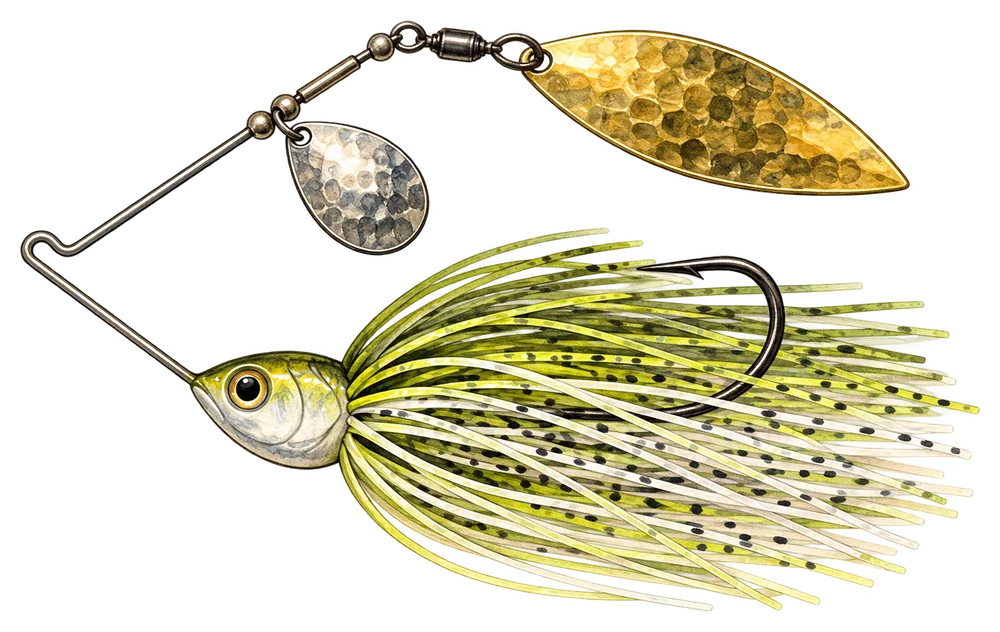 Spinnerbait | Near the surface to mid-water | Active: retrieve steadily, even slowly | you want to work below the surface through weed or need to work it slowly |
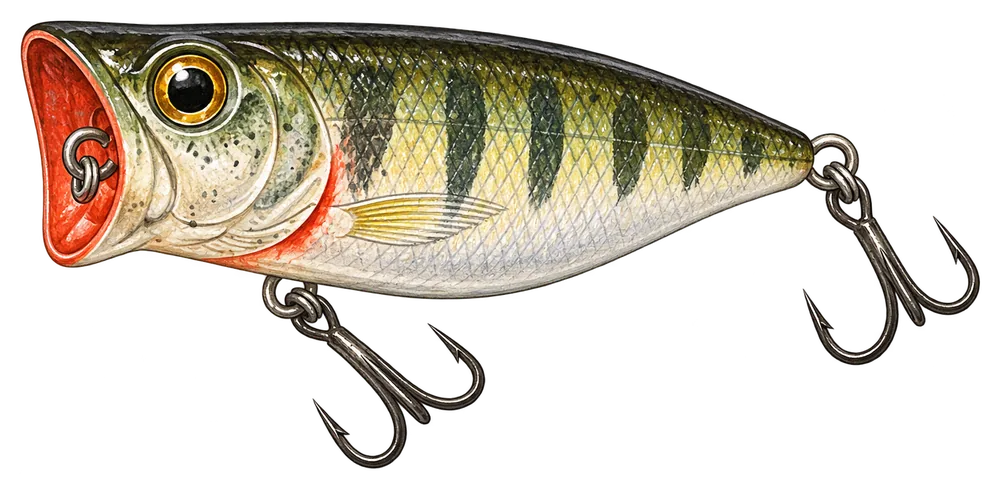 Popper | Surface | Active: short jerks, then a pause | you want to lure with plops, pauses and short jerks |
What you need
- Strong rodFor playing fish over weed you need backbone, so that the pike does not flee into the thicket. More on this
- LineBraided main line, with a bite-proof trace in front of it. More on this
- Pike traceSteel or titanium, because pike teeth cut through ordinary line. More on this
- DisgorgerHelps you free the pike from the hook quickly and gently after the bite. More on this
More on the method: Spinning.
At a glance
Editorial assessment, not measured values.
If it does not work
Wind faster. The propeller must keep gripping the water so that the lure stays on top.
Choose a model with a movable propeller. It gives way on the bite, and the hook grips better.
With a long soft trailer, fit an extra hook. Rigid propellers also cause missed bites.
Fight firmly from the start and give no chance to flee into the thicket of weed.
Take a steel or titanium trace. Ordinary line cannot withstand pike teeth.
Switch to a quieter lure. Many pike can be provoked by loud lures only once or twice.
Frequently asked questions
What is the difference between a buzzbait and a spinnerbait?
The buzzbait has a propeller on the shaft and runs at the surface. The spinnerbait carries a spinner blade on a hinge and runs below the surface.
When is a buzzbait worth using?
When predators, especially pike, hunt just below the surface. It suits use over weed, in high summer in the morning and evening, or after the end of the pike closed season in spring in shallow, weedy waters.
How fast do I have to retrieve the buzzbait?
Briskly and steadily. The propeller must keep gripping the water so that the lure stays on top. If it dives, wind faster.
How do I avoid missed bites?
Choose a propeller that is movable on the shaft. With a long soft trailer, an extra hook helps. Then the hook grips even on timid bites.
Which trace do I need?
For pike, a bite-proof trace of steel or titanium. It protects the line from the sharp teeth and reduces the risk of a pike being lost along with the lure.
Before fishing, the current permits, state rules and water rules apply: bait bans, number of hooks, closed seasons, protected species and catch limits can differ. Many federal states expressly ban live baitfish. Take bait remains and packaging away with you. All details are guide values without guarantee and do not replace legal advice.
Sources
- Blinker: Buzzbaits, lärmende Propeller aus Amerika
- Blinker: Angeln auf Hecht, Top-Hechtköder für Kraut
- Blinker: Auf Hecht an der Oberfläche, Topwater-Tipps
- Rute & Rolle: Rapfen, rasante Räuber
- Fisch & Fang: Zielfisch Hecht, Stahl der Wahl
- Bayerische Landesanstalt für Landwirtschaft: Prüfungsfragen zur Fischerprüfung 2023/2024
- Bayern: Ausführungsverordnung zum Fischereigesetz (AVBayFiG), Anlage zu § 11: Schonzeiten und Mindestmaße
The sources explain terms and basic principles. Retrieve, colour choice and values are editorial starting points and depend on water, weather and lure.
More metal lures
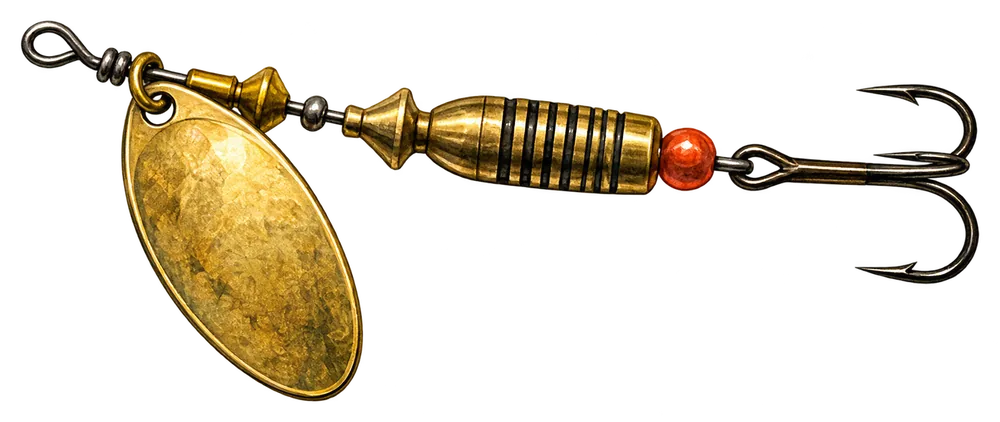 Spinner
 Spoon
 Bladed Jig
 Pilker
 Tailspinner
Created with AI support from the sources listed (AI notice). Last updated: 31 October 2026. Found a mistake? Write to us. Who is behind the site: About me.