
Knowledge · Tackle
Pike leader: Steel, titanium or hard mono
A pike leader is the bite-proof end piece between the mainline and the lure. It keeps the pike’s teeth away from line and knot. Here you can read which material suits what, how long and strong the leader should be and how to tell a worn one.
Why ordinary line breaks on a pike
The sharp teeth of the pike cut through ordinary fishing line. That is why, according to the Bavarian angling exam (Fischerprüfung), a leader made of bite-proof material of suitable strength, steel for example, belongs between the lure and the mainline. Leaders made of PE fibre or aramid are soft and abrasion-resistant, but they are not regarded as pike-proof. Fluorocarbon too can be damaged by sharp pike teeth unless it is very thick.
If the line breaks, the pike swims off with the lure and hook in its mouth. A research group at Carleton University in Canada released 51 pike for this purpose, each with a lure with a transmitter hanging in the jaw or throat. Three fish died; all the others except one got rid of the lure within 14 days. Barbs lengthened this time, and shortly after the break-off the fish swam noticeably restlessly. The pike measured a good half a metre on average, and the water was 20 to 24 °C. The authors advise avoiding break-offs from the outset with suitable tackle, explicitly with a wire leader for fish with sharp teeth.
Steel, titanium, hard mono and fluorocarbon
| Material | Guide value for pike | Strength | Limit |
|---|---|---|---|
| Steel, braided | from approx. 9 kg | flexible, for any lure size | kinks |
| Titanium | approx. 10 kg when spinning | thin, does not kink | can break without warning |
| Hard mono | from approx. 0,60 mm | much harder than nylon | stiff, safety disputed |
| Fluorocarbon | from approx. 0,90 mm | inconspicuous, does not kink | stiff, better for large lures |
The guide values in the table come from Blinker and apply to targeted pike fishing.
Steel
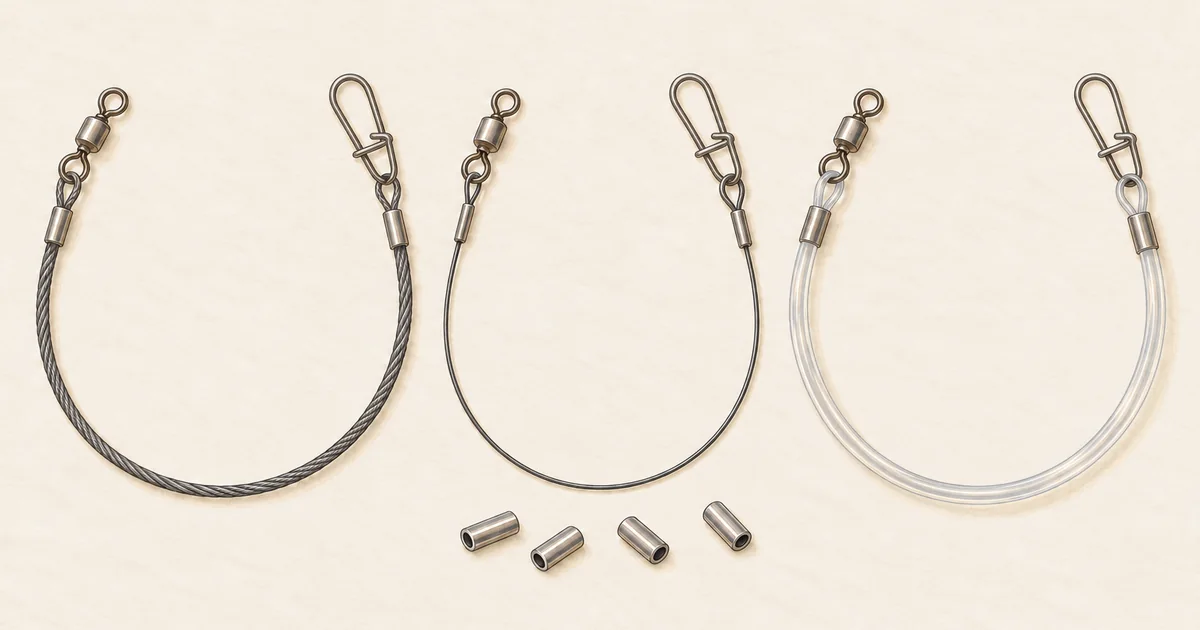
A steel leader usually consists of 7 (1×7) to 49 (7×7) braided stainless-steel strands. The more strands, the softer. 7×7 is used for small lures such as mini crankbaits or soft plastics on a light jig head, 1×7 for larger crankbaits, soft plastics and spinners with enough action of their own. With 1×7, a single strand is more likely to break. Coated steel, mostly 1×7 with a plastic coating, is more sluggish, and for that very reason keeps the trebles of wildly thrashing lures out of the leader. Stiffer still is the single-strand spring steel wire (Spinnstange), which hardly allows tangles when jerking, that is, working large lures with sharp pulls. The biggest weakness of steel is kinks.
Titanium
Titanium comes single-strand and braided. It springs back to the straight shape after bending and does not kink. Single-strand titanium is stiffer than braided, but considerably thinner. For spinning for pike, titanium with 10 kg breaking strain is regarded as sufficient. On durability the statements differ: Fisch & Fang wrote in 2010 that titanium leaders last for ever. Blinker warns in 2024 that titanium can break without warning after some use, and advises replacing it as a precaution after a few days‘ fishing.
Hard mono and thick fluorocarbon
Hard mono is an especially hard, stiff nylon. From about 0,60 mm it is regarded as fairly pike-proof, ordinary monofilament line only from 0,80 to 1,00 mm. Fisch & Fang, by contrast, does not see hard mono as an alternative, because material failures occur more or less regularly.
Fluorocarbon is inconspicuous in the water and does not kink. It is regarded as pike-proof from about 0,90 mm or around 80 lb breaking strain, that is, about 36 kg. Only metal is completely bite-proof. At these thicknesses the material is stiff. On small lures it slows the action; on large soft plastics and swimbaits it stops the lure flipping over in the cast and tangling in the leader.
Length and breaking strain as a guide value
The question catalogue for the angling exam (Fischerprüfung) in Saxony-Anhalt gives at least approx. 30 cm for pike fishing, and Fisch & Fang says the same for artificial lures. For trolling and on steep drop-offs, around 70 cm is used. A beginner’s article gives at least 20 cm for spinning and 50 cm with a baitfish. For fluorocarbon, 50 to 70 cm is often sensible: that is as long as it can still be cast without the swivel having to go through the rod rings.
The minimum length has two reasons: the pike bites beyond the leader, or it rolls itself into the leader during the fight. If it is too short, it gets the mainline between its teeth. From this comes the rule of thumb in Fig. 1: the leader must be longer than lure and mouth together.
For breaking strain in targeted pike fishing, steel from about 9 kg applies; the beginner’s article gives 8 to 15 kg. Crankbaits and soft plastics are fished on 9 to 12 kg; for very large lures, jerking and strong current, up to 16 kg is used. What your mainline still holds after the knot, you can work out in the line calculator.
To remember: The bigger the lure, the longer the leader. For artificial lures the sources give at least 20 to 30 cm, for baitfish, trolling and steep drop-offs 50 to 70 cm. Whether your water has its own requirements is set out in the fishing permit (Erlaubnisschein).
Crimp, swivel and snap
Braided steel is usually finished with crimps: the wire runs through the eye of the swivel or snap, back through a small metal sleeve, and a crimping tool squeezes the sleeve. For fluorocarbon and hard mono, aluminium crimps and a suitable tool are usual, so that the material is not damaged in the sleeve.
Knots are used too: single-strand titanium holds with a clinch knot of just two turns that does not close completely. You tie fluorocarbon directly to braid with the FG knot; at the swivel, a uni knot or a clinch with about three turns holds.
At the top sits a swivel, which stops the line twisting, and at the bottom a snap, to change lures quickly. According to the Bavarian exam catalogue, when spinning the swivel must be at least as strong as the line. All parts should be matched to the breaking strain of the wire; the fittings of cheap ready-made leaders are often regarded as inadequate.
Working with trace wire yourself
If you build your own traces, you decide length, breaking strain and fittings yourself. According to Blinker, shop-bought wire traces often come with crude swivels and snaps. How you connect a wire depends mainly on its construction.
Strands, knots and kinks
Strands are the individual wires of a trace. 1×7 means seven strands, 7×7 seven bundles of seven strands each, and 1×1 a single wire (Fig. 2, bottom). According to Blinker, single-strand wire made of titanium or stainless steel carries about twice as much as braided wire of the same diameter, because braiding costs strength. In return it is stiffer, and that helps in the cast: the lure flips over less often and catches in the trace less often.
| Wire | Joining | Kinks |
|---|---|---|
| 7×7 braided | Crimp or knot | does not kink so easily |
| 1×7 braided | Crimp, knot or twisted | kinks and curls quickly |
| 1×7 coated | wrapped around itself, coating fused | kinks just the same, frays less often |
| Stainless steel 1×1 | Haywire twist | not kink-resistant |
| Titanium 1×1 | Clinch with two turns | kink-resistant |
When twisting, the loose end of the wire is wound tightly around the main strand; Fisch & Fang describes this for 1×7. The haywire twist for single-strand stainless steel just twists the wire around itself and needs no crimp. According to Blinker, coated 1×7 is passed around the eye, wrapped around itself and heated over a flame until the plastic fuses.
You can also knot braided steel, with a clinch or grinner knot or a figure-of-eight loop. Blinker advises moistening wire, too, before tightening and pulling the knot down slowly so that no fine kinks form. It calls knotting steel directly to braid risky: the hard, slightly sawing surface of the wire can damage the line as it is tightened. A small leader ring between the two keeps the materials apart.
Two Blinker articles take different views on whether a kink noticeably weakens the steel. One still considers kinked wire bite-proof and hardly any weaker, while the other calls every kink a weak point in the material. In Blinker, titanium is regarded as kink-resistant.
Crimps and crimping pliers
The crimp must match the wire. According to Blinker, both strands of the loop slide in side by side without catching and still have hardly any play inside. A second Blinker article recommends crimps that are slightly wider than two wire diameters. If the wire has too much play, the connection holds considerably less. You find out which size suits your wire by trying it. For steel, Fisch & Fang names brass crimps.
According to Blinker, many predator anglers reinforce the connection with a third pass: the end of the wire is bent back and pushed into the crimp once more. For this, the crimp may be wide enough to take three wires, but no wider.
The crimp should be long enough to fill the whole jaw recess of the pliers. Crimp points are the spots where the crimping pliers press into the crimp, three to six depending on the pliers. According to Blinker, this type of crimping gives the highest strength. In one of its examples a short crimp received only two of three crimp points and still held well.
Combination pliers only squash the crimp flat; the wires get little grip in it and can slip out. The crimping notch on many fishing pliers is also often imprecisely made and sets only a few crimp points, so the connection holds less well. On ferrule crimpers from the electrical trade the Blinker articles disagree: one accepts them as long as the connection holds, while another warns in general that ordinary pliers from a DIY store or electrical supplier could damage the trace when crimping. Crimp fluorocarbon and hard mono gently, because if it is crimped too hard the material is crushed in the sleeve and weakened.
Crimping a loop in seven steps
- Measure the wire and cut it with side cutters or a cutter. Ordinary scissors will manage thin steel, but according to Blinker their blade wears badly in the process.
- Thread on the crimp, taking care that the end of the wire does not unravel into individual strands.
- Pass the wire through the eye of the swivel or snap and push it back through the crimp.
- If the crimp has room, bend the end back and insert it a third time.
- Place the crimp fully in the recess of the crimping pliers and squeeze firmly.
- Snip off the protruding end close to the crimp.
- Test the connection under load before the trace goes into the rig box.
For the pull test, an article in Fisch & Fang describes a simple method: weights are added to a series of identically built traces until the first one breaks. The author then tests the rest with one kilogram less. A dumbbell or a sack of coarse gravel is enough as a load. That way you also know what your traces really hold.
Titanium in the crimp: a Blinker author reports from experience that smooth titanium slips easily out of the crimp. He therefore runs one end of the wire around the outside of the crimp, inserts it once more from the loop side and covers the crimp with shrink tube. Single-strand titanium can also be knotted, as described above.
For zander and perch fishing too
For zander, ordinary monofilament is enough, provided there are no pike. Since it can never be ruled out that a pike bites, only steel comes into question when fishing with a stinger treble, even if the target is zander. Steel is also used when fishing for zander with baitfish, because modern 7×7 is often softer and finer than monofilament line.
Thin leaders are enough as pike insurance: around 3 to 4 kg is quoted for perch and 6 to 7 kg for zander. Titanium of 3 to 4 kg is, by this account, even suitable for small perch lures.
Checking and replacing
- Kinks: A steel leader must have no kinks, as it says in the exam catalogue for Saxony-Anhalt. Kinks occur when a heavy lure wraps itself round the leader in the cast or in the fight.
- Coils: Coiled leaders do not belong in the spares, according to the same catalogue, but are disposed of safely.
- Strands and crimps: Run your fingers along the wire after fishing, including the crimps. If a broken strand sticks out, replace the leader at once.
- Spinning wires (Spinnstangen): Bent wires disturb the lure’s action. After hard fights and freed snags it is worth a look; spring steel can usually be bent back.
- Fluorocarbon: Check for abrasion after every fish and shorten or replace the damaged section.
Common mistakes
- Thin fluorocarbon as a pike leader. It is pike-proof only from about 0,90 mm; anything thinner does not protect reliably.
- Braid in front of the lure. A soft leader of PE fibre or aramid is abrasion-resistant, but not bite-proof.
- Too short for the lure. If the pike takes a large lure deep, it reaches the mainline.
- Strong wire, weak snap. The leader is only as strong as its weakest part.
- Carrying on fishing with a kinked leader. The kink weakens the wire exactly where the next pike pulls.
Frequently asked questions
Does a steel leader scare the fish?
The angling press is not agreed. In one source a scaring effect of wire is regarded as unfounded, but very shiny surfaces can scare fish in clear water. Matt or dark leaders are then the better choice.
Can I make steel leaders myself?
Yes, with wire from the spool, crimps, swivels, snaps and crimping pliers with several pressure points. Heat the cutting point briefly before cutting so that the wire does not fray.
Is the crimping notch on fishing pliers good enough?
Not really for traces you want to rely on. According to Blinker, the built-in notches are often imprecise and press in too few places. Proper crimping pliers with several crimp points hold better; combination pliers are no good at all.
How long does a leader last?
None of the sources gives a fixed figure. You replace steel at the first kink or a broken strand, titanium, according to one source, as a precaution after a few days‘ fishing. Check fluorocarbon after every fish.
Related
- Pike: teeth, lies and lures in profile
- Spinning rod: length and casting weight for pike lures
- Braided line: the mainline ahead of the leader
- Jig head rig: fitting a soft plastic with a steel leader
- Baitfish rig: leader with trebles for the dead baitfish
- Landing a fish and unhooking: removing the hook from toothy mouths
- Multitool and fishing pliers: side cutters and pliers for on the go
- Line calculator: breaking strength after the knot and a rough guide for the clutch
Sources
- Blinker: Was kommt vorneweg? Raubfischvorfächer im Vergleich (Werkstoffe, Knicke, Titan, Tragkraft)
- Blinker: Fluorocarbon-Vorfach für Hecht (0,90 mm, Klemmhülsen, Knoten, Länge, Kontrolle)
- Fisch & Fang: Zielfisch Hecht, Stahl der Wahl (Drahttypen, Spinnstangen, Hardmono, Länge, Tragkraft, Quetschhülsen, Twisten)
- Land Sachsen-Anhalt: Fragenkatalog zur Fischerprüfung (PDF) (Mindestlänge, Knicke, Kringel)
- Bayerische Landesanstalt für Landwirtschaft: Prüfungsfragen zur Fischerprüfung 2023/2024 (PDF) (beißsicheres Vorfach, Wirbel)
- Queen’s University Biological Station: Lure-shedding of northern pike (Fisheries Research 2019) (Hechte nach Schnurbruch)
- Blinker: Einsteiger-Guide Hecht (Länge, Tragkraft)
- Blinker: Angeln mit Stinger (Zander; Hülse auffädeln, Ende kürzen) und Fisch & Fang: Mit Köderfisch auf Winter-Zander (Stahl beim Zanderangeln)
- Blinker: Bissfeste Mono-Vorfächer, unsichtbar auf Hecht (nur Metall zu 100 % bissfest, Mono nicht zu fest quetschen)
- Blinker: Stahlvorfach selber bauen, Crimpen ist Vertrauenssache (Hülsengröße, dritter Durchgang, Druckpunkte, Kombizange)
- Blinker: Pro-Tipp, das richtige Stahlvorfach für Hecht und Co (Hülsenweite, gewöhnliche Zangen, Knick als Schwachstelle)
- Blinker: Knick im Stahlvorfach, wann muss ich es austauschen? (Knick und Tragkraft, ummantelter Stahl)
- Blinker: Einer für alle, 1×1-Stahlvorfächer im Überblick (einfädiger Draht, Tragkraft, Haywire-Twist, Knicke)
- Blinker: Das richtige Vorfach zum Angeln (7×7 und 1×7, ummantelter Draht, Titan in der Hülse)
- Blinker: Stahlvorfach knoten, geht das? (Knoten, Anfeuchten, Draht an Geflecht)
- Blinker: Stahl, ganz stealthy (Beschläge fertiger Vorfächer)
- Blinker: Angler-Werkzeug, was muss noch mit ans Wasser? (Klemmkerbe an Angelzangen)
- Blinker: Immer gut abschneiden (Stahl schneiden)
- Fisch & Fang: Stahlvorfächer testen (Zugprobe mit Gewichten)
Text AI-assisted, drawing AI-generated. Sources opened and checked in October and November 2026, no graphics taken from the sources.
All figures are guide values without guarantee. Which leader suits depends on lure, water and pike stock; what counts are the requirements in your fishing permit.