
Knowledge · Knots
How to tie a clinch knot
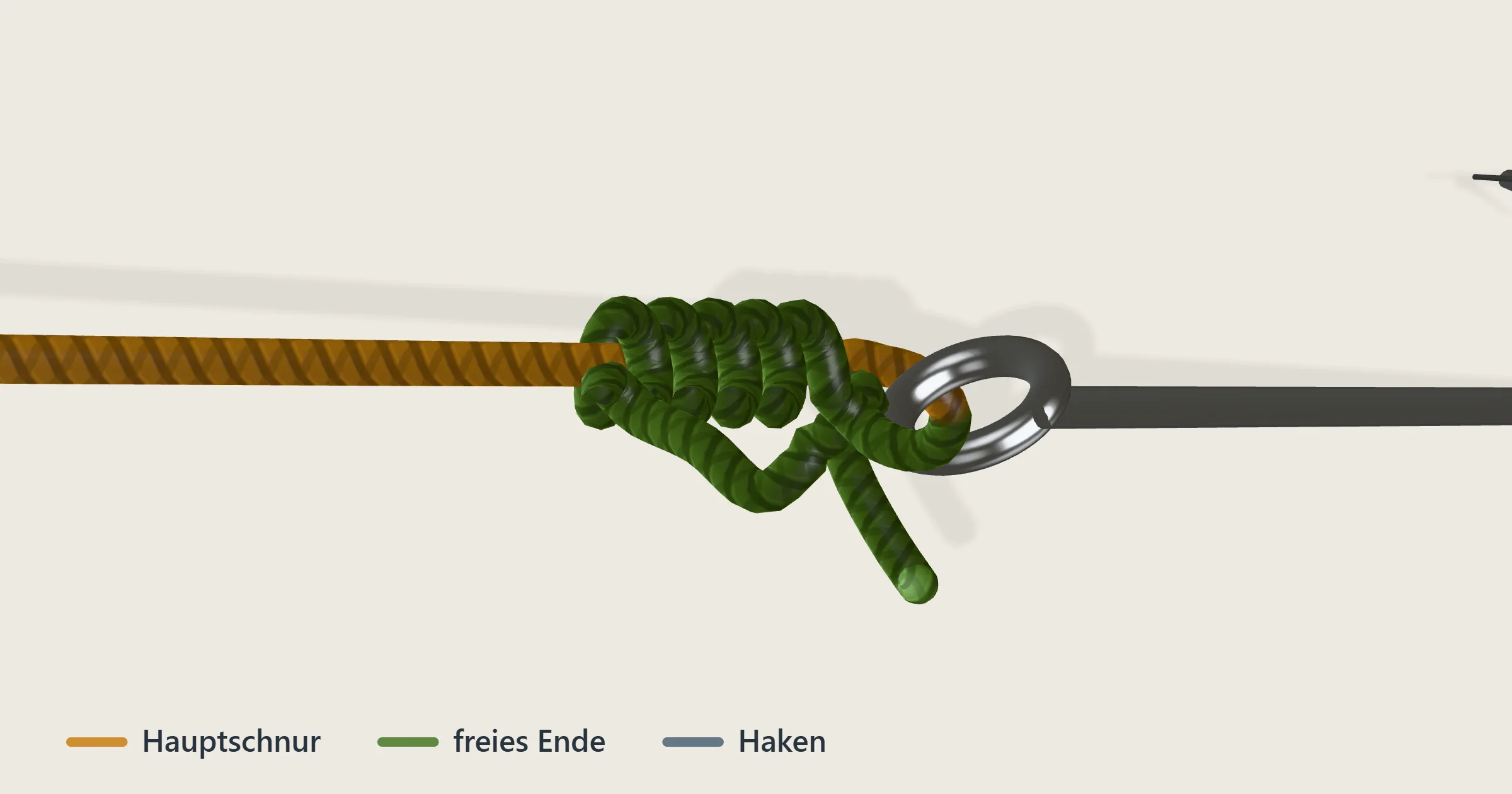
The Clinch knot ties hooks, swivels or lures with an eyelet to monofilament line: thread through, wrap around the main line, back through the small loop at the eye. It is the simple basic form of the improved clinch and quick to tie.
What is the clinch knot good for?
The clinch connects the line to anything with an eyelet, such as hooks, swivels or lures. On a smooth surface it can come undone under load. For braided line, Blinker names the clinch with doubled line as a sturdier form; Wikipedia lists the grinner as an alternative, described here as the Uni/grinner knot.
With very thick line the knot is hard to tighten; Wikipedia gives about 0,4 mm as the limit. The difference from the improved clinch knot is a single step: there the end also runs through the large loop that forms when it is brought back. NetKnots points out that many anglers now mean the improved form when they say “clinch”. Fly anglers keep using the simple one because it is quick to tie.
Tying the clinch knot: step by step
- Thread through. Pass the line through the eyelet and leave enough end protruding for the turns.
- Wrap. Wrap the free end around the main line, away from the eye. NetKnots gives at least five turns, seven to eight for thin line; Wikipedia four to five.
- Back through the small loop. Bring the end back to the eye and pass it through the small loop directly behind the eye.
- Moisten and tighten. Moisten the knot and pull it tight. Blinker’s reason for moistening is that it prevents breakages.
- Test and trim. Test the knot with a pull test and then cut off the protruding end.
Common mistakes
- Tightened dry: Without moistening, according to Blinker, the risk of the line breaking increases.
- Line too thick: From about 0,4 mm the knot often no longer tightens fully.
- Smooth braid: The simple clinch can open under load. Use a different knot there.
Pull test and knot strength
First check that the turns lie neatly side by side and the line is undamaged. Then pull steadily on both sides of the connection. For practice use a blunt ring; do not pull with bare fingers on an open hook or on thin line. If an end slips or the knot distorts, tie it again. A pull test does not measure breaking strength, it only shows gross tying faults.
Material, diameter and tying technique affect every connection. The line calculator gives you a rough guide using cautious knot factors of our own.
Related knots
With one extra step the clinch becomes the improved clinch knot. The Palomar knot and the Uni/grinner knot come into question as alternatives for braided line.
Used in these rigs: Carolina rig, waggler rig, sbirolino rig and baitfish rig.
Note: The number of turns depends on the line. Try out on your own line how many turns let the knot close up neatly, and check it with a pull test.
Frequently asked questions
Clinch or improved clinch?
The difference is one step: with the improved clinch, the end also runs through the large loop. NetKnots writes that the improved version has replaced the plain one for many anglers; fly anglers still tie the plain one because it is quick. Both are designed for monofilament line.
How many turns for a clinch knot?
NetKnots gives at least five, seven to eight with thin line; Wikipedia four to five. With fluorocarbon, three to five are enough according to Blinker. The thicker the material, the fewer the turns.
When is the clinch knot unsuitable?
With very thick line: Wikipedia gives about 0,4 mm as the limit above which it often no longer pulls tight. On very slick surfaces such as braid, it can open under load. The Palomar knot or the uni knot are better suited there.
Sources
- NetKnots – Clinch Knot
- Wikipedia – Clinchknoten
- Blinker – Der Clinch-Knoten
- NetKnots – Improved Clinch Knot (Abgrenzung zum verbesserten Clinch)
- Blinker – Fluorocarbon knoten: So geht’s (Windungen bei Fluorocarbon)
Sources opened and checked on 8 November 2026. Texts in our own words, sketch created independently; no graphics taken from the sources. You will find all knots in the overview of fishing knots.
All figures are guide values without guarantee. Follow the line manufacturer’s instructions.