
Knowledge · Rigs & setups
Sbirolino rig
The sbirolino is a casting weight with a line tube that runs freely on the main line and carries light baits such as waxworms, trout paste or flies out to distance. Whether it floats or sinks slowly or quickly helps decide how deep the bait runs behind it.
What a sbirolino is
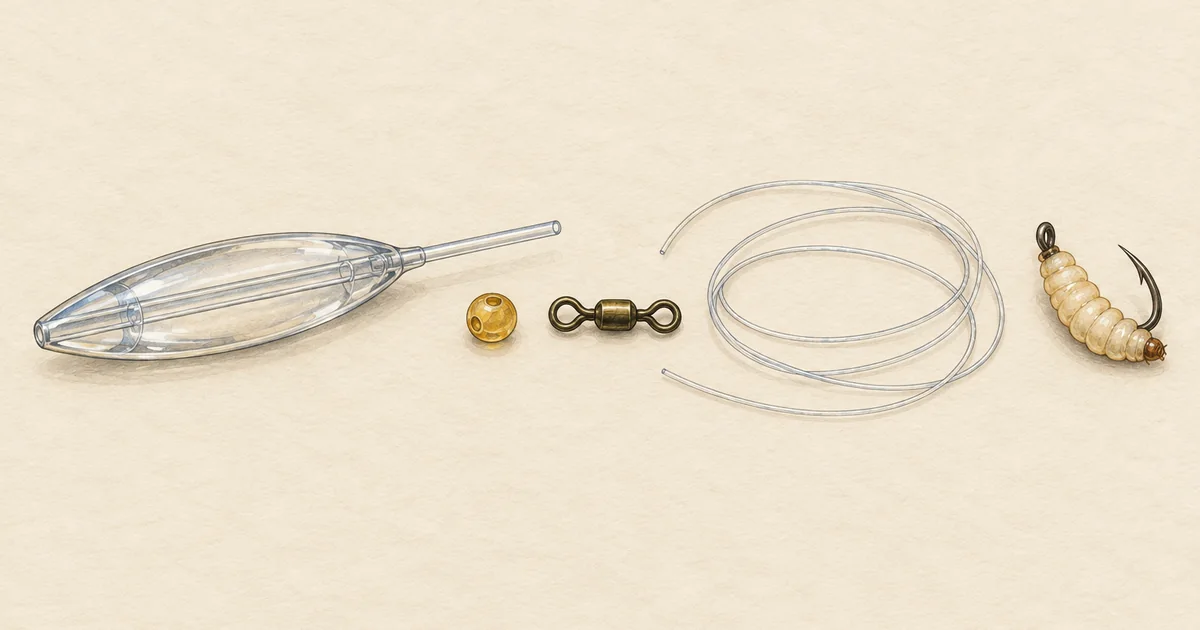
A sbirolino consists of a body and a tube through which the line runs. In Italy it is called a bombarda; the name sbirolino has caught on only in Germany (Blinker). According to Fisch & Fang it serves only as a casting weight, not as a bite indicator, and manages a casting distance of 70 to 80 metres.
It comes in floating, slow-sinking and fast-sinking versions. The weight determines the casting distance, not the sinking speed (Rute & Rolle). That is why two numbers are often printed on it: first the total weight, which decides the casting distance, then the underwater weight, which determines the sinking (Fisch & Fang).
| Sinking behaviour | Runs | Typical use |
|---|---|---|
| floating | at the surface, the bait just below it | fish are holding shallow, for example in summer; garfish |
| slow-sinking | between surface and depth | spring at the trout lake, sea trout on the coast |
| fast-sinking | deep, about 3 to 6 metres (Fisch & Fang) | fish are holding deep |
Printed running depths are only guidelines for a medium retrieve speed (Blinker).
What you need
- a sbirolino to match the depth of the fish, plus a second one to switch to. Blinker gives 10, 15 and 20 grams as examples, and over 30 grams on a lake of 1.5 hectares.
- a rubber bead or silicone stopper to protect the knot.
- a three-way swivel, preferably with a snap link for quick hooklength changes.
- monofilament main line of 0.18 to 0.22 millimetres (Blinker), whose stretch cushions the cast and the fight.
- hooklength line, often fluorocarbon. An author in Fisch & Fang seldom uses more than 0.15 millimetres.
- single hooks in sizes 4 to 8, because bigger ones grip better (Blinker), or 8 to 10 (Fisch & Fang).
- a long rod: at least 3.30, better 3.60 to 4.60 metres with a casting weight of up to about 30 grams (Fisch & Fang). Blinker considers around 3 metres enough in most cases, because bankside bushes get in the way of long rods. A match rod also suits.
- a reel with a low gear ratio, according to Blinker around 5:1 and at most 5.9:1. Otherwise the bait cannot be worked slowly.
You can compare breaking strain and diameter in the line calculator.
Set-up of the sbirolino rig
From the rod to the hook come the main line, sbirolino, bead, three-way swivel, hooklength and hook. The sbirolino must run freely, so that the fish takes line on the bite without feeling resistance. The bead protects the knot that the sbirolino hits on the cast (Blinker).
The hooklength is much longer than with other rigs, because trout perceive the sbirolino with their lateral line and eyes and can shy away from it (Blinker). Blinker gives 1,50 to 2,20 metres, and up to 4,50 metres for very wary fish.
Tying it in six steps
- Thread on the sbirolino, facing the way it does in Fig. 1. A threading needle helps (Fisch & Fang).
- Slide on the bead or stopper.
- Tie on the three-way swivel. Rute & Rolle uses the clinch knot for this.
- Cut the hooklength to length. Wind the sbirolino up to just short of the rod tip. The hooklength must not be longer than the rod, otherwise you cannot get the fish into the landing net (Rute & Rolle, Fisch & Fang).
- Clip on the hooklength, tie on the hook. A loop on the hooklength, such as a surgeon’s loop, goes into the snap link. Hook knots are in the knot overview.
- Add the bait and test it. Pull it through shallow water at the bank; it must spin (Fisch & Fang).
Bait behind the sbirolino
Anything that spins or moves will do (Fisch & Fang). At the trout lake that is mainly two waxworms in an L shape, the first lying entirely along the hook shank, the second at a right angle to it (Blinker), and trout paste, kneaded into a propeller. According to Blinker, the spinning bait sends out pressure waves and provokes the trout to bite.
The rotation causes line twist. A triple swivel made of three linked swivels counteracts this (Blinker, Fisch & Fang). With lures that spin a lot, an author in Fisch & Fang adds a second one about 40 centimetres in front of the lure. At the same distance in front of the hook he pinches on a split shot, a slightly heavier one with buoyant paste.
Lures work just as well: Rute & Rolle names twisters, small spoons and crankbaits, spinner blades and flies. More under Streamer, Wet fly and Twister. Blinker also lists ordinary maggots and mealworms.
Retrieve and depth
After the cast you wind in slowly. Trout anglers call this trolling (Fisch & Fang), though it has nothing to do with trolling from a moving boat.
- Counting down: after it lands, count the seconds to the bottom. If it was about ten and the trout are holding higher up, on the next cast you count only to two or three before you start winding. With no bite, you feel your way deeper cast by cast (Blinker).
- Speed: retrieved slowly, a sinking sbirolino runs deeper; retrieved fast, it rises (Blinker, Rute & Rolle).
- Pauses: in pauses the sbirolino and bait sink. Often the trout bite exactly then (Blinker).
Use: trout lake, reservoir, coast
On the trout pond, trolling with the sbirolino is considered the most successful method from spring to autumn, according to Fisch & Fang. In winter the bait has to run very slowly, and the magazine then advises a light float (float rig).
On some reservoirs only lures are allowed. A reader’s report in Blinker describes such a drinking-water reservoir with brown trout and rainbow trout: there many people fish the fly or nymph on a floating sbirolino. The water rules of the Landesverbands Sächsischer Angler allow the bubble float and sbirolino with a lure in still salmonid waters.
On the river the bubble float carries light baits to the asp as well. The Blinker profile puts a hooklength of half a metre to one metre behind it, with a small twister on a single hook, a wet fly, a streamer or a dead small fish on it.
On the coast the sbirolino carries the fly to sea trout that feed on small prey and hold too far out for the fly rod (Rute & Rolle). There Fisch & Fang gives 15 to 25 grams, Rute & Rolle 20 to 35 grams. The hooklengths measure two to over three metres and are 0.23 to 0.27 millimetres (Fisch & Fang) or 0.30 to 0.38 millimetres thick (Rute & Rolle). The rods are 3.40 to 3.60 (Rute & Rolle) or 3.60 to 3.90 metres long (Fisch & Fang).
For garfish, Fisch & Fang names floating or slow-sinking models, a 0.30 hooklength of around 1.5 metres, single hooks of size 4 to 8 and usually a fish strip as bait. Blinker advises light sbirolinos of around ten grams, which offer far less resistance on the bite than a bubble float.
Local rules: how many rods and hooks are allowed and which baits are permitted is set out in the fishing permit (Erlaubnisschein) and in the water or pond rules. At the Landesverband Sächsischer Angler, for example, the bait decides whether the sbirolino rod counts as a coarse-fish, salmonid or predator rod. More under Fishing permit and water map.
Common mistakes
- Hooklength tangles on the cast: brake the line with your finger on the spool just before it lands, and the rig stretches out (Blinker, Fisch & Fang). Baits that are too heavy encourage tangles (Blinker).
- Wrong sinking behaviour: a fast-sinking model runs under shallow-holding fish. Blinker calls inferring the sinking behaviour from the weight a cardinal error. If the bites do not come, change the count or the model.
- Hooklength too thick: thick line is conspicuous. For wary pond trout on the bottom rig, Fisch & Fang even names 0.12 millimetres, but warns of line breaks. On the coast, by contrast, Rute & Rolle advises beginners to use the thicker hooklength, which tangles less often.
- Hooklength too short: the bait runs too close to the sbirolino. It may only be shorter when the trout bite greedily, as the strike then goes through better (Blinker).
Frequently asked questions
Does the tube point towards the rod or the hook?
Fig. 1 shows the usual orientation with the tube towards the rod and the body towards the hooklength, as in the rig drawing in the Blinker basics article. According to Blinker, the long tube stabilises the flight and prevents tangles.
Monofilament or braided main line?
Mostly monofilament at the trout lake, because the stretch cushions the cast and the fight. With braid, the hook pulls out more easily according to Blinker, so it only pays off at very long distance. On the coast, Rute & Rolle recommends braid of 0.13 to 0.15 millimetres.
Open the bail arm or keep the line tight when a fish bites?
The sources contradict each other here. Fisch & Fang advises opening the bail arm at once and striking gently when the trout takes line. Blinker thinks that is wrong, because depending on the model the sbirolino can sag and drag the bait with it, and advises: rod forward, line under tension, watch the rod tip.
Related
- Float rig: for very slow retrieve or a fixed depth.
- Fishing at the trout pond: fishing licence (Fischereischein), pond rules and stunning after the catch.
- Fishing ponds in Germany and fishing ponds in Denmark: find trout lakes for the Sbirolino rig, with map.
- Fishing rods: length, casting weight and action.
- Landing a fish and unhooking: netting and removing the hook.
Sources
- Blinker: Angeln mit Sbirolino (Aufbau, Gerät, Führung), Tipps und Tricks am Forellensee (Bienenmaden, Pausen), Spinnfischen auf Hornhecht (Hornhecht), Forellen in Trinkwassertalsperren (Leserbericht), Steckbrief Rapfen (Wasserkugel am Fluss)
- Fisch & Fang: So fangen Sie am Forellensee (Gewichtsangaben, Rute, Biss), Forellensee-Einmaleins (Vorfach, Haken, Bleischrot), Auf Meerforelle mit Sbirolino und Fliege (Küste), Hornhecht-Spaß für jedermann (Hornhecht)
- Rute & Rolle: Weitwurfrakete Sbirolino (Gewicht, Köder, Führung), Meerforellen: Tipps für Sbirolino (Küste)
- Landesverband Sächsischer Angler: Gewässerordnung, Ausgabe 2024 (Sbirolinoangel, Salmonidengewässer)
Text AI-assisted, drawing AI-generated. Sources opened and checked in October 2026; no graphics taken from the sources.
All figures are guidelines without guarantee. What is allowed on your water is governed by state law, the fishing permit and the pond or water rules.