
Knowledge · Types of water
Fishing at a trout pond
At the trout pond you fish for a fee for fish that the operator has stocked, mostly rainbow trout of table size. The page shows where the fish stand, which rig suits which season and how to look after your catch. Whether you need a fishing licence (Fischereischein) depends on the federal state.
At a glance
- Spots
- Inlet and monk (Mönch), in summer the aerator, the bank in the wind, the edge in front of the reed
- Fish
- Mostly rainbow trout, depending on the pond also brown and sea trout, char, sturgeon or carp
- Methods
- Float, sbirolino or a drifted float for searching, bottom rig (Bodentaster) with a ledger rig for sluggish fish
- Papers
- Fishing licence (Fischereischein) depending on the federal state, below for all 16 states; plus the pond rules
- After the bite
- Stun, kill, and only then remove the hook
What a trout pond is
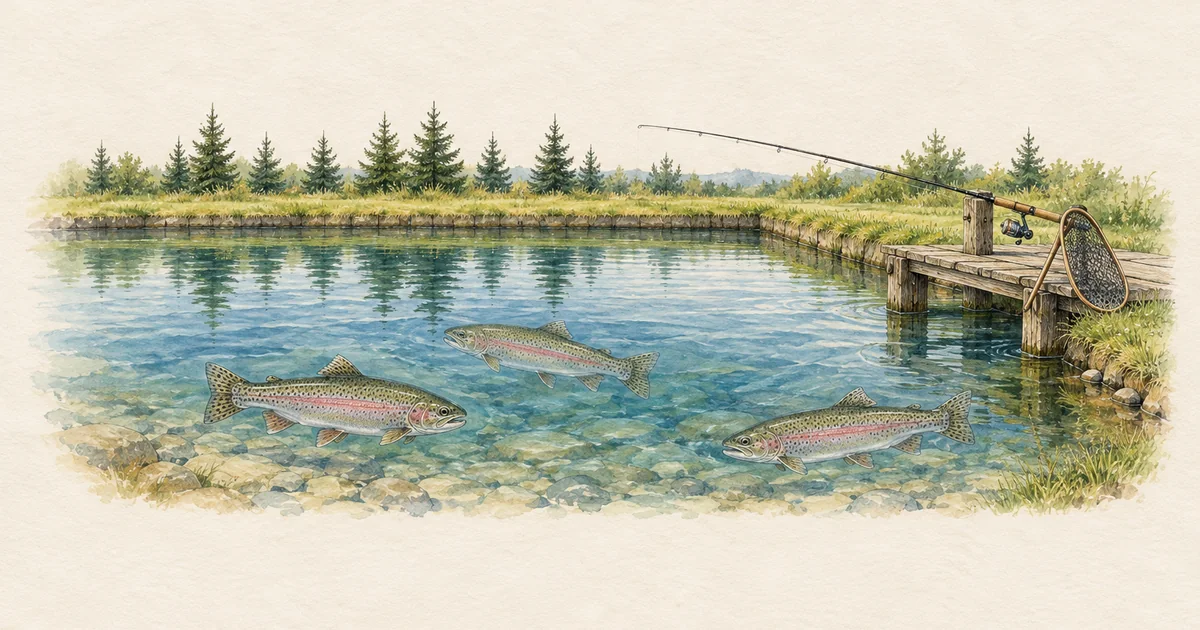
A trout pond is a commercial angling pond: the operator stocks fish from fish farming, you pay for the fishing and take your catch home. Mostly rainbow trout are stocked (Merkblatt des LALLF Mecklenburg-Vorpommern). An expert report for Schleswig-Holstein also names brown and sea trout, char, sturgeon, carp, tench, eel, catfish, pike, zander and perch (Institut für Binnenfischerei, 2014).
The “salmon trout” is not a species of its own. This is the trade name for rainbow trout with red flesh (Jahresbericht zur Deutschen Binnenfischerei 2023).
The main fish at the pond. According to LFV Bayern 25 to 60 centimetres long on average; it tolerates warmth and lack of oxygen better than the brown trout.
Named in the report for Schleswig-Holstein as stocking. It needs cooler, more oxygen-rich water than the rainbow trout.
The report also names char as stocking at angling ponds.
Stocked at some ponds, according to the report alongside tench, eel, catfish, pike, zander and perch.
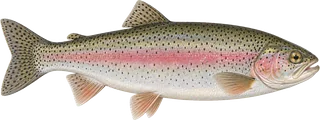
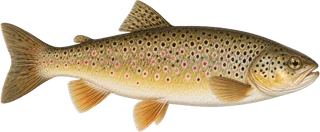
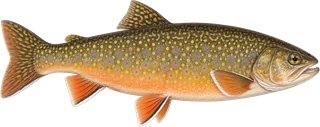
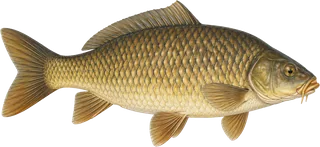
Fish pictures: AI-generated illustrations. A click opens the portrait.
The bands and red dots come from the Catch calendar and describe the species in general. At the pond what counts is what the operator stocks and when. Ask about the last stocking.
Do you need a fishing licence?
Each federal state decides this for itself. This means the commercial angling pond: an operator stocks fish and you pay for the fishing. The details apply to adults. As of 25 October 2026, checked against state law and authority websites. Choose your state for the details:
- Baden-Württembergask first
- Bavarialicence compulsory
- Berlinlicence compulsory
- Brandenburgwithout a licence only with a coarse-fishing rod
- Bremenlicence compulsory
- Hamburglicence compulsory
- Hesselicence compulsory
- Mecklenburg-Western Pomeranialicence compulsory
- Lower Saxonyno licence required
- North Rhine-Westphalialicence compulsory
- Rhineland-Palatinatelicence compulsory
- Saarlandlicence compulsory
- Saxonywithout a licence under supervision
- Saxony-Anhaltlicence compulsory
- Schleswig-Holsteinwithout a licence under supervision
- Thuringialicence compulsory
Baden-Württemberg
The licence requirement does not apply at a managed pond farming or fish farming facility. It does apply at enclosed small waters of up to 0.25 ha. Whether a pure angling pond with bought-in fish counts as pond farming has not been settled officially. According to the wording, no licence is probably needed there. Ask the operator or the lower fisheries authority (Fischereibehörde) beforehand (§ 1 Abs. 2, § 31 FischG BW).
Bavaria
Anyone fishing with a hand line needs the fishing licence (Fischereischein), also at a fenced-off pond. Children and young people from 7 to 17 may fish in the responsible company of an adult licence holder (Art. 46, 47 BayFiG, Staatsministerium).
Berlin
The fishing licence (Fischereischein) is compulsory at ponds too, plus the fishing levy (Fischereiabgabe) (€21 a year for licence A) (§ 1, § 8 Abs. 4 LFischScheinG, § 2 LFischG Berlin).
Brandenburg
With a coarse-fishing rod you do not need a licence: a rod with a single hook and paste, worm or maggot. Spinners, spoons and rods with more than one hook count as predator-fishing rods, for which the licence is compulsory. Whether a fly on a sbirolino or a drifted paste still counts as a coarse-fishing rod is not expressly regulated: if in doubt, take the licence or ask the operator beforehand. At a managed pond the fishing levy (Fischereiabgabe) for the hand line does not apply (§ 17 Abs. 4 Nr. 4 BbgFischG, §§ 7, 26a Abs. 3 BbgFischO, § 2 Abs. 4 Nr. 1 FischAbgV).
Bremen
The fishing licence (Fischereischein) is compulsory at ponds too (§ 34 BremFiG). The law does not provide for a fishing levy.
Hamburg
The law has no exception for angling ponds, and the authority names the licence for any fishing. Children under 15 may fish with a hand line under the supervision of an adult licence holder. Fishing levy €10 a year (§ 9, § 12 HmbFAnG, § 1 HmbFAnGDVO).
Hesse
The law expressly also applies to permanently fenced-off fish ponds. Young people from 10 to 15 may fish with a hand line under the supervision of an adult licence holder (§ 2 Abs. 1 Nr. 2, § 29 HFischG).
Mecklenburg-Western Pomerania
The fishing licence requirement also applies in angling pond facilities. Without an exam, from the age of 14 you can get the tourist fishing licence (Touristenfischereischein) for up to 28 days. Children under 14 do not need a licence, but a fishing permit (§ 7 LFischG M-V, LALLF-Merkblatt, FSchVO; LALLF: Touristenfischereischein).
Lower Saxony
In inland waters the state does not prescribe a fishing licence. As everywhere, though, you may kill fish only with the required knowledge (Sachkunde). The state recommends that anglers without the required knowledge fish under the supervision of a competent person (§ 57 Nds. FischG, § 4 TierSchG, ML-Hinweise Angelteiche; Ausführungsbestimmungen zum Nds. FischG, LAVES-Hinweise für Angelteiche).
North Rhine-Westphalia
Guests need the fishing licence. Only owners of private waters are exempt. Children and young people from 10 to under 16 may fish in the company of a licence holder (§ 31 LFischG NRW, GV. NRW. 2026 S. 383).
Rhineland-Palatinate
Angling ponds come under the fisheries act, the licence is compulsory, plus an official photo ID. Since 19.02.2026 children and young people from 7 to 17 may fish in the company of an adult licence holder without a licence of their own (§ 1 Abs. 2 Nr. 2, § 33 LFischG RP).
Saarland
The law also applies to closed private waters in which fishing takes place. Owners and tenants of pure breeding waters are exempt. Further exceptions can be allowed only by the Fischereiverband Saar in special cases and for fishing events (§ 4 Abs. 3, § 27 Abs. 2 SFischG).
Saxony
With the hand line you can fish without a licence if the operator has registered the pond with the fisheries authority (Fischereibehörde), instructs you in handling the catch and supervises you (§ 3 Abs. 3 SächsFischG). No fishing levy is charged.
Saxony-Anhalt
The licence requirement also applies at ponds and closed private waters. The fishing levy (Fischereiabgabe) is €6 a year (§ 1 Abs. 2, § 28 FischG LSA, § 7 DVO-FischG).
Schleswig-Holstein
At commercial angling ponds you do not need a fishing licence if the operator provides supervision: a person aged at least 18 with a fishing licence or a qualified fish farmer. The offer is voluntary, so ask beforehand. You still pay the fishing levy (Fischereiabgabe): €18 a year plus a fee (§ 5 Abs. 5 LFischG-DVO, Landes-FAQ, 26.02.2026).
Thuringia
The licence is compulsory at fenced-off fish ponds too. Without an exam, from the age of 14 you can get the quarterly fishing licence (Vierteljahresfischereischein) for the hand line, once a year (§ 1, § 26, § 29 ThürFischG, § 35 ThürFischAVO).
Note: Through his house rules the operator may demand more than the law does, for example a fishing licence. What applies at the pond is in the pond rules. More on the licence: Fishing licence and angling exam.
Where the fish stand in the pond
The rainbow trout likes clear, cool, oxygen-rich water, but tolerates warmth and lack of oxygen better than the brown trout. That is why it is popular in pond farming; on average it grows 25 to 60 centimetres long according to the Landesfischereiverband Bayern. For that reason Blinker recommends these places:
- Inlet and outlet (the “monk”, Mönch): fresh, oxygen-rich water flows in here, and according to Blinker fish almost always stand there.
- In summer, near an aerator, because it enriches the water with oxygen.
- The bank the wind blows onto: it washes food in, and the oxygen content is high there. In cold wind in winter a bay sheltered from the wind is better.
- The edge in front of reed and plant beds, along which the fish travel.
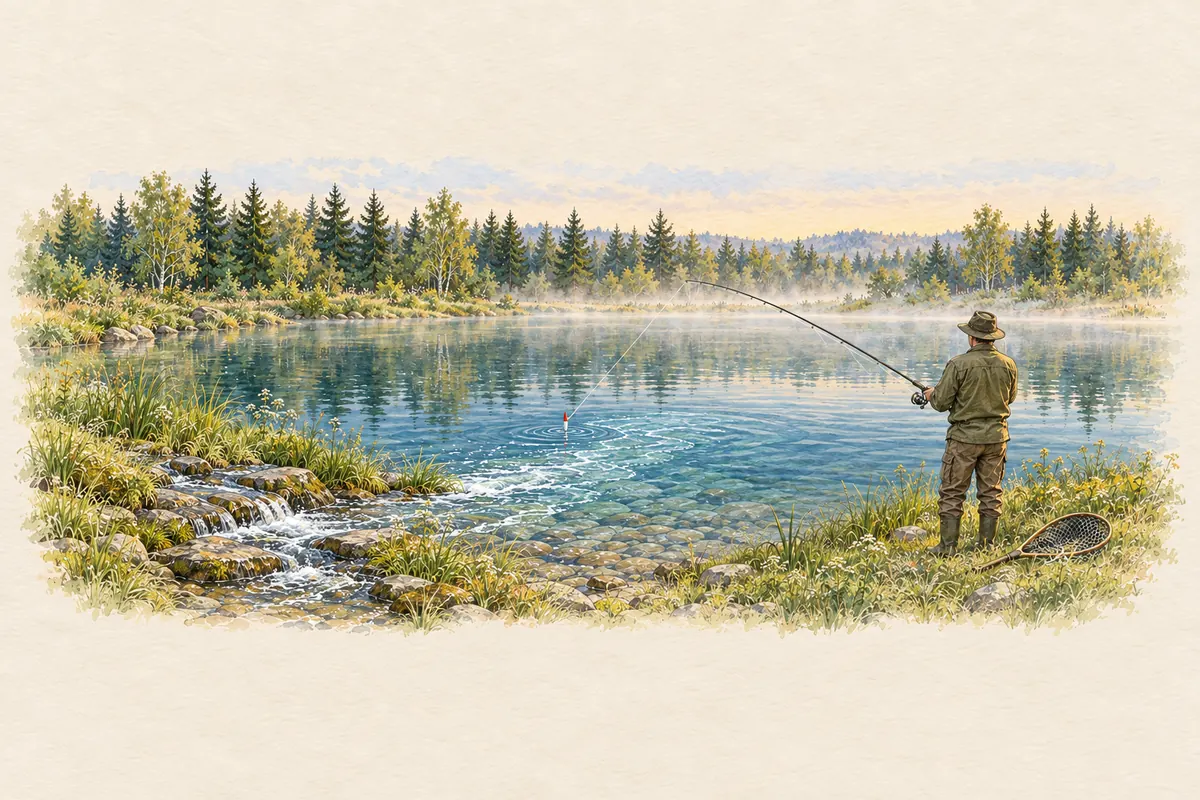
The season also decides. Choose it: the drawing shows where the trout then stand and how deep the bait hangs:
Spring
In spring, according to Fisch & Fang, trout often stand close to the bank, because the water warms up there first. A sbirolino or a drifted float suits searching.
Summer
In summer, according to Blinker, it pays to be near an aerator, because it enriches the water with oxygen. Fresh, oxygen-rich water also flows in at the inlet and the monk.
Autumn
Rute & Rolle advises presenting the bait one level deeper in autumn and winter. For sluggish fish the bottom rig (Bodentaster) with a ledger rig then suits.
Winter
In the cold season, according to Fisch & Fang, trout are often sluggish and stay in the deepest places. In cold wind, according to Blinker, a bay sheltered from the wind is better than the bank in the wind.
More on this: Water temperature and oxygen. Also ask the operator: according to Blinker he has an interest in his guests catching fish, and will tell you good places and methods.
Tackle and rig
For small ponds Blinker gives light rods of 2.70 to 3.30 metres with a casting weight up to about 30 grams, and for larger lakes 3.60 to 3.90 metres. The reel gets 0.18 monofilament line; cheap line is, according to Blinker, hard, holds knots poorly and coils. All dimensions are guide values from magazines, not regulations.
Float, static
Bait quietly at the presumed depth, hooklength 50 to 70 cm. Set-up: Float rig, the amount of lead is shown by the calculator.
Sbirolino or float, drifted
Searching for fish, spring to autumn, with a long hooklength. Set-up: Sbirolino rig.
Bottom rig (Bodentaster), ledger rig
For sluggish fish in autumn and winter, hooklength 50 to 150 cm. Set-up: Running ledger rig.
Drawings: AI-generated, schematic.
On the float: at a small pond floats with a carrying capacity of 2 to 4 grams are enough, on large lakes up to 7 grams are fine according to Blinker. It is weighted so that only a small piece shows (calculator). A hooklength of 70 centimetres with a size 8 hook completes the float rig.
As baits Blinker names maggots, bee grubs, small worms and mealworms (Maggots and larvae). Experienced trout anglers name the bee grub particularly often, because it is bigger and more conspicuous than the maggot. With paste the rig matters: on the float it should sink, according to Blinker. On the ledger rig, by contrast, the bait should float up, says Rute & Rolle. If the paste does not lift the hooklength, small pilot shot helps. Fisch & Fang recommends presenting the bait just above the bottom rather than lying on it, because the bottom of many ponds is muddy.
When drifting: set the float a little deeper, because the bait rises under tension (Rute & Rolle). The bait should spin even with slight movement, so you shape paste like a propeller and thread the bee grub on in an L shape. Do not wind in monotonously, make short pauses; Blinker reports that trout often grab on the sink. With the sbirolino you open the bail on a bite and strike only when the trout takes line (Fisch & Fang). Set-up and dimensions: Sbirolino rig and Running ledger rig.
Fish that have been swimming in the pond for a long time know the tricks. For them Fisch & Fang recommends a hooklength of 0.12 millimetres, which hardly stands out, but then demands a careful fight. How many rods you may use is in the pond rules.
Common mistakes
- Offering the same bait for too long: Blinker switches from bee grub to paste if there is no bite after ten to fifteen casts.
- Not changing the depth: Blinker calls the depth setting extremely important and advises trying different heights.
- Not testing the paste: Fisch & Fang advises checking how it behaves in the water at the bank before casting out.
- Unhooking the fish first and then killing it, instead of in the order given below.
After the bite: stun, kill, then unhook
Only someone with the necessary knowledge and skills may kill a fish (§ 4 Abs. 1 Tierschutzgesetz, § 4 Tierschutz-Schlachtverordnung). This applies throughout Germany, even where no fishing licence is required. The fishing licence can serve as proof.
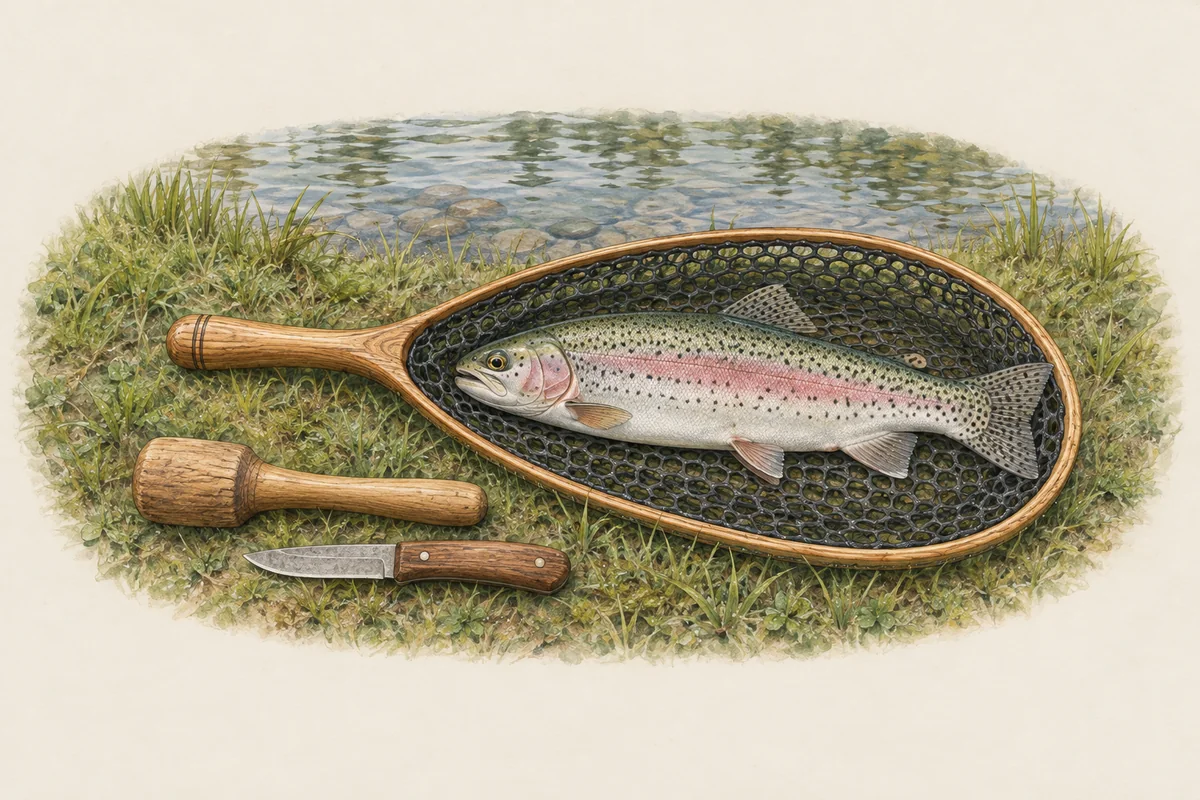
At a trout pond you take the fish with you. The Animal Welfare Slaughter Regulation (Tierschutz-Schlachtverordnung) requires stunning it immediately before killing (§ 12 Abs. 10 TierSchlV). The order:
- Landing
- Stunning
- Killing
- Removing the hook
Not the other way round: unhooking first and then killing is a typical mistake.
- Land it with the landing net.
- Stun it immediately with a firm blow to the head. The time between catching and stunning should be as short as possible (Anlage 1 TierSchlV).
- Kill it straight afterwards, for example with a stab to the heart or a gill cut.
- Only now remove the hook. This is what the guidance from Lower Saxony and North Rhine-Westphalia requires (LAVES, LAVE NRW).
A vertebrate may be killed only by someone with the knowledge and skills for it (§ 4 Tierschutzgesetz). How the blow and the stab to the heart are placed is shown on the page Stunning and killing a fish.
What the pond rules often regulate
- At most two rods per person, landing with a drop net (Hinweise NRW).
- No keepnet: caught fish are not kept alive (Lower Saxony, NRW).
- No competition fishing. In North Rhine-Westphalia the ban is in the state fisheries act, in Schleswig-Holstein it is meant to be in the pond rules (Merkblatt).
- No fishing that is aimed from the outset at releasing the fish (Merkblatt Schleswig-Holstein).
Freshly stocked fish and the waiting period
Stocking fish and fishing them out again straight away is legally disputed. In 2000 the Federal Administrative Court still regarded two months of closed season after stocking as permissible for a catch pond (judgment of 18.01.2000, 3 C 12.99; cited in the Gutachten des Instituts für Binnenfischerei). The states give shorter periods:
- Schleswig-Holstein: at least two weeks between stocking and catching (Merkblatt, November 2025).
- Mecklenburg-Western Pomerania: at least four weeks (Merkblatt, Stand März 2022).
- Lower Saxony: two weeks recommended for fish from nearby and four weeks for longer transport (LAVES, 2013).
Weeks between stocking and catching one stroke = one week
- Schleswig-Holsteinat least 2 weeks
- Lower Saxony2 weeks recommended from nearby, 4 for longer transport
- Mecklenburg-Western Pomeraniaat least 4 weeks
- Federal Administrative Court 20002 months of closed season regarded as permissible
The Bavarian state office for health and food safety takes a fundamentally critical view of angling ponds, because the fish have already been in human hands once (LGL Bayern). Ask the operator when it was last stocked.
Before you set off
- Rule for your federal state checked: fishing licence or supervision at the pond
- Pond rules read: number of rods, keepnet, releasing
- Drop net for landing with you
- Priest and knife packed: first stun and kill, then remove the hook
- Baits to switch between with you: bee grubs, paste, small worms
- Float weighted, see Float weighting
- Asked the operator about good places and the last stocking
- Thought about the catch, see Storage and hygiene
Frequently asked questions
Do I need a fishing licence at a trout pond?
That depends on the federal state. In Bavaria, Hesse, North Rhine-Westphalia and Mecklenburg-Western Pomerania the licence is compulsory, in Lower Saxony and at a commercial pond in Schleswig-Holstein not necessarily. Check beforehand and read the pond rules.
Which baits are most often offered at a trout pond?
Bee grubs, trout paste, small worms and soft lures such as twisters are usual according to Blinker. Which one is catching changes from day to day. Switch after a few unsuccessful casts.
May I put caught trout back?
Often not. The leaflet from Schleswig-Holstein recommends banning in the pond rules fishing that is aimed from the outset at releasing the fish. At a trout pond you generally take the catch with you.
How deep should the float be set?
That cannot be said across the board. Blinker advises trying different depths. In autumn and winter the fish stand deeper, and when drifting you set the float a little deeper.
Examples in the areas
These area pages describe waters of this type with their local rules:
Germany: Fishing in Baden-Württemberg
Related
- Find fishing ponds in Germany: trout lakes and angling parks by postcode, radius and fish species, with map; for holidays also Denmark and Austria
- Rainbow trout and brown trout: features of the two species
- Fishing with children: what children may do in each state, and the children’s rod for getting started
- Float rig: set-up, depth and distribution of lead
- Sbirolino rig: long casting and drifting with maggots and paste
- Running ledger rig for the ledger rig
- Working out float weighting
- Fishing paste and Maggots and larvae as bait
- Stunning and killing a fish and Landing a fish and unhooking
- Storing and hygiene for your catch
- Trout fishing on a pond: spoon, sbirolino and trailed float
Sources
- Tierschutz-Schlachtverordnung, § 12 und Anlage 1; Tierschutzgesetz, § 4
- LAVES Niedersachsen: Hinweise und Empfehlungen zum Betrieb von Angelteichen (Dezember 2013)
- Land Schleswig-Holstein: Merkblatt Angelteiche (November 2025)
- Land Schleswig-Holstein: FAQ zur Fischereischeinpflicht (26.02.2026)
- LALLF Mecklenburg-Vorpommern: Merkblatt Angelteiche (März 2022)
- Nordrhein-Westfalen: Zweites Gesetz zur Änderung des Landesfischereigesetzes, GV. NRW. 2026 S. 383
- Blinker: Forellen angeln, Tipps und Tricks am Forellensee (12.11.2025; Gerät, Köder, Plätze)
- Rute & Rolle: Forellenteich, die besten Montagen (26.11.2025; Montagen, Vorfachlängen)
- Fisch & Fang: Zielfisch Forelle, so fangen Sie am Forellensee (2010; Schleppen, Grundmontage)
- Landesfischereiverband Bayern: Fischlexikon (Regenbogenforelle: Lebensraum, Länge)
- LAVE Nordrhein-Westfalen: Hinweise zum Betrieb von Angelteichen
- Institut für Binnenfischerei: Gutachten zu Angelteichen (2014), LGL Bayern: Tierschutzaspekte der Angelfischerei, Jahresbericht zur Deutschen Binnenfischerei 2023
- Bayerisches Fischereigesetz, Hessisches Fischereigesetz, Brandenburgisches Fischereigesetz und Brandenburgische Fischereiordnung, Sächsisches Fischereigesetz; Fischereigesetze von Baden-Württemberg, Berlin mit Landesfischereischeingesetz, Bremen, Hamburg, Rhineland-Palatinate, Saarland, Saxony-Anhalt und Thuringia; Verordnungen zur Fischereiabgabe und zum Vierteljahresschein: HmbFAnGDVO, DVO-FischG Sachsen-Anhalt, ThürFischAVO
- Saisonbänder und Laichpunkte der Fischkarten: Fangkalender von Angel Momente (redaktionelle Einschätzung mit den dort genannten Quellen)
Text AI-assisted, drawings AI-generated. Sources opened and checked in October 2026; no graphics taken from the sources.
A guide without guarantee. Status: 25 October 2026, checked against state law and authority websites. What counts is the law of your federal state (Bundesland) and the pond rules of the operator.