
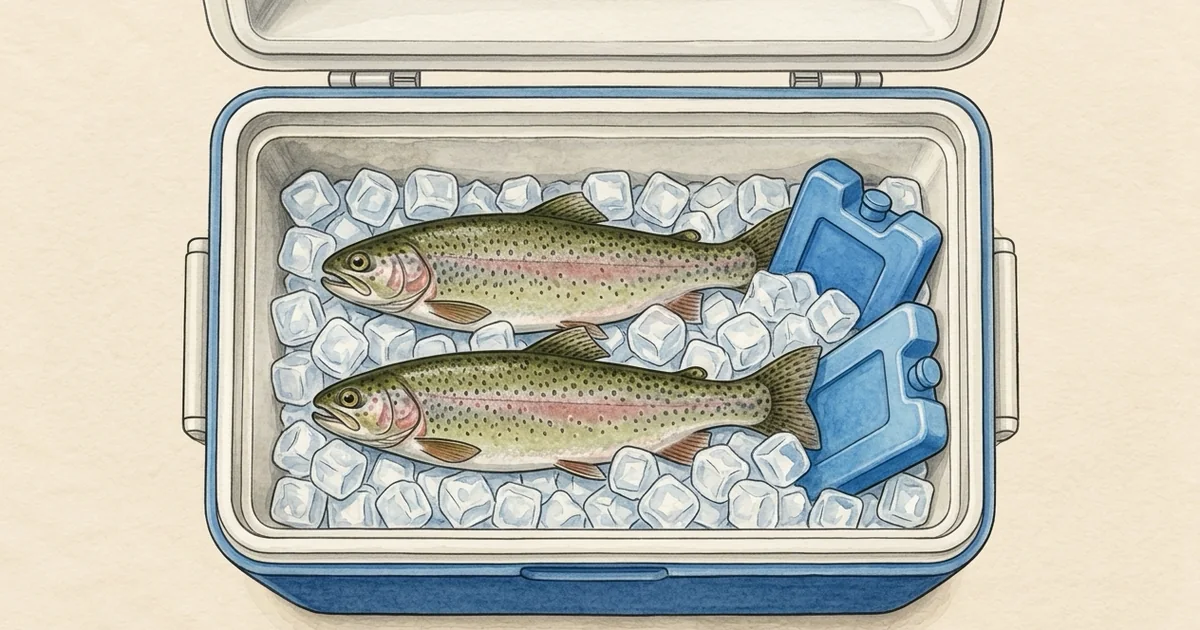
Knowledge · Kitchen and use
Storage and hygiene
Freshly caught fish spoils quickly, so cooling counts from the very first moment. When it comes to storing fish, the Verbraucherzentrale (consumer advice centre) and the authorities usually count the time limits from purchase. If you catch your own, play it safe and count from the catch, and prepare or freeze the fish as soon as you can.
Cooling from the first moment
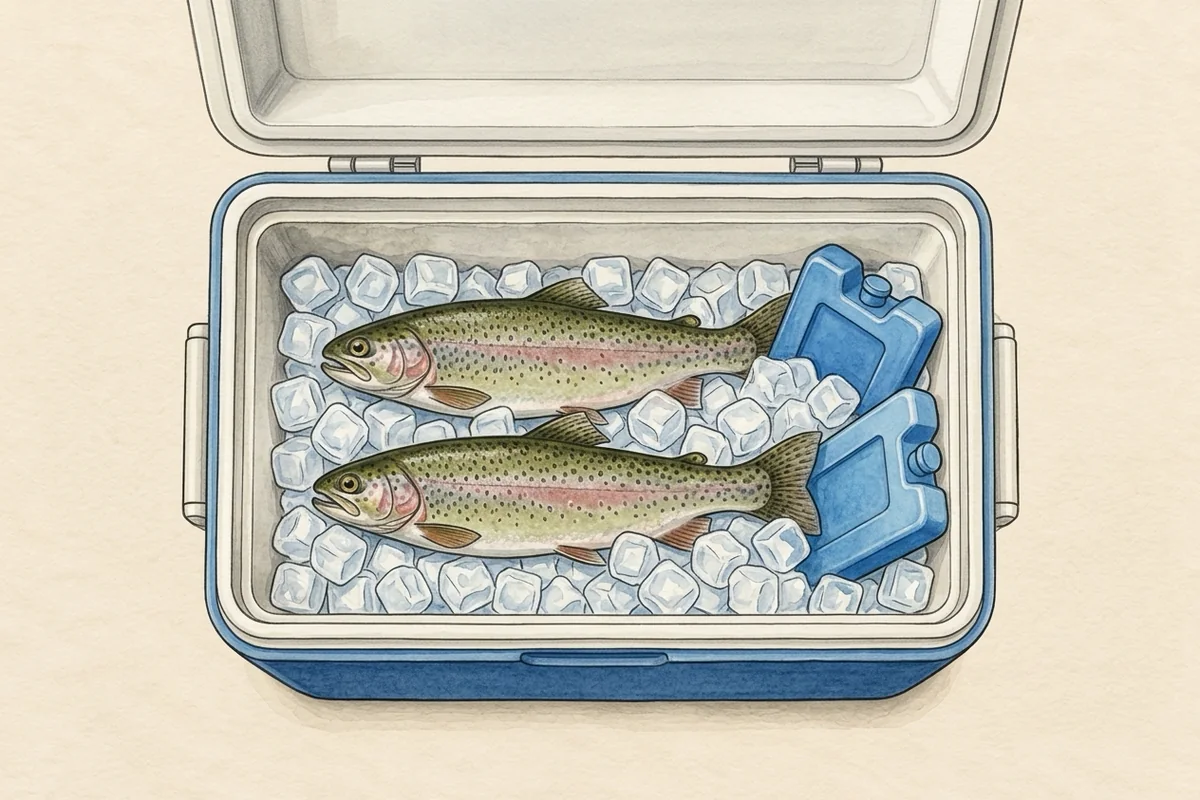
Fish spoils quickly: it has a high water content, its protein is delicate, and the cell structure is usually loose (BZfE). The consumer advice centre recommends always transporting it in an insulated bag or cool bag. For fresh fish on ice it gives 0 to 4 degrees Celsius, and for fish products below 7 degrees Celsius.
The Federal Institute for Risk Assessment (BfR) recommends getting chilled goods home as quickly as possible and putting them straight into the fridge. In summer, cool boxes are advisable for longer journeys. So a cool box with ice or ice packs belongs in your tackle bag as soon as you want to take fish home, and the journey home goes straight to the fridge without detours. Stunning and gutting beforehand are described under Stunning and killing a fish and Gutting a fish.
At the water: cool box instead of a bag
In the trade, according to the BZfE, fresh fish goes on ice right after the catch, and larger fish are often gutted for transport. For anglers, the question catalogue of the state angling exam (Fischerprüfung) in Bavaria (LfL) asks exactly this: a carp killed on a summer morning stays freshest in a cool box with ice packs, not in a plastic bag in the shade and not in a keepnet. According to the LfL, you don’t need to wash it out in the water you are fishing. It is better to clean it with drinking water you have brought along and keep it chilled. That’s why I put a bottle of tap water just for the fish next to the ice packs.
Recognising freshness
According to the consumer advice centre, you recognise fresh fish by its light, natural colour, bright red gills, clear eyes, smooth, glossy moist skin and firm scales. It smells pleasantly of the sea; a typical fishy smell only starts once it is spoiling. The BVL describes a neutral smell. The flesh gives elastically and keeps no dent after brief pressure. If fish smells sour or rancid and putrid, you no longer eat it, says the BVL.
In the fridge: place and temperature
According to the BfR, raw fish belongs on the bottom shelf above the vegetable drawer, close to the back wall, or in a 0-degree compartment. It is coldest there, and no drip runs onto other food. The BZfE gives 0 to 4 degrees Celsius for the lowest glass shelf and advises a bowl with a lid or film. The BfR requires closed containers or complete covering.
According to the BfR, the fridge temperature should be at most 7 degrees Celsius, better below 5. The institute advises checking it regularly at different places in the appliance, not keeping the door open longer than necessary and not packing the fridge too full, so that the cold air can circulate.
How long does fish keep?
The bodies give different time limits. Plan with the shorter one. Cooked or smoked fish keeps for about two days according to the BVL and the consumer advice centre, deep-frozen fish for several months according to the consumer advice centre.
| Where | Raw fish | Cooked or smoked | Temperature |
|---|---|---|---|
| Consumer advice centre | Day of purchase or the next day | 2 days (cooked) | 0 to 4 °C on ice |
| BVL | about 1 day | about 2 days | 4 °C in the fridge |
| BZfE | Day of purchase, next day if necessary | no figure given | 0 to 4 °C, bottom shelf |
| BfR | no figure given | no figure given | at most 7 °C, better below 5 °C |
| LfL (angling exam) | 2 days at most from killing | no figure given | 4 to 6 °C |
Note: The Verbraucherzentrale, BVL and BZfE count from the time of purchase; only the LfL exam catalogue counts from killing. To be safe, count from the catch and prepare or freeze the fish as soon as you can. This is a precautionary rule of this site, not a figure from an authority.
Freezing and thawing
Freezing
The consumer advice centre gives several months for deep-frozen fish and points out freezer burn. That is the name for dried-out, discoloured patches caused by damaged packaging, trapped air or fluctuating temperature (VKI). In fish, freezer burn can, according to the VKI, point to an interrupted cold chain and so to possible germs. The BZfE therefore advises packing fish vacuum-sealed or at least airtight in boxes or bags. Label the packs with species and date, and you know which is next.
The sources used here do not give exact figures in months for fish. The Austrian Verein für Konsumenteninformation (VKI) writes about meat that leaner meat can be stored for longer, because fat oxidises even when frozen and can taste rancid. For fish the same rule is in the LfL exam catalogue: the leaner, the longer it keeps. The BVL names herring, salmon and mackerel as oily fish. As a guide value for good storage conditions the VKI gives minus 18 degrees Celsius. If the temperature in a household freezer rises to as much as minus 12 degrees, according to the BfR the quality suffers from greying, freezer burn or ice crystals forming; the institute does not see a health risk in this.
According to the LfL, freezing should happen quickly at the lowest possible temperature. The Kompetenzzentrum für Ernährung in Bayern (KErn) recommends fresh, cooled food in small portions, packed water- and airtight, and the quick-freeze function if the appliance has one. This does not make the fish germ-free. A large proportion of bacteria survive deep-freezing; according to the BfR most only stop multiplying between minus 5 and minus 8 degrees, and cold does not kill viruses at all. So only fresh fish goes into the freezer.
Thawing
Thaw fish in the fridge. At room temperature, any germs present thaw too and multiply (BfR). According to the BZfE, it is best to put larger fish, fillets and portions on a sieve overnight so the thaw water can drain away. Always throw it away. The BfR adds: remove the packaging, put the fish in a covered bowl and clean hands, surfaces and objects thoroughly after contact with the thaw water. Raw fish thawed in the microwave is processed immediately. Bought frozen goods should not begin to thaw on the way home and belong straight in the freezer; for pre-cooked or breaded products such as fish fingers, the information on the pack applies (BZfE).
May thawed fish go back into the freezer? The BfR writes: raw foods of animal origin should first be heated through completely after thawing. After that, chilled storage or refreezing once they have cooled down completely is possible. So do not refreeze raw thawed fish raw; cook it and then freeze it. In a power cut, according to the BfR, a well-filled appliance keeps the frozen food cold for many hours if you keep it closed, at least at first. If raw fish has partly thawed, soft on the outside and still frozen inside, the same rule applies: cook it through completely first.
Freezing for eating raw
Fish you caught yourself may only go on the plate raw after its own cold treatment. According to LAVES Lower Saxony, this takes at least one day at minus 20 degrees Celsius for sea fish and at least one week for freshwater fish. The BVL speaks of a few days at minus 20 degrees. Check with a thermometer that your appliance reaches minus 20 degrees. Why these values apply and what happens at less cold is explained under Parasites in fish.
Hygiene with raw fish
According to the BfR, raw foods of animal origin are particularly often contaminated with pathogens. They pass directly from one food to another when both touch unpackaged, or indirectly via hands, utensils, work surfaces and knives. Experts call this cross-contamination.
- Keep raw fish apart from food that will not be heated, during storage and preparation (BVL).
- First prepare food that will not be heated, then salad and raw vegetables, and raw animal ingredients last. If that is not possible, clean surfaces, utensils and hands thoroughly in between (BfR).
- After contact with raw fish, wash your hands with warm water and soap and dry them carefully. Clean kitchen utensils with hot water and washing-up liquid or in the dishwasher (BfR).
- Change dishcloths and tea towels at least once a week and wash them at at least 60 degrees Celsius. Sponges are less suitable according to the BfR, because they dry slowly and bacteria multiply quickly in damp cloths.
- Rinse the fish only gently and briefly with a little cold water and pat it dry with kitchen paper. The old 3-S rule of cleaning, souring and salting no longer applies according to the BZfE.
- Cook it until the flesh no longer looks glassy and gives easily to a fork. For food, the BfR gives at least 70 degrees Celsius for two minutes throughout.
Important for risk groups: The BfR does not recommend raw fish for small children, pregnant women and people with a weakened immune system unless it is cooked through completely before eating. More on smoked fish under Smoking fish. The text does not replace medical advice.
Common mistakes
- The fish stays in the bag without cooling. The consumer advice centre recommends transport in an insulated or cool bag, the BfR a cool box in summer.
- Frozen fish lies on the worktop to thaw. At room temperature germs multiply (BfR), in the fridge they do not.
- The thaw water ends up in the sink next to the salad. According to the BZfE it must be thrown away, and everything that touched it is cleaned (BfR).
- Fish thawed raw is frozen raw again. For this the BfR requires complete heating first.
- The dish stands open in the fridge. The BfR requires closed or completely covered containers.
- Mackerel or tuna are left lying warm. According to the Veterinäramt-Zweckverband Jena-Saale-Holzland, histamine poisoning occurs most often after tuna, mackerel or sardines. Histamine is heat-stable and stays active even after heating, so cooking does not rescue spoiled fish. Typical symptoms are headache, vomiting, stomach ache and diarrhoea, usually within 30 to 60 minutes.
Frequently asked questions
How long may fresh fish stay in the fridge?
The BVL gives about one day at 4 degrees Celsius, the consumer advice centre the day of purchase or the day after. Go by the shorter figure and freeze early rather than late.
May I refreeze thawed fish?
According to the BfR, only once it has been heated through completely. After that, refreezing after cooling is possible. Do not refreeze raw-thawed fish raw.
Is an ordinary freezer enough to eat fish you caught yourself raw?
Only if it reaches minus 20 degrees Celsius. LAVES gives 24 hours for sea fish and a week for freshwater fish. Check the temperature with a thermometer.
How can I tell that fish has gone off?
A sour or rancid, putrid smell is a clear sign (BVL). Fresh fish has clear eyes, red gills and firm flesh without a dent (consumer advice centre). If in doubt, throw the fish away.
Related
- Parasites in fish: freezing times and cooking values for eating raw
- Gutting a fish: the step before cooling
- Filleting and deboning a fish: cutting fillets cleanly and chilling them
- Scaling and skinning fish: the preparation for filleting
- Smoking fish: cooling and shelf life of smoked fish
- Stunning and killing a fish: the order straight after the catch
- Kitchen and use: an overview of all the steps after the catch
Sources
- Verbraucherzentrale: Fisch, alles zu Haltbarkeit und Lagerung (Temperaturen, Fristen, Frischemerkmale, Gefrierbrand)
- BVL: Lebensmittelhygiene, Fisch (Frist bei 4 Grad, Trennung von Speisen, Garen, Rohverzehr)
- BZfE: Fisch, vom Einkauf in die Küche (kälteste Stelle, Verpacken, Auftauen, Abspülen)
- BfR: Korrektes Kühlen von Lebensmitteln im Privathaushalt (Kühlschrank, Auftauen, Wiedereinfrieren, Stromausfall)
- BfR: Lebensmittelinfektionen im Privathaushalt (Kreuzkontamination, Reinigung, Garen, Risikogruppen)
- LAVES Niedersachsen: Sushi selber machen (Gefrierzeiten für Rohverzehr)
- Zweckverband Veterinär- und Lebensmittelüberwachungsamt Jena-Saale-Holzland: Histaminvergiftung (Histamin in Thunfisch und Makrele)
- VKI, Presseinformation: Haltbarkeit eingefrorener Lebensmittel (Gefrierbrand, minus 18 Grad, Fettoxidation)
- LfL Bayern: Staatliche Fischerprüfung, Prüfungsfragen 2023/2024 (Kühlbox, Trinkwasser, Frist, Fettgehalt, Frosten)
- BZfE: Fisch und Meeresfrüchte, vom Fang in den Handel (Eis nach dem Fang)
- KErn Bayern: Gefrier-Navi (Portionen, Verpackung, Schockfrosten)
Text AI-assisted, drawing AI-generated. Sources opened and checked in October 2026; no graphics taken from the sources.
All figures are guide values without guarantee. The text does not replace medical advice; the instructions of the food inspection authorities are what count.