
Knowledge · Kitchen and use
Scaling and skinning fish
Which fish you need to scale, which are skinned and which need neither depends on the species and the recipe. Perch and zander have spiny rays in the first dorsal fin, so grip them in a way that your hand can’t slip into it.
When to scale and when not
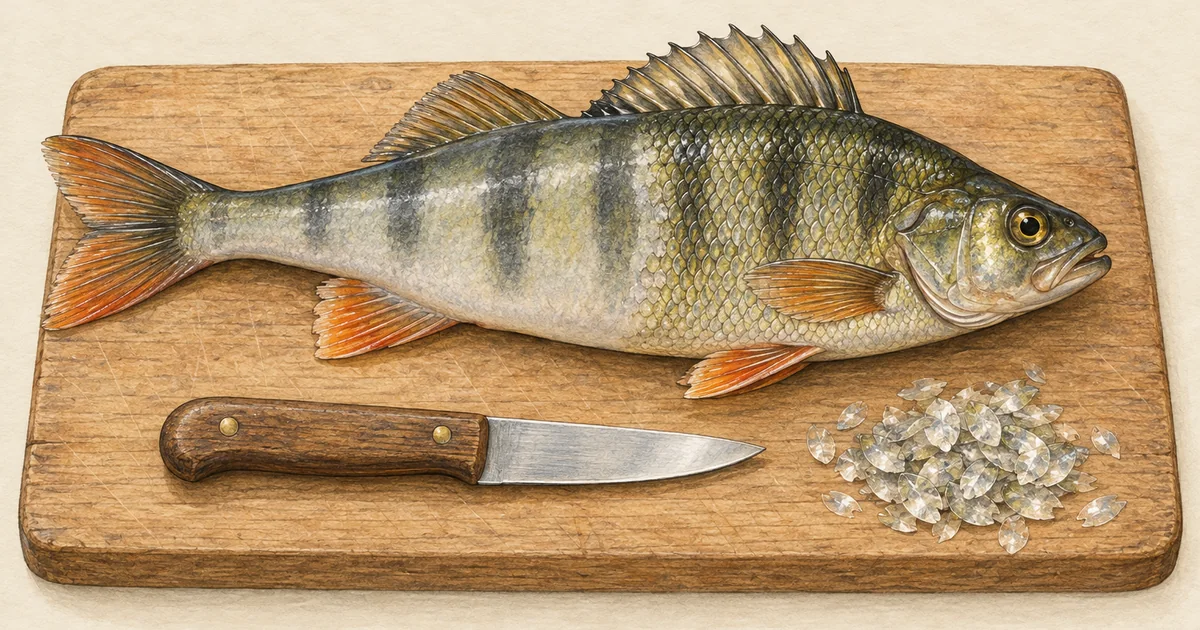
A fish is scaled when the skin is eaten and the scales would get in the way when eating. That is how the learning portal of the Landesfischereiverband Bayern sums it up, and it narrows it down: only fish with medium to large scales. That applies to perch, zander, carp, roach and bream when they are fried or grilled with the skin on.
According to the learning portal, these are not scaled:
- Fish without scales such as the wels catfish.
- Fish with very small scales: eel, tench, all species of trout and char. The tiny scales are eaten.
- Fish that are skinned. If you scale first, the skin tears when you pull it off.
- Fish that are filleted.
Blinker leaves the scales on for curing and smoking. Before freezing, the magazine advises scaling fish with hard scales, because it is harder on thawed, softer fish.
The sources do not agree everywhere. A trout recipe in Fisch & Fang removes scales and slime anyway. According to Wikipedia, fish cooked “au bleu” is not scaled and is gutted carefully so that the slime layer stays intact: it turns pale blue when cooked. A recipe for blue carp in Blinker scales it nonetheless and protects the mucous membrane.
| Fish | Scale or skin | Note |
|---|---|---|
| perch | scale or fillet | Ctenoid scales sit firmly, spines in the dorsal fin |
| Zander | scale or fillet | Ctenoid scales, spiny rays, spine on the gill cover |
| Carp | scale | Cycloid scales, particularly large on the mirror carp |
| Roach, bream | scale | Cut the fins off with scissors |
| Trout, char | do not scale | tiny scales are eaten |
| Tench | do not scale | very small scales under a thick layer of slime |
| Eel | skin, remove the slime for smoking | Blood is poisonous raw |
| Wels catfish | skin | scaleless, cut the skin behind the head, blood poisonous raw |
Why perch and zander are more trouble
Each scale sits in a pocket of the dermis. The scales overlap like roof tiles, with the free edge pointing backwards. If you push from the tail, you lift them out of their pockets. Most native freshwater fish have cycloid scales, according to the question catalogue for the angling exam in Saxony. Their edge is smooth. Perch and zander have ctenoid scales. According to the learning portal their rear edge is toothed, the fish feels like sandpaper and the scales sit more firmly. More under Body shape and fins.
Scaling step by step
The procedure is given by the learning portal of the LFV Bayern, with additions from Fisch & Fang and Wikipedia. The fish has been stunned, killed and bled, see Stunning and killing fish.
- Early and before gutting. It is easiest on fresh fish with the belly still closed, while the slime has not dried. Recipes in Fisch & Fang also scale fish that have already been gutted.
- Lay it flat and hold it. The learning portal grips the head and secures the gill cover with the thumb. Wikipedia gives a grip at the tail, as Fig. 1 shows. Kitchen paper or a cloth gives grip.
- Position the scaler or the back of the knife. The learning portal holds the tool at about 45 degrees, while Wikipedia sets the blade at roughly a right angle to the skin. The back of the knife spares the skin.
- Push from tail to head. The scales are pushed out of their pockets towards the head, also on the back edge and the belly side.
- Rinse and pat dry. You rinse off loose scales under running water. The Bundeszentrum für Ernährung advises rinsing fish only very briefly in cold water and patting it dry with kitchen paper.
Scales fly everywhere. The learning portal recommends scaling fish inside a large carrier bag, with a sieve in the sink. If you scale perch or zander often, Fisch & Fang recommends a fish scaler with a catch tray.
Spines: Perch and zander have spiny rays in the first dorsal fin and a spike on the gill cover (fish encyclopaedia of the LFV Bayern). The Saxon exam question catalogue names the zander as a species whose fin rays can injure you. Grip the fish so that your hand cannot slip onto the fin.
Skinning: eel, wels catfish and skinless fillets
The wels catfish is skinned. The Blinker describes it like this: the whole fish, not yet gutted, hangs from a hook. The skin is cut once around the body just behind the head. Pliers grip it and pull it downwards, which takes strength. At the tail the last piece is cut off, and only then is the fish gutted and filleted. Raw wels blood is poisonous, like eel blood, so keep it away from wounds and eyes (see the section on blood below).
For eel, the learning portal gives the same steps: score the skin around the head, grip it with pliers, pull it off towards the tail, ideally with two people (fig. 3). A dry cloth helps you hold on, as according to Blinker an eel is almost impossible to grip with bare hands. In a recipe from Fisch & Fang the gutted eel is skinned, then scissors cut off the fin fringes.
If you fillet the fish and pull the skin off the fillet, you do not need to scale it. The cuts are shown on the page Filleting a fish. For small perch for frying, a reader in Blinker describes a different way: flash-freeze them briefly, then a sharp knife lifts the skin and scales off the flesh together. That is a personal account, not a tested method.
In a Blinker recipe the plaice is washed, cut open along the backbone and fried whole; skinning is not mentioned there. The flounder has an upper side as rough as sandpaper. The magazine does not call gloves excessive.
Slime: a sign of freshness, and hard work with eel
The Federal Centre for Nutrition counts a clear, colourless layer of slime among the signs of a fresh fish. Scaleless fish often have sturdier skin and more slime, writes the learning portal. Eel and tench are also thickly coated in slime. If the tench is cooked „au bleu“, the slime stays intact.
With eel, the tough slime gets in the way. Before smoking, the Blinker puts eels in a cool brine of 80 grams of salt per litre of water for at least 12 hours. Afterwards the softened slime can be stripped off between thumb and forefinger from head to tail. For smoking, the eel is not skinned there; more under Smoking fish.
Eel and wels catfish blood is poisonous raw
Eel blood contains a toxin. The Lexikon der Biologie describes the eel toxin as heat-labile and haemolytic: heat destroys it, and it attacks red blood cells. Among other things it causes irritation of the mucous membranes and nausea.
So the rule is: no eel blood in open wounds and none in the eyes. This is required by the exam question catalogue for the angling exam (Fischerprüfung) in Saxony from the state office for the environment, agriculture and geology. It names eel and wels catfish as fish with blood that particularly irritates mucous membranes. The learning portal of the LFV Bayern calls raw eel and wels blood poisonous (the wels is called „Waller“ in German) and advises washing the blood off thoroughly straight away after contact. According to it, the blood becomes harmless from 70 degrees, as reached by boiling and frying.
Note: This section does not replace medical advice. If eel or wels blood gets into your eye or a wound and you develop symptoms, ask a doctor or a poison information centre.
Work cleanly, take the waste with you
Scales and skin are parts of the fish and do not belong in the water. In Bavaria this is regulated: dead fish and parts of fish must not be put into a water, with exceptions for bait fish and groundbait fish (§ 21 AVBayFiG). What applies to you is set by your federal state (Bundesland) and the water rules; if in doubt it is stated in the fishing permit (Erlaubnisschein). Where the waste goes is explained on the page Gutting a fish. Cleaning and cooling are covered on the page Storage and hygiene.
Frequently asked questions
Do trout have to be scaled?
No, writes the learning portal of the LFV Bayern: their scales are so small and thin that you eat them. If the trout is to be cooked „au bleu“, the scales and slime stay on the fish.
Is a fillet with skin scaled beforehand?
Yes, if the skin is eaten. For crispy fried fish the Fisch-Informationszentrum leaves it on the fillet. A recipe in Fisch & Fang scales the ide first and then fillets it so that the skin stays on.
Is scaling allowed at the water?
That is set by your federal state (Bundesland) and the water rules. According to the learning portal of the LFV Bayern, most angling clubs already ban gutting at the water. Catch the scales in a bag and take them with you.
Related
- Gutting a fish: belly cut, kidney and where the waste goes
- Filleting and boning a fish: the three cuts and the Y-bones of the pike
- Storage and hygiene: cooling, time limits and freezing
- Smoking fish: hot and cold smoking, brine and wood
- Stunning and killing fish: the order of steps before any use
- Fish scaler: remove scales quickly and without a blade
Sources
- Landesfischereiverband Bayern, Lernportal der Fischerjugend: Betäuben und Schlachten, Allgemeine Fischkunde, Fische versorgen (Arten, Ablauf, Aal häuten, Aalblut)
- Landesfischereiverband Bayern: Fischlexikon (Stacheln und Schuppen von Barsch und Zander)
- Spektrum, Lexikon der Biologie: Aalgift, eels (Eigenschaften und Wirkung)
- Sächsisches Landesamt für Umwelt, Landwirtschaft und Geologie, Fragen zur Fischerprüfung: Spezielle Fischkunde, Allgemeine Fischkunde (Aalblut, Schuppentypen, Flossenstrahlen des Zanders)
- Verordnung zur Ausführung des Bayerischen Fischereigesetzes, § 21 (keine Teile von Fischen ins Gewässer)
- Bundeszentrum für Ernährung: Fisch, vom Einkauf in die Küche (Schleimschicht, Abspülen)
- Fisch-Informationszentrum: Vor- und Zubereitung (Haut am Filet, Küchenpapier)
- Blinker: Fisch filetieren, Wels filetieren und räuchern, Räucheraal, Glatte Aale, 10 Mythen aus der Fischküche, Karpfen blau, Barsch ohne Schuppen, Schollen-Rezept (Praxis bei Wels, Aal, Karpfen, Barsch, Scholle)
- Fisch & Fang: 10 Tipps für die Fischküche, Plötzen in Dill-Ei, Brassenschnitten, Brat-Aal, Forelle in Wein-Gemüse-Sud, Aland-Filets (Arbeitsrichtung, Flossen, Aal abziehen)
- Wikipedia: Abschuppen, Blaukochen (Küchenpraxis, keine Rechts- oder Gesundheitsangaben)
Text AI-assisted, drawing AI-generated. Sources opened and checked in October 2026; no graphics taken from the sources.
All figures are guide values without guarantee. They do not replace medical advice; what is allowed at the water is set by your federal state (Bundesland) and the water rules.