
Knowledge · Tackle
Fish scaler: Removing scales quickly
A fish scaler is a small scraping tool that lifts the scales of a whole fish out of the skin, working from the tail towards the head. This page covers how it works, when the back of a knife or a wire keepnet is enough, and how to get the scales into a bag and a sieve instead of on the tiles and worktop.
How the scaler works
Scales overlap like roof tiles. Each sits in a pocket of the dermis, with its free edge pointing towards the tail. That is what the exam catalogue of the Sächsischen Landesamts für Umwelt, Landwirtschaft und Geologie says. Anyone who wants to loosen the scales therefore works against this lie: the tool runs from tail to head, catches the free edges and lifts the scales out of their pockets. The learning portal of the Landesfischereiverband Bayern and Fisch & Fang agree on this direction.
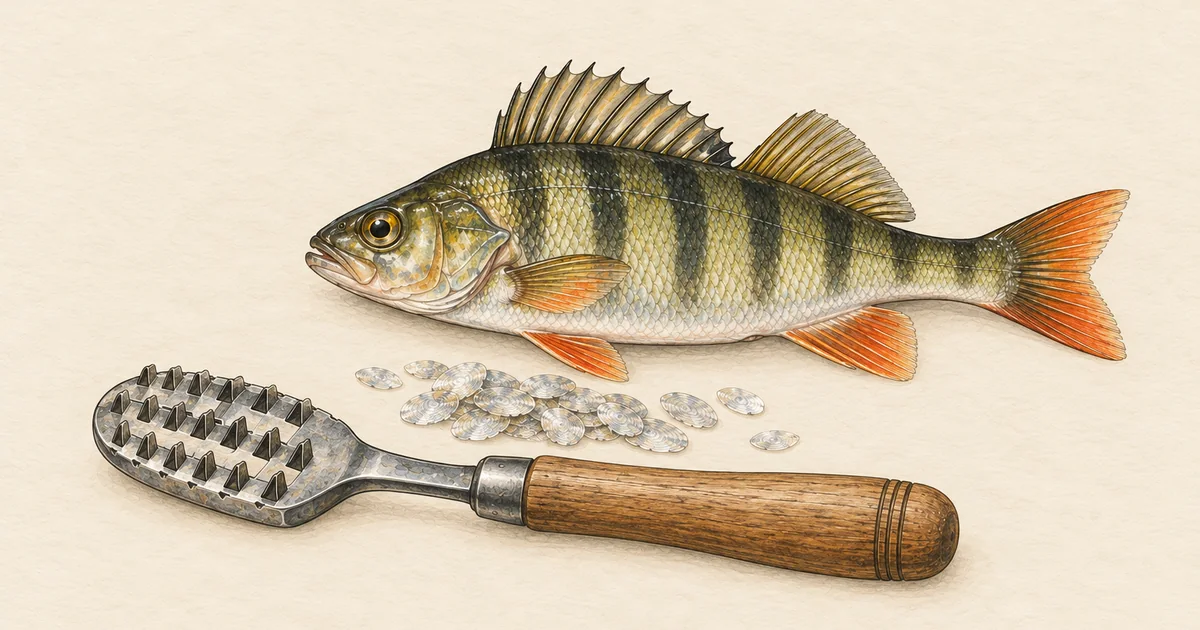
The learning portal holds scalers, like the back of a knife, at about 45 degrees to the skin. It also reminds you of the back edge and belly side, which carry scales too. That is exactly where the special tool helps, for example on the belly, where a knife can hardly reach.
The main troublemakers are perch and zander. They have ctenoid scales, whose rear edge is finely toothed and which sit more firmly than the smooth-edged round scales that carp, for example, have. Scaling such fish is extremely laborious, but a good scaler still manages it.
Designs
A fish scaler is a scraper-like tool made of metal or plastic, sometimes with a wooden handle. A common type is an open metal frame whose edges are lined with rows of small teeth, with a handle behind it. Fig. 1 is drawn that way too.
- Open toothed frame: the basic shape, as in the photo. The loosened scales fly freely, so it belongs in a bag or the sink.
- Scaler with a catch tray: If you scale often, especially perch or zander, Fisch & Fang recommends this design. A catch tray on the tool collects the scales instead of scattering them around the room.
Without a scaler: back of a knife and wire keepnet
A knife is enough for a single fish. You hold the fish by the tail end and stroke towards the head with the blunt side of a filleting knife until the scales have come loose after a few minutes. Which knives serve at the water and in the kitchen is covered under Angling knife and Filleting knife.
With herring it is different, because its scales sit loosely. According to Blinker, you put 10 to 20 herring into a wire keepnet, hold it in the water and shake it back and forth for 30 to 60 seconds. The fish rub their scales off on the wire mesh. More herring at once are not recommended.
Scales in the water: When you shake the net, the scales end up in the water. Whether that is allowed is regulated by state law and the water’s own rules. Bavaria, for example, prohibits putting dead fish and parts of fish into a water (§ 21 AVBayFiG). What applies at your water is in the fishing permit (Erlaubnisschein); if in doubt, ask the club.
Scaler and substitutes compared:
| Tool | Strength | Limit |
|---|---|---|
| Scaler with a toothed edge | firmly seated ctenoid scales, belly side | scales fly about without a bag |
| Scaler with a catch tray | collects the scales | worthwhile if you scale often |
| Back of a knife | no extra tool | hard to get at the belly |
| Wire keepnet | 10 to 20 herring at once | loose scales only, observe the water regulations |
Which fish need the scaler
Only fish with medium to large scales that come to the table with the skin on are scaled. Besides perch and zander, that includes pike with its firm scales. Then there is carp: according to the learning portal, the mirror carp has the largest scales of all. If you leave the skin on the fillet, you have one more reason: the skin contains flavour compounds that pass into the flesh during cooking.
According to the learning portal, scaleless wels catfish as well as eel, tench, trout and char do not need a scaler; their tiny scales are eaten along with the fish. The Bavarian angling exam (Fischerprüfung) even asks about it: the sensible tools for trout fishing listed there are disgorger, priest and knife, and the answer with the fish scaler is wrong (LfL Bayern, question 4.163). If you fillet and pull off the skin, you also save yourself the scaling (learning portal, looking after fish). Which species is treated how is shown on the page Scaling and skinning fish.
No scales all over the kitchen
The scaler loosens the scales. Where they fly is decided by the workstation.
- Large shopping bag: If you scale the fish inside the bag, the scales stay in the bag, advises the learning portal of the LFV Bayern.
- Sink strainer in the basin: A strainer at least 10 cm across catches scales and scraps before they block the drain. The learning portal gives this guide value too.
- Moist skin: Dried-on scales are hard to loosen. That is why herring are covered with a wet cloth straight after catching. The learning portal prefers to scale perfectly fresh fish, whose belly is still closed and whose mucous membrane has not dried out.
Afterwards the scaler, board and work surface go thoroughly under hot water, as do your hands. The Bundesamt für Verbraucherschutz und Lebensmittelsicherheit recommends this for preparing fish. The bag of scales is disposed of with the other waste, as described under Gutting fish.
Common mistakes
- Scraping in the wrong direction. From head to tail the tool runs with the lie of the scales and does not lift them out of their pockets.
- Letting the catch dry out. Once skin and scales have dried, they come off only with difficulty. It is harder after thawing too, because the flesh has become softer. Fish with hard scales are therefore scaled before freezing.
- Scaling first, then skinning. If the skin is to come off, the scaler stays where it is. Otherwise the skin tears when it is pulled off, warns the learning portal.
- Scaling trout and tench. The work is unnecessary; their small scales are eaten.
- Forgetting the back and belly. The back edge and belly side carry scales too, and they get in the way later when eating.
Frequently asked questions
Do I need a scaler for trout?
No. Trout and char have scales so small that you eat them. The Bavarian angling exam (Fischerprüfung) too does not count the scaler among the sensible tools for trout fishing.
Won’t a kitchen knife do?
For individual fish, yes, using the back of the knife. The scaler is worth it if you often prepare perch or zander with the skin on, and on the belly side, where a knife grips poorly.
How do I scale lots of herring at once?
In a wire keepnet, 10 to 20 at a time; that is how it is described for herring. Until then keep the fish moist with a wet cloth. Whether the scales may go into the water is settled by the water’s rules.
Related
- Scaling and skinning fish: which species are scaled and which skinned, plus eel and wels catfish
- Gutting fish: the belly cut after scaling and where the waste goes
- Filleting and boning fish: the route that skips scaling
- Filleting knife: the flexible blade whose back also scales
- Filleting glove: a firm grip on slippery fish when scaling and cutting
- Storage and hygiene: chilling and freezing after cleaning
- Line calculator: planning breaking strain and knots for the next day’s fishing
Sources
- Landesfischereiverband Bayern, Lernportal der Fischerjugend: Betäuben und Schlachten und Allgemeine Fischkunde, Fische versorgen (Winkel und Richtung, Rücken und Bauch, Einkaufstüte, Spülsieb, Arten ohne Schuppen, erst häuten, Filet ohne Schuppen, frischer Fisch, Kammschuppen, Spiegelkarpfen)
- Sächsisches Landesamt für Umwelt, Landwirtschaft und Geologie: Fragen zur Fischerprüfung, Allgemeine Fischkunde (PDF) (Lage der Schuppen in Taschen der Lederhaut, nach hinten gerichtet)
- Bayerische Landesanstalt für Landwirtschaft: Staatliche Fischerprüfung, Prüfungsfragen 2023/2024 (PDF) (Frage 4.163, Werkzeug beim Forellenfischen)
- Bundesamt für Verbraucherschutz und Lebensmittelsicherheit: Hygienischer Umgang mit Fisch (Geräte und Flächen mit heißem Wasser reinigen)
- Verordnung zur Ausführung des Bayerischen Fischereigesetzes, § 21 (keine toten Fische und Fischteile ins Gewässer)
- Fisch & Fang: 10 Tipps für die Fischküche (Schupper mit Auffangschale, Arbeitsrichtung)
- Blinker: Fischschuppen, die zweite Haut, Zanderfilet, So werden Heringe geschuppt, Heringsangeln, 10 Mythen aus der Fischküche (Messerrücken, Bauchseite, Tüte oder Becken, Hecht, Kammschupper, Aroma der Haut, Drahtkescher, feucht halten, vor dem Einfrieren schuppen)
- Wikipedia: Fischschupper (Material, Griff, Zahnreihen, Arbeit gegen die Schuppenrichtung; nur ergänzend)
Text AI-assisted, drawing AI-generated. Sources opened and checked in October 2026; no graphics taken from the sources.
All figures are guide values without guarantee. What is allowed with scales and fish waste at the water is regulated by your federal state (Bundesland) and the water’s rules.